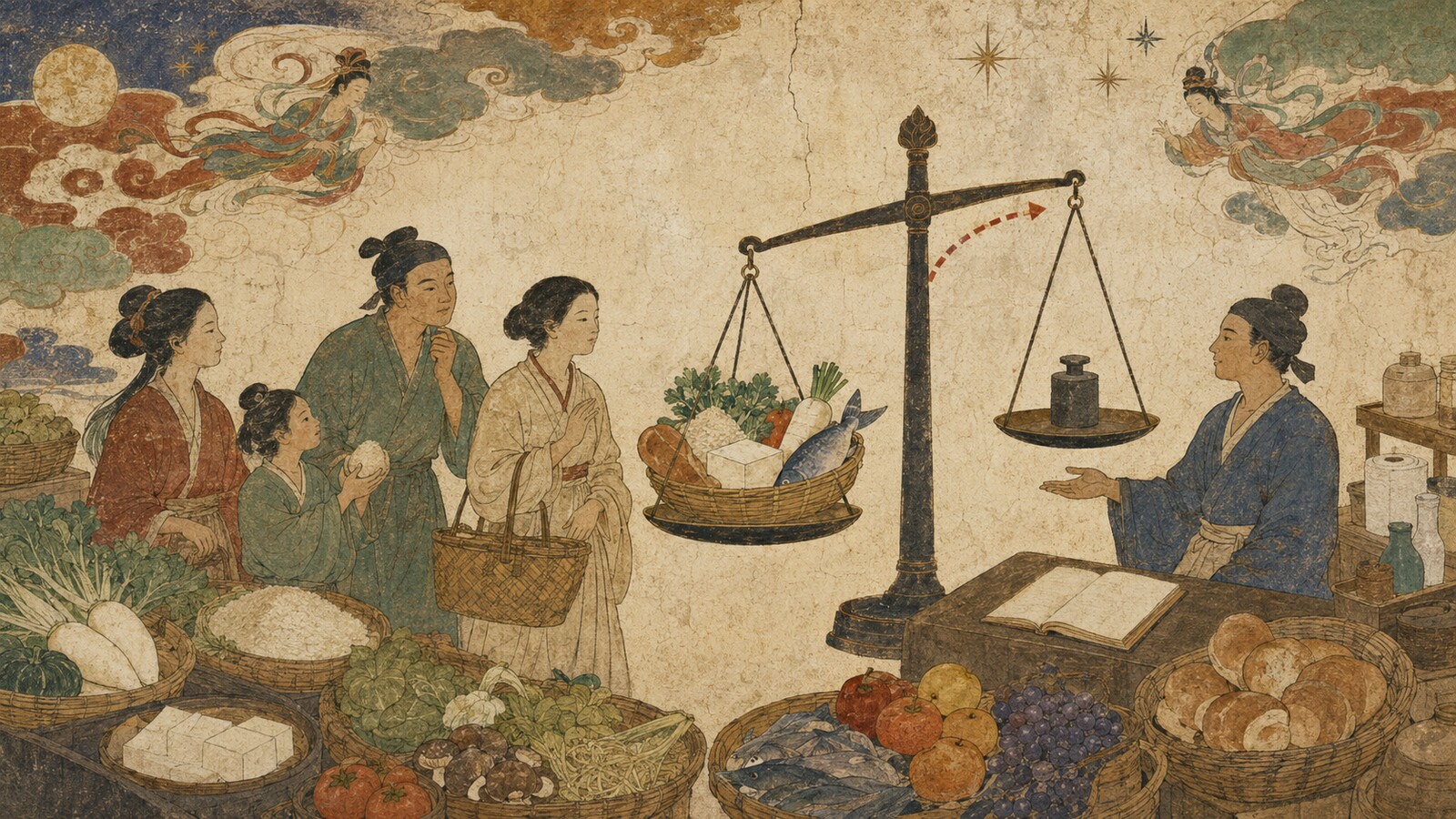
At a supermarket checkout, the argument looks almost too easy.
A basket with a pre-tax price of ¥10,000 currently costs ¥10,800 under the 8-percent reduced rate. At 1 percent, it would cost ¥10,100. The household keeps ¥700. Measured against today’s checkout total, the price falls 6.48 percent if the full tax reduction is passed through and the underlying price does not change.
For a family buying food every week, relief arrives without an application form, an income test or a municipal processing queue. For a pensioner, a student or a parent watching every item scan, the state does not promise that help will come later. The receipt changes now.
Then the camera pulls back from one basket to the national budget. Daiwa Institute of Research estimates the seven-point reduction would remove about ¥4.4 trillion in annual revenue. The government plan has also contemplated roughly ¥600 billion a year in targeted payments for low- and middle-income households, broadly offsetting the final 1 percent for eligible recipients. On that arithmetic, the combined order of magnitude approaches ¥5 trillion a year, or ¥10 trillion over two years, before any replacement revenue or behavioral change.
The seven yen has not vanished. It has moved—from the receipt to a decision about social security, local finance, other taxes, spending cuts or debt.
What Takaichi has moved forward
Reuters reported on July 29, citing the Yomiuri newspaper, that Takaichi had conveyed her intention to proceed to former prime minister Taro Aso and Liberal Democratic Party Secretary General Shunichi Suzuki. Aso, a powerful fiscal conservative within the party, reportedly said he would not oppose the cut if the prime minister decided on it. That is a consequential political opening, not a Cabinet decision.
The plan would reduce the levy on qualifying food and beverages from April 2027 through roughly March 2029. It is designed as a bridge to a future income-linked benefit system aimed more precisely at low- and middle-income households. The administration says it wants to avoid financing the measure with additional deficit bonds, but it has not yet published a complete replacement-funding plan.
The proposal is both the fulfillment and revision of a campaign promise. Takaichi’s LDP fought the February election on suspending the 8-percent food tax for two years—effectively a zero rate. The new plan stops at 1 percent, then pairs the remaining point with targeted support. Politically, the government can describe the result for eligible households as effectively zero. Legally and administratively, however, 1 percent and zero are not the same.
Why one, instead of zero?
The unlikely answer is the cash register. Retailers and system vendors warned that many large, interconnected payment and accounting systems were not designed to process a zero-percent taxable category quickly. Rebuilding and testing them could take as long as a year. A nonzero 1-percent rate could reportedly be introduced in five or six months, allowing an April start.
The “register wall” became an embarrassment because Japan is one of the world’s most technologically sophisticated retail markets. But a modern register is not merely a calculator. It connects product databases, loyalty points, cashless payments, tax-inclusive shelf labels, receipts, inventory, accounting, qualified invoices and headquarters reporting. A tax-rate change must work in every layer, on the busiest shopping day, without turning millions of transactions into incorrect tax records.
One percent preserves a taxable rate inside systems already built to distinguish rates. It also leaves the final point available for targeted compensation rather than giving the same percentage reduction to everyone. Yet this compromise creates its own complexity: the invoice system must track 1-percent outputs alongside 10-percent purchases and other rates, while businesses and tax authorities manage credits and possible refunds across the supply chain.
The technical argument should not become a political alibi. Governments change tax law; vendors change software. The serious question is not whether systems can eventually do it, but what can be implemented accurately by April 2027, how much conversion will cost, and who will pay small retailers for the work.
“Food” has a legal border
Japan’s current reduced rate does not cover everything a household might call food spending. Since October 2019, 8 percent has applied to food and nonalcoholic beverages sold for consumption away from a restaurant. Alcohol and eating-out services remain at the 10-percent standard rate. Regular newspaper subscriptions also receive 8 percent, but they are not food and are not necessarily part of this proposal.
If the bill keeps those boundaries, a supermarket rice bag, takeaway bento and bottled tea would move to 1 percent. A beer or restaurant meal would stay at 10 percent. The same prepared food can already be taxed differently depending on whether it is takeaway or an eating-out service. At present the gap is two percentage points. Under the new plan it could become nine.
That larger border increases the value of classification. Shops must determine whether a bundled product is mainly food, whether a sale is takeaway or dine-in, and which rate belongs on each invoice. Consumers will have a stronger incentive to choose the 1-percent side. Restaurants, already paying higher tax than takeaway sellers, may argue that the state has widened a competitive disadvantage.
The Diet will also need to specify what happens to the national and local portions. Today’s 8-percent food rate consists of 6.24 percent national consumption tax and 1.76 percent local consumption tax. A fall to 1 percent cannot be divided by wishful thinking. Either local governments lose revenue, the central government compensates them, or lawmakers design a new split.
| Purchase under current rules | Current rate | Possible rate under plan | Issue to watch |
|---|---|---|---|
| Groceries and nonalcoholic drinks | 8% | 1% | Main target, but the final statutory product definition is pending. |
| Takeaway prepared food | 8% | 1% | The gap with dine-in food could widen from 2 to 9 points. |
| Restaurant dining | 10% | 10% unless changed | Hospitality businesses may face a sharper competitive boundary. |
| Alcohol | 10% | 10% unless changed | Excluded from today’s reduced-rate food category. |
| Qualifying newspaper subscription | 8% | Unclear / outside food plan | Shares the current reduced rate but not the proposal’s stated purpose. |
Why households want the receipt to change
The household case is stronger than a generic slogan about inflation. In 2025, two-or-more-person households spent an average ¥94,895 a month on food, according to the Statistics Bureau. Nominal food spending rose 5.5 percent, but real food consumption fell 1.2 percent. The Engel coefficient—the share of consumption spending devoted to food—rose to 28.6 percent.
Those figures describe families paying more while buying less in real terms. They also include restaurant meals and other items that would not all qualify for the proposed 1-percent rate, so ¥94,895 cannot simply be multiplied by seven points to promise a household saving. The actual benefit depends on the eligible portion of each family’s basket and on whether retailers pass the cut through to tax-inclusive prices.
The attraction of a food-tax cut is universality. Everyone eats. Lower-income households generally receive a larger benefit relative to income because food consumes more of their budget. No one must prove a sudden loss or wait for last year’s income record to catch up with today’s grocery price.
Its weakness is also universality. Higher-income households spend more yen in absolute terms and can buy more expensive qualifying food, so they often receive a larger cash saving even though it is smaller relative to income. OECD research concludes that reduced rates on basic food can be progressive as a share of income, yet remain an inefficient distribution tool because better-off households capture more absolute benefit than targeted transfers would give them.
That is the intellectual logic of the two-stage plan: broad, immediate relief now; income-linked support later. It is also the political risk. The broad benefit will be visible on every receipt. The targeted replacement will require rules, data and exclusions. Voters may like the bridge more than the destination.
The ¥5 trillion question
Japan’s fiscal year 2026 general-account budget is ¥122.3 trillion. It includes ¥39.1 trillion in social-security spending and ¥29.6 trillion in new government bonds, a 24.2-percent bond-dependency ratio. Consumption tax provides nearly 22 percent of budget revenue and is its largest individual tax source.
An estimated ¥4.4 trillion annual loss equals about 3.6 percent of the entire budget, roughly 11.3 percent of social-security spending, and about one-sixth of projected consumption-tax receipts. These comparisons do not mean a food-tax cut mechanically cancels a particular pension or hospital program. They show the scale of the funding choice.
Consumption-tax revenue has been tied politically and legally to social security because it is relatively stable and spreads the burden beyond the working-age population. The Finance Ministry argues that the increases from 5 to 8 and then 10 percent supported an all-generations system including pensions, health care, long-term care and child-rearing measures. A temporary cut does not automatically reduce benefits, but it removes revenue from the same fiscal architecture.
The administration has considered using tax revenue that exceeded earlier projections. Economic recovery and inflation lifted estimated fiscal 2026 tax receipts to ¥83.7 trillion, 25 percent above five years earlier. But revenue overperformance is not a permanent funding category. If it is used for the cut, lawmakers must decide what happens if growth slows, inflation eases or other spending rises.
The options are finite: reduce other spending, raise another tax, use reserves or surplus revenue, issue debt, or combine them. A promise not to issue new deficit bonds is meaningful only when the replacement is named.
A tax cut that lowers inflation—and can raise it later
If passed through, the cut would mechanically lower tax-inclusive food prices and the consumer-price index around implementation. Bank of Japan Governor Kazuo Ueda has said a temporary food-tax suspension could push prices down for a time but was likely to have only a limited effect on medium- and long-term inflation expectations. Rational consumers know the tax is scheduled to return.
The reverse movement matters. A ¥100 pre-tax item costs ¥108 at 8 percent and ¥101 at 1 percent. The downward step is 6.48 percent from the current checkout price. Restoring the tax from 1 to 8 percent would lift the same unchanged item by 6.93 percent from its temporary price. Statistically and politically, the second movement may feel larger.
Daiwa Institute of Research estimated that the ¥4.4 trillion revenue loss would lift GDP by only about ¥300 billion. That does not make household relief worthless; welfare and macroeconomic stimulus are different objectives. It does show why the policy should not be sold as a machine that converts each yen of foregone revenue into a yen of new growth.
Fiscal credibility creates another loop. Government-bond yields reached multidecade highs earlier in July as investors focused on Takaichi’s expansionary program. If an unfunded tax cut weakens confidence in the yen, more expensive imported food can consume part of the relief the tax cut was designed to provide. At the edition’s reference rate of ¥163.41 per dollar, that risk is not abstract.
A tax Japan spent a generation learning to accept
The consumption tax is not merely another revenue line. It is one of modern Japan’s most politically difficult institutions. Prime Minister Masayoshi Ohira proposed a general consumption tax in 1979 and abandoned it after a severe electoral backlash. Prime Minister Yasuhiro Nakasone submitted a sales-tax bill in 1987 and withdrew it amid public opposition.
Noboru Takeshita finally enacted the broad-based consumption tax at 3 percent, effective April 1, 1989. It promised a more stable revenue base for an aging society and a shift away from relying so heavily on income taxes. It also entered public life amid distrust over fairness, prices and whether businesses would pass the burden transparently.
The rate rose to 5 percent in April 1997. Consumption surged before the change and fell afterward, although the Asian financial crisis, the end of income-tax relief and higher medical costs make it misleading to assign the entire downturn to one tax. The 2014 jump from 5 to 8 percent imposed an estimated ¥8.2 trillion additional household burden and produced another pronounced rush to buy followed by contraction. The experience made politicians wary of abrupt consumption shocks.
In October 2019, the standard rate reached 10 percent, but food stayed at 8 under a newly introduced reduced-rate system. Free early-childhood education, cashless-payment rewards and other countermeasures helped limit the consumption disruption relative to 2014. In October 2023, qualified invoices began tracking transactions and input-tax credits in a multi-rate system.
If enacted, the 2027 reduction would be the first time the tax’s direction has turned downward. Food remained at 8 when the standard rate rose in 2019; it did not fall. That historical novelty explains both the plan’s political force and the Finance Ministry’s anxiety.
1979 · Ohira’s general consumption-tax plan collapses after electoral backlash.
1987 · Nakasone submits, then abandons, a proposed sales tax.
1989 · Takeshita introduces the consumption tax at 3%.
1997 · The rate rises to 5%; front-loading and a consumption slump follow.
2014 · The rate rises to 8%, producing a large household burden and demand swing.
2019 · The standard rate reaches 10%; qualifying food remains at a reduced 8%.
2023 · The qualified-invoice system begins for the multi-rate tax.
2026 · Takaichi advances a plan to legislate a temporary 1% food rate from April 2027.
The hard part is the end date
A temporary tax cut is easy to begin and difficult to end. Households build the lower checkout total into their budgets. Retailers redesign systems and prices. Political opponents can describe restoration as a tax increase even when the original law scheduled it from the start.
Takahide Kiuchi of Nomura Research Institute warned that pushing the rate back up after two years may prove difficult because households would experience it as a de facto hike. The government’s answer is supposed to be an income-linked benefit system ready to take over when the universal cut expires. That replacement is therefore not a secondary reform. It is the exit mechanism.
Targeting can direct more help to people who need it and spend less on affluent households. But Japan must decide whose income counts, how quickly income changes are detected, whether support is individual or household-based, how self-employed people qualify, how benefits phase out without creating a new earnings cliff, and how people without a registered bank account receive money. A precise system can be fairer; it can also be slower and easier to miss.
The worst design would combine the cost of universality with the gaps of targeting: a broad cut that becomes politically permanent, plus a benefit system layered on top without stable funding.
- Legal status and dates: Is April 2027 credible, and does the law specify an automatic March 2029 reversion?
- Covered basket: Do the current food, alcohol, takeaway and dining-out boundaries remain, and what happens to newspapers?
- Full funding: Which revenue or spending changes cover the estimated ¥4.4 trillion cut and ¥600 billion targeted benefit?
- Local protection: How is the current 1.76-point local share replaced or redesigned?
- Pass-through and systems: Who pays for register and accounting changes, and how will government detect withheld tax savings or errors?
- The bridge destination: Will the income-linked benefit be legislated, tested and ready before the temporary rate ends?
Relief now, invoice later
The case for acting is visible in the household data: families paid 5.5 percent more for food in nominal terms in 2025 while consuming 1.2 percent less in real terms. A government that tells people to wait for wages and productivity while grocery quantities shrink is asking for political trouble.
The case for discipline is visible in the budget: the tax finances an aging society, local services and a state already issuing nearly ¥30 trillion in new bonds this year. Calling the cut temporary does not pay for it. Calling it stimulus does not guarantee growth. Calling 1 percent “effectively zero” does not erase the remaining tax or the cost of the benefit used to offset it.
Takaichi’s proposal is compelling because the benefit can be printed on a receipt. Its danger is that the cost appears somewhere citizens do not see: in a future budget, a local transfer, a higher bond yield or the politically explosive moment when 1 becomes 8 again.
Seven yen per ¥100 is a modest household number and a vast national number. The policy will succeed only if Japan can tell the truth about both at the same time.
Reporting Notes and Sources
Information was checked through July 30, 2026, at 10:12 a.m. JST. The 1-percent rate remained a reported government plan, not enacted law. Fiscal figures combine the government’s fiscal 2026 budget with public estimates of the proposal; final cost, scope, national-local allocation and funding depend on legislation. Checkout examples assume unchanged pre-tax prices and full pass-through. Japan.co.jp calculations are rounded.
- Reuters: Takaichi’s decision to proceed, expected Cabinet timing and autumn legislation
- Reuters: ¥4.4 trillion revenue estimate, ¥600 billion benefits and the bridge to targeted support
- Reuters: April 2027 timetable, register issue, budget and funding debate
- The Guardian: retail-system constraints behind the 1% compromise
- Ministry of Finance: current consumption-tax structure, reduced-rate scope and invoice system
- Ministry of Finance: fiscal 2026 budget, tax revenue, bond issuance and social-security spending
- Ministry of Finance: consumption-tax revenue and the social-security system
- Statistics Bureau: 2025 household food spending, real consumption and Engel coefficient
- OECD Consumption Tax Trends: distributional strengths and limits of reduced food rates
- RIETI: 2026 analysis of income-linked benefits and refundable tax-credit design
- Bank of Japan: household burdens and lessons from the 1997 and 2014 tax increases
- International Monetary Fund: the 2019 increase and effect of government countermeasures
- Nippon.com: political history from the failed 1979 and 1987 proposals to the modern tax