- A car can be essential long after the water recedes
- Kashiwa: the agreement became an operating plan
- Shizuoka shows the scale—and the limits
- New partners in Numazu and Fujieda
- An idea with roots before the latest storms
- The dangerous final journey after parking
- What a flooded underground garage taught Japan
- Who opens the gate, and who bears the loss?
- Drills are the bridge between agreements and safety
- The hierarchy is lives first, then property
A car can be essential long after the water recedes
When a storm threatens a Japanese neighborhood, the immediate question is where its residents will be safe. There is a second problem that can shape the recovery: where to put the family car. In communities built around commuting, hospital visits, school drop-offs and deliveries, a flooded vehicle can mean more than a large repair bill. It can sever a household’s everyday access to work and essential services.
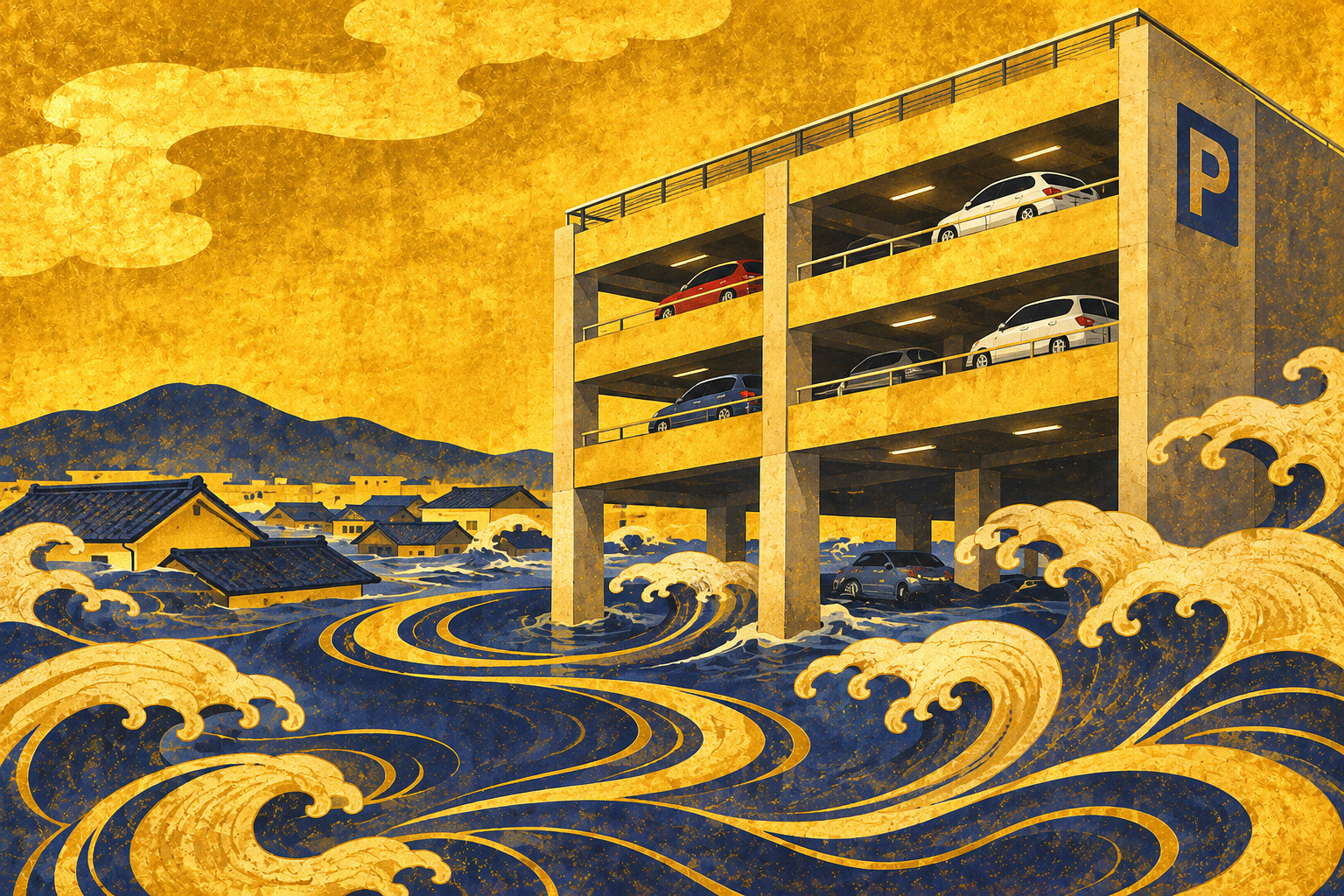
Local governments are increasingly considering an existing asset as part of the answer: upper floors of private parking structures. A mall or commercial complex may have elevated space that can be opened temporarily before floodwaters reach residential streets. But there is a critical distinction. A place to protect a car is not necessarily a safe place for its driver to shelter.
Kashiwa: the agreement became an operating plan
On September 21, 2026, Kashiwa City in Chiba Prefecture announced temporary vehicle-parking arrangements in anticipation of heavy rain from Typhoon No. 25. In addition to municipal properties, Aeon Mall Kashiwa participated. The municipal notice specified the fourth and fifth floors of its multistory garage from 9 a.m. to 10 p.m., with different arrangements later in the evening. The details mattered: a driver could not assume that any floor was available around the clock.
Jiji Press reported on November 9 that roughly 400 spaces at the mall were offered without charge during September 21–22 and that 42 vehicles used them. Those numbers demonstrate actual activation, but they do not establish whether the program reached everyone who needed it. Nor can the utilization figure alone distinguish successful early preparation from shortcomings in publicity or access. The 42-car figure is attributed to Jiji’s reporting, not an independent JAPAN.co.jp count.
Shizuoka shows the scale—and the limits
Shizuoka City has put numbers and operating rules in public view. Its official guidance lists 13 cooperating private facilities with 2,501 spaces as of June 1, 2026, distinguishing these from city-owned emergency parking. The facilities become available when significant inundation is anticipated, and their use requires coordination with the businesses involved. Residents are informed through city channels when a site is actually opened.
That is meaningful capacity, but the total alone is not a measure of equal protection. A garage must be reachable before roads flood and must be situated appropriately for the local flood scenario. Residents living far from a participating facility may have little practical benefit. A structure that is high enough can still be inaccessible if the route to it runs through a low-lying underpass.
New partners in Numazu and Fujieda
Numazu City, also in Shizuoka Prefecture, announced an agreement on October 7 with Shin Nihonho, the operator associated with the Concorde Numazu property, to use the multistory parking facility as a cooperative emergency vehicle-parking site. Its appeal is straightforward: an asset designed for ordinary commerce can serve an additional public purpose during severe weather.
Fujieda City identifies cooperating private lots and asks prospective partners to meet criteria including nighttime access, sufficient space, low modeled inundation risk and location outside landslide warning zones. The seemingly mundane requirement for nighttime access is particularly revealing. A parking garage that cannot be opened after a storm warning has little emergency value, however sturdy the building.
An idea with roots before the latest storms
These arrangements did not begin in 2026. A Ministry of Land, Infrastructure, Transport and Tourism case study documents a July 2020 agreement involving Odawara City, a commercial facility and a neighborhood association for vehicle evacuation and temporary shelter in cars during storm-related disasters, including arrangements contemplated for people with pets.
Kawaguchi City reached a related memorandum with Aeon companies in 2022 that included flood emergency evacuation space at commercial parking facilities. The historical development matters because different programs evolved to solve different problems. Some are designed to store unoccupied cars. Others contemplate people staying inside vehicles. They should not be described as interchangeable.
The dangerous final journey after parking
The most serious operational question may arise after the car has reached safety. Shizuoka’s vehicle-protection system, according to Jiji Press, does not itself provide accommodation for drivers. People must return home if safe or proceed to another suitable place. If the only way out of the garage is to walk through rising water, a measure intended to save property can expose someone to greater danger.
An effective plan therefore needs more than a route into the garage. Officials and residents must consider how drivers will leave, whether transport is operating, whether the facility is also an authorized human shelter, and whether a second journey would add traffic congestion. Moving a vehicle after conditions have become dangerous defeats the premise of early evacuation.
What a flooded underground garage taught Japan
It is a mistake to imagine that all parking structures provide flood protection. On September 12, 2025, intense rainfall inundated the Kusunoki underground parking facility in Yokkaichi, Mie Prefecture, damaging 274 vehicles, according to MLIT. The ministry responded in March 2026 with guidelines for flood prevention at nationally administered underground parking facilities.
The episode underlines the importance of topography, entry ramps, drainage, shutoff procedures and flood-hazard maps. An upper-floor garage can be useful in a particular scenario, but the building and its approach roads must still be assessed against local river flooding and intense urban rainfall. Drivers should not infer that a familiar parking sign represents an officially opened refuge.
Who opens the gate, and who bears the loss?
Public-private agreements create a coordination task. Who receives the city’s request to open? Can a night shift operate barriers and elevators during a power failure? Which floors are reserved for emergency users? Is entry first-come-first-served? How will drivers know if space has run out? The practical answers depend on the specific municipality and facility.
Free emergency parking should not be confused with a guarantee that a parked vehicle will survive—or that an operator will compensate owners if it does not. A motor policy’s flood coverage, contractual conditions, the duties of an operator and the effects of an extreme weather event involve different legal questions. The sources reviewed do not establish a common nationwide liability rule for these local agreements.
Drills are the bridge between agreements and safety
Tachikawa City conducted a vehicle evacuation drill at Aeon Mall Musashimurayama in October 2024. The exercise simulated rising river levels, a request for permission from the cooperating facility and a subsequent public notice inviting residents to move vehicles. The sequence illustrates why simply signing a memorandum does not mean a gate will open efficiently when needed.
Good evaluation would track how quickly a facility opens, how many people receive warnings, whether drivers can enter and depart safely, and how motorists with mobility needs are accommodated. Counting spaces is necessary. Measuring safe use would tell a much more complete story.
The hierarchy is lives first, then property
Japan’s Cabinet Office revised its evacuation-information guidance in March 2026 as the country updated weather and disaster-warning terminology. The fundamental question for a family remains unchanged: is there still time to move safely? A vehicle is valuable; entering dangerous floodwater to save one is not a justified trade.
The sensible use of these programs begins before a storm, with an examination of local hazard maps and official opening notices. Residents need to know not only which parking floor can accept a vehicle but also where people will go afterward. Private parking garages can become useful pieces of disaster infrastructure—but only when a plan for people is as carefully designed as the plan for their cars.
Sources and reporting method
This report prioritizes Japanese municipal and national primary sources. Use counts not directly documented in the accessible municipal releases are attributed to Jiji Press. JAPAN.co.jp did not conduct on-site inspections or original interviews for this article.
- 柏市・2026年9月21日の車両臨時駐車場開設情報 / Kashiwa City parking notice
- 柏市の避難施設・利用条件(配信転載) / Kashiwa city opening details
- 時事通信・2026年11月9日付の車両避難調査 / Jiji Press, November 9 report
- 静岡市・水害時における車両の避難場所のご案内 / Shizuoka City
- 沼津市・2026年10月7日協定 / Numazu City agreement
- 藤枝市・風水害時の車両用避難場所 / Fujieda City
- 立川市・2024年の車両退避訓練 / Tachikawa City drill
- 国土交通省・地下駐車場の浸水対策 / MLIT underground-parking guidance
- 内閣府・2026年3月避難情報ガイドライン / Cabinet Office evacuation guidance
- 国土交通省・小田原市の2020年事例 / MLIT Odawara historical example
- 川口市・2022年の商業施設との覚書 / Kawaguchi City