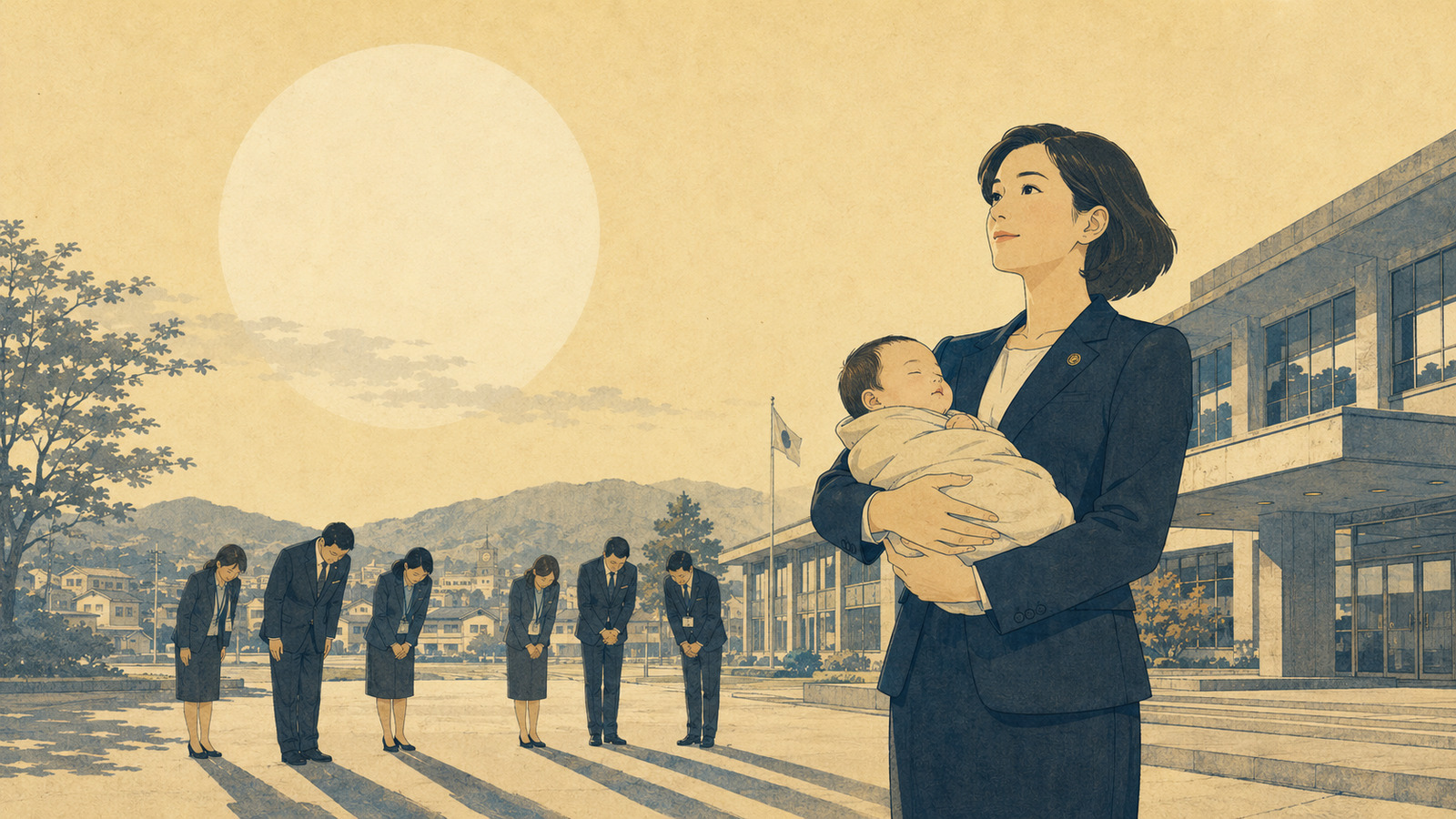
At one of her final public appearances before stepping away from office, Shoko Kawata joined a street procession for Yawata’s Taiko festival. Tradition normally placed the mayor on top of the mikoshi, the portable shrine moving through the summer streets. Kawata, visibly pregnant, walked behind it instead. The ritual continued. It simply changed shape around the body of the person holding office.
That image captures the experiment that began on July 20. Kawata, the 35-year-old mayor of Yawata in Kyoto Prefecture, became the first sitting Japanese mayor known to step away from active duties for childbirth. Her first child is due in September. The city has designated Vice Mayor Shigeto Nose as acting mayor for 16 weeks, from July 20 through November 8.
This is not maternity leave in the ordinary legal sense. Private employees and ordinary public servants are covered by labor protections and personnel rules governing pregnancy and childbirth. An elected mayor is a special public officeholder, not an employee working fixed hours for an employer. The labor laws that provide a defined absence, benefits and a route back to work do not apply in the same way. Because no mayoral protocol existed, Kawata and Yawata had to build one around the Local Autonomy Act’s provisions for an acting chief executive.
Building Leave for an Office That Has None
Yawata’s formal notice does not create a statutory category called “mayoral maternity leave.” Its title is more precise: the establishment of an acting official in connection with the mayor’s childbirth. Article 152 of the Local Autonomy Act allows a deputy to exercise the chief executive’s authority when the mayor is unable to serve or the office is vacant. The mechanism has traditionally covered illness, injury and other incapacities. Yawata is using it prospectively for the physical interruption of late pregnancy, birth and recovery.
Nose will not be a ceremonial caretaker. The city says he will, in principle, exercise the mayor’s full authority and lead dealings with the assembly. Yawata’s two vice mayors will divide major public appearances. During a disaster, the crisis-management chief will direct operations under the acting mayor. Official documents normally issued in Kawata’s name will instead identify Nose as acting mayor, preserving their legal force and making the chain of authority visible to residents.
The city also plans a roughly weekly online briefing with Kawata and telephone or online communication during emergencies. That continuity is understandable, but it creates a boundary that must be handled carefully. If the deputy legally holds the authority, the administration cannot operate with two final decision-makers. Information sharing should not become an expectation that the mayor will keep governing from a maternity ward. The precedent therefore tests both delegation and the right to be genuinely unavailable.
The acting mayor controls routine administration and assembly relations. Two vice mayors divide ceremonial duties. The crisis-management chief directs the field during disasters under the acting mayor. Weekly online updates and emergency communications keep Kawata informed, while official documents shift to the acting mayor’s name.
Shoko Kawata and a New Political Generation
Kawata studied economics at Kyoto University and entered Kyoto City government after graduation, working in roles that included social-welfare casework. She later became a political aide. In 2023, with no family political dynasty behind her, she ran for mayor of Yawata as an independent. She won at 33, becoming the youngest female mayor in Japan at the time.
Yawata sits between Kyoto and Osaka, a city associated with Iwashimizu Hachimangu shrine and the landscape where major rivers converge. It also faces the slow emergency common to Japanese suburban communities. Its population declined from about 74,300 in 2002 to below 68,000 by the spring of 2026. Demography appears locally as empty classrooms, a smaller tax base, scarce workers, thinner transit service and a growing demand for elder care.
Kawata campaigned on childcare and the future of a shrinking city. That makes her pregnancy more than a private episode in public view. If the chief executive of a government that urges families to have confidence in parenthood must resign, conceal pregnancy or work through physical recovery, the policy message collapses. Kawata has said that people in positions of responsibility should be able to protect their bodies and care for newborns without paralyzing their organizations.
From the 1946 Ballot to the First Woman City Mayor
Japanese women voted in a national election for the first time in April 1946, when 39 women won seats in the House of Representatives. The first postwar unified local elections followed in 1947. Three women—Fuku Sawaguchi, Hisa Akagi and Tomo Matsuno—were elected village heads, becoming Japan’s first women to lead local governments.
Another 44 years passed before a woman led a city. In 1991, lawyer Harue Kitamura was elected mayor of Ashiya in Hyogo Prefecture. She later directed the city’s recovery from the 1995 Great Hanshin-Awaji Earthquake while herself affected by the disaster. In an era when a woman mayor was treated as a novelty, Kitamura established authority through one of local government’s hardest tests.
Women governors and mayors gradually became more visible. The 2018 Act on Promotion of Gender Equality in the Political Field declared that parties should aim for candidate numbers as close to equal as possible, but it imposed no binding quota. Sanae Takaichi’s emergence as Japan’s first female prime minister in 2025 was a historic national breakthrough; it did not create a broad pipeline beneath her. The government’s 2025 gender-equality white paper counted only 64 women among 1,740 mayors of cities, wards, towns and villages—3.7 percent.
1947 Maternity Protection, 1991 Childcare Leave
Japan’s postwar Labor Standards Act treated pregnancy and childbirth as questions of health and workplace safety. Under current rules, an employee may request leave beginning six weeks before an expected birth, while an employer generally may not allow her to work for eight weeks afterward. Maternity leave protects physical recovery. It is distinct from childcare leave, which supports a longer period of care after birth.
The Child Care Leave Act enacted in 1991 became the foundation for a system later expanded to cover more workers, employment benefits, shorter hours and leave for fathers immediately after birth. Employees and ordinary civil servants now operate within rules for applying, assigning replacement staff, maintaining insurance and returning to work.
Elected politicians sit outside that architecture. Their authority comes from voters and lasts for a term; their compensation is not an hourly wage; and there is no employer who can approve a conventional leave request. The office was implicitly designed around a leader who would remain continuously available—a model far easier to satisfy when nearly every officeholder was a man with unpaid care performed elsewhere in the household.
When Childbirth Was Recorded as an “Accident”
The gap has not been limited to mayors. Some local assembly rules once failed to list childbirth as a valid reason for absence. Women councillors had to categorize it as an “accident,” an “unforeseen circumstance” or another generic excuse. The national government has pressed assemblies to state explicitly that childbirth, childcare and family care are legitimate reasons to be absent and to account for the pre- and postpartum periods.
Japan’s Diet also treated childbirth and care primarily as individual absences rather than employee-style rights. Reform has been incremental because elected office does not fit neatly inside labor law. Yet the practical result was clear: the first pregnant officeholder in an institution carried two workloads at once. She had to prepare for childbirth while designing the precedent for authorization, pay, replacement authority, emergencies and return to office.
That burden shapes who becomes a candidate. Japanese politics rewards late-night meetings, weekend events, continuous constituency work and visible personal sacrifice. These norms raise the entry price for young adults, parents and caregivers long before voters see their names on a ballot. A 3.7 percent female share among local chief executives reflects not just election outcomes, but who can plausibly organize a life around running at all.
The Argument Over Full Pay
Some of the criticism focused on Yawata’s plan not to reduce Kawata’s mayoral salary. The comparison with ordinary employment is emotionally powerful. Many workers do not receive their regular wage during maternity leave; eligible employees commonly rely instead on a health-insurance allowance of roughly two-thirds of standard remuneration. To a household balancing its own bills, full public pay can appear privileged.
But a mayor’s compensation belongs to a different legal structure. It is set by ordinance for the responsibilities and status of an elected office during a fixed term, not calculated from hours clocked at city hall. Kawata is not resigning. She retains the office while the acting-mayor system protects continuity. Cutting compensation only when the officeholder gives birth, in the absence of a neutral rule for comparable incapacity, would raise its own equality problem.
The durable answer is neither personal applause nor personal punishment. It is a rule written before the next case. Municipalities need transparent provisions defining the normal period, acting authority, compensation, benefits, emergency contact, disclosure and return. The treatment of the next pregnant mayor should not be improvised through an online referendum on whether she appears sufficiently dedicated.
The Myth of the Irreplaceable Leader
Behind the criticism lies an old theory of management: a leader should be available every hour because no one else can substitute for the leader. But an institution that fails when one person is absent is also vulnerable to earthquakes, illness, accidents and sudden death. Delegation, documented decisions, multiple trained executives and rehearsed emergency procedures are not merely family policy. They are resilience.
A leader who takes leave is not necessarily abandoning responsibility. The responsible act can be to transfer authority publicly, ensure that residents know who is accountable, and test whether the organization can operate legally without informal instructions from the absent chief. Yawata’s decision to publish details down to the name printed on municipal documents is important for that reason.
Remote technology can help, but it can also camouflage overwork. Recovery from childbirth is not predictable, and newborn care cannot be treated as an interruption between video calls. The real measure of organizational strength is not whether Kawata can remain constantly reachable. It is whether the city can function on the days she cannot be reached at all.
A Demographic Crisis Too Large for One Mother
Japan recorded about 686,000 births to Japanese nationals in 2024, while the total fertility rate fell to a record-low 1.15. Governments have expanded child allowances, nursery capacity, education support, parental leave and incentives for marriage and childbirth. Yet insecure incomes, housing costs, long working hours, unequal domestic labor and fear of career damage remain powerful deterrents.
One mayor’s maternity arrangement will not reverse those trends, and no woman politician should be made personally responsible for solving the birthrate. Kawata’s contribution is narrower and more practical. A municipality experiencing depopulation is demonstrating that an officeholder can give birth without surrendering elected office and that government can continue without pretending childbirth has no physical cost.
If it works, the lesson travels beyond city hall. Owners of small companies, hospital department heads, school principals and nonprofit directors are often told that they cannot step away because no substitute exists. If a city can legally delegate its highest executive powers, other organizations may be forced to examine how much of their own supposed indispensability is poor succession planning.
Six Tasks That Turn a First Into a System
| Task | What a durable rule requires |
|---|---|
| Coverage and duration | A standard absence framework for childbirth, childcare, family care and serious illness. |
| Acting authority | Clear start and end dates, delegated powers, and a boundary between briefings and commands from the absent mayor. |
| Compensation | Pay and benefits set transparently by ordinance, not by approval or anger directed at an individual. |
| Assembly and emergencies | Named responsibility for budgets, assembly answers, emergency orders and disaster command. |
| Return | A planned transition that can include flexible hours, remote participation and progressive resumption of duties. |
| National learning | Evaluation and shared guidance so every municipality does not have to invent the process again. |
What Remains on November 9
If the schedule holds, Nose’s period as acting mayor ends on November 8. Success should not be measured by how many online meetings Kawata managed to attend. It should be measured by whether municipal services continued, whether the deputy’s authority was unambiguous, whether Yawata remained prepared for emergencies, and whether Kawata had the time necessary for birth and physical recovery.
The precedent is not only about women. Its logic applies to fathers, mayors caring for relatives, councillors undergoing cancer treatment and any public servant whose life refuses to fit an uninterrupted political calendar. It asks whether democratic office is reserved for people who can appear to have no private needs, or can be redesigned for the lives citizens actually lead.
At the Taiko festival, the mikoshi moved even though the mayor was no longer riding on top. Kawata walked behind it and fulfilled the ritual differently. From July 20, Yawata’s administration began answering the same question: can the institution keep moving when its leader steps away? For the first time in Japan, the answer is being tested as a public system rather than a private exception.
Sources and references
The acting-mayor dates, authority and continuity plan are based on Yawata’s official notice, with the broader history checked against government statistics, labor guidance and contemporary reporting.
- Yawata City: Establishment of an acting mayor in connection with childbirth
- Reuters: Japan’s first sitting mayor to take maternity leave
- The Guardian: Kawata’s career, Yawata’s population decline and political participation
- TV Asahi: Acting authority, compensation and return-to-work plan
- Ministry of Health, Labour and Welfare: Maternity and childcare protections
- Cabinet Office: White Paper on Gender Equality 2025
- Cabinet Office: Women in politics and local-assembly family-care rules
- Cabinet Office: Act on Promotion of Gender Equality in the Political Field
- Ministry of Health, Labour and Welfare: 2024 vital statistics
- Prefectures and Municipalities: Women local-government leaders since 1947
- Kobe Shimbun: Harue Kitamura, Japan’s first woman city mayor