- The hidden shift behind a cold bottle
- What the robot actually does
- Physical AI still has a human on call
- A six-year history, not a sudden robot revolution
- Why a convenience store is harder than a factory
- Putting the 70% figure in perspective
- Fewer empty shelves do not automatically mean higher profit
- The rollout will be an experiment in different local economies
- What remains human in a more automated store
The hidden shift behind a cold bottle
The convenience store is one of Japan’s most finely tuned pieces of everyday infrastructure. Customers see immaculate shelves, hot food and a refrigerator that seems never to run out. They rarely see what happens behind its doors: workers carrying cases of drinks into a cold backroom, sorting bottles, checking gaps and moving stock toward the shopper-facing display. The work is repetitive, physically demanding and difficult to postpone.
On November 19, 2026, FamilyMart announced that it would begin a wider deployment in January 2027 of TX GHOST, a beverage-replenishment robot built by Tokyo-based robotics company Telexistence, alongside a digital inventory system called the Smart Shelf. The two companies have been developing and testing the approach since 2020. The stated objective is not to eliminate every task in a convenience store, but to automate one of the persistent chores that competes for employees’ time.
FamilyMart says pilot stores have reduced the labor associated with the targeted beverage inventory and replenishment work by about 70% per store per day. That figure is consequential, but its scope matters: it is not a claim that total staffing, payroll or operating hours across an entire store have fallen by 70%.
What the robot actually does
The new arrangement divides the job into two distinct workflows. Employees receive beverage deliveries and place products on a Smart Shelf. After scanning the first item of a product type, the shelf system can track where stock is located and how many items remain. Telexistence says it also estimates and proposes quantities needed for replenishment, even when different products share a shelf.
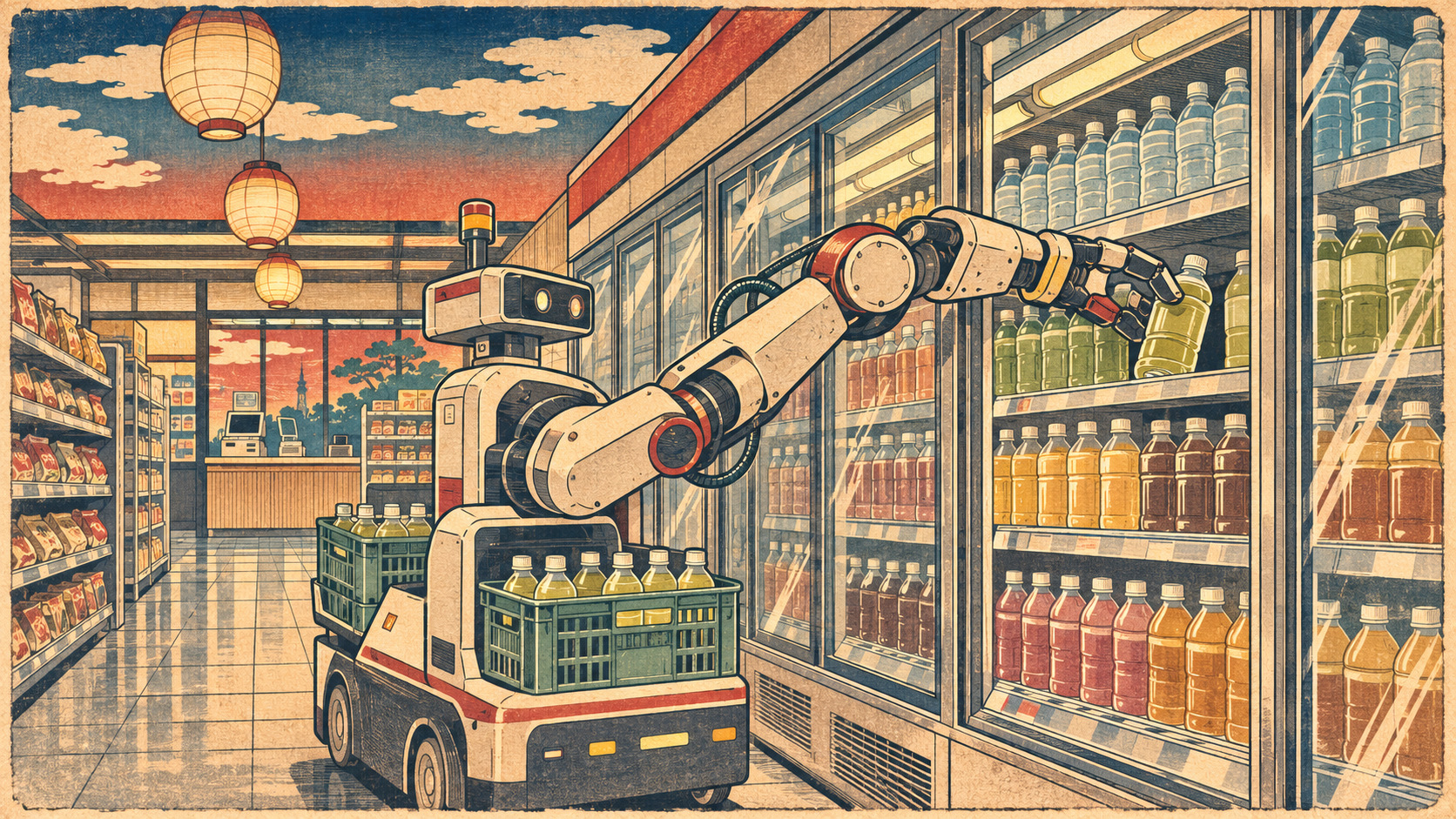
TX GHOST works on the other side of that inventory handoff, behind the shopper-facing refrigerator. It takes drinks from stock and places them onto retail shelves. According to the companies, it can operate around the clock and has a stated maximum placement capacity of roughly 1,800 bottles a day. Maximum rated throughput is not the same as daily demand, average throughput or independently measured uptime.
The software analyzes store sales data to prioritize popular beverages. That makes this more than a robotic arm following a timer. It ties physical placement to an inventory decision: what is selling, what needs refilling and which item should be handled first. Still, the claim that this will reduce missed sales is a business hypothesis until comparable before-and-after sales results are released.
Physical AI still has a human on call
The image of an autonomous robot working tirelessly in a refrigerator is compelling, but Telexistence describes a hybrid system. TX GHOST performs most routine stocking movements independently. When a bottle falls over or an unfamiliar arrangement defeats its ordinary routine, an operator can intervene remotely to assist.
This exception-handling loop is central to the company’s concept of physical AI. A robot that must manipulate real objects encounters friction, awkward angles, changing packages and unexpected clutter. The company says remote-control episodes also generate training data that can improve its robotics foundation models, expanding the range of situations the system can eventually resolve without human assistance.
That raises a more useful question than whether a machine is “fully autonomous.” How frequently is human intervention required, how much does remote support cost, how quickly is service restored after a network failure, and how are video feeds and operational data handled? Public materials do not provide complete answers. A genuinely productive installation must work as an economic and human system, not merely as an impressive demonstration.
A six-year history, not a sudden robot revolution
FamilyMart’s November announcement is the latest chapter in a longer effort. The retailer and Telexistence began work together in 2020. In November 2021, they publicized the installation of a robot called TX SCARA at the FamilyMart store inside Japan’s Ministry of Economy, Trade and Industry in Kasumigaseki, Tokyo. Its control system, Gordon, was designed to determine when and how drinks should be moved from the back of the refrigerator to the shelves.
In August 2022 the companies announced plans to expand TX SCARA and a store-work analysis system called TX Work Analytics toward 300 stores. That earlier program also examined how to reorganize staff schedules and tasks around automation. It was already clear that the opportunity lay at the intersection of robotics, merchandising and labor management.
TX GHOST and the Smart Shelf represent another iteration: a clearer division between employee loading, inventory visibility and robot placement. What the new announcement does not establish is how many of the previously targeted 300 stores were operating at the time of the announcement, how many older machines will be replaced, or how the new platform’s uptime compares with TX SCARA. The history supports a story of gradual engineering, not a single overnight breakthrough.
Why a convenience store is harder than a factory
Industrial robots are exceptionally effective when a production line presents the same parts, in repeatable positions, within a controlled space. Retail is less forgiving. Drinks arrive in different packages and volumes, customers remove items unpredictably, and inventory changes by hour and season. Stores also differ in layout, staff availability and how much room they have behind their refrigerated displays.
Beverage replenishment nevertheless has advantages as an early automation target. There are recurring shapes, a geographically constrained workspace and an easily observed outcome: the right bottle is available in the right slot. The challenge lies in the exceptions. A fallen bottle, mixed stock or an unexpectedly full shelf can defeat a rigid machine sequence. The Smart Shelf supplies inventory context while remote control supplies a path through the irregular cases.
Japan has a powerful reason to test whether this can scale: labor is a scarce resource, and convenience stores offer an enormous variety of services in limited space. FamilyMart reported 16,481 domestic stores as of October 31, 2026, including affiliate-operated chains. That is the size of its network, not a disclosed number of future robot installations. National eligibility must not be confused with universal deployment.
Putting the 70% figure in perspective
Suppose, purely as an illustration, that a store previously spent 100 minutes a day on the beverage tasks included in a trial. A 70% reduction would free 70 minutes. That says nothing about how many minutes a real pilot store actually saved: FamilyMart has not published a detailed store-level time study with that figure in the November release.
Nor can released minutes be converted mechanically into wage savings. They could make it easier to cover a thinly staffed shift, reduce overtime, improve shelf upkeep, or allow an employee to devote more time to customers. Labor savings will depend on staffing patterns and the practical ability to rearrange shifts. The robot has costs of its own: acquisition or leasing, power, installation, maintenance, connectivity and remote operator support.
Without an installation price, contract terms, payback period, sample size and distribution of pilot outcomes, an independent return-on-investment calculation is not possible. The 70% result is a reported pilot finding, not a verified nationwide projection of staffing savings.
Fewer empty shelves do not automatically mean higher profit
Intelligent shelf refilling could prevent a popular drink from sitting in a stockroom while its retail slot is empty. Prioritizing fast sellers may improve availability during a rush. That is a plausible mechanism for stronger sales, and one of the reasons the companies emphasize analyzing historical purchase patterns.
But a shelf can be empty because the store has no inventory, because a delivery is delayed, or because the item has been discontinued. A robot working behind the refrigerator cannot solve the entire upstream supply chain. More frequent replenishment could improve on-shelf availability without necessarily increasing gross margin enough to pay for the installation.
Independent evaluation should track out-of-stock minutes, sales volume, waste, worker effort, electricity use, intervention frequency, and customer experience before and after deployment. Until those figures are available, “maximizing sales” is an objective, not an established result.
The rollout will be an experiment in different local economies
A high-volume store in a busy metropolitan station may benefit from every minute of saved replenishment time. A small suburban shop may sell far fewer beverages and have less space to accommodate machinery. Locations in rural areas can face acute staffing shortages but also different sales profiles and maintenance logistics.
The economic threshold is therefore unlikely to be identical everywhere. The companies say the rollout will target FamilyMart locations nationwide, yet have not announced a complete list of installations, a total deployment count or an end date. Reporting from Japan has suggested that early deployment will emphasize major metropolitan regions; a national rollout should not be treated as the immediate conversion of every branch.
Franchise economics are also critical. Who bears equipment costs? Who owns the robot? Which party pays if the system is idle? Does installation require replacing a refrigerator? The public announcement does not settle those questions. As the project expands, franchisee experience will be as important as factory-floor engineering.
What remains human in a more automated store
The strongest argument for the project is not that a convenience store can function without people. It is that employees could spend fewer hours in a chilled stockroom and more time where human judgment is valuable: serving a customer, solving a delivery problem, maintaining food quality or responding to the particular needs of a neighborhood.
Telexistence frames its mission as bringing robots out of factories and into everyday life. That ambition will be tested in the most mundane of places, where a thirsty commuter expects the drink they want to be cold, visible and within reach. Success will be measured less by a promotional video of a robotic arm than by months of dependable service across many imperfect stores.
Japan’s retail automation story is entering a practical phase. TX GHOST is not proof that stores are about to become workerless. It is a carefully scoped attempt to make one repetitive task less exhausting and more predictable—and a test of whether AI can deliver measurable gains once the novelty wears off.
Sources, method and limitations
This analysis compares the November 19 corporate announcements, historical 2021 and 2022 releases, published store counts and contemporary reporting. It does not independently audit robot output or pilot economics. Installation cost, intervention rate and sample details remain unavailable; illustrative calculations are not observed results.
- ファミリーマート:2026年11月19日公式発表 / FamilyMart announcement (Nov. 19, 2026)
- Telexistence:TX GHOSTとスマートシェルフ / TX GHOST and smart shelf
- ファミリーマート:2021年TX SCARA実店舗導入 / 2021 TX SCARA pilot
- ファミリーマート:2022年300店導入計画 / 2022 expansion plan
- ファミリーマート:2026年10月31日時点の店舗数 / Store count as of Oct. 31, 2026
- ITmedia:現場での自律制御と遠隔補助 / Reporting on operation
- FNN:担当者の説明と導入地域 / Interview and planned launch areas