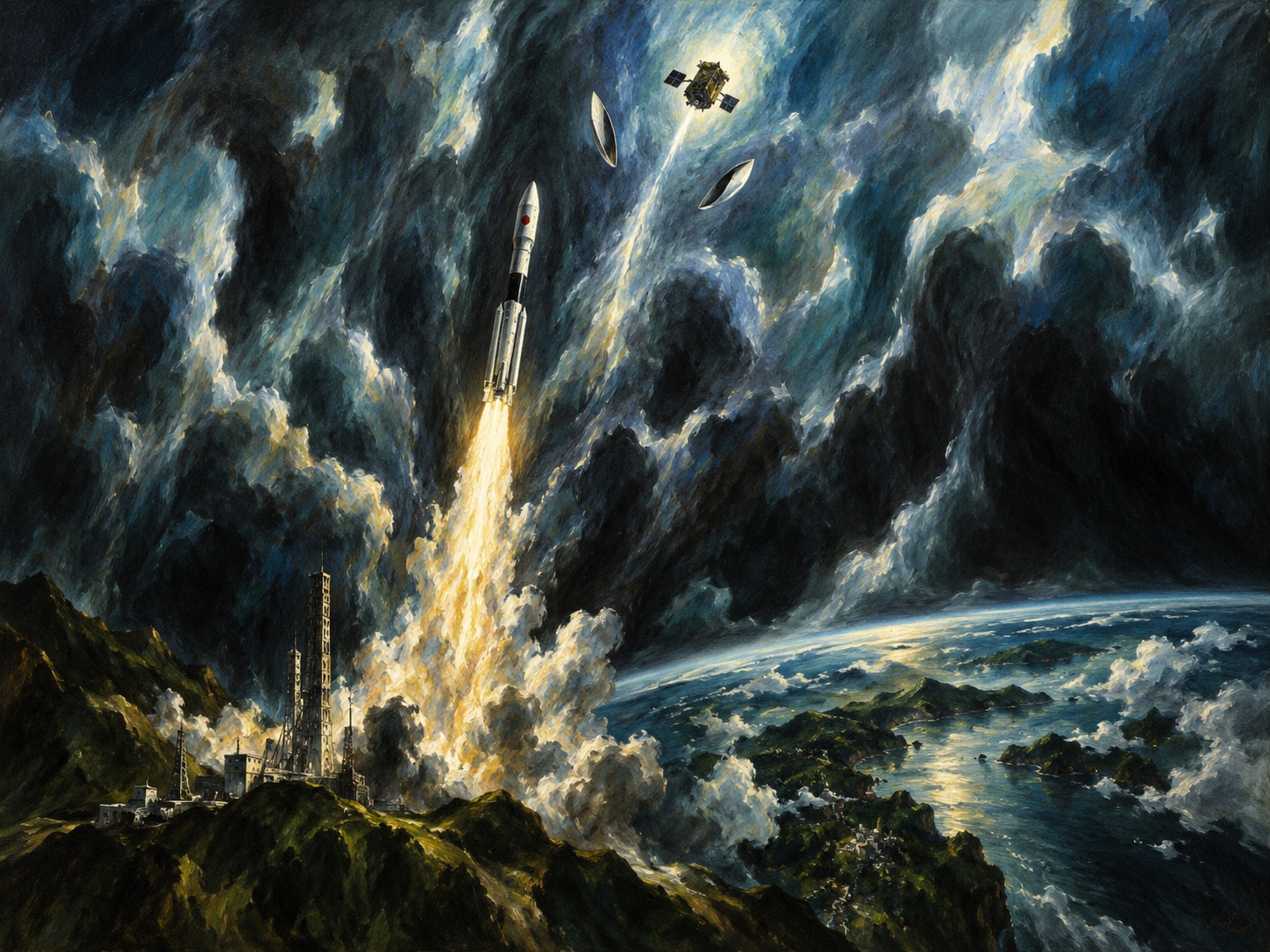
Space transportation has traditionally been described as an ascent problem: build the payload, place it on a rocket and reach orbit. But a commercial microgravity economy needs a second direction. If a company grows a crystal, manufactures a material or performs a biomedical experiment in orbit, the customer may need the physical result back on Earth before any economic value can be realized.
That return journey sits at the center of a launch agreement announced September 14 by Sendai-based ElevationSpace and Mitsubishi Heavy Industries. ElevationSpace says it has signed a rideshare launch-service contract to fly the second vehicle in its ELS-R Space Environment Utilization and Recovery Platform series on Japan’s H3 rocket in 2027.[1]
The announcement does not identify the specific H3 flight, a precise launch date, the co-passenger payloads, the detailed target orbit or the contract price. ElevationSpace says the deal was possible because the timing and orbital conditions of an H3 rideshare mission aligned with the development and demonstration schedule for ELS-R.[1]
A European launcher for Aoba, an H3 for the second vehicle
The agreement gives ElevationSpace a second launch path. Its first ELS-R demonstration spacecraft, Aoba, is scheduled for launch from the second half of 2026 onward aboard Spectrum, the small launch vehicle being developed by Germany’s Isar Aerospace. The previously announced Isar contract described Spectrum as designed to carry roughly 1,000 kilograms to low Earth orbit.[2]
The follow-on ELS-R spacecraft is now planned to ride Japan’s H3 in 2027. CEO Ryohei Kobayashi described access to H3 as an important step toward making the platform suitable for a wider range of customer needs, following the company’s effort to secure global launch access through Isar Aerospace.[1]
For a space-services company, launcher diversity is more than symbolism. It can reduce exposure to schedule delays, launcher-specific failures, orbital constraints and conflicts between a customer’s timetable and a rocket provider’s manifest.
| Item | Detail |
|---|---|
| Announcement | September 14, 2026 |
| Launch vehicle | H3 |
| Contract | Rideshare launch transportation service |
| Payload | Second ELS-R Space Environment Utilization and Recovery Platform spacecraft |
| Planned launch | 2027 |
| Not disclosed | Price, exact date, H3 flight number, co-passengers and detailed target orbit |
ELS-R is meant to combine a microgravity laboratory with a return vehicle
ElevationSpace’s basic proposition is to fly customer payloads on a small free-flying spacecraft, conduct experiments, demonstrations or manufacturing in low Earth orbit, and then return physical products or samples through atmospheric re-entry for recovery on Earth.[3][4]
Microgravity can suppress buoyancy-driven convection, sedimentation and other gravity-dependent effects that complicate experiments on Earth. That environment has long been used for work involving protein crystals, fluids, combustion and advanced materials. Some customers need only data from orbit. Others need the actual sample back for analysis, testing or downstream manufacturing.
In February 2026, ElevationSpace was placed on a JAXA Space Strategy Fund list of domestic on-orbit demonstration providers capable of coordinating launches in Japan. JAXA describes such providers as organizations that carry customer payloads and provide operational demonstration opportunities in orbit.[5]
Japan’s recovery heritage extends beyond Hayabusa
Japan’s best-known return missions are the asteroid sample-return spacecraft Hayabusa and Hayabusa2. Hayabusa released its capsule in June 2010; the capsule re-entered Earth’s atmosphere and was recovered in the Woomera Prohibited Area in Australia, ultimately delivering microscopic material from asteroid Itokawa.[6]
A decade later, Hayabusa2’s re-entry capsule was recovered in Australia on December 6, 2020, carrying material from asteroid Ryugu.[7]
For commercial low-Earth-orbit logistics, an equally important milestone came in 2018. JAXA’s HTV-7 cargo spacecraft carried the HTV Small Re-entry Capsule, or HSRC. After departing the International Space Station, the capsule returned experimental samples through the atmosphere and was recovered at sea near Minamitorishima. JAXA described it at the time as a demonstration of a capability Japan had not previously possessed: returning cargo from the ISS.[8][9]
ElevationSpace is trying to transform pieces of that national technical heritage into a commercial service customers can purchase repeatedly. A one-off scientific return mission and a logistics business are very different things.
H3 has moved from development crisis to commercial test
H3 is Japan’s current flagship launch vehicle, jointly developed by JAXA and Mitsubishi Heavy Industries. Its first test flight failed in March 2023 when the second-stage engine did not ignite. JAXA concluded the payload could no longer reach its intended orbit and transmitted a destruct command, losing the ALOS-3 Earth-observation satellite.[10]
After investigation and corrective work, the second test flight succeeded in February 2024. Successes followed with Flights 3, 4, 5 and 7. Flight 8 failed in December 2025, creating another reliability challenge, but Flight 6 succeeded in June 2026 and Flight 9 successfully launched the Michibiki No. 7 quasi-zenith satellite on August 11, according to Mitsubishi Heavy Industries’ mission record.[11][12]
For commercial customers, reliability is only one variable. Launch cadence, price, orbital flexibility, schedule assurance and the quality of payload integration all affect whether H3 can compete as a transportation service rather than function mainly as a launcher for government missions.
Japan’s first privately provided H3 rideshare has already flown
The ElevationSpace deal comes after an important operational milestone. On June 12, 2026, H3 Flight 6 carried six small secondary spacecraft. JAXA confirmed injection of the second stage into its planned orbit, separation of PETREL and STARS-X and the transmission of separation signals to BRO-22, VERTECS, HORN-L and HORN-R.[13]
Space BD says four of those payloads flew through its H3 rideshare service under an agreement with JAXA, making the mission the first private-sector rideshare service on a Japanese flagship rocket. The company also developed an interface plate and sequencer to release multiple satellites from one payload port, and said those systems functioned in orbit as designed.[14][15]
That matters because “rideshare on H3” is no longer only a business plan. Japan has now accumulated real integration and flight experience. ElevationSpace’s planned 2027 mission belongs to the next stage: turning that capability into a repeatable commercial offering.
The economics of rideshare come with constraints
Rideshare can reduce launch cost because a small spacecraft does not have to purchase an entire large rocket. Multiple customers share the transportation capacity.
The trade-off is control. The primary mission and overall manifest can dictate launch timing, orbital destination and operational rules. Rideshare payloads must fit strict requirements for safety, separation, radio systems, propulsion, hazardous materials and mechanical interfaces. ElevationSpace itself says its H3 agreement became possible because the mission’s timing and orbital conditions matched its development plan.[1]
A recoverable spacecraft is especially sensitive to that bargain. An observation satellite may complete its launch objective once it is injected into a usable orbit. ELS-R must later reach a re-entry trajectory that supports a safe return location. The ascent orbit and return architecture therefore have to be designed as one system.
The business is shifting from the price of launch to the price of using space
Launch cost was historically the dominant barrier to commercial activity in orbit. Reusable rockets, rideshare programs and a growing small-launch market have widened access. As that happens, customers increasingly care about the total cost of the mission: payload engineering, integration, in-orbit operations, communications, sample handling, return and post-flight analysis.
ElevationSpace’s international partnerships show that it is trying to assemble that broader service layer. In July 2026 it signed an agreement with Luxembourg-based Space Cargo Unlimited to explore integration of the company’s autonomous BentoBox payload platform with future ElevationSpace free-flying demonstration and recovery spacecraft.[16]
In August it announced cooperation with U.S.-based Aegis Aerospace to study orbital experiments and high-cadence payload-return services involving the ISS and future commercial low-Earth-orbit destinations.[17]
The post-ISS era makes the return trip a market
The International Space Station is scheduled to end operations around 2030. The United States and private companies are developing commercial stations intended to maintain a human presence and research capability in low Earth orbit. ElevationSpace sees that transition as a core market opportunity.[3]
Today’s ISS logistics system includes large cargo vehicles and crew spacecraft. Future commercial stations will also generate material that needs to travel in both directions: scientific samples, manufactured products, biological material, failed hardware and time-sensitive payloads. Some cargo will need large vehicles; other customers may prefer small, frequent return capsules.
ElevationSpace is separately developing ELS-RS, a high-frequency unmanned return service intended for crewed low-Earth-orbit facilities. In May 2026 it announced a memorandum with Japan LEO Shachu to study an integrated chain of launch, resupply, on-orbit experimentation and cargo recovery for the post-ISS environment.[18]
A ¥6.4 billion Series B points beyond a one-spacecraft demonstration
ElevationSpace was established in February 2021. In June 2026 it said it had raised ¥6.4 billion in a Series B round, bringing cumulative funding since founding to ¥10.1 billion. The company said the capital would support space-to-Earth transportation, space-environment utilization services and international expansion.[19]
At the time of that funding announcement, the company said Aoba had completed its critical design review and had entered flight-model assembly.[19]
For a space startup, flying the first spacecraft is only the first business threshold. A commercial operator must repeatedly design, manufacture, test, insure, launch, operate, recover and refurbish or rebuild systems while meeting customer schedules. A contract for a second spacecraft is therefore a meaningful indicator that ElevationSpace is designing for a sequence of missions rather than a single technology demonstration.
Japan wants to double its space market
Japan’s Basic Plan on Space Policy set a goal of roughly doubling the combined domestic market for space equipment and space solutions from about ¥4 trillion in 2020 to about ¥8 trillion in the early 2030s. The Space Strategy Fund is intended to provide support on the order of ¥1 trillion across transportation, satellites and exploration-related technologies.[20]
The government also recognizes a launch-cadence problem. Cabinet Office material noted that in 2024 the United States completed 153 successful launches carrying satellites and China 66, while Japan completed five. The comparison is used to argue that Japan must strengthen the international competitiveness of its space-transportation sector.[21]
In that context, a Japanese startup purchasing a Japanese flagship launch is symbolically useful but economically insufficient by itself. The real test is whether launch providers, spacecraft companies, integrators, universities and industrial customers begin buying and selling missions repeatedly.
Japan’s launch law moved forward in 2026, but re-entry remains unfinished business
The regulatory environment is particularly important for ElevationSpace because its product is defined by the return journey. Japan passed amendments to its Space Activities Act in June 2026, with the law promulgated on June 17. The changes broaden the launch-permit framework, including coverage of space rockets that do not necessarily carry or separate an artificial satellite.[22][23]
But Diet deliberations explicitly noted that landing of reusable rocket stages and intentional re-entry were not fully included in the 2026 amendment’s liability and government-indemnification provisions. Cabinet Office reviews had classified re-entry as an area requiring rapid legal action but additional policy design.[24]
For a company planning frequent returns, those questions are commercial infrastructure. When must a re-entry permit be obtained? How is control from outside Japan treated? What safety standards apply to the recovery area? Who bears liability if a return vehicle causes third-party damage? Regulatory predictability affects insurance, customer contracts and mission cadence.
Why H3 matters beyond the label “domestic”
H3 is offered in multiple configurations with different numbers of LE-9 main engines and solid rocket boosters. Mitsubishi Heavy Industries lists performance of more than 4 tonnes to a 500-kilometer sun-synchronous orbit and more than 6.5 tonnes to geostationary transfer orbit for relevant configurations.[25]
A small return spacecraft does not need to buy all of that capacity. The commercial question is whether H3 can routinely use surplus performance to serve smaller customers while still meeting the requirements of its primary missions.
MHI is also broadening its private-sector manifest in other directions. In July 2026 it signed a launch and transportation agreement with ispace for the ULTRA lunar lander, currently planned for an H3 launch in 2028. That contract and the ElevationSpace rideshare illustrate two different emerging markets for the same national launcher: lunar transportation and low-Earth-orbit commercial services.[26]
The second flight has to prove more than survival
A capsule that returns safely once can demonstrate a technology. A commercial service faces harder metrics. Can customer payloads be integrated on schedule? Are orbital conditions repeatable enough for experiments? Can temperature, vibration and contamination limits be guaranteed? How accurately can the vehicle reach its recovery zone? How quickly can a sample be handed back to the customer? Can the company do it again?
Japan.co.jp’s analysis is that the most important part of the H3 announcement is not that ElevationSpace has “booked a rocket.” It is that the company is building a multi-flight architecture — first Aoba on a European launcher, then a second ELS-R on H3 — before the first platform has become a routine commercial service.
If the two spacecraft can fly on different launch systems, perform useful work in orbit and return physical value to Earth, Japan will have more than another satellite startup. It will have the beginning of a new logistics route.
A space economy needs a return ticket
Launch is the most visible moment in space business: fire, sound and a vehicle clearing the tower. But the durable economic work comes afterward.
A platform must operate, complete the experiment, communicate with the ground, protect the customer’s payload and — when required — return it safely. Only when customers can repeat that cycle does space begin to function less like a series of national expeditions and more like an industrial environment.
The ElevationSpace-MHI contract secures one part of that cycle: an H3 ride upward in 2027. The more consequential test comes later. Can the value created in orbit make the trip home on schedule? Japan’s commercial-space ambitions may ultimately be judged not only by how often its rockets leave Earth, but by whether a dependable return lane exists as well.
Sources & Reference Material
- ElevationSpace, rideshare launch agreement with Mitsubishi Heavy Industries, Sept. 14, 2026 (company release on PR TIMES)
- ElevationSpace, launch agreement with Isar Aerospace for Aoba, March 4, 2025
- ElevationSpace, updated vision for crewed space transportation and orbital logistics, July 29, 2025
- ElevationSpace / Space Cargo Unlimited MoU on in-orbit demonstration and return, July 9, 2026
- ElevationSpace selected as a domestic on-orbit verification and testing provider, Feb. 13, 2026
- JAXA/ISAS, Hayabusa return capsule materials
- JAXA/ISAS, Hayabusa2 re-entry capsule recovery result, Dec. 6, 2020
- JAXA, HTV Small Re-entry Capsule (HSRC)
- JAXA, HTV-7 small re-entry capsule recovery
- JAXA, failure of H3 Test Flight No. 1, March 7, 2023
- JAXA, H3 flight history
- Mitsubishi Heavy Industries, H3 past missions
- JAXA, H3 Flight 6 launch result, June 12, 2026
- Space BD, first privately provided rideshare service on Japan's flagship rocket, April 24, 2026
- Space BD, completion of H3 Flight 6 private rideshare service, June 12, 2026
- ElevationSpace / Space Cargo Unlimited, standardized in-orbit demonstration and manufacturing service MoU
- ElevationSpace / Aegis Aerospace, on-orbit experiments and high-cadence payload return, Aug. 6, 2026
- ElevationSpace / Japan LEO Shachu, post-ISS low-Earth-orbit infrastructure cooperation, May 11, 2026
- ElevationSpace, ¥6.4 billion Series B and ¥10.1 billion cumulative funding, June 19, 2026
- Cabinet Office, Space Strategy Fund Basic Policy
- Cabinet Office, review of the Space Activities Act
- Cabinet Office, 2026 amendment to the Space Activities Act
- Cabinet Legislation Bureau, bill amending the Space Activities Act
- House of Representatives, Cabinet Committee, 221st Diet, June 10, 2026
- Mitsubishi Heavy Industries, H3 launch vehicle lineup and performance
- Mitsubishi Heavy Industries / ispace, H3 launch agreement for ULTRA lunar lander, July 29, 2026
Sources checked through September 14, 2026. Public materials do not disclose the H3 contract price, exact launch date, flight number, co-passenger payloads or detailed target orbit for the second ELS-R mission. At verification time, Japan.co.jp also found no official confirmation that the first spacecraft Aoba had launched, so it is described according to the company's published schedule: from the second half of 2026 onward. Analysis is by Japan.co.jp.