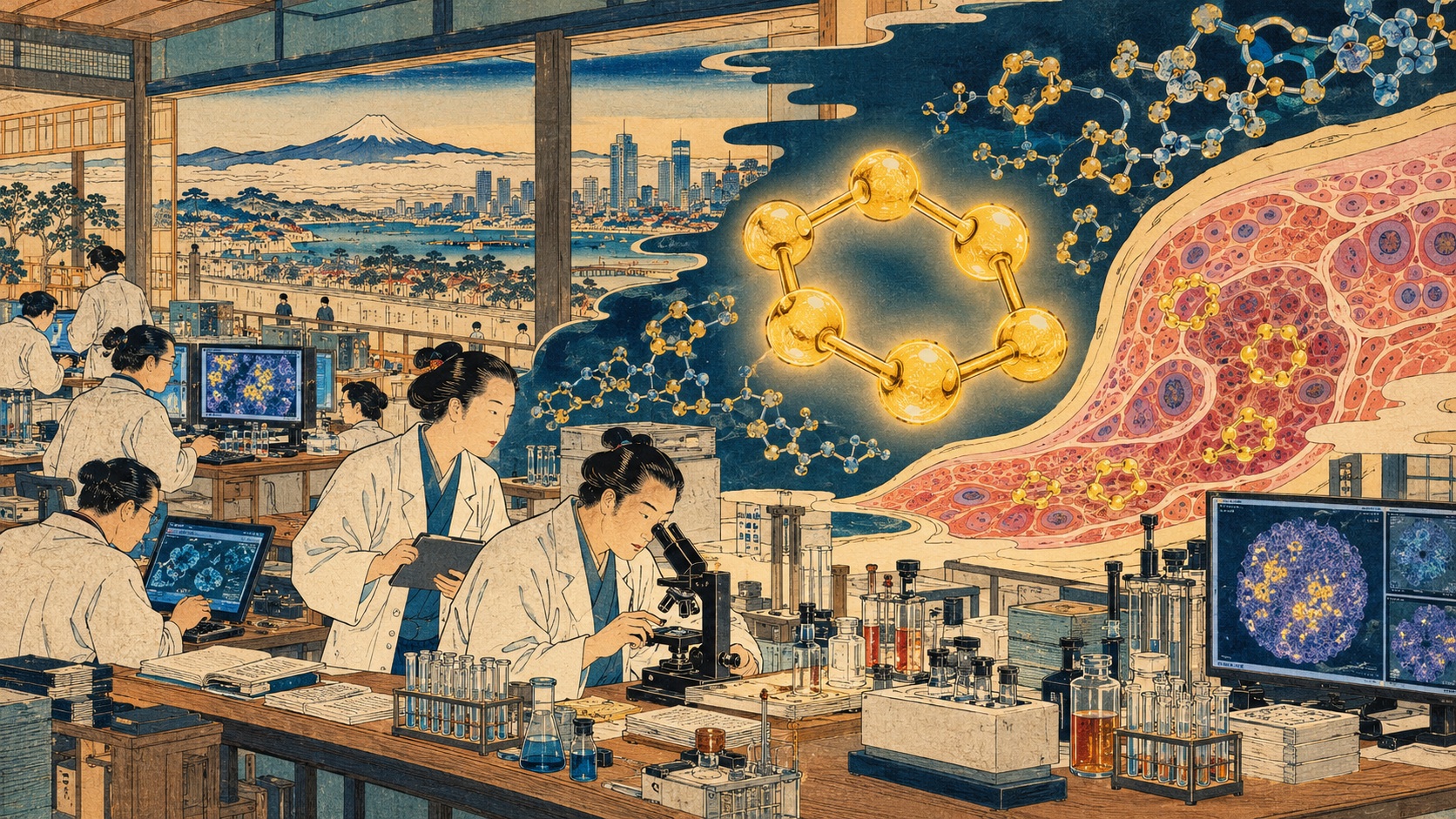
A mineral-world molecule appears in a very human place
Sulfur evokes volcanoes, hot springs and bright yellow mineral deposits. But a ring of eight sulfur atoms—cyclo-octasulfur, or S8—also belongs in the biology of mammals, according to an international team led by Japanese researchers. Their work identifies S8 in cells and tissues, suggests a role in protecting vulnerable fats from oxidation, and reports striking differences in human breast-cancer samples. The surprise is real; a new clinical cancer test is not.
First, a timeline that changes the headline
The peer-reviewed paper appeared in Science on September 24, 2026. Tohoku University announced it September 25, Shimadzu issued a Japanese release October 7 and the company published an English announcement October 26. The late English release may bring the discovery to new readers but does not make the underlying science new on October 26. This is an October 28 explanatory investigation into the significance and limitations of previously published work.
What an eight-atom ring actually is
Cyclo-octasulfur is a form of elemental sulfur whose eight atoms form a ring. It is not hydrogen sulfide, the gas associated with a rotten-egg smell, and it is not equivalent to all sulfur-containing molecules in proteins. Sulfur has always been important to life, but whether mammals themselves made and stored this particular form of elemental sulfur had remained unclear. The study broadens how researchers think about sulfur handling inside cells.
How to find something you did not know to look for
The team used a molecular capsule designed to capture S8 selectively, then combined mass spectrometry with Raman microscopy. Shimadzu says instruments including its Nexera liquid chromatography series and LCMS-8060 and LCMS-8060NX mass spectrometers were used. The analytical advance matters because merely identifying elemental sulfur in a complex biological sample is challenging; targeting the ring molecule and corroborating signals through different methods strengthen the chemical identification.
Inside the cell: a storehouse beside the fats
Researchers reported S8 in mammalian tissues and cells, including mitochondria and lipid droplets, with particularly substantial accumulation in the droplets. Lipid droplets are not passive oil blobs. They take part in metabolism and cellular stress responses. Finding an elemental-sulfur store in these lipid-rich compartments makes a provocative biological connection: sulfur chemistry may be positioned exactly where fats need protection against oxidation.
A possible brake on a distinctive form of cell death
The work indicates that S8 can provide a reservoir for reactive sulfur species, including molecules formed through reactions involving glutathione. It connects that chemistry to lipid peroxidation and ferroptosis, a type of iron-associated cell death. Ferroptosis is of interest in cancer biology and many other diseases. But preventing cell death is not uniformly beneficial: protecting a healthy tissue might be desirable, while protecting a tumor from death could create the opposite problem. Clinical implications require careful context.
Why the breast-cancer result needs an exact description
The investigators found elevated S8 in studied human breast-cancer tissue relative to noncancerous breast tissue, and increased supersulfide-related molecules in patients’ exhaled breath. Those are related observations, not one identical measurement: the breath finding was not simply a test for S8 itself. Neither result establishes that the molecule causes cancer, reliably differentiates all patients from healthy people, or offers an approved screening method. Patient cohorts and independent validation are the next necessary questions.
An experiment in diseased joints
The researchers also administered solubilized S8 into the joints of mice used to model knee osteoarthritis. They reported less lipid peroxidation in joint tissue. That provides a lead for mechanistic or therapeutic research, not evidence that humans with osteoarthritis should receive sulfur injections or take over-the-counter sulfur products. Safety, formulation, dosing, and durable outcomes would have to be established in future work.
A longer history, from sulfur cycles to cellular signaling
Microbiologists have long studied elemental sulfur in environmental sulfur cycles. Biologists have separately explored sulfur-containing amino acids, hydrogen sulfide signaling and more reactive sulfur species. This paper connects those traditions by putting S8—a familiar form of elemental sulfur—inside mammalian cells as a potentially functional store. The distinction matters for researchers studying how cells balance chemical defense and controlled cell death.
The international collaboration behind the discovery
Tohoku University names Takaaki Akaike, International Research Fellow/Professor in its Graduate School of Medicine, among the Japanese leaders, alongside Tetsuro Matsunaga of Akita University and Michito Yoshizawa of Institute of Science Tokyo. The collaboration also involved German researchers and Shimadzu. The methods span chemistry, cellular analysis and disease models—an example of why a biological discovery may depend as much on measurement innovation as on a new hypothesis.
Where the cancer promise stops
An association between a molecule and a tumor is only an opening question for a diagnostic. A clinically useful test would need defined patient groups, sensitivity, specificity, performance against benign or inflammatory conditions, reproducibility and independent confirmation. This paper does not demonstrate that breath chemistry can replace imaging or biopsy. Nor does it show that consuming sulfur, visiting hot springs, or taking supplements prevents cancer or treats disease.
The eight-atom question for tomorrow
Why do mammalian cells synthesize and collect S8? Does the amount reflect a useful defense, a response to disease or both? What happens when the metabolic pathway is altered in distinct tissues? Those are the consequential questions made more tractable by this research. A spectacularly simple molecular shape has turned out to inhabit an intricate biological system. The responsible headline is not a cure discovered, but a previously hidden piece of life’s chemistry brought into view.
Sources and verification
Checked Japanese university primary disclosures and Shimadzu releases against the original Science publication citation. No independent patient-data analysis or researcher interviews were conducted.