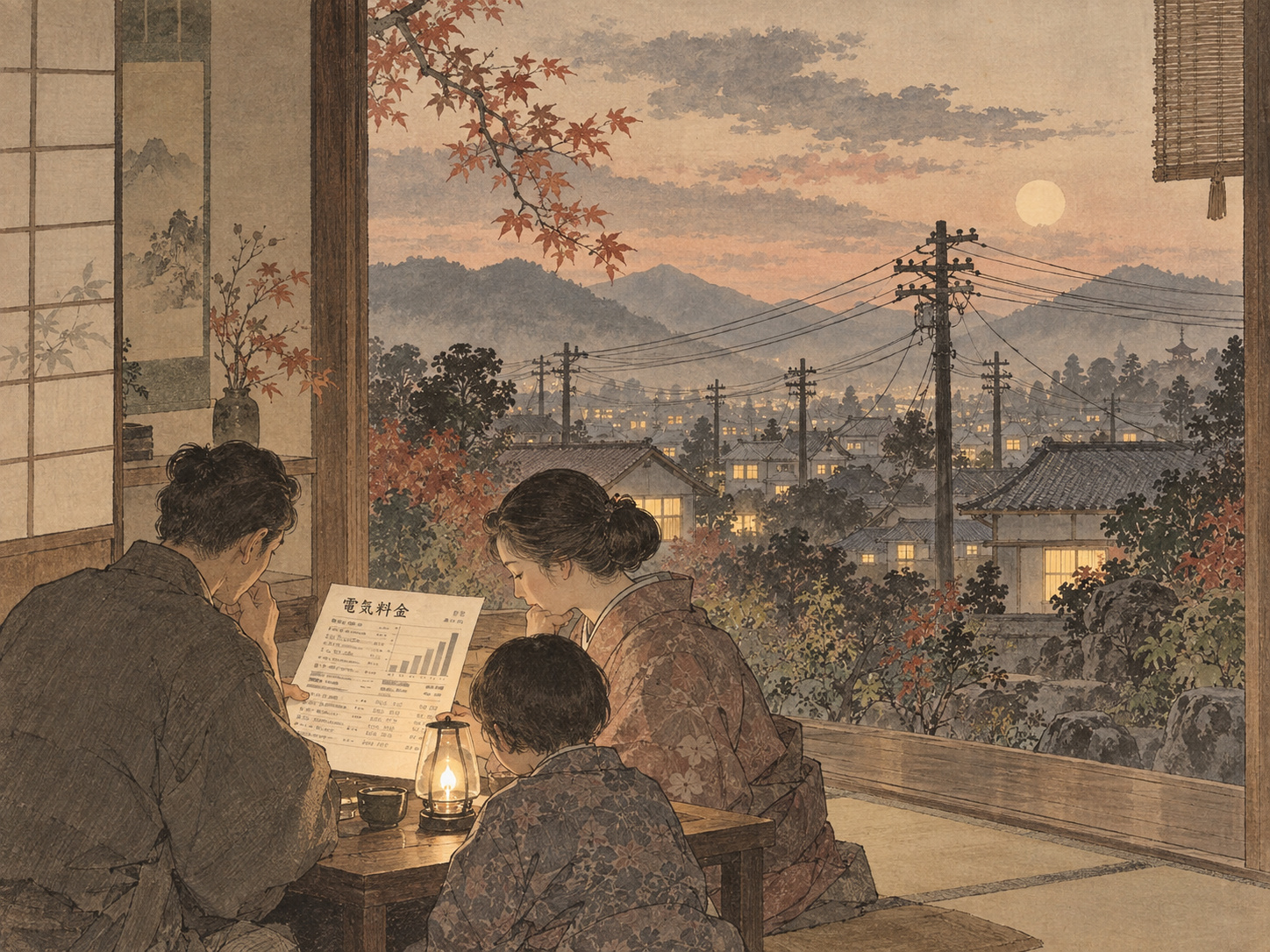
Japanese households receiving an electricity bill in October are still benefiting from the government’s summer support. September usage remains discounted by ¥3.50 per kilowatt-hour for low-voltage customers and ¥1.80/kWh for high-voltage customers. The larger shock comes next: October usage, generally appearing on November bills.
All 10 major regional power companies are expected to charge more for a standard household in November than in October. Jiji Press calculated increases ranging from ¥835 to ¥1,578. Tokyo Electric Power Company’s standard model rises ¥1,286 to ¥9,561, while Okinawa Electric Power climbs ¥1,578 to ¥10,752, the highest amount among the 10. The ending subsidy is a major driver, but it is not the only one: fuel costs remain elevated amid Middle East instability, while revised transmission and distribution charges also take effect in some regions on November 1.[1]
The timing matters
The phrase “October electricity bill” can be misleading. Japan’s 2026 summer support covers electricity consumed in July, August and September. Low-voltage discounts were ¥3.50, ¥4.50 and ¥3.50/kWh respectively; high-voltage customers received ¥1.80, ¥2.30 and ¥1.80/kWh. For many households those reductions appear on bills issued in August, September and October. The subsidy therefore disappears from October consumption and is usually felt on the November bill.[2]
Tohoku Electric Power makes the mechanism unusually clear. Its fuel-cost adjustment for low-voltage customers in November 2026—covering October usage—is minus ¥6.29/kWh, a ¥3.85 increase from the previous month. The company says the main reason is the end of the government’s special electricity-price measure. Its standard household model, 30 amps and 260 kWh, rises ¥1,486 to ¥9,690; that increase includes ¥485 associated with the November 1 revision to wheeling charges.[3]
Why the government brought subsidies back for summer 2026
The latest program was announced after Prime Minister Sanae Takaichi set out measures in response to Middle East instability on May 25. The next day, Economy, Trade and Industry Minister Ryosei Akazawa said the government would support electricity and gas costs from July through September because air-conditioning demand rises during Japan’s hottest months and households should not be discouraged from using cooling necessary to protect health.
The rates were deliberately highest in August: ¥3.50/kWh for low-voltage electricity in July, ¥4.50 in August and ¥3.50 in September; high-voltage rates were ¥1.80, ¥2.30 and ¥1.80. City-gas relief was ¥14, ¥18 and ¥14 per cubic meter. Akazawa said the combined electricity and gas support would reduce costs for a standard household by roughly ¥5,000 over the three months.[4]
The program was financed with ¥513.5 billion from fiscal 2026 reserve funds. Retail electricity and gas companies apply the government-set discount directly to bills and receive reimbursement from the state, meaning households do not file an application or receive a separate cash payment.[5]
Akazawa also signaled from the beginning that the measure was meant to end with summer. In his May 26 press conference, he said household electricity use generally falls in October and that, at that point, the government did not consider further support necessary, while promising to keep monitoring the impact of Middle East conditions.[4]
A simple household calculation
The direct effect of losing the low-voltage subsidy is proportional to consumption. At 260 kWh a month, ¥3.50/kWh equals ¥910. At 300 kWh it is ¥1,050. At 400 kWh it is ¥1,400. That is why it is wrong to describe the entire November increase as a new surge in fuel prices: a large part is the removal of a policy discount that had been suppressing the bill.
Tokyo Electric Power Grid’s published fuel-adjustment figures show the layering clearly. Its low-voltage adjustment for October 2026 is minus ¥9.30/kWh, already ¥1.66 higher than September. For November it becomes minus ¥5.33, another ¥3.97 move upward. The November change includes the disappearance of the subsidy, so consumers experience fuel markets and public policy as a single movement on the final bill.[6]
A subsidy system born from the post-2022 energy shock
Japan’s current pattern of electricity relief began after Russia’s invasion of Ukraine, soaring global fuel prices and a sharply weaker yen pushed import costs higher. On October 28, 2022, the government approved the Electricity and Gas Price Volatility Mitigation Program as part of a wider economic package.
From January 2023 usage, households and other low-voltage customers received a ¥7/kWh discount, high-voltage users ¥3.50/kWh and eligible city-gas customers ¥30 per cubic meter. At 400 kWh a month, the electricity component alone cut a model household bill by ¥2,800.[7]
What followed was not a clean phase-out. Support was repeatedly reduced, extended and revived. The low-voltage rate fell to ¥3.50/kWh beginning with September 2023 usage. It remained ¥3.50 in early 2024, was reduced to ¥1.80 in May 2024 and then ended—only to return from August through October under an emergency heat-relief program. Subsequent cost-of-living measures revived support again in later periods. The 2026 summer program belongs to this cycle of targeted re-entry rather than to one continuous subsidy.[8]
This history has changed the meaning of the monthly power bill. Electricity prices no longer reflect fuel and grid costs alone; they also reflect whether the government happens to be absorbing part of those costs in a given month.
The 2023 tariff reset still matters
Another structural break came in June 2023, when seven major utilities raised regulated household tariffs after fuel costs had surged. Government review reduced the requested increases, but approved hikes still ranged from roughly 14% to 42%. The Agency for Natural Resources and Energy noted at the time that the ¥7/kWh subsidy meant actual post-revision bills for model households at six of the seven companies were lower than they would otherwise have been.[9]
That episode illustrates the role subsidies have played ever since: they do not necessarily lower the underlying cost structure. They temporarily cover part of it. When support ends, households see more of the fuel, generation and network costs that had been masked.
Grid charges are rising too
This autumn’s increase is unusually complicated because the subsidy expiration overlaps with changes in wheeling charges—the fees electricity retailers pay for use of transmission lines, substations and local distribution networks.
Tohoku Electric says its November 1 retail-rate revision adds ¥485, or 5.9%, to its standard household model before other monthly adjustment movements are considered. Hokkaido Electric likewise says it will reflect revised wheeling charges from November 1 and prorate November bills between the old and new rates according to the number of days of use.[10][11]
These costs are tied to a wider national problem: Japan must maintain aging grid infrastructure while spending more to connect renewable generation, harden networks against disasters and move electricity between regions. For consumers, however, all of those policy choices collapse into one number at the bottom of the bill.
Why regional bills differ so much
Japan does not have one national household electricity price. Regional utilities have different generation mixes, fuel procurement portfolios, nuclear restart schedules, hydro resources, islands to serve, fuel-adjustment rules and network costs.
Hokuriku Electric’s regulated low-voltage fuel adjustment, for example, moves from minus ¥9.82/kWh in October 2026, when the government discount still applies, to minus ¥6.19 in November after support ends. Kyushu Electric Power Transmission and Distribution likewise states explicitly that only bills from August through October—covering July through September usage—receive the 2026 special discount.[12][13]
Okinawa is particularly exposed because its grid is isolated from mainland Japan and relies heavily on thermal generation. Jiji’s standard-household comparison puts Okinawa Electric’s November bill at ¥10,752, the highest among the 10 major companies, with the largest month-on-month increase at ¥1,578.[1]
Businesses lose support as well
The 2026 summer program also covered the high-voltage contracts commonly used by small and midsize businesses, although at lower rates than households: ¥1.80/kWh for July and September usage and ¥2.30 in August. Extra-high-voltage customers were outside the national program, with some support instead available through local-government measures funded by central grants.[2]
For power-intensive manufacturers, restaurants, supermarkets, refrigerated logistics operators and other businesses, a change of only a few yen per kilowatt-hour can materially affect monthly operating costs. Companies with little ability to raise prices are especially exposed. That is why the end of household subsidies can eventually feed back into consumer inflation through business costs.
The policy dilemma: relief versus price signals
Electricity subsidies work quickly. During extreme heat, directly lowering the unit price makes it easier for households to use air conditioning without fearing an immediate financial penalty. The system is administratively simple because the discount appears automatically on the bill.
But repeated subsidies are expensive and can blur the signal that energy is scarce or costly. They may reduce incentives to conserve power or invest in insulation, efficient air conditioners and other energy-saving equipment. And because the discount is based on consumption, households that use more electricity receive a larger absolute subsidy.
The 2026 summer program alone was budgeted at ¥513.5 billion.[5] The harder long-term questions are therefore not simply whether to extend relief, but how Japan reduces exposure to imported fuels, finances grid investment, balances nuclear and renewable generation, and targets assistance toward households and businesses least able to absorb high prices.
Three numbers households should watch this autumn
The first is consumption. The end of the subsidy scales directly with kilowatt-hours. The second is the fuel-cost adjustment, which reflects movements in imported crude oil, LNG and coal with a lag. The third is the household’s tariff plan and regional utility, because regulated and competitive plans can respond differently.
There is one mitigating factor: autumn demand is usually lower. A household that turns off air conditioning in October may consume enough less electricity that its total bill falls even as the unit economics worsen. That seasonal decline was part of the government’s rationale for ending summer support.[4]
But the underlying price structure is still moving higher. Once the summer discount disappears, households again bear more of the actual combination of fuel and grid costs.
Japan’s latest electricity increase is therefore not just another monthly price change. Since 2022, the country has tried to manage energy security, inflation, summer heat and infrastructure investment through the same household bill. November will show consumers what that bill looks like when one of the government’s largest cushions is removed.
Sources
- Jiji Press / Nippon.com, Sept. 29, 2026
- METI, electricity and gas support for July–September 2026 usage
- Tohoku Electric Power, November 2026 fuel-cost adjustment
- METI, Minister Ryosei Akazawa press conference, May 26, 2026
- Agency for Natural Resources and Energy, FY2026 electricity and gas relief budget
- TEPCO Power Grid, fuel-cost adjustment notices
- Japan Energy White Paper 2023
- Agency for Natural Resources and Energy review of electricity and gas price-relief programs
- Agency for Natural Resources and Energy, June 2023 tariff revision explainer
- Tohoku Electric Power, wheeling-charge retail-rate revision
- Hokkaido Electric Power, rate revision FAQ
- Hokuriku Electric Power, fuel-cost adjustment history
- Kyushu Electric Power Transmission and Distribution, fuel-cost adjustment system