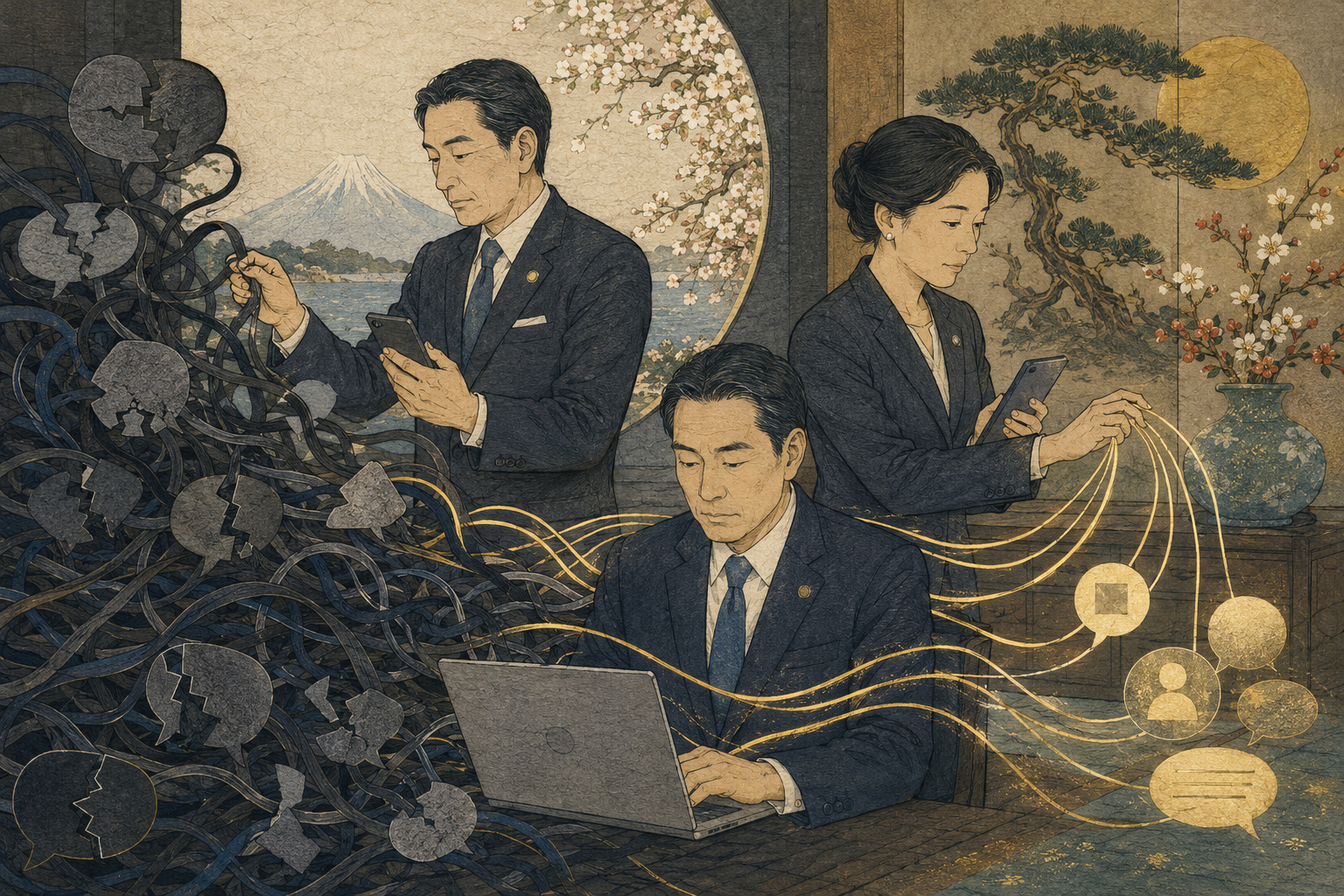
The sentence was almost disarmingly ordinary: “Hello. I’m Harada, director of the Policy Division in the International Cooperation Bureau.” For a creator introducing a newsletter, it would barely register. From a ministry whose institutional grammar has long favored “the Government of Japan” over “I,” it marked a quiet departure.
Takashi Harada’s June 22 post did not open with an argument about trolls, bots or hostile states. It began with a bureaucratic problem. When Japan announces aid, the news may be compressed to a single line: Japan gives country A so many billion yen. The number is accurate, Harada wrote, but the reason for the project and its meaning for Japan are often lost. Into that empty space can rush a much simpler story: money is being sent abroad while people at home struggle.
The Foreign Ministry’s answer is unexpectedly personal. Managers who design development policy will write in their own names about where they served, what they saw and why a project exists. Harada described three years at Japan’s embassy in Pakistan, where Japanese cooperation helped local auto-parts makers meet quality standards and helped shape a business environment in which Japanese manufacturers could operate. Aid, in his telling, was neither anonymous generosity nor a bag of cash disappearing overseas. It was a long investment in institutions, skills, trust and Japan’s own room to work in the world.
A name changes the message
A named official can do something a press release rarely does: acknowledge the question underneath the complaint. Harada confronted it directly—why help overseas when people in Japan need help? His answer was not that the question was ignorant. He called it a subject an ODA policymaker must address head-on.
That tone is the innovation. A conventional release authenticates a decision: date, amount, recipient, purpose. A bylined explanation can reconstruct the chain of reasoning and invite the reader to judge it. It also creates accountability. The author’s rank, experience and choice of evidence are visible. If the post is wrong or evasive, the same name that lends credibility attracts scrutiny.
Kyodo described the real-name series as unusual even across Japanese ministries. The official account belongs to the bureau, not to Harada personally, and the language remains government communication. Yet the byline opens a narrow window in the wall between the drafting desk and the public. It says that policy was made by people with memories and judgments—not generated by a faceless machine.
“Prebunking” is older than the internet
The idea behind the experiment comes from a line of research more than six decades old. In 1961, psychologists William McGuire and Demetrios Papageorgis tested whether exposing people to weakened counterarguments—and refuting them—could make beliefs more resistant to a later persuasive attack. They called the process inoculation, borrowing the metaphor of a vaccine.
Digital researchers later adapted that model to misinformation. Modern prebunking may warn people about a likely false claim, explain the relevant facts in advance, or teach manipulation techniques such as scapegoating, false dilemmas and emotionally loaded language. In seven experiments involving almost 30,000 participants, a Cambridge-led team found that short videos improved people’s ability to identify manipulation. A real-world YouTube test found an average five-percentage-point lift in recognition. The effect was meaningful but not magical.
That caveat matters. Prebunking is not simply “say the government’s position first.” Classic inoculation includes forewarning and a refuted, weakened challenge. A ministry that publishes only flattering stories may produce advertising, not resilience. The reader must be given enough evidence to understand the objection, test the answer and keep a distinction between a disputed value judgment and a falsifiable claim.
| Problem | Weak response | Stronger public response |
|---|---|---|
| A true number lacks context | Repeat the number more loudly | Show purpose, financing, recipient, time horizon and Japanese interest |
| A false claim is emerging | Wait for a formal briefing cycle | Publish a short correction linked to primary evidence and translations |
| A narrative exploits fear | Call all critics misinformed | State the concern fairly, separate fact from policy choice, answer each |
| Attribution is uncertain | Guess who is behind it | Describe the observed behavior and say what remains unknown |
The expensive lesson of “Africa Hometown”
The urgency is not theoretical. At the August 2025 Tokyo International Conference on African Development, the Japan International Cooperation Agency paired four Japanese cities with Ghana, Nigeria, Mozambique and Tanzania under an “Africa Hometown” initiative. It was designed to strengthen exchange. It did not create a migration program or special visas.
But overseas statements and reports used language suggesting special visas, relocation or even the dedication of Japanese territory. JICA issued a factual correction on August 25 and said on August 27 that the Nigerian presidency and a Tanzanian newspaper had amended erroneous wording. By then, posts alleging that the government intended to bring large numbers of African immigrants to Japan were racing through domestic social media. Participating cities were inundated with complaints.
On August 28, a parliamentary vice-minister for foreign affairs acknowledged that the government’s response had, in the end, been slow. Less than a month later, JICA withdrew the initiative. It repeated that it had never promoted immigration and apologized for the burden on municipalities, while also conceding that the name “hometown” and the act of “designation” had invited misunderstanding.
This was not a laboratory case of a wholly fabricated sentence injected from nowhere. There were inaccurate foreign claims, an ambiguous English label, a politically sensitive domestic subject, authentic government material and a lagging correction. That mixture is precisely why “misinformation” is a more useful description than “fake news.” An information crisis can grow from mistakes, translation, omission, opportunism and genuine anxiety before anyone proves a centrally directed deception campaign.
- Misinformation: false or inaccurate information, whether or not the person sharing it intends to deceive.
- Disinformation: false or manipulated information spread deliberately to mislead.
- FIMI: foreign information manipulation and interference—a coordinated pattern of manipulative behavior that may use falsehoods, selective truths, impersonation or artificial amplification.
- Criticism: disagreement with ODA priorities, cost, design or results. It is not misinformation merely because a ministry dislikes it.
From quiet correction to visible proof
Japan’s public diplomacy did not begin with a note account. In 1954, still a recipient of World Bank finance itself, Japan joined the Colombo Plan and began technical cooperation in Asia. The first ODA loan went to India in 1958. The Japan Overseas Cooperation Volunteers began in 1965, the Japan Foundation was established in 1972, and JICA followed in 1974. Exhibitions, language study, expert exchanges and development projects built Japan’s image through presence rather than argument.
For decades, correcting the record was largely a matter of a diplomatic approach, a letter to an editor, a background briefing or a ministry webpage. Social media collapsed that timetable. A deceptive screenshot can cross languages in minutes; a forged document can borrow the visual authority of a government seal; an emotional caption can reach millions before specialists agree on a translation.
In August 2023, the Foreign Ministry confronted a document presented as one of its diplomatic cables. It purported to show a scheme involving ballast-water exchange and the dilution of water treated by the Advanced Liquid Processing System at Fukushima Daiichi. The ministry said the contents were groundless and the cable entirely fake. The significance was not only the disputed policy. The fabrication imitated the evidence a diplomat normally trusts: an internal record.
That December, Japan and the United States signed a memorandum to cooperate in identifying and countering foreign information manipulation. The 2025 Diplomatic Bluebook said MOFA had begun strengthening the links among its information, policy and communication divisions, launched a public information-manipulation portal in 2024, and worked through the G7 Rapid Response Mechanism. Crucially, it also said Japan’s response rests on a free information space and requires the resilience of media, think tanks and civil society—not government alone.
1954 Japan joins the Colombo Plan and begins government technical cooperation.
1972–74 The Japan Foundation and then JICA give cultural and development diplomacy permanent institutions.
2018 The G7 creates its Rapid Response Mechanism to coordinate against foreign threats to democracies.
2023 MOFA denounces a forged Fukushima-related cable; Japan and the United States sign an information-manipulation memorandum.
2025 The Africa Hometown controversy demonstrates the cost of an explanatory vacuum.
2026 ODA officials begin writing publicly under their own names; the G7 adopts a shared open-source analysis framework.
A table that reached seven million screens
The shift became visible during a sharp Japan–China dispute in November 2025. Chinese government communications suggested that crimes targeting Chinese nationals were surging and that travel to Japan had become more dangerous. On November 21, Japan’s Foreign Ministry published a table of reported serious crimes—murder, robbery and arson—in which the victim’s nationality was Chinese. It said the claim of a rising security risk was not borne out.
The Japan Times later reported that the ministry’s Japanese-language social-media post drew more than seven million views. The instrument was almost comically bureaucratic: a statistical table. Yet it was built for the feed—compact, bilingual and directly connected to underlying categories. Diplomacy had turned a document into shareable evidence without turning the reply into an insult.
That restraint is strategic. A 2026 peer-reviewed study of China’s aggressive “wolf-warrior” diplomatic messaging found modest but detectable deterioration in sentiment toward China across experiments in Japan, South Korea and Taiwan; the effects varied by place and outcome. The lesson is not that politeness always wins. It is that a rebuttal can reject a claim without copying the anger that carried it.
Japan’s problem is also bigger than any bilateral quarrel. In February 2026, Reuters reported on a U.S. research institute’s finding that a network of X and Tumblr accounts pushed anti-Japanese-election narratives as part of a wider alleged China-linked influence operation. China’s embassy denied the allegation. Responsible reporting preserves both the attribution and the denial: detecting a coordinated pattern does not automatically prove who ordered it.
The hardest line: facts are not obedience
A democratic government has a duty to provide accurate information and no right to declare every opposing narrative illegitimate. “Japan spent X yen” can be checked. “The project is worth that cost” is a political judgment. “This program creates a special visa” can be disproved by its legal terms. “Japan should accept more—or fewer—migrants” is a policy preference. Collapsing those categories would convert counter-misinformation into message control.
Named officials can improve that boundary because their claims can be questioned in public. They can also blur it. A career official who becomes the face of a policy may be targeted personally. A conversational post can be mistaken for a legal commitment. A correction can amplify the rumor it quotes. Old screenshots can survive a later edit. If the series succeeds, its credibility will come not from personality alone but from disciplined publishing.
- Lead with the verified fact, then describe the false or misleading claim without sensational repetition.
- Link to primary records, definitions, dates and methodology—not only another government assertion.
- Publish in the languages and formats in which the claim is moving, including charts, captions and accessible text.
- Separate errors from policy disagreements and disclose uncertainty or incomplete attribution.
- Timestamp the post, preserve corrections and make substantial edits visible.
- Protect officials from harassment while keeping the institution accountable for what they publish.
What ODA’s long history can—and cannot—prove
The note series arrives while aid budgets are under pressure worldwide. OECD preliminary data show total ODA from donor members and associates fell 23.1% in real terms in 2025, the largest annual contraction on record. Japan provided about US$16.2 billion, or ¥2.4273 trillion, equal to 0.35% of gross national income. The Foreign Ministry ranked Japan fourth by volume among the 33 DAC countries excluding the European Union and 13th by ODA as a share of GNI. Those two rankings describe different dimensions, a small example of why context belongs beside any league table.
Japan’s general-account ODA budget tells another story. It rose from ¥233.2 billion in 1978 to a peak of ¥1.1687 trillion in 1997, then declined; the initial 2026 budget is ¥583.5 billion. That does not settle whether a single project is effective. It explains why officials feel compelled to show what long relationships purchase.
Harada’s Pakistan account is evidence of mechanism, not a universal verdict. Technical advice can raise supplier quality; infrastructure can improve market access; cooperation can create trust. ODA can also be poorly designed, politically convenient or difficult to evaluate. A mature public record should contain outcomes, costs, failures and changes—not only anecdotes of gratitude.
Japan’s 2023 Development Cooperation Charter explicitly links cooperation with both partner-country challenges and Japan’s national interest. Saying that openly is healthier than presenting aid as pure altruism. Japan imports much of its energy, resources and food; it depends on stable sea lanes, functioning markets and diplomatic support. The honest debate is not “charity or self-interest.” It is which partnerships can produce shared benefit, on what terms and with what safeguards.
The new diplomat is still a diplomat
There is a tempting mythology around digital diplomacy: the brave official discards the script, speaks spontaneously and defeats falsehood with authenticity. Real public service is less cinematic. Harada’s post sits on an institutional account. It links to official and JICA material. The series has an editorial purpose and a publication rhythm. That structure is a strength.
A diplomat’s authority comes partly from not improvising national policy. Going public does not mean abandoning clearance, accuracy or restraint. It means translating them into a medium where silence is also interpreted and delay has a distribution cost. The craft is to write fast enough for the feed and carefully enough for the archive.
The first ODA post did not rebut a specific viral falsehood. It tried something harder: filling the space in which the next one might grow. It gave a name to the drafter, a place to the experience and a chain of consequences to an aid number. Whether readers accept the policy is theirs to decide.
That is the democratic promise of the experiment. Diplomacy need not become louder than misinformation. It has to become earlier, clearer and easier to verify. The goal is not a timeline in which everyone agrees with the Foreign Ministry. It is a public square in which disagreement does not begin from an invented set of facts.
Reporting notes and principal sources
This article uses public material checked through August 11, 2026 at 8:06 AM Japan Standard Time. The documented initiative is the International Cooperation Bureau’s official note series, not an unannounced requirement for all diplomats to maintain personal social-media accounts. “Misinformation” is used for inaccurate information without assuming intent; “disinformation” is reserved for deliberate deception or attributed findings. The Reuters-reported 2026 influence network remains an outside research finding that China denied. ODA volume and ODA as a share of GNI measure different dimensions; the underlying amount, share and comparison set are stated above.
- MOFA International Cooperation Bureau: Takashi Harada’s opening note on why officials are writing publicly
- Kyodo via Kumamoto Nichinichi Shimbun: real-name ODA posts and the prebunking aim
- Ministry of Foreign Affairs: history of Japan’s ODA since the 1954 Colombo Plan
- Ministry of Foreign Affairs: general-account ODA budget history through 2026
- Ministry of Foreign Affairs: preliminary 2025 Japanese ODA data
- OECD: Japan development co-operation profile and comparison methodology
- JICA: August 25, 2025 correction of Africa Hometown claims
- JICA: withdrawal of the Africa Hometown initiative
- TV Asahi: foreign-affairs vice-minister acknowledges delayed response to the rumors
- Ministry of Foreign Affairs: August 2023 statement on a fabricated diplomatic cable
- Diplomatic Bluebook 2025: strategic communications, disinformation and the free information space
- Ministry of Foreign Affairs: 2023 U.S.–Japan memorandum on foreign information manipulation
- Ministry of Foreign Affairs: November 2025 crime-statistics rebuttal
- The Japan Times: MOFA’s use of graphics and the reach of its statistical rebuttal
- University of Cambridge: seven experiments on scalable misinformation inoculation
- The ANNALS: review of psychological inoculation theory and evidence
- European External Action Service: working definition of FIMI
- G7 Rapid Response Mechanism: 2026 Information Manipulation Set framework
- Reuters: outside researchers’ 2026 influence-operation finding and China’s denial
- The International Journal of Press/Politics: 2026 experiments on wolf-warrior diplomacy