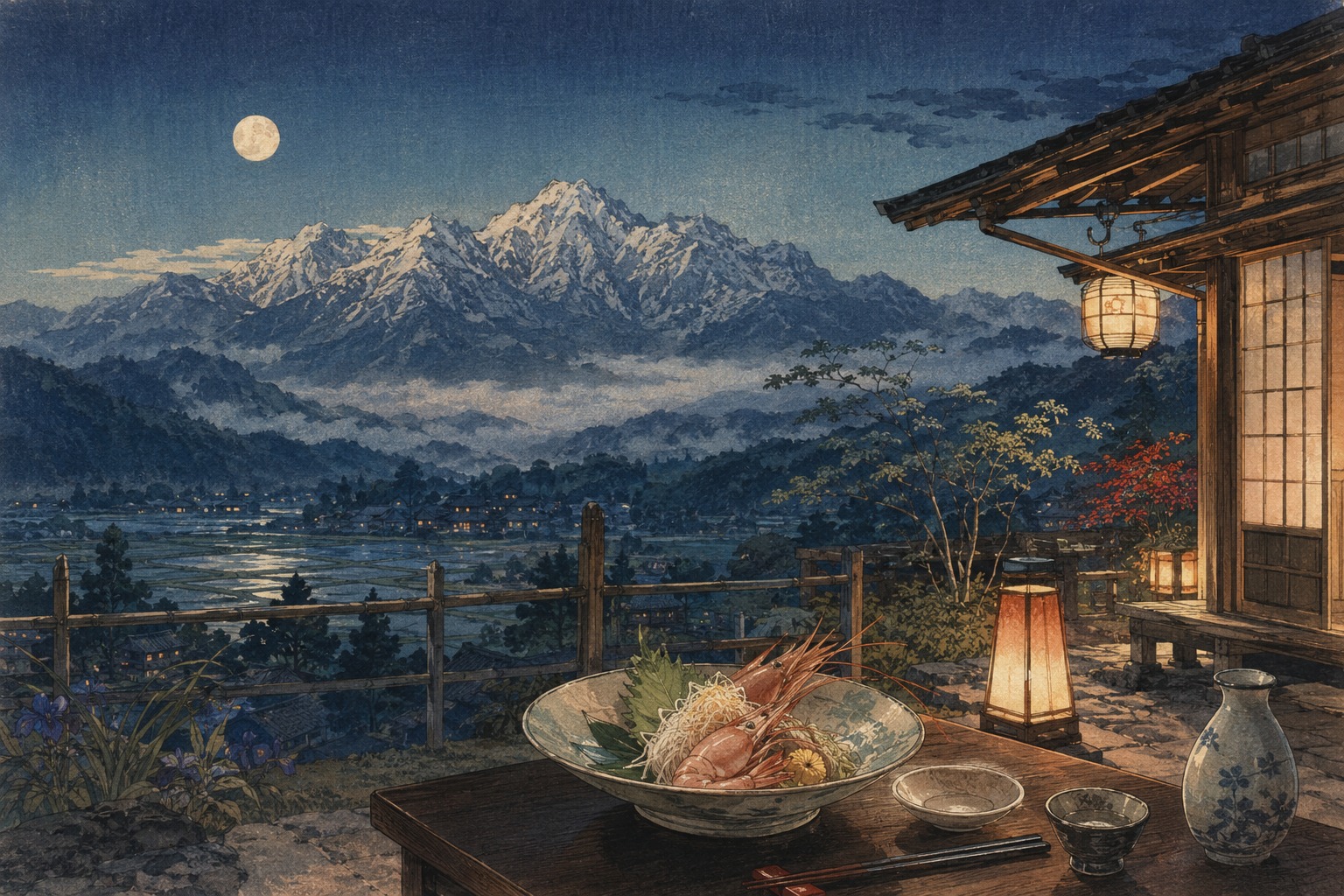
J-CAT and Forbes JAPAN announced the inaugural Forbes JAPAN Destinations of the Year 2026 results on July 30. Thirty operators and initiatives, selected from more than 200 candidates, form “The 30 Collection.” L’évo in Toga, Toyama Prefecture, received the highest distinction, THE ICON. The formal Award & Reception is scheduled for August 6 at the Tokyo Station Hotel; as of this article’s August 1 publication, that ceremony is still in the future. A magazine feature is planned for the October 2026 issue of Forbes JAPAN, due August 25.
A restaurant that makes remoteness legible
L’évo is an auberge built around what chef Eiji Taniguchi calls “avant-garde regional cuisine.” Wild mountain vegetables, game, native produce and fish from Toyama Bay enter the kitchen. But the regional claim extends beyond ingredients. Plates come from potters and glass artists; metalworkers, woodcarvers, farmers, fishmongers, a winery, a silk weaver, a goat-cheese producer and other partners appear on L’évo’s own roster of specialists. Three private cottages, a garden and the restaurant are dispersed like a small settlement.
The award’s official citation says Taniguchi has spent 15 years building relationships with producers and artisans. That number matters more than the usual language of “hidden gem.” A gem can be extracted and carried away. A relationship has to be maintained. L’évo’s proposition is that a meal can hold a watershed: snow becomes mountain water; water nourishes rice, vegetables, animals and Toyama Bay; forests yield mushrooms and game; makers turn local knowledge into vessels and furniture. The plate is not the destination. It is where the destination becomes briefly visible.
A “destination” once meant a dot at the end of an itinerary. The 30 Collection asks whether it can instead mean a local system—one that a visitor enters without owning.
How L’évo arrived in Toga
Taniguchi did not inherit this landscape as a hometown story. Born in Osaka in 1976 and raised by a father who cooked Japanese cuisine, he trained in hotels, restaurants and a bakery in Japan, and at Relais Bernard Loiseau in Burgundy. He moved to Toyama in 2010 to lead a resort-hotel restaurant and opened L’évo as owner-chef in 2014. In December 2020, he moved the operation into Toga and rebuilt it as an auberge.
The relocation changed the grammar of the restaurant. In a city, “local” can be a procurement rule. In Toga, it becomes weather, access and time. Peaks above 1,000 meters enclose the sky. Winter snowpack commonly reaches two to three meters, according to L’évo. The property’s own access page describes narrow roads and steep gradients; its website simply says, “L’évo is hard to get to.” Only three cottages are available each night, and restaurant reservations are required.
Recognition followed. The Michelin Guide Hokuriku 2021 special edition gave L’évo two stars and a green star. Gault & Millau named Taniguchi Chef of the Year in 2017 and again in 2022. The Japan Times’ Destination Restaurants program named it Restaurant of the Year for 2021. Yet guidebook prestige does not explain THE ICON by itself. The new award says L’évo excelled across all four of its criteria: contemporary cultural interpretation, rootedness in place, a business that can recirculate value, and a long-term relationship with community and environment.
Toga has made the margin a center before
L’évo’s decision to make world-class work in a remote village has a striking local precedent. In 1973, Toga relocated five gassho-zukuri farmhouses into what became a cultural village. Three years later, theatre director Tadashi Suzuki moved the Waseda Shogekijo troupe from Tokyo to Toga. One farmhouse became a theatre. In 1982, a Greek-style amphitheatre designed by Arata Isozaki opened and the Toga Festival began as Japan’s first international theatre festival.
Suzuki described the move partly as an indictment of Japan’s concentration of political, economic and cultural institutions in Tokyo. The village that looked peripheral became a place to which artists traveled from the world. Toga Art Park now calls itself a global performing-arts base and a “Mecca of Theatre.” The parallel with L’évo should not be forced—an auberge is not an avant-garde company—but both reverse the same assumption. They do not ask how mountain culture can imitate the capital. They ask what becomes possible when distance from the capital is treated as an artistic condition.
The four tests—and the winners that embody them
The organizers say an advisory board evaluated candidates using J-CAT fieldwork and interviews. THE ICON is reserved for an initiative outstanding on all four axes. The four category winners make the framework easier to understand.
| Distinction | Honoree | What the award recognizes |
|---|---|---|
| THE ICON | L’évo Toga, Toyama | A Toyama-wide network of gastronomy, craft, nature and lodging turned into a reason to make the journey. |
| Future Forward Cultural evolution | Ryūiki no Gakkō Yakushima, Kagoshima | A watershed curriculum linking “10 days in the mountains, 10 by the sea, 10 in the village,” with farming, salt making, forest and river life. |
| Local Identity | Yambaru Hotel Nanmei Shinshitsu Kunigami, Okinawa | Vacant homes and local “sherpas” make the village—not an enclosed resort—the experience to be inherited. |
| Circular Business | Bed and Craft Inami, Toyama | Craft-in-residence lodgings connect guests with woodcarvers and return sales and accommodation revenue to makers and the town. |
| Social Sustainability | SOIL Setoda Setoda, Hiroshima | A “living room for the town” ties lodging to a shopping street, bathhouse, food, books and daily community life. |
| Saison Special Award | Marutomi Ichikawamisato, Yamanashi | A one-party workshop in traditional reddish-brown wabi fireworks: learn, make and launch rather than merely watch. |
The words are ambitious, and that creates an obligation. “Circular” should mean more than buying local décor once. “Sustainable” should mean more than asking guests to reuse towels. The credible question is whether money, skills, decision-making power and environmental care continue to circulate after the marketing campaign ends.
The complete 30: a field guide to the new map
The collection is most revealing when seen together. It includes famous hospitality names, very small community projects and cultural institutions. The following descriptions condense the official award page; they are not independent ratings by Japan.co.jp.
| Honoree and place | Experience or regional proposition |
|---|---|
| L’évo Toga, Toyama | Avant-garde regional cuisine joining mountain and bay, local makers, three cottages and a farm. |
| Ryūiki no Gakkō Yakushima, Kagoshima | Learn Yakushima as one watershed through mountains, coast, settlement, farming and play. |
| Yambaru Hotel Nanmei Shinshitsu Kunigami, Okinawa | Village guides, empty-home reuse and encounters with prayer, work and everyday Yambaru culture. |
| Bed and Craft Inami, Toyama | Stay among art, apprentice to woodcarvers and distribute guest spending through a craft town. |
| SOIL Setoda Setoda, Hiroshima | A community stay linking the Shiomachi shopping street, food, bathhouse, books and port life. |
| Marutomi Ichikawamisato, Yamanashi | A private, four-hour encounter with traditional wabi fireworks, from composition to launch. |
| Moricho: Storehouse Sauna and Cultural-Property Inn Oga, Akita | A century-old registered property recast around Namahage culture, fermentation, sauna and town walks. |
| THREE GOATS Morioka, Iwate | A guided seven-day passage on the 1,000-kilometer Michinoku Coastal Trail, meeting communities shaped by disaster and recovery. |
| Craft Invitation by SOE Echizen–Sabae, Fukui | Stay in a washi-producing district and meet the workshops behind seven regional industries. |
| Auberge Homachi Mikuniminato Mikuni, Fukui | Ten renovated townhouses make an old Kitamaebune port into a distributed hotel with regional cuisine. |
| Takigahara Craft & Stay Komatsu, Ishikawa | Stone culture, a reused storehouse, farming and reinvestment in abandoned fields and satoyama scenery. |
| Hanamurasaki Yamanaka Onsen, Ishikawa | A 1902 ryokan remade as a cultural salon with tea, art, owner-led interpretation and staff training. |
| Nagai Sake Kawaba, Gunma | High-level brewery tasting framed by the terroir of the Tone River headwaters. |
| Shiroiya Hotel Maebashi, Gunma | Architecture and contemporary art turn a hotel into a catalyst for revaluing the city center. |
| Yakumo Saryo Meguro, Tokyo | A breakfast experience in a tea salon, beginning and ending with tea. |
| GORA KADAN FUJI Subashiri, Shizuoka | A stay conceived with a regenerative pilgrimage around sacred Mount Fuji. |
| BYAKU Narai Narai-juku, Nagano | A preserved Nakasendō post town becomes a base for lacquer craft and trail walking. |
| POJ Studio Gion, Kyoto | A residential education program intended to pass traditional skills to another generation. |
| Imperial Hotel, Kyoto Gion, Kyoto | Historic architecture as a threshold into Gion’s living kagai culture. |
| ume, yamazoe Yamazoe, Nara | Guests enter—not merely observe—satoyama routines and become temporary participants in living culture. |
| Inujima Seirensho Art Museum Inujima, Okayama | An art itinerary through a former copper refinery and the island’s Art House Project. |
| Millennium Olive Terrace for your wellness Shodoshima, Kagawa | A wellness stay formed around an olive tree said to be a thousand years old. |
| Entô Oki, Shimane | A hotel and field base that brings visitors closer to an island community inside a UNESCO Global Geopark. |
| Takyo Abeke Iwami Ginzan, Shimane | An unforced domestic stay that treats ordinary time and human company as forms of wealth. |
| Otani Sanso Nagato Yumoto, Yamaguchi | A major inn connecting guests with the history and bathing culture of the sacred On’yū spring. |
| Craft Inn Te [té] Yame, Fukuoka | Sleep among handwork, learn from makers and enter the craft life of Yame. |
| Enowa Yufuin Yufuin, Oita | A farm-driven auberge built around curiosity about food, cultivation and landscape. |
| Fujiya Hotel Kannawa Onsen, Oita | Heritage ryokan architecture and a miso-making experience shaped by hot-spring minerals. |
| Nabeshima Auberge Hizen Hamashuku, Saga | A sake-brewery auberge combining Nabeshima brewing and gastronomy in a historic district. |
| Wataya Besso Ureshino Onsen, Saga | Tea tourism links hot springs, Ureshino tea and Hizen Yoshida ceramics. |
What the 30 have in common
The collection is geographically uneven but conceptually coherent. It contains only one Tokyo project. Kyushu and the Hokuriku arc are especially visible. Many honorees repurpose buildings: a registered inn in Oga, townhouses in Mikuni, a post town in Narai, a refinery on Inujima, merchant architecture in Echizen and ryokan in hot-spring towns. Preservation becomes an operating cost supported by present-day use, not a nostalgic backdrop maintained elsewhere.
A second group treats the visitor as an apprentice rather than a spectator. Bed and Craft enters woodcarving workshops. Marutomi teaches a fireworks tradition. Craft Inn Te and POJ Studio turn handwork into education. The promise is that time with a maker produces both revenue and recognition. The danger is that a complex vocation can be reduced to a brief consumable performance. The strongest projects protect the craftsperson’s time, price the encounter honestly and offer routes from curiosity to deeper study.
A third group expands the unit of travel. THREE GOATS works along a thousand-kilometer coastal trail. Ryūiki no Gakkō follows water from mountain to sea. SOIL Setoda and Auberge Homachi distribute the hotel into a town. Entô treats geology, community and accommodation as one field. These projects are not selling an isolated attraction; they are organizing connections that the conventional itinerary tends to erase.
Toyama’s double distinction is not accidental
L’évo and Bed and Craft appear different: one begins with a dining room in Toga, the other with renovated villas and woodcarving workshops in Inami. But both make a network visible. A guest does not encounter “Toyama craft” as a generic souvenir category. The guest meets makers, uses objects, walks streets and pays into a structure designed to keep production alive.
Nanto gives those models unusually deep material. The city includes the Ainokura and Suganuma gassho-zukuri villages, inscribed with Shirakawa-go on UNESCO’s World Heritage List in 1995. UNESCO emphasizes that these steep-roofed settlements evolved in response to difficult mountain geography, mulberry cultivation and sericulture—and that their social structure endured enormous postwar change. Inami, another Nanto district, is known for woodcarving. Toga has spent half a century turning a mountain village into an international theatre address.
That history complicates the easy phrase “undiscovered Japan.” These places were never empty, waiting for a metropolitan or foreign gaze. They already had economic systems, spiritual practices, festivals, architecture and arguments about survival. The more respectful tourism language is not discovery but entry: visitors are allowed into work that began before them and will, if the model succeeds, continue after them.
From counting arrivals to asking what remains
The award arrives at a turning point in Japan’s tourism policy. The Visit Japan campaign began in 2003. The Tourism Nation Promotion Basic Law followed in 2006, and the Japan Tourism Agency was established in 2008. Foreign arrivals passed 10 million in 2013 and reached 31.88 million in 2019. The pandemic then collapsed the annual count to 245,862 in 2021.
The rebound was faster and larger than many expected. JNTO counted 36.87 million arrivals in 2024 and a record 42.68 million in 2025. Through June 2026, the cumulative total was 21.08 million even though June itself fell 6.8 percent from a year earlier. Those totals bring export earnings and jobs. They also intensify crowding, housing, transport, waste and resident-friction problems in places already famous enough to be overwhelmed.
Japan’s 2023 Tourism Nation Promotion Basic Plan therefore names three priorities: sustainable tourism, higher tourism consumption and attraction to regional areas. The 30 Collection is an independent, private-sector program—not a government implementation list—but it speaks the same language. Its thesis is that Japan does not need only more people crossing the national border. It needs more journeys that cross the invisible border between consuming a place and contributing to its continuity.
The promise—and trap—of high-value travel
Many of the 30 experiences are premium products. L’évo is a celebrated, reservation-only auberge with three cottages. The collection includes luxury ryokan and significant hotel projects. High-value, low-volume tourism can be sensible in a fragile village: fewer guests can generate more revenue with less traffic. It can support specialist labor and conservation that mass-market prices cannot.
But price is not proof of sustainability. An expensive room can still import its food, send profit elsewhere, underpay workers, overload water systems or turn residents into scenery. Nor is exclusivity a substitute for public life. A town remains healthy because people can live, work, raise children and meet needs there—not because every vacant building becomes a high-end guest room.
The award’s circular-business test is therefore the most important and the hardest to verify from a website. How much procurement stays in the region? What share reaches makers and guides? Are young people trained into viable careers? Do residents shape visitor limits and behavior? Are ecological costs measured? Can a project survive a downturn without abandoning the partners who made its story valuable?
- Local retention: the share of guest spending that remains with regional workers, suppliers and owners.
- Transmission: apprenticeships, wages and career paths that keep endangered skills economically possible.
- Resident authority: whether communities help set capacity, conduct and development limits.
- Ecological accounting: transport, water, waste, habitat and food-system impacts—not only visible conservation gestures.
- Access and dignity: whether everyday services and housing remain viable alongside premium hospitality.
- Collaboration: whether the promised 30-member community shares knowledge and business rather than ending at a gala.
An award with an interest in the market
Readers should understand who built the program. J-CAT operates Otonami, a domestic premium-experience platform, and Wabunka, which designs high-value inbound travel; it also conducts area branding and tourism consulting. Forbes JAPAN is a business publication. The advisory board includes entrepreneurs, designers, an academic, a narrativist and a J-CAT executive. A sponsor selected the special award.
That does not invalidate the collection. It explains its point of view. This is not a government certification, a resident referendum or an anonymous restaurant guide. It is an industry-led effort to identify experiences that could define a more valuable market. Its commercial knowledge can help small operators become bookable and legible. Its commercial interests also make transparent criteria, evidence and follow-up essential.
The organizers say they want the 30 to become a co-creation community rather than a list that expires after publication. That is a better test than prestige. If a fireworks maker in Yamanashi learns from a woodcarving-stay model in Toyama; if an Okinawan village hotel exchanges capacity rules with an Oki island base; if a trail operator in Tohoku improves local contracting with lessons from Setoda, the collection may create the “surface” of connected practice it promises.
Why L’évo is the right symbol—and an unfinished one
L’évo’s greatest achievement may be that it makes abundance visible without pretending abundance is effortless. The fish depends on cold water and working ports. The game implies forests, hunters and butchery. A plate depends on potters, glass artists and people who know how to maintain a snowbound road. The room depends on builders and cleaners. The destination is the labor between the celebrated moments.
Its story is also unfinished, as every serious regional project must be. Relationships built over 15 years have to survive succession. Climate change alters snow, water, forests and fisheries. A famous chef can attract the world, but a resilient system cannot depend on one person forever. Awards raise demand; demand tests capacity. The challenge is to let attention strengthen the network rather than distort it.
The real destination is not where the traveler arrives. It is what the traveler’s arrival helps a place keep.
The mountain road to Toga will not become less winding because L’évo has been named THE ICON. That is precisely the point. Japan’s next travel map may not be drawn by removing every inconvenience. It may be drawn by understanding what the narrow road protects, who keeps it open, and why a journey is worth making without demanding that the place become easier to consume.
Sources and methodology
Japan.co.jp treated the organizers’ July 30 release and official award site as the controlling sources for the selection, 200-plus candidate pool, judging axes, honorees and award descriptions. Because the program is co-founded by a commercial experience company and a business publication, those claims are attributed rather than presented as independent certification. L’évo’s own site supplied its concept, partner network, cottages, farm, access and environmental descriptions; biographical and award history was cross-checked against the publisher of Taniguchi’s 2025 book. Tourism data comes from JNTO and policy history from the Japan Tourism Agency. UNESCO, Toga Art Park and the Suzuki Company of Toga supplied historical context. Interpretive and critical passages are Japan.co.jp analysis. The displayed exchange rate—1 U.S. dollar to 160.57 Japanese yen—was supplied with a timestamp of July 31 at 12:54 a.m. UTC, equivalent to 9:54 a.m. JST.
- Forbes JAPAN Destinations of the Year 2026: official award site and complete collection
- J-CAT: July 30 announcement, winners, criteria and co-creation plan
- L’évo: official site
- L’évo: concept, chef and regional partners
- L’évo: auberge, cottages and access statement
- Graphic-sha: Eiji Taniguchi biography and L’évo honors
- JNTO: 2025 annual visitor arrivals
- JNTO: June and first-half 2026 visitor arrivals
- Japan Tourism Agency: 2023 Tourism Nation Promotion Basic Plan
- Japan Tourism Agency: institutional and policy history
- UNESCO: Historic Villages of Shirakawa-go and Gokayama
- Toga Art Park: history from the cultural village to the international theatre base
- Suzuki Company of Toga: the 1976 move from Tokyo
