DENSO Halts Spark-Plug and Exhaust-Sensor Transfer as Powertrain Assumptions Shift
Why would DENSO keep combustion-related businesses it had already agreed to sell? The answer lies in a global auto market where BEVs, hybrids and combustion systems are coexisting longer than suppliers once assumed.
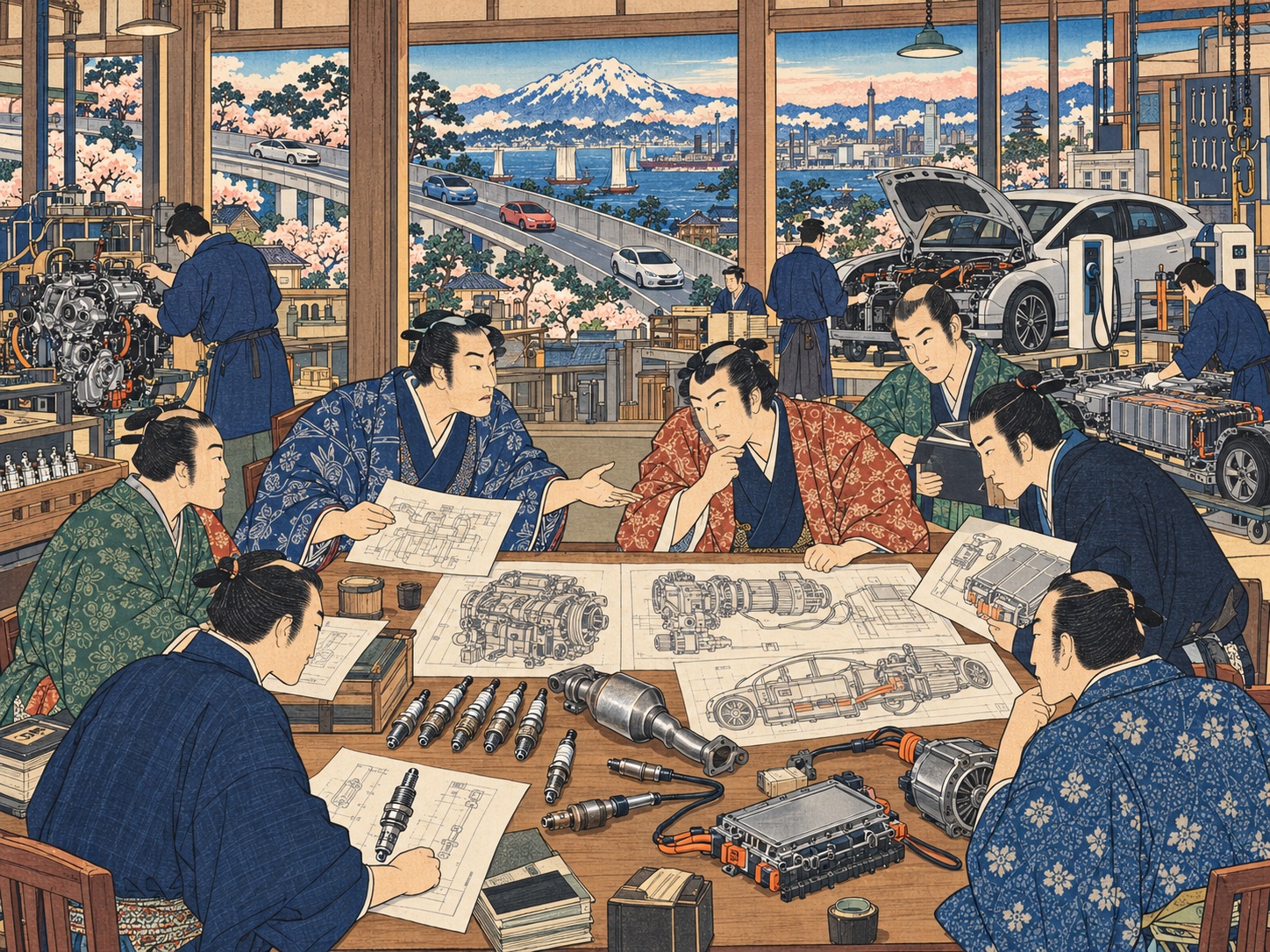
AICHI, Japan. DENSO Corporation has abandoned a plan to transfer its spark-plug and exhaust-gas sensor businesses to Niterra Co., Ltd., ending a transaction that had been under discussion since 2023 and formally contracted in September 2025. The companies said on October 2 that they will terminate the business-transfer agreement and will not execute the sale.
The significance reaches beyond one canceled transaction. DENSO said electrification is continuing, but demand for a wider mix of powertrains is lasting longer than it had originally expected because energy conditions and regulatory frameworks differ by region. Products once treated as candidates for consolidation in a shrinking internal-combustion market are being reconsidered as strategically useful pieces of a broader system portfolio spanning conventional engines, hybrids, plug-in hybrids, battery EVs and fuel-cell vehicles.
In 2023, consolidation looked like the rational answer
The transaction began with a memorandum of understanding on July 10, 2023. DENSO said at the time that the automotive industry faced a difficult dual obligation: accelerate investment in products for electric vehicles while maintaining competitiveness and stable supply for internal-combustion components whose long-term market was expected to contract.
That logic was straightforward. Suppliers would need enormous spending on motors, inverters, power electronics, semiconductors, thermal systems and software. At the same time, hundreds of millions of combustion-powered and hybrid vehicles would still require high-quality ignition and emissions-control parts. As volumes decline unevenly, duplicating factories and engineering resources across multiple suppliers can become expensive. Consolidating mature product lines with a specialist can preserve scale while freeing capital for growth areas.
DENSO's own portfolio policy reinforced that approach. In its earlier integrated-report disclosures, the company described reviewing dozens of product groups for emphasis, de-emphasis or exit based on growth, profitability and strategic fit. Spark plugs and exhaust sensors were profitable products with deep technical history, but they had been placed on the transfer side of that portfolio equation.
Niterra was not an arbitrary buyer
Niterra is one of the most historically logical destinations imaginable for a spark-plug business. The Japanese company, formally named Nippon Tokushu Togyo Co., Ltd. in Japanese, was founded in 1936 after the spark-plug operation of NGK Insulators was separated. It began production of NGK spark plugs in 1937 and started manufacturing automotive oxygen sensors in 1982.
The company changed its English corporate name from NGK SPARK PLUG CO., LTD. to Niterra Co., Ltd. in April 2023, while its official Japanese name remained 日本特殊陶業株式会社. As of July 2026, its representative director and president is Keiji Suzuki. Its corporate profile still lists spark plugs and other internal-combustion-engine-related products as a core business.
On September 1, 2025, the companies moved from exploration to a binding transfer agreement. DENSO said the combination of the two suppliers' technology, manufacturing capabilities and supply networks would strengthen competitiveness and support stable supply of internal-combustion products, while DENSO concentrated resources on electrification and clean-energy fields such as hydrogen. Completion was subject to competition-law approvals and other conditions; no execution date had been fixed.
| Date | Decision | Strategic logic |
|---|---|---|
| July 2023 | Begin transfer talks | Prepare for electrification while optimizing supply of combustion-engine parts expected to shrink over time |
| September 2025 | Sign transfer agreement | Combine technology, manufacturing and scale to improve competitiveness and continuity of supply |
| October 2026 | Cancel transfer | Diverse powertrain demand is lasting longer than expected, increasing the value of keeping the products inside DENSO |
Electrification is advancing — but not along one timetable
It would be a mistake to read DENSO's reversal as evidence that the EV transition has stopped. The International Energy Agency's Global EV Outlook 2026 says global electric-car sales — counting battery-electric and plug-in hybrid vehicles — rose 20% in 2025 to more than 20 million units, roughly one in four new cars sold worldwide. In China, the electric share approached 55%.
But the same global picture is uneven. Charging availability, electricity and fuel prices, regulation, income, vehicle duty cycles and energy security differ sharply by market. The IEA notes that EV growth can stall in regions with weaker policy support or inadequate charging infrastructure. For many drivers and fleets, especially where charging is constrained, hybrids and plug-in hybrids remain practical ways to cut fuel consumption without relying entirely on public charging.
DENSO's 2026 mid-term plan, “CORE 2030,” makes that diversity explicit. The company says it intends to support ICE, HEV, PHEV, BEV and FCEV technologies rather than bet on a single architecture. Its strategy materials also identify slower-than-anticipated BEV adoption as one of the environmental changes that shaped the new plan.
That positioning is visible in DENSO's product activity. In August, the company announced that a newly developed two-motor hybrid drive module had been adopted for the new Jeep Cherokee from Stellantis. For DENSO, hybrid technology is not merely a stopgap between combustion and battery power; in some regions and vehicle categories, it can remain a substantial market for years.
Why spark plugs and exhaust sensors still matter in a hybrid world
A battery-electric vehicle needs neither spark plugs nor exhaust-gas sensors. A hybrid or plug-in hybrid, however, still has an internal-combustion engine. Even if that engine runs intermittently, it must start reliably, burn fuel efficiently and meet emissions requirements over a wide range of operating conditions.
A spark plug ignites the air-fuel mixture in a gasoline engine. An oxygen sensor measures oxygen content in exhaust gas; an air-fuel-ratio sensor can measure the mixture across a wider range with greater precision. Their signals help the engine-control system adjust fuel injection, combustion and after-treatment. As emissions and fuel-economy rules tighten, the engines that remain in the market often require more precise control, not less.
That gives the canceled transaction a systems-level meaning. If spark plugs and exhaust sensors are viewed only as stand-alone components, they look like mature products. If they are viewed as inputs to integrated engine control, hybrid control, thermal management and emissions systems, keeping them can strengthen DENSO's ability to offer a complete powertrain solution.
DENSO has been reshaping its portfolio since its founding
DENSO traces its independent history to December 16, 1949, when Toyota Motor's electrical-components operation was separated as Nippondenso Co., Ltd. The company adopted the name DENSO Corporation in 1996. Over decades it expanded from starters and alternators into fuel injection, engine management, air conditioning, semiconductors, safety systems, advanced driver assistance and electrification.
It has also repeatedly sold or deemphasized mature activities. That history matters because the 2026 decision is better understood as a change in portfolio assumptions than as a repudiation of electrification. In 2023, it was reasonable to assume that scale consolidation would become increasingly important in combustion-related products. In 2026, DENSO concluded that the ability to support a broader, longer-lived mix of powertrains made these particular businesses more valuable inside the company than outside it.
Niterra now has to revisit an important assumption in its 2030 plan
The reversal also changes Niterra's strategic arithmetic. In its Medium-term Management Plan 2030, Niterra identified automotive components as a major earnings driver and explicitly incorporated, under certain assumptions, the spark-plug and exhaust-sensor businesses it expected to acquire from DENSO. Its English investor materials say the target of ¥1 trillion in revenue and ¥285 billion in EBITDA by the fiscal year ending March 2030 included the impact of the planned acquisition.
That means investors will now need to watch how Niterra revises the plan, if at all, and how it intends to replace the expected scale, technology and sales contribution. As of October 3, Japan.co.jp could not find a separate October 2 cancellation release in the 2026 news list on Niterra's corporate website, and detailed financial effects or alternative growth measures had not been disclosed there. Those points should not be inferred before the company provides formal guidance.
Does keeping the business contradict CORE 2030?
On the surface, the reversal looks awkward. DENSO signed the 2025 transfer agreement while saying it wanted to maximize resources for electrification and clean energy. A year later it is retaining the businesses. But the 2026 CORE 2030 plan is more nuanced than a simple shift away from combustion.
DENSO plans ¥3.7 trillion in research and development and ¥2.2 trillion in capital investment over the five fiscal years through 2030, with electrification and intelligent-mobility fields receiving heavier investment. At the same time, the company says its combustion and thermal portfolio will be divided between technologies that should continue to deepen in response to market demand and areas where competitiveness should be optimized across the supply chain.
That is a selective portfolio strategy: expand electrification aggressively, but retain combustion-related technologies that add system value or remain essential to serving customers across different regions.
Four questions now matter
First, profitability. Can DENSO preserve returns while maintaining factories, engineering and supply commitments for products in mature markets? Second, supply structure. The original transaction was designed partly to create a sustainable production base as volumes change. DENSO now needs to show how it will solve that problem without consolidation with Niterra.
Third, system integration. Can DENSO use spark plugs and exhaust sensors to strengthen higher-value packages that connect engine control, hybrid operation and thermal management? Fourth, Niterra's plan. How will Niterra adjust a 2030 growth framework that had explicitly included the proposed acquisition?
This is not a story of EVs losing and engines winning
The auto transition is not happening as a clean handoff in which one technology disappears the moment another reaches scale. Battery EVs are growing rapidly. At the same time, hybrids, plug-in hybrids and increasingly efficient combustion vehicles remain a huge part of the global market. If that period of coexistence lasts longer than expected, suppliers must fund the future while still supporting the present.
DENSO's decision to keep a business it had already agreed to sell captures that tension. Electrification still commands enormous investment. Yet the value of a component depends not only on whether its stand-alone market is growing or shrinking, but also on whether it helps a supplier control and integrate the full vehicle system. In a powertrain market that is diversifying instead of converging quickly, that distinction can change the answer to a multiyear strategic decision.
Primary sources and reference material
- DENSO: “DENSO to Discontinue the Transfer of Its Spark Plug and Exhaust Gas Sensor Business to Niterra” (Oct. 2, 2026)
- DENSO: “Signs Agreement to Transfer Part of Its Ceramic Product Business” (Sept. 1, 2025)
- DENSO: “Begins Business Transfer Negotiations for Selected Product Operations” (July 10, 2023)
- DENSO: 2030 Mid-Term Management Plan “CORE 2030”
- DENSO: CORE 2030 Growth Strategies
- DENSO 75th Anniversary History: Founding
- Niterra: A History of Niterra Co., Ltd.
- Niterra: Corporate Overview
- Niterra: Medium-term Management Plan 2030
- International Energy Agency: Global EV Outlook 2026