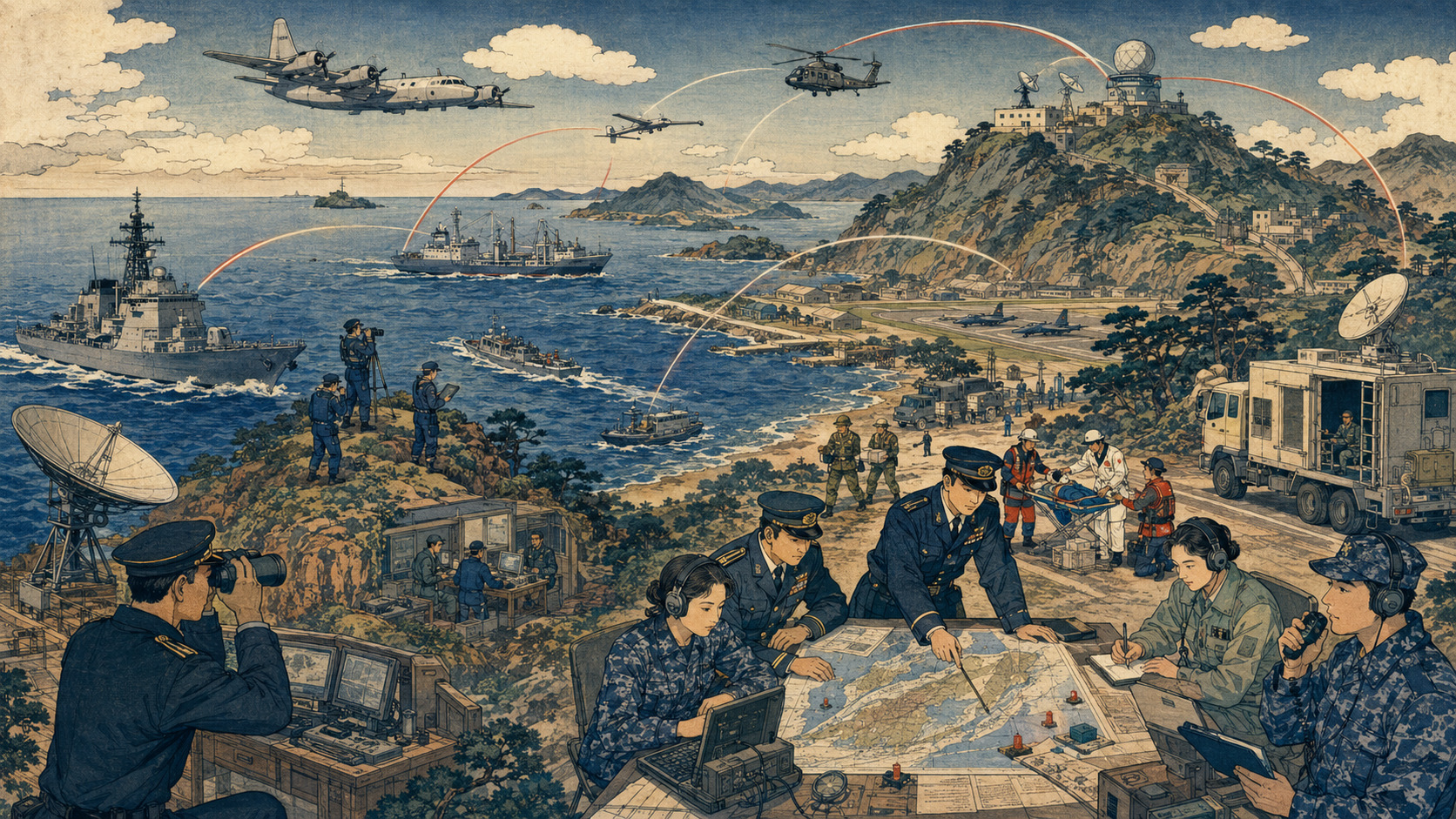
Look at the chain of islands running southwest from Kyushu toward Taiwan not as empty space on a map but as an operating system. The sea is wide; the islands are narrow; usable ports and runways are scarce. A radar detects an object. Satellites and networks communicate a position. A commander decides. Aircraft, ships, missiles or drones move. If fuel, ammunition, maintenance or communications fail, the chain breaks.
That chain is the real subject of the Defense of Japan 2026 white paper, released on August 4 under the theme “Security Connected to the Future.” Covering developments primarily from April 2025 through March 2026, with significant events through May, the report gives unusual prominence to “new ways of warfare,” the defense industry and the human base. It is not merely a catalogue of missiles or a defense-budget brochure. It is an argument that the state’s ability to detect, decide, act and endure must be built as one system.
The system remains wrapped in the postwar language of “minimum necessary” force. But necessity is a moving ruler. The 1947 Constitution, the 1954 Self-Defense Forces, the 1976 Basic Defense Force Concept, peacekeeping operations in 1992, the 2015 security legislation and counterstrike capabilities in 2022 each redrew the line. Japan rarely announced that an old constraint had disappeared. It reinterpreted the constraint for a new environment.
A white paper is an argument, not an order
Japan issued its first defense white paper in 1970 and has published one every year since 1976. Its stated purpose is to explain the condition, challenges and work of national defense as plainly as possible. It also justifies budgets, recruits personnel, signals resolve to allies and sends deterrent messages to potential adversaries. It is a sourcebook and an instrument of policy communication at the same time.
The Constitution, statutes, Cabinet decisions, National Security Strategy, National Defense Strategy, Defense Buildup Program, annual budgets and Diet oversight carry the formal authority. The white paper binds those elements into a story. A careful reader must separate four questions: What happened? How does the ministry assess it? What has the government promised? What can deployed forces actually do?
What changed in 2026: warfare, factories and people become one system
The paper draws lessons from Russia’s war against Ukraine and other recent conflicts: the mass use of unmanned systems, AI-accelerated decision-making, simultaneous operations in space, cyber, electromagnetic and information domains, and the industrial endurance required for a long war. Defense production and technology, previously treated as a chapter, becomes its own Part IV. The human resource base becomes Part V.
The architecture matters. A Cold War force could be pictured through counts of tanks, destroyers and fighters. A modern capability includes sensors, code, encryption, spectrum access, data, commercial satellites, spare parts, ammunition storage, runway repair and the sleep of the people doing the work. A launcher without targeting data, secure communications or reloads is inventory, not a durable military capability.
Cheap machines change the arithmetic of expensive forces
In Ukraine and the Middle East, first-person-view drones, loitering munitions and unmanned boats have damaged tanks, artillery, ships and air defenses that cost vastly more. Not every drone is cheap, and “AI” does not autonomously settle wars. But the exchange ratio becomes punishing when an attacker launches inexpensive systems in volume and a defender repeatedly fires costly interceptors.
The white paper concedes that technology and tactics now turn over quickly. A procurement culture built around perfect equipment developed over a decade cannot be the only answer to jamming and software that change in months. Japan needs rapid prototypes, field testing, continuous upgrades and permission to learn from failure—paired with accounting rules capable of distinguishing useful experimentation from waste.
SHIELD: a web of unmanned systems across the southwest
The paper’s emblem is SHIELD: Synchronized, Hybrid, Integrated and Enhanced Littoral Defense. The concept combines large numbers of lower-cost unmanned aircraft, surface vessels and undersea vehicles across the Ground, Maritime and Air Self-Defense Forces by FY2027. The diagram includes surveillance and ship-launched systems, as well as air and surface attack roles.
The name says shield; some of its components strike. The purpose is to distribute the force, complicate an opponent’s targeting and reduce danger to crewed platforms. It also fits a country running short of service members. But unmanned does not mean unstaffed. Operators, intelligence analysts, communications specialists, maintainers and lawyers remain in the chain. Jamming, cyber intrusion, target identification, civilian harm and accountability do not disappear when the cockpit is far away.
Seven capabilities, multiplied—not seven shopping lists
| Priority | Function | What makes it real |
|---|---|---|
| Stand-off defense | Act from outside an adversary’s threat range | Targeting, long-range weapons, launch platforms, lawful authorization |
| Integrated air and missile defense | Counter aircraft, cruise, ballistic and hypersonic threats | Sensor fusion, inventory, simultaneous engagement, sustainable costs |
| Unmanned defense | Operate UAVs, USVs and UUVs at scale | Jamming resistance, mass production, updates, rules of engagement |
| Cross-domain operations | Unify land, sea, air, space, cyber and electromagnetic operations | Shared data, encryption, specialists and allied interoperability |
| Command, control and intelligence | Recognize, decide and direct rapidly | Resilience, distributed command, information quality, civilian control |
| Mobile deployment and civil protection | Move forces and supplies while protecting residents | Ports, airports, transport, evacuation plans and local cooperation |
| Sustainability and resiliency | Keep fighting and restore bases | Munitions, fuel, parts, maintenance, hardened facilities and medicine |
The seven priorities behave more like multiplication than addition. A zero in one can collapse the product. The government’s FY2027 objective—that Japan take primary responsibility for dealing with an invasion and, with allied support, disrupt and defeat it—cannot be measured by equipment deliveries alone.
The shield’s longer arm: where does counterstrike end?
The three security documents adopted in December 2022 committed Japan to counterstrike capabilities against missile-launching and other targets. Upgraded Type 12 missiles, U.S.-built Tomahawks and hypersonic weapons sit in that context. The government says such action would occur only after an armed attack, when the three conditions for the use of force are met, no suitable alternative exists and the response remains the minimum necessary. A preemptive strike, it says, is still impermissible.
The legal line and the operational line are not the same. Can Japan locate mobile launchers at long range, determine that an attack has begun, limit civilian harm, avoid excessive dependence on allied intelligence and preserve enough evidence for later scrutiny? The farther a weapon reaches, the more uncertainty and escalation management matter. Between “can reach” and “can lawfully and correctly use” lies an enormous institution.
The ban on preemption will be tested in minutes
Ballistic-missile flight times are short. Hypersonic glide vehicles and low-flying cruise missiles complicate detection. Cyberattacks, disinformation and satellite interference could arrive together. A Cabinet may have to decide with fragmentary information. The meaning of “initiation of an attack” therefore becomes central to an exclusively defense-oriented policy.
Deterrence requires some operational ambiguity. Democracy requires something else as well: a defined chain among the prime minister, defense minister, Joint Operations Commander and U.S. forces; records that preserve why a decision was made; Diet oversight; and a credible process for investigating mistakes without publishing sensitive targeting methods. Those are the safety mechanisms on a long-range shield.
The invisible chain from radar to launcher
A stand-off weapon becomes a capability through detection, identification, tracking, assignment, engagement and battle-damage assessment. Japan is combining satellite constellations, unmanned aircraft, land- and sea-based radar and allied intelligence. It is also reinforcing defense communications satellites against jamming and improving interoperability.
More sensors also mean more wrong or manipulated data. AI can triage imagery faster, but probability does not become certainty by passing through an algorithm. Japan must audit friend-or-foe identification, distinctions between military and civilian ships, data provenance, software updates and adversarial deception. The crucial specification is not only the missile’s range. It is who bears responsibility for error.
The Joint Operations Command: making three services fight one battle
Japan established a permanent Joint Operations Command in March 2025. Previously, the Chief of Staff, Joint Staff both advised the defense minister and carried much of the operational burden in a major contingency. The new commander specializes in continuous command across the Ground, Maritime and Air Self-Defense Forces, including space, cyber and the electromagnetic spectrum, and in coordination with U.S. and partner forces.
An organization chart does not create jointness. Island defense, sea-lane protection and air defense operate on different clocks and institutional languages. Police, the Coast Guard, fire services, municipalities and private infrastructure companies may join the chain. Success depends on common procedures written before a crisis, exercises that expose friction and a culture in which bad news can travel upward.
Cyber defense that reaches into an attacker’s system
Under legislation enacted in 2025, the JSDF can from October 2026 conduct remote-access and neutralization measures against systems being used for serious cyberattacks when a special need exists. The change matters because defense no longer ends at the boundary of a government network.
Attribution errors, third-country infrastructure, collateral damage to civilian systems and oversight of secret operations are difficult. Attackers hide borders and uniforms. The faster the response, the greater the need for clear warrants or authorizations, independent supervision, after-action reporting and allied responsibility. In cyberspace, the boundary of an exclusively defensive policy is drawn by authority and procedure, not geography.
11,000 recruits for 15,000 positions: the most serious shortage is human
The paper says the JSDF recruited about 11,000 people in FY2025 against a plan for approximately 15,000. Mid-career departures fell by roughly 1,000 to about 4,600, yet personnel sufficiency remained around 90 percent. Demography, private-sector competition and expanding missions are converging. Space, cyber and AI specialists have many ways to use their skills without wearing a uniform.
The government has added or raised more than 30 allowances, lifted the monthly starting salary for a high-school graduate to roughly ¥240,000, and plans a new pay structure in FY2027. It is introducing cyber-specialist and mid-career routes. All assignment restrictions on women were removed in July 2025. Pay alone, however, does not fix long hours, frequent moves, family burdens, housing, harassment or organizational culture. Drones may reduce danger, but they can also increase the data and responsibility carried by each person.
When a factory becomes “defense capability itself”
Under the 2023 Act on Enhancing Defense Production and Technology Bases, the defense minister approves Stable Manufacturing Plans for supply-chain resilience, efficient production, cybersecurity and business succession. In FY2025 the government approved 164 plans, 124 involving small and medium-sized businesses. When a supplier exits, Japan can lose competition, specialist knowledge and even the ability to obtain repair parts.
But “the industry is weak, therefore spend” can inflate costs in a market with few buyers and limited competition. Defense programs are secret, customers are governments and export destinations are political decisions. Civilian spillovers and regional jobs are possible; broad productivity growth is not automatic. Startup support, long contracts and government-owned facilities require independent scrutiny of price, schedule, performance and exit conditions.
Mitsubishi, GCAP and a defense market crossing borders
Japan, Britain and Italy aim to field the Global Combat Air Programme fighter in 2035. Mitsubishi Heavy Industries, BAE Systems and Leonardo lead the aircraft partnership, while Mitsubishi Electric and others work on electronics. Reuters reported on August 6 that Mitsubishi Electric would establish three domestic GCAP electronics facilities and target annual defense sales of ¥690 billion by the year ending March 2031.
Australia selected an upgraded Mogami-class frigate for its next general-purpose warship in 2025, and contracts for the first three advanced in 2026. Joint development and exports expand production runs, interoperability and technology sharing. They also turn design authority, intellectual property, export destinations and wartime supply into shared decisions. Sovereignty no longer means making every component alone. It means choosing dependencies and managing them.
The end of the “Five Categories”: the export line moves again
Japan long restricted arms transfers under the Three Principles on Arms Exports and related policy. The 2014 Three Principles on Transfer of Defense Equipment and Technology replaced that system with rules for prohibition, limited approval and end-use control. In 2024, the government allowed third-country transfers of completed GCAP fighters under conditions. On April 21, 2026, it abolished the operational limit that had confined finished-equipment exports to rescue, transport, warning, surveillance and minesweeping.
The government argues that transfers strengthen partners’ deterrence and Japan’s industrial base while remaining subject to the U.N. Charter and rigorous review. The risks remain: diversion, onward transfer, human-rights abuse, prolongation of war, and conflict between company profit and diplomacy. Relaxation needs case-by-case explanations, enforceable end-use conditions and continuing Diet supervision.
¥8.8093 trillion, more than ¥9 trillion, and ¥11 trillion are not the same number
The charted fiscal 2026 defense-related expenditure is ¥8.8093 trillion. Spending under the Defense Buildup Program is ¥8.2607 trillion on an expenditure basis. The minister’s foreword says the total exceeds ¥9 trillion for the first time when specified costs related to SACO and U.S. force realignment are included.
The approximately ¥11.0 trillion figure is different again. It combines FY2025 initial and supplementary budgets for Defense Buildup Program expenses and “complementary initiatives,” then compares the sum with FY2022 GDP to reach about 2.0 percent. It is not the same as core defense expenditure divided by current-year GDP. The basket, the GDP year, and whether a supplementary budget is included all change the answer.
- Does the numerator include only core defense, or also Coast Guard, research, infrastructure, SACO and U.S. realignment?
- Is the denominator FY2022 GDP, current-year actual GDP or a forecast?
- Is this an initial budget, a supplementary-inclusive total or multi-year contract authority?
What can ¥43 trillion still buy under inflation and a weak yen?
The 2022 Defense Buildup Program set an FY2023–FY2027 buildup level of roughly ¥43 trillion and a contract base of about ¥43.5 trillion. Imported equipment, fuel and electronics are sensitive to the exchange rate; domestic producers face higher materials and labor costs. A larger nominal total does not guarantee the quantities, delivery dates and readiness originally planned.
Defense spending resembles insurance, except the result is harder to measure. If no attack occurs, analysts cannot directly observe whether deterrence worked or hostile intent never existed. That makes nonsecret performance evidence essential: deliveries, training, availability, improved munitions supply, base-repair time, staffing and contract delay. Capability should be audited as usable condition, not money appropriated.
1945–1954: how a country abolished its armed forces and built the JSDF
Defeat in 1945 destroyed not only Japan’s military organization but the legitimacy of state violence after a catastrophic war. Article 9 of the Constitution, effective in 1947, renounced war and the threat or use of force and declared that land, sea and air forces and other war potential would not be maintained. Then the Cold War hardened: the Chinese revolution in 1949 and Korean War in 1950 shifted occupation priorities toward regional stability.
The National Police Reserve appeared in 1950, followed by the National Safety Force and Coastal Safety Force in 1952. On July 1, 1954, the Defense Agency and the Ground, Maritime and Air Self-Defense Forces were established. The government’s constitutional logic was that Article 9 did not deny Japan’s inherent right of self-defense and that the minimum force necessary for self-defense was not prohibited “war potential.” That structure remains the foundation.
The Yoshida bargain: prioritize recovery and lean on the alliance
Postwar Japan emphasized limited rearmament and economic growth while relying heavily on U.S. bases and extended deterrence. The 1957 Basic Policy on National Defense combined national capacity, public support, international cooperation and the Japan-U.S. security system. The revised 1960 security treaty clarified American defense commitments, but the enormous Anpo protests revealed deep public fear of bases and entanglement in U.S. wars.
Prime Minister Eisaku Sato articulated the Three Non-Nuclear Principles—Japan would not possess, manufacture or permit the introduction of nuclear weapons—in 1967; the Diet endorsed them in 1971. A nonnuclear Japan nevertheless depended on the U.S. nuclear umbrella. The 2026 paper reaffirms the principles, but the tension between them and extended deterrence remains.
1976: enough force to avoid a vacuum
Against the background of détente, the first National Defense Program Outline adopted the Basic Defense Force Concept in 1976. Rather than build against a specific enemy’s large invasion force, Japan would prevent a power vacuum and maintain enough capability to handle limited, small-scale aggression on its own. The Miki Cabinet also adopted a policy keeping defense spending within one percent of GNP.
The cap was never an immutable law; the FY1987 budget passed the line, and post-Cold War policy shifted from size toward mobility, jointness and international cooperation. Still, “not becoming a major military power” became a durable political norm. The post-2022 increase is transformational not simply because of its size, but because it updates that norm quickly.
1991: Japan discovered that a check could not buy recognition
Japan made a huge financial contribution during the Gulf War but faced criticism for “checkbook diplomacy” because its people were absent from the visible effort. After the ceasefire, the Maritime Self-Defense Force sent minesweepers to the Persian Gulf. JSDF vessels performing a real mission far from Japan marked a symbolic break.
The 1992 International Peace Cooperation Act and dispatch to Cambodia institutionalized overseas activity under principles including a ceasefire, consent and impartiality. Missions expanded from elections, roads, transport and ceasefire monitoring. The meaning of an exclusively defense-oriented policy was no longer confined to the coast; it had to be reconciled with a Japanese role in sustaining international order.
2001–2011: the Indian Ocean, Iraq—and then Tohoku
After the September 11 attacks, special legislation sent MSDF ships to provide refueling and logistical support in the Indian Ocean. Legislation for Iraq in 2003 put GSDF personnel in Samawah for humanitarian and reconstruction work and ASDF units on transport missions. The government stressed noncombat areas and support roles, while debate continued over the boundary with the use of force. The Defense Agency became a ministry in 2007.
The March 11, 2011 triple disaster revealed another face of security. Land, sea and air units performed rescue, search, transport, water, bathing, medical and nuclear-emergency missions, working with the U.S. military’s Operation Tomodachi. Public trust rose. The event also showed that a major disaster and military emergency could compete for the same aircraft, ships, communications, medicine and people.
2013–2015: a national strategy and limited collective self-defense
Japan created its first National Security Strategy and a National Security Council in 2013. A July 2014 Cabinet decision changed the interpretation of permissible force. Japan could act when an attack on a closely related country posed a clear danger to Japan’s survival and fundamentally threatened the people’s rights, no suitable alternative existed and force remained the minimum necessary.
The 2015 security legislation put that interpretation into statute. The government described the authority as limited and consistent with an exclusively defense-oriented policy. Critics objected to recognizing part of the right of collective self-defense through interpretation rather than constitutional amendment and warned that the scope was uncertain. The 2026 emphasis on cross-domain alliance operations rests on this foundation.
2022: Ukraine’s shock and the three strategic documents
Russia’s full-scale invasion demonstrated that a major power could attempt to change borders by force, threaten nuclear escalation and exhaust weapons and factories in a prolonged war. In December 2022, Japan adopted a National Security Strategy, National Defense Strategy and Defense Buildup Program together. Counterstrike capability, the five-year ¥43 trillion level and seven priority capabilities were set there.
The 2026 white paper is both an implementation report and a bridge to the next change. The government says it brought forward the spending level corresponding to two percent of FY2022 GDP into FY2025 and will revise the three documents during 2026. The white paper is not an endpoint; it is the public case for whatever comes next—more spending, faster unmanned procurement and a deeper industrial policy.
China, North Korea and Russia: separate observations from judgments
The paper describes China’s military activities as an “unprecedented and greatest strategic challenge” to Japan and the international community. It says the cross-strait military balance is shifting rapidly in China’s favor and lists 2025 carrier deployments, operations east of Iwo To, close approaches to JSDF aircraft and radar-illumination incidents. Of 595 FY2025 scrambles, 366 responded to Chinese aircraft and 214 to Russian aircraft.
North Korea is called an “even more grave and imminent threat.” The ministry assesses that Pyongyang is believed able to mount nuclear weapons on ballistic missiles capable of reaching Japan. Russia is modernizing forces in the Far East, the paper says, while deepening military cooperation with China and North Korea. These are official Japanese assessments; military activity does not by itself prove intent.
China lodged a formal protest on August 5, accusing the paper of exaggerating a “China threat” and making unwarranted comments on Taiwan. Historical fear of Japanese remilitarization is not a reason for Tokyo to avoid transparency; nor does it make Beijing’s opaque buildup irrelevant. A security dilemma begins when one side’s defense looks like the other side’s attack preparation.
Before the phrase “Taiwan contingency,” there are lives in the Nansei Islands
People live on Yonaguni, Ishigaki, Miyako and Okinawa. Tourists visit. New units, ammunition depots and military use of ports and airports may reinforce deterrence, while also concentrating concerns about targeting, land, noise, evacuation, medicine and supply. As of January 2026, about 70 percent of the land area used exclusively by U.S. forces in Japan was in Okinawa Prefecture.
Civil protection cannot end in a brochure. How many people move, on which ships or aircraft, over how many days, and to where? How are older residents, hospital patients and foreign visitors informed? When a port is needed for both forces and evacuation, who has priority? Without local participation and realistic exercises, one of the seven capabilities stops on paper.
The alliance is an amplifier—and a dependency
The Japan-U.S. alliance amplifies Japanese capability through intelligence, extended deterrence, bases, logistics, equipment and training. Coordination between Japan’s joint commander and U.S. Indo-Pacific Command, along with Tomahawks, F-35s, Aegis systems and satellite information, offers speed and scale that Japan would struggle to produce alone.
It also creates dependence on American priorities, inventories, export permissions, software updates and parts. Autonomy does not require weakening the alliance. It requires clarity about what is decided jointly, what Japan can sustain itself and what happens when political judgments differ. Partnerships with Australia, Britain, Italy, the Philippines, India, South Korea and NATO diversify dependencies while adding coordination costs.
Disaster relief is not a side mission
In a country exposed to earthquakes, tsunami, typhoons and volcanoes, disaster deployment is the form of security the public sees most directly. Reconnaissance, transport, medicine, water, engineering, helicopters, ships and communications serve both emergencies and war. Harder bases, distributed communications, stockpiles and municipal cooperation can help against missiles and the next major earthquake.
The reverse is also true. A Nankai Trough earthquake occurring during a regional crisis would force brutal tradeoffs. As climate change intensifies disasters and population decline shrinks medical, firefighting and construction workforces, planning should assume compound emergencies. “Whole-of-nation defense” cannot become property of the military sector alone.
The Japanese shield: an 81-year timeline
1945 Defeat; Imperial Army and Navy dismantled.
1947 Constitution takes effect; Article 9 renounces war and war potential.
1950 Korean War; National Police Reserve established.
1952 Reorganized as National Safety Force and Coastal Safety Force.
1954 Defense Agency and Ground, Maritime and Air Self-Defense Forces established.
1957 Basic Policy on National Defense adopted.
1960 Revised Japan-U.S. Security Treaty and Anpo protests.
1967/1971 Three Non-Nuclear Principles declared and endorsed by the Diet.
1970 First defense white paper.
1976 First National Defense Program Outline, Basic Defense Force Concept and one-percent-of-GNP policy; annual white papers begin.
1991 MSDF minesweepers dispatched to the Persian Gulf after the Gulf War.
1992 Peacekeeping law and Cambodia mission.
2001 Anti-Terrorism Special Measures Law and Indian Ocean support.
2003 Iraq humanitarian, reconstruction and transport missions.
2007 Defense Agency elevated to Ministry of Defense.
2011 Massive response to the Great East Japan Earthquake and Fukushima disaster.
2013 First National Security Strategy and National Security Council.
2014 Defense export principles and Cabinet decision allowing limited collective self-defense.
2015 Security legislation and revised alliance guidelines.
2018 National defense guidelines adopt Multi-Domain Defense Force concept.
2022 Three strategic documents, counterstrike capability and roughly ¥43 trillion FY2023–27 buildup.
2023 Defense production-base legislation.
2025 Joint Operations Command begins; Australia selects upgraded Mogami frigate.
2026 Five export categories abolished; SHIELD, broader spending above ¥9 trillion and early strategy revisions.
Nine tests for a real capability
| Test | Question | Publishable evidence |
|---|---|---|
| Legality | Does it comply with Article 9, the three conditions for force and international law? | Legal basis, authorization and Diet reporting |
| Awareness | Can Japan detect and continuously track the right object? | Exercise evaluation, error controls, sensor availability |
| Command | Can decisions and orders move under attack? | Alternate headquarters, network recovery, joint exercises |
| Reach | Does equipment work at required range and conditions? | Tests, deliveries, training and integration |
| Endurance | Can operations continue for weeks or months? | Supply, repair, replenishment and availability |
| People | Are recruitment, retention, expertise and families supported? | Fill rate, exits, hours and harassment outcomes |
| Industry | Are supply chains, schedules and prices healthy? | Delay, cost, supplier count and SME participation |
| Civilians | Can residents, hospitals and infrastructure be protected? | Local plans, live exercises and transport capacity |
| Control | Can mistakes be investigated while secrets remain protected? | Audit, Diet scrutiny, after-action review and disclosure |
What to watch before the next white paper
First, whether the 2026 revisions of the three strategic documents connect threats, objectives, cost, funding and deadlines. Second, whether SHIELD moves from a concept illustration to testing, volume production and service integration under jamming. Third, how much autonomous targeting information and democratic control Japan has over counterstrike decisions.
Fourth, whether defense-industry policy improves competition, schedule, price, technology and skills—not merely sales and exports. Fifth, whether the roughly 90-percent staffing level rises and better treatment reduces exits, harassment and family strain. Sixth, whether Okinawa and Nansei residents become authors of the plan rather than objects in it.
A shield with a longer arm cannot survive on a shorter explanation
Japan’s postwar pacifism was not a doctrine of doing nothing. It made force exceptional, wrote restraints into law and language, and distributed security across economic power, diplomacy, the U.S. alliance and international cooperation. The JSDF was born inside that design and acquired social legitimacy through disaster relief and carefully bounded overseas missions.
The 2026 shield sees farther. It reaches farther, coordinates swarms of machines, shares data with allies, and joins factories, universities and ports to defense. It may deter aggression and reduce harm. It may also widen the risks of error, arms racing, fiscal strain, misuse after export and concentrated local burdens.
The useful question is not the binary “Is Japan pacifist or militarist?” It is who defines minimum necessity, on what evidence, for how long, and who investigates failure. The longer the shield’s arm, the stronger its handle must be: law, records, the Diet, independent audit and local consent. That is how an exclusively defense-oriented policy becomes an institution rather than a slogan.
Reporting note and principal sources
Information was checked through August 7, 2026, 9:02 a.m. JST. We reviewed the 610-page Japanese white paper and its English digest and compared them with official strategy documents, laws and government explanations, historical records, foreign responses and wire reporting. Claims about threat, equipment performance and deterrent effect are attributed to the ministry where appropriate and are not treated as independently proven outcomes.
- Japan Ministry of Defense: Defense of Japan 2026 landing page
- Defense of Japan 2026, complete Japanese edition
- Defense of Japan 2026, English digest
- Defense of Japan 2026, reference volume
- Ministry of Defense historical chronology
- Ministry of Defense: 70 years of the JSDF through white papers
- Ministry of Defense: publication history of the white paper
- Ground Self-Defense Force: organizational history
- House of Representatives: Constitution of Japan
- Cabinet Secretariat: national security strategy and legislation
- Cabinet Secretariat: Q&A on the 2014 security decision
- Ministry of Defense: April 2026 revision of defense-transfer rules
- Defense minister press conference on exports and the industrial base
- Ministry of Defense: Japan’s U.N. peacekeeping cooperation
- Maritime Self-Defense Force: Great East Japan Earthquake response
- Reuters: the 2026 paper’s defense-industry and growth argument
- Reuters: China’s protest over the paper
- Associated Press: unmanned systems and new warfare
- Reuters: Mitsubishi Electric’s GCAP production investment