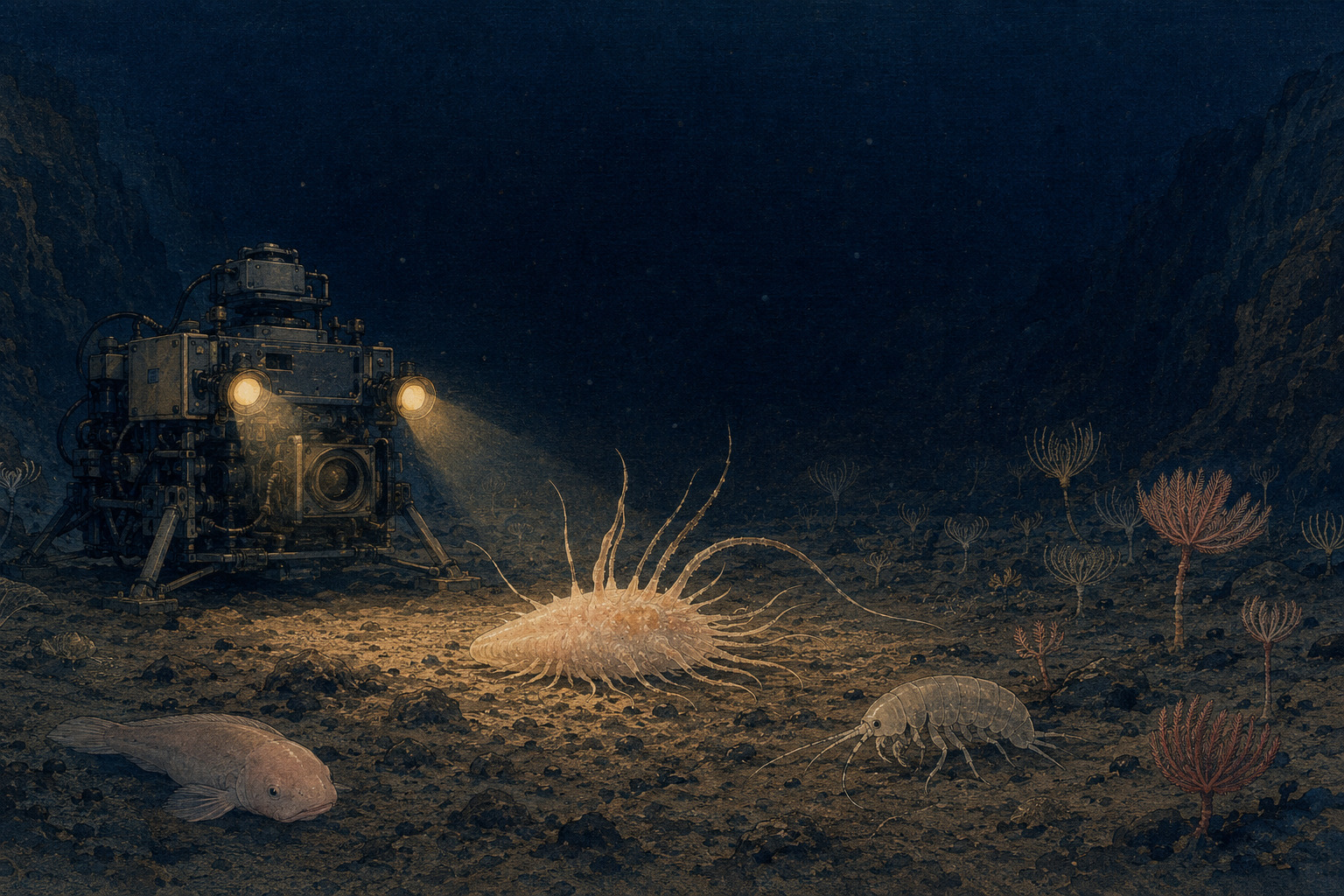
The 108 are not newly discovered species
In March 2026, a peer-reviewed paper in Biodiversity Data Journal published an illustrated catalogue of bottom-dwelling animals recorded in the Japan, Izu–Ogasawara and Ryukyu trenches. The researchers could distinguish 78 morphotaxa consistently in the footage. A further 30 broad groups—brittle stars or amphipods, for example—may have contained several visual forms, but those forms could not be separated reliably. Each broad group was therefore counted only once. The result was a conservative minimum of 108 morphotaxa.
A morphotaxon is an observation unit whose members share a recognisable appearance in images. It may correspond to a formally named species, but it need not. Juveniles and adults, females and males, damaged animals or cryptic sister species can look misleadingly different—or deceptively alike. Conversely, a single entry ending in “spp.” can conceal multiple species. The authors called 108 a minimum precisely because they did not divide uncertain images more finely than the evidence allowed.
The headline phrase “108 forms of life” therefore does not mean 108 new species, 108 formally recognised species or 108 individual animals. The catalogue combines known species, animals identifiable only to genus or family, unresolved groups that may contain several species, and one animal that cannot yet be placed below the kingdom level. The important achievement is not a naming tally. It is the creation of a comparable visual baseline across several of Japan’s deepest environments.
Two kinds of eyes on the Ring of Fire
The footage came from the two-month Ring of Fire Expedition in August and September 2022, conducted from the DSSV Pressure Drop within Japan’s exclusive economic zone. Three free-falling landers—Skaff, Flere and Closp—carried high-definition cameras and CTD instruments that measured conductivity, temperature and depth. They stayed at individual sites for long periods, filming the animals that moved across the bottom or gathered around bait.
The second set of eyes belonged to Limiting Factor, a two-person submersible rated for full ocean depth. Forward-facing and downward cameras recorded the changing substrate as the vehicle crossed slopes, rock terraces and sediment plains. A lander is excellent at watching one place and attracting mobile scavengers. A moving submersible sees a transect and reveals attached animals and habitat relationships that bait does not draw into view. Combining the two platforms exposed more of the trenches’ physical and biological structure than either would have shown alone.
The analysis was more exacting than fast-forwarding through dramatic video. Taxonomic specialists extracted frames and compared body shape, appendages, movement, substrate and depth with published descriptions, archived imagery and specimens. They used “indet.” for a single recognisable form that could not be identified to a lower rank, and “spp.” when several possible forms could not be separated consistently. This open nomenclature does not force a species name onto an image. It maps uncertainty so a later expedition knows where a specimen would matter most.
Three trenches, three geological histories
Calling the study area “Japan’s deepest ocean” as though it were one place erases essential differences. East of Honshu, the Pacific Plate descends beneath the Okhotsk Plate at the Japan Trench, where great earthquakes and mass wasting repeatedly shift sediment. The Izu–Ogasawara, or Izu–Bonin, Trench runs south from the Boso Triple Junction and reached 9,775 metres in this survey. The Ryukyu Trench parallels the Nansei Islands between Taiwan and Kyushu, shaped by oblique subduction and slow-slip events.
| Trench | Geology and scale | Expedition coverage | Of the 78 distinguishable forms |
|---|---|---|---|
| Japan | About 611km long; Pacific Plate subducts at roughly 9cm a year; frequent earthquakes and sediment remobilisation | To 8,022m; the most intensively sampled trench | 61 |
| Izu–Ogasawara | About 1,122km; includes the Boso Triple Junction; Pacific Plate subducts at roughly 3–6cm a year | 4,534–9,775m; deepest fish, sponges and crinoid aggregations | 45 |
| Ryukyu | About 1,012km; oblique Philippine Sea Plate subduction; maximum surveyed depth 7,339m | The shallower hadal range of the three | 27 |
The figures 61, 45 and 27 overlap, so they cannot be added to obtain a total. Among the other 30 broad unresolved groups, 28 appeared in the Japan Trench, 23 in Izu–Ogasawara and 21 in Ryukyu. Japan appears richest in this dataset, but the paper explicitly cautions that it also received the greatest sampling effort. More camera time raises the chance of encountering rare forms. These figures are a baseline for a future standardised comparison, not a finished league table of trench diversity.
At 9.13 kilometres, an animal without a home in the tree of life
Two sequences require greater caution than any others. A lander recorded one animal at 8,022 metres in the Japan Trench. A crewed submersible recorded a very similar animal at about 9.13 kilometres in the Izu–Ogasawara Trench. Each had what appeared to be a pale, bilaterally symmetrical body, with leaf-like projections that became longer toward the front. Both slowly glided through the water and settled toward the seabed.
The researchers initially wondered whether the animals might be nudibranchs. The paired appendages and leaf-like dorsal structures recalled rhinophores and cerata, and the outline resembled the white-lined nudibranch Dirona albolineata. Expert opinion then diverged. Some thought the appendages looked too rigid for a nudibranch. Others saw a generally molluscan form but could go no further. A sea cucumber was also suggested, yet neither the movement nor the body matched known deep-sea holothurians cleanly.
The paper entered the animal as Animalia incerta sedis: an animal of uncertain taxonomic position. That is not a species name, a declaration of a new species, or a proposal for a new phylum. It is a working label that says the evidence does not support confident placement below the kingdom Animalia.
A camera sees the outside; taxonomy often needs the inside
Assigning an animal to a phylum can depend on the digestive tract, nerves, muscles, microscopic ossicles, radulae, development and DNA. Video preserves movement, depth, external shape and surroundings, but not fine anatomy or the hidden surface. The two animals may represent one species, close relatives, or superficially similar members of a known group. No physical specimen was recovered, so there is no internal anatomy, genetic sequence or type specimen.
If it were a nudibranch, the depth record would be extraordinary. The comparison used in the paper puts the next deepest nudibranch at 4,435 metres; an observation at 9,131 metres would be 4,722 metres deeper. But an “if” is not evidence. It is not presently accurate to call this the world’s deepest sea slug or a new nudibranch species. Two similar observations in different trenches make a lighting artefact or one damaged animal less likely, but they do not settle its identity.
| What the footage supports | What the footage cannot yet support |
|---|---|
| Similar animals were recorded in the Japan and Izu–Ogasawara trenches | That the individuals belong to one species, a known species or a new species |
| A seemingly bilateral body, leaf-like projections and slow gliding are visible | Formal placement among molluscs, sea cucumbers or another phylum |
| An animal with this form can occur at 8,022m and about 9.13km | Population size, reproduction, diet or full geographic range |
There is also a small internal discrepancy in the published depth. The results table and discussion use 9,131 metres, while the narrative results and press summary use 9,137 metres. This article reports “about 9.13 kilometres,” the precision the documentation safely supports. Six metres does not change the biological interpretation, but record-setting hadal observations deserve a visible distinction between measured and reported values.
A crinoid meadow on terraces of rock
Near the Boso Triple Junction in the Izu–Ogasawara Trench, a roughly four-hour submersible transect at about 9,137 metres encountered more than 1,500 stalked crinoids on rock terraces. Their long stems anchored them to hard substrate while their arms reached into the flow for suspended particles. It was the opposite of the familiar image of an empty mud plain with a few scavengers: a three-dimensional meadow in one of the planet’s deepest habitats.
This was not the first evidence of crinoids there. The Soviet research vessel Vityaz trawled stalked crinoids from the southern Izu–Ogasawara Trench in 1955, and a remotely operated vehicle observed them from 8,967 to 9,102 metres in 1999. The 2022 transect connected animals, rock, density and feeding posture in continuous video, turning isolated occurrence records into a view of habitat.
Trench slopes are not uniformly buried in soft sediment. Faulting and collapse expose rock that gives attached suspension feeders a foothold. Steep topography can accelerate near-bottom flow and carry organic particles through narrow corridors. The meadow is a vivid reason why depth alone cannot explain hadal diversity.
Carnivorous sponges set a depth record
In the same trench, members of the carnivorous sponge family Cladorhizidae were seen from 9,568 to 9,744 metres. The study describes this as the deepest in-situ observation of the family. Often shaped like branching stalks or harps, these sponges do not rely solely on filtering tiny particles. Hook-like structures capture small crustaceans and other prey that are then digested.
Continuous filtration can be costly where food particles are extremely sparse. Waiting for fewer, larger packets of energy is one adaptation to deep-sea scarcity. Yet the images could not resolve the sponges to species, and the paper correctly kept them at a higher taxonomic rank. “Deepest observation of the carnivorous sponge family” is accurate; “a new deepest-living sponge species” is not.
Crinoids and sponges are also a methodological lesson. Neither is likely to rush toward bait. A lander alone could have produced a portrait dominated by fishes, amphipods and shrimps. The moving submersible revealed the attached communities and the physical habitat that organised them.
The fish at 8,336 metres—and the chemistry inside it
On August 15, 2022, a small snailfish approached a baited lander at 8,336 metres in the Izu–Ogasawara Trench. Later identified as a juvenile of the genus Pseudoliparis, it became the deepest fish ever recorded on video. At 8,022 metres in the Japan Trench, two Pseudoliparis belyaevi were trapped and returned as specimens, setting the depth record for fish physically collected. The results were published in a peer-reviewed paper in 2023.
The apparent disappearance of fish below roughly eight kilometres involves more than pressure alone. Deep-sea fishes accumulate compounds such as trimethylamine N-oxide, or TMAO, which help stabilise proteins against pressure. A 2014 study found that TMAO levels increased with depth and estimated that fish fluids would reach the same osmotic concentration as seawater near 8,200 metres, suggesting a biochemical depth constraint. The 8,336-metre observation sits close to that estimate, but 8,200 is not a universal wall. Species, measurements and seawater conditions vary, while temperature, food and breeding habitat also shape distributions.
There is a longer history behind the record. In 2008, a baited lander filmed a large aggregation of snailfish feeding actively at 7,703 metres in the Japan Trench. Continuous video replaced the stereotype of the solitary, sluggish “extreme” fish with animals gathering, maintaining position in a current and competing for food. The 2022 juvenile was not an isolated miracle. It stood at the end of a steady extension of method and depth.
Supergiants, shrimps and isopods: a behavioural atlas
The giant amphipod Alicella gigantea appeared in all three trenches. The animal, which can exceed 20 centimetres and is often called a “supergiant,” was seen preying on smaller amphipods at bait. The submersible, however, repeatedly found individuals resting on rocks and other hard substrate. The combined footage suggests more than a scavenger roaming over featureless mud; it also reveals a predator using terrain.
Cerataspis monstrosus, a red larval form once thought to be an entirely separate creature, occurred from 4,534 to 6,692 metres. The deep-sea shrimp Benthesicymus crenatus was recorded from 4,534 to 7,571 metres in all three trenches, extending what had appeared to be a Japan-Trench-centred distribution. Munnopsid isopods reached 9,734 metres across the three systems. Among sea cucumbers, the family Elpidiidae contributed ten morphotaxa, making it the most visually diverse family in the catalogue.
Twice in the Japan Trench, cameras also caught snailfish that appeared not to have eyes. Angle, resolution, injury, disease or an individual mutation could explain the appearance. Without a specimen, the images do not establish a blind lineage. It is a perfect demonstration of both the power and the limit of a visual guide: behaviour and occurrence can be preserved, while tissue and heredity remain inaccessible.
There is no single “trench ecosystem”
The 2026 catalogue combined lander and submersible records to build a broad occurrence guide. An earlier 2025 paper in the Journal of Biogeography asked a narrower ecological question using six submersible dives from 6,939 to 9,775 metres. It counted 29,556 organisms, 70 morphotaxa, 11 phyla and eight habitat types. The different totals are not contradictory. The studies used different footage, sampling footprints and counting rules to answer different questions.
| Study | Data | What was counted | Main purpose |
|---|---|---|---|
| 2025 ecology study | Six crewed-submersible dives, 6,939–9,775m | 29,556 individuals, 70 forms, eight habitats | Relationships among depth, food supply, earthquakes and community structure |
| 2026 image catalogue | About 425 lander hours plus 35.5 submersible hours, 4,534–9,775m | At least 108 morphotaxa | Identification guide, depth and trench occurrences, targets for later specimens |
In the ecological analysis, nutrient-rich mud at about 7.5 kilometres in the Japan Trench supported many sea cucumbers and other deposit feeders. At similar depths in the more food-limited Ryukyu Trench, brittle stars dominated and sea cucumbers were nearly absent. Beyond nine kilometres in Izu–Ogasawara, crinoids, sponges and other suspension feeders stood out on exposed rock. Depth mattered, but so did the organic material arriving from surface production, earthquake disturbance, slope position and whether the bottom was mud or stone.
Earthquakes destroy, bury—and deliver carbon
No ecological history of the Japan Trench can omit the magnitude-9.0 Tohoku earthquake of March 11, 2011. The rupture displaced the seabed and destabilised slopes. Video taken four months later at 7,553 and 7,261 metres showed a dense nepheloid layer extending 30 to 50 metres above the bottom. At the trench-axis site, visible large bottom fauna were almost absent; a turbid downslope current and dead organisms were also recorded.
Later sediment research estimated that the earthquake remobilised about 0.2 cubic kilometres of sediment and transferred more than one teragram of organic carbon into the trench. Disturbance can bury animals and change oxygen and substrate, yet the same event can carry a major pulse of food into a chronically energy-limited depth. Destruction and subsidy are two sides of the same process. “The earthquake increased biodiversity” and “the earthquake erased life” are both too simple.
The 2025 community analysis found that highly seismically active areas tended to have many individuals but lower diversity, with a few opportunistic forms dominating. More stable parts of the under-riding slope supported a more diverse community. That is an ecological interpretation of long-term disturbance regime, topography and food together—not proof that the 2011 event alone produced every pattern observed in 2022.
From rope and trawl to robots and a full-ocean-depth sub
The word “hadal” comes from Hades and conventionally refers to trench depths from 6,000 to 11,000 metres. The 19th-century Challenger expedition used sounding lines and collecting gear to help overturn the belief that the deep sea was lifeless, but it could not target steep trench faces while recording behaviour and position together. In the 1950s, the Vityaz trawl proved that crinoids existed in the Izu–Ogasawara depths—but only as a point record brought to the surface.
A landmark in Japan’s exploration came in March 1995, when JAMSTEC’s remotely operated vehicle KAIKO reached 10,911.4 metres in the Mariana Trench and filmed polychaetes and crustaceans. In 1996 it sampled sediment and microorganisms below 10,000 metres; in 1998 it captured the amphipod Hirondellea gigas at 10,911 metres. KAIKO was lost in 2003, but the operational experience of joining depth, image and specimen continued through Japanese deep-sea programmes.
In 2019, the two-person Limiting Factor, built around a titanium pressure sphere, descended to the deepest point in each of the five oceans during the Five Deeps Expedition. It established a new model for repeatable, privately operated full-ocean-depth diving. In Japan’s trenches in 2022, it supplied moving habitat transects while free-fall landers supplied long stationary observations. Progress in exploration is not merely going deeper. It is seeing the same world through instruments with different biases.
| Year | Milestone | Why it matters now |
|---|---|---|
| 1872–76 | The Challenger expedition samples the global deep sea | Specimens help establish that diverse life exists at depth |
| 1955 | Vityaz trawls stalked crinoids in the Izu–Ogasawara Trench | Early evidence for a nine-kilometre rock community |
| 1995–98 | KAIKO dives to 10,911.4m and records or collects animals and sediment | Japan develops full-ocean-depth robotic operations |
| 2008 | A snailfish aggregation is filmed at 7,703m in the Japan Trench | Baited landers preserve continuous behaviour |
| 2011–19 | Post-earthquake observation and carbon-transport studies | Disturbance and food delivery become measurable long-term processes |
| 2019 | Limiting Factor visits the deepest point of all five oceans | Repeatable, two-person full-ocean-depth diving |
| 2022–23 | Three-trench expedition and publication of the 8,336m fish record | Lander and submersible observations are integrated |
| 2025–26 | Community analysis and the 108-form visual catalogue | Geology, disturbance, food and taxonomy can be compared |
Cameras are not neutral observers
A baited lander summons mobile scavengers, predators and curious fishes or crustaceans from beyond the camera frame. The number gathered is not a natural density per square metre. Very small animals disappear below pixel scale; animals inside mud, beneath rocks or within sponges remain hidden. Transparent forms, rapid swimmers and distant individuals are hard to identify.
A submersible has different biases. It illuminates a narrow moving strip and may avoid terrain too steep or unsafe to approach. If time and travel distance differ among trenches, raw morphotaxon counts are not directly comparable. Bright lights and vehicle movement may repel or attract animals. Image identification can survey enormous depths without damaging specimens, but its taxonomic resolution depends on image quality and body orientation.
That does not make 108 a weak result. The catalogue links each form to images, depth, trench and often substrate, showing future researchers where physical collection would resolve the most uncertainty. JAMSTEC’s own deep-sea image library contains 6,079 dives and 44,050 hours of video from seven crewed and uncrewed vehicles between 1982 and 2023. Standardised visual taxonomy can turn stored footage from illustration into time-series data.
Human traces fall into trenches too
The expedition footage included debris thought to be human-made. An object found on the bottom need not have sunk directly from the sea surface above that point. Plastics, metals and fishing gear can travel in currents, then move downslope through mass wasting or bottom flow until trench geometry concentrates them. A trench is a plate-boundary depression—and potentially a terminal basin for material from land and the upper ocean.
Video alone cannot establish an object’s composition, age, source or chemical effect. A few sightings also cannot yield a pollution density for all three trenches. Yet they refute the romantic picture of a pristine realm sealed away from human activity. The same topography that funnels sediment and organic carbon may funnel our waste.
A baseline therefore records more than unusual fauna. Repeat the same transect with the same settings, and future observers can compare communities, substrate and the kinds and locations of debris. Reproducibility is what turns surprising video into environmental monitoring.
What the research shows—and what it does not
| The evidence shows | The evidence does not yet show |
|---|---|
| At least 108 image-based morphotaxa occurred in footage from three trenches | 108 new species, or the complete species total for the trenches |
| A similar unplaced animal appeared at 8,022m and about 9.13km | A new species, new phylum or the world’s deepest nudibranch |
| The Japan Trench contained the most observed forms in this dataset | That it would rank richest under equal sampling effort |
| Crinoids, sponges, snailfish, sea cucumbers and crustaceans occupied distinct habitats | Population sizes, genetic isolation or long-term trends for each form |
| Food, substrate and seismic disturbance corresponded with community patterns alongside depth | That any one factor alone determines diversity in a trench |
The survey took place within Japan’s exclusive economic zone and involved researchers from the Minderoo–UWA Deep Sea Research Centre, Tokyo University of Marine Science and Technology, JAMSTEC and other institutions. It was not a JAMSTEC-led expedition. The Pressure Drop and Limiting Factor were part of the Caladan Oceanic-linked 2022 operation, followed by international collaborative analysis that included JAMSTEC scientists. The accurate account is a meeting of Japan’s deep-sea research legacy with international, privately operated full-ocean-depth technology.
The next step is reproducible evidence, not a bigger “monster”
The most direct route to identifying the unplaced animal is to return to the same depth bands and terrain, film from several angles at higher resolution, and—if possible—recover a specimen intact. Environmental DNA might narrow the candidate lineages, but if the organism has no reference sequence, a DNA fragment in seawater cannot automatically be linked to one shape on one video. Formal taxonomy will require external form, internal anatomy, DNA, behaviour and precise collection location to meet in the same evidence chain.
Just as important is a repeated survey that standardises observation time, transect distance, depth band, bait quantity and camera settings among trenches. With the catalogue in hand, researchers can ask whether the same forms return and which images represent genuinely new occurrences. Physical collection can then focus on groups for which video is weakest, on unexpected depth extensions and on candidates for environmental indicators, rather than sampling indiscriminately.
The deepest sea is not merely a record board for the limits of life. Trenches are natural experiments where plate tectonics folds earthquake disturbance, carbon transport, exposed rock, depth and pressure into narrow basins. The minimum of 108 is not a number designed to exaggerate the unknown. It is an index that lets the next observation begin in the same language.
A catalogue in darkness is made for future comparison
The animal gliding at about 9.13 kilometres is a compelling emblem for what humans do not know. The study’s durable value, however, is larger than one mystery. A familiar shrimp, an unnamed isopod, a dense crinoid terrace and an apparently empty mud plain all entered the same catalogue with depth and place attached.
The 1955 trawl turned a crinoid into proof of presence. KAIKO in 1995 turned life below ten kilometres into image and specimen. The 2008 lander turned the lives of snailfish into continuous behaviour. The paired platforms of 2022 and the visual guide of 2026 begin to turn isolated points into comparable lines. Recording “unknown” accurately is also scientific progress.
A future expedition may give the unplaced animal a formal name. It may instead prove to be a known animal assuming an unexpected shape under extreme pressure. Either outcome preserves the value of today’s footage. Mature exploration does not stop being astonished; it draws a clear line between astonishment and evidence, then launches the next voyage from that line.
Primary sources and further reading
- Jamieson et al., “Faunal biodiversity of the lower abyssal and hadal zones of the Japan, Ryukyu and Izu-Ogasawara trenches,” Biodiversity Data Journal 14:e182172 (2026): the central peer-reviewed source for the 108 morphotaxa, trench occurrences, mystery animal and methods.
- Full text at PubMed Central: article text, figures, tables and discussion of image-identification limits.
- Pensoft / EurekAlert research release (April 7, 2026): summary of the 460 hours, crinoid aggregation, sponges and unplaced animal.
- Swanborn et al., “Seismic Disturbance, Productivity and Depth Shape Hadal Benthic Habitats and Biodiversity,” Journal of Biogeography 52:e70053 (2025): quantitative analysis of 29,556 individuals, 70 forms and eight habitats.
- University of Western Australia: Rare deep-sea dives reveal what shapes biodiversity (2025): institutional explanation of community differences among the trenches.
- Jamieson et al., “New maximum depth record for bony fish,” Deep-Sea Research Part I 199:104132 (2023): the 8,336m video and 8,022m capture records.
- JAMSTEC: World’s deepest fish filmed (April 3, 2023): official Japanese account of the expedition, depths and Guinness record.
- University of Western Australia: Scientists break record after finding world’s deepest fish (2023): research-institution release on the record.
- Fujii et al., “A Large Aggregation of Liparids at 7703 Meters and a Reappraisal of the Abundance and Diversity of Hadal Fish,” BioScience (2010): the 7,703m Japan Trench aggregation.
- Jamieson et al., “Behavioural observations of the hadal fish Pseudoliparis amblystomopsis,” Proceedings B (2009): continuous hadal-fish behaviour at bait.
- Yancey et al., “Marine fish may be biochemically constrained from inhabiting the deepest ocean depths,” PNAS (2014): TMAO and the proposed biochemical depth constraint.
- Oguri et al., “Hadal disturbance in the Japan Trench induced by the 2011 Tohoku–Oki Earthquake,” Scientific Reports (2013): turbidity, downslope flow and fauna four months after the earthquake.
- Kioka et al., “Megathrust earthquake drives drastic organic carbon supply to the hadal trench,” Scientific Reports (2019): remobilised sediment and organic-carbon transfer after 2011.
- JAMSTEC: KAIKO: the 1995 dive to 10,911.4m, sampling below 10,000m and the 1998 amphipod collection.
- JAMSTEC E-library of Deep-sea Images: 6,079 dives and 44,050 video hours from 1982–2023.
- Woods Hole Oceanographic Institution: Hadal Zone: definition, topography, pressure and habitat conditions from 6,000–11,000m.
- Triton Submarines: Triton 36000/2 Limiting Factor: two-person, full-ocean-depth submersible and titanium pressure hull specifications.
- Five Deeps Expedition FAQ: the 2019 dives to the deepest point of all five oceans and system operations.
Editorial note: The figure 108 is a conservative minimum of image-based morphotaxa, not a count of new species. No specimen of the unplaced animal exists, and its phylum, species status and the identity of the two individuals remain unresolved. The paper reports the deepest sighting as both 9,131m and 9,137m in different passages; we therefore use “about 9.13km.” The higher count in the Japan Trench is affected by greater sampling effort. The 70-form, 29,556-individual study published in 2025 and the 108-form catalogue published in 2026 use different footage and answer different questions. The hero image is an editorial illustration, not expedition evidence.