Across the routine, the music must disappear for a combined minimum of 40 seconds. What remains is the defining test of a cheerleading routine: can a team create its own rhythm, project words together and lead the audience while still controlling the bodies moving across the floor?
That requirement sits inside a short and unforgiving frame. Under the public rules of the Foundation of Japan Cheerleading Association, or FJCA, a free-performance cheerleading routine lasts between two minutes 20 seconds and two minutes 30 seconds. It takes place in a 12-metre square. The unaccompanied cheer or sideline portion must total at least 40 seconds.
JAPAN CUP2026 Cheerleading Japan Championships began Thursday, August 27, and runs through Sunday at Yoyogi National Stadium First Gymnasium in Tokyo. Its formal title is JAPAN CUP2026チアリーディング日本選手権大会. The tournament does not place every age and format into the same contest: primary-school, middle-school, high-school, university, adult club and masters athletes compete under categories and skill limits designed for their stage.
Saturday is two different championship days
The August 29 schedule divides the arena into two sessions and the competition into two kinds of urgency. Doors open at 8:10 a.m.; the first session starts at 8:45. Finals in Cheerleading Spirits and Division 2 are followed by urban cheer dance doubles, cheer dance doubles and cheer dance competition. Results and awards are scheduled for 1:20 p.m.
After the reserved-seat turnover, the second session begins at 1:50 p.m. Its central events are not finals. The Division 1 high-school semifinal starts at 2:08, university at 5:10 and adult at 6:35. The middle-school semifinal has already occupied the morning. These teams are competing for the right to perform again on Sunday, when the principal Division 1 national titles are decided.
The distinction matters. A single label—“national championship”—can conceal what each performance must accomplish. Some teams have to peak once on Saturday. Others must qualify without exhausting the athletes or exposing a new difficulty they cannot reliably repeat the next afternoon.
| Time | Official event | Status |
|---|---|---|
| 8:50 a.m. | Cheerleading Spirits performance competition | Final |
| 9:30 a.m. | Free Performance Division 1 — Middle School | Semifinal |
| 11:10 a.m. | Free Performance Division 2 | Final |
| 12:25 p.m. onward | Urban cheer dance doubles, cheer dance doubles and cheer dance | Competition; awards scheduled for 1:20 |
| 2:08 p.m. | Free Performance Division 1 — High School | Semifinal |
| 5:10 p.m. | Free Performance Division 1 — University | Semifinal |
| 6:35 p.m. | Free Performance Division 1 — Adult | Semifinal |
The hardest skill may be the space between skills
A free-performance routine combines arm motions, partner or group stunts, pyramids, tumbling, jumps and dance with music and the spoken cheer and sideline sections. FJCA's viewing guide identifies accuracy, execution and difficulty as judging concerns, but also speed, continuity, musical and verbal harmony, formation, spacing, synchronization, vitality and appeal to the audience.
That list changes how a performance should be watched. The airborne top is an obvious focal point. The competitive routine also lives in the base who moves half a step to receive the landing, the athletes who reach the next formation on the correct count, and the voices that remain unified after a demanding tumbling pass. A difficult stunt that destabilizes everything around it may be less convincing than a slightly easier sequence completed with control.
Transitions expose a team's real level. They have none of the frozen clarity of a pyramid and little of the dramatic release of a basket toss. Yet a late runner, a wide gap or a rushed grip can damage the formation that follows. In 150 seconds, there is no neutral time. Recovery itself becomes choreography.
- Watch the bases and spotters before the top rises, not only the athlete in the air.
- Follow the landing through the next two counts; control must continue after the catch.
- Listen for unity when the music stops and the words section begins.
- Check whether spacing stays clean when the formation changes quickly.
- Judge the entire team: one extraordinary athlete cannot synchronize 15 others alone.
Safety is a competitive constraint
Age categories are not cosmetic labels. They define what a routine may contain. The published rules allow university and adult club teams up to three layers and 2.5 levels in a stunt, with minimum spotter requirements under specified conditions. Middle-school teams are limited to two layers and 2.5 levels and require at least one hands-on spotter for a top in such a stunt. Lower-primary teams are limited to two layers and two levels; tosses and somersaults are prohibited.
Rotation and catching rules become more permissive only in defined stages. Middle-school basket tosses may include twists but not somersaults. The university and adult rules permit more rotation while specifying how many bases must receive particular dismounts. Upper-primary, middle-school and high-school categories can also be divided into youth and advance classifications according to the safety code.
This architecture does two things at once. It prevents younger athletes from being judged against skills they should not perform, and it gives them a visible path toward later categories. Progress means more than adding rotation. It means acquiring the strength, position awareness, communication and reliable catches that make new permissions usable.
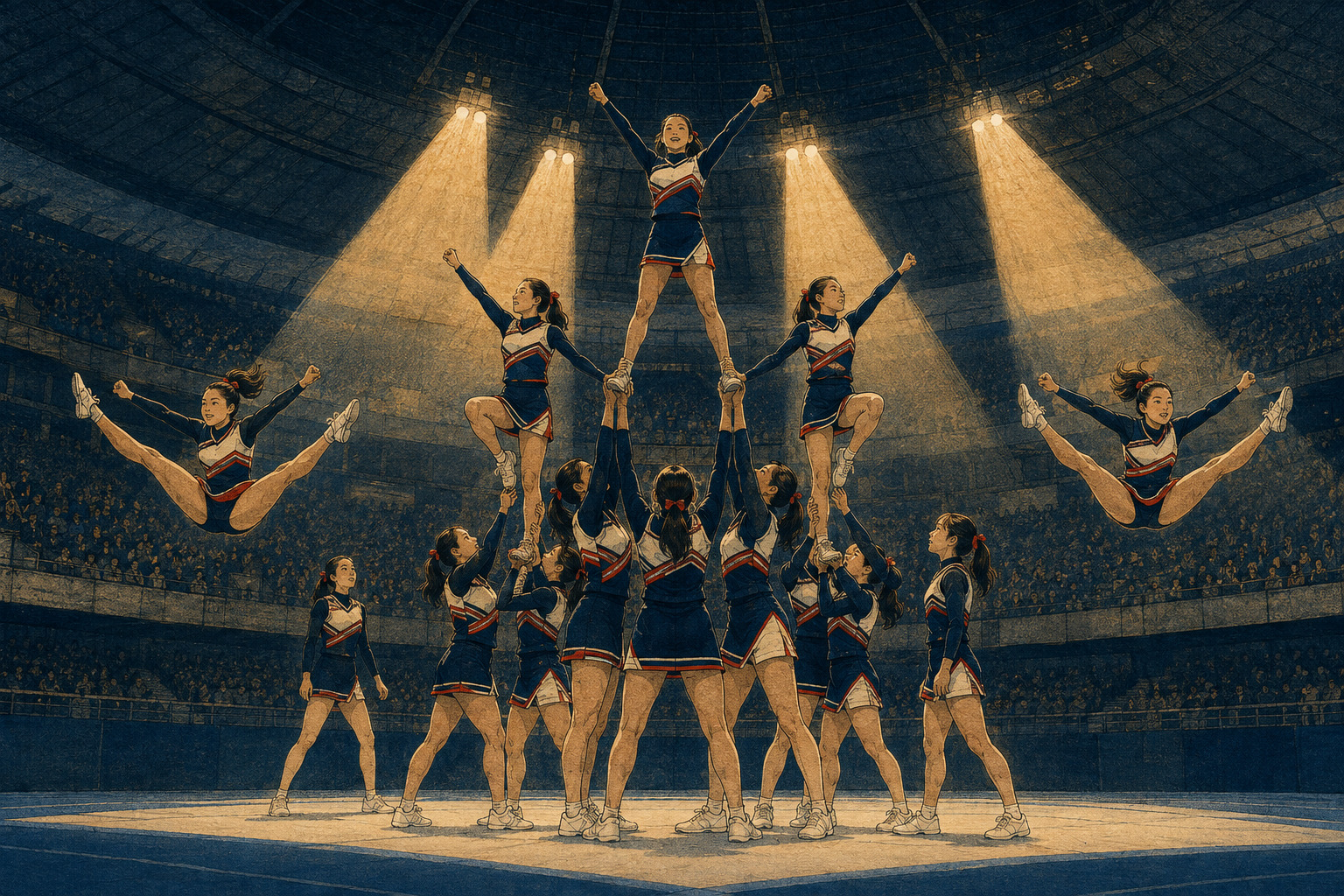
A cheerleading image can flatten that system into a dramatic silhouette. Real instruction cannot. That is why the illustration attached to this article is explicitly editorial, not a diagram: the correct number and placement of bases and spotters depend on the skill, division and current rules.
Yoyogi is the end of a national summer
JAPAN CUP does not begin when the arena doors open. FJCA's 2026 calendar identifies eight regional championships as national-championship qualifiers: Tohoku, Hokushinetsu, Kansai, Kanto, Kyushu, Hokkaido, Chubu, and Chugoku-Shikoku. They ran from June 13 through July 12. The three-day Kanto qualifier used the same First Gymnasium in June.
The national program then builds several routes into four days. Thursday carried repechage rounds for middle-school youth, middle school, high-school youth, high school and university. Friday included the event officially called the Friday Tournament, as well as the youth finals. Adult repechage and a Friday Tournament round appear on Saturday before the adult semifinal.
The public event page gives the sequence, but not a complete plain-language explanation of every advancement condition. The careful conclusion is structural: reaching the final floor may involve a regional result, a repechage, a tournament round and a semifinal, with pathways varying by category. It should not be simplified into one universal bracket.
Eighty-one athletes, no more than 16 on the floor
Nippon Sport Science University VORTEX illustrates the compression behind a university routine. An official pre-tournament FJCA profile identifies the team as the 2025 Division 1 university champion. Its head coach told the federation that the 2026 club had 81 members, including 27 first-year students—the largest group in its history.
The published free-performance rules permit a university team of eight to 16 athletes. A roster of 81 therefore becomes several competitive groups, specialist roles and difficult selection decisions long before anyone enters Yoyogi. Depth can raise the quality of practice. It also demands a system that develops athletes who will not appear in the headline team.
The federation's promotional interview emphasizes VORTEX's partner stunts and its attempt to build small increases in difficulty, including changes of body position at extension height. That is useful evidence of process, not a forecast of the winner. The defending champion still has to turn a large training organization into one synchronized semifinal performance—and, if it advances, do it again.
A championship that had to invent its common language
The predecessor of today's FJCA was established on June 15, 1987. The first national championship followed on April 24, 1988 under the name Cheerleading National Championship in Japan. A national student championship began in 1989; the first all-Japan high-school championship and the first instructor certification test followed in 1991.
The organization adopted the Japan Cheerleading Association name in 1994 and published a competition rule book in 1995. In 1998, the 12th national championship became the JAPAN CUP national championship. Those milestones describe an institutional task as important as popularizing the activity: defining terms, judging criteria, age divisions and safety rules so teams trained in different regions could meet on one floor.
1987 — The predecessor organization is established on June 15.
1988 — The first national championship is held on April 24.
1991 — The first national high-school championship and instructor certification test.
1995 — FJCA publishes its competition rule book.
1998 — The 12th national championship adopts the JAPAN CUP name.
2026 — Eight regional qualifiers lead into a four-day national championship; an association 40th-anniversary service award ceremony is scheduled for Sunday.
The championship now spans lower and upper primary school, middle school, high school, university, adult club and masters categories, alongside small groups, doubles, cheer dance and other formats. Its breadth does not erase the differences between them. It stages those differences together so a child can see a later pathway and an adult athlete can remain part of the sport beyond school.
An Olympic swimming hall built to hold a voice
The First Gymnasium predates the national cheerleading championship by more than two decades. It was completed in 1964 for swimming and diving at the Tokyo Olympics. Architect Kenzo Tange designed a suspended roof carried by two 280-metre main cables between two principal pylons. The large uninterrupted interior made athlete and audience part of one space.
Japan's Agency for Cultural Affairs lists Yoyogi Stadium—its First and Second Gymnasiums—as an Important Cultural Property, designated on August 2, 2021. The official record praises the integration of form, structure and function in a major work of postwar modernism.
Cheerleading offers an unexpectedly precise way to understand that building. The roof distributes enormous loads through cables and anchor blocks. A stunt distributes human weight through bases, grips and controlled contact. The analogy should not be pushed into engineering equivalence, but both make force legible. What looks weightless is possible because support has been designed carefully.
The building also changes sound. In the required words section, the team's voice travels into a hall created for a mass public. The audience is not merely watching a private feat. It is being asked to answer, clap and recognize that cheerleading retains the communicative purpose from which the competitive form developed.
The finish is the first still second after the landing
Smile, spirit and appeal are judged qualities. They are not evidence that the labor is easy. A competitive smile is held while an athlete is calculating timing, absorbing force, locating teammates and managing fatigue. It communicates confidence to an audience and useful calm to a team.
That is why the photograph most people want—the top at maximum height—cannot explain the whole sport. The more revealing moment may come immediately after: the catch is complete, every athlete is balanced, and the formation begins to travel on the next count without anyone advertising the correction just made.
On Sunday, the results will reduce thousands of hours to rankings. Competition needs that reduction; a national championship has to name champions. But JAPAN CUP's larger map runs from a lower-primary team under the strictest skill limits to adult and masters athletes who have chosen to keep training. It includes the regional floor, the second-chance round, the semifinal and the performance that finally receives a medal.
The 40 seconds without music belong to every stage of that map. They remind the arena that this sport was not created only to defy gravity. It was created to direct attention, generate a common rhythm and ask other people to join.
- Foundation of Japan Cheerleading Association — official JAPAN CUP 2026 title, four-day schedule, venue and change notice
- Japan Sport Council — First Gymnasium event listing and August 29 session times
- FJCA — event categories, team composition, routine length, competition area and safety-rule summary
- FJCA — official descriptions of motions, stunts, pyramids, tumbling, jumps and dance
- FJCA — judging and viewing guide, cheer and sideline functions
- FJCA — eight 2026 regional championships designated as national qualifiers
- FJCA — institutional history, first national championship and adoption of the JAPAN CUP name
- FJCA — formal corporate name, establishment date, membership and national events
- FJCA — official pre-tournament interview with Nippon Sport Science University VORTEX
- Nippon Sport Science University — official VORTEX club profile and 2025 competition record
- Japan Sport Council — First Gymnasium's 1964 completion, Kenzo Tange and suspended-roof system
- Agency for Cultural Affairs — Important Cultural Property record for Yoyogi Stadium First Gymnasium