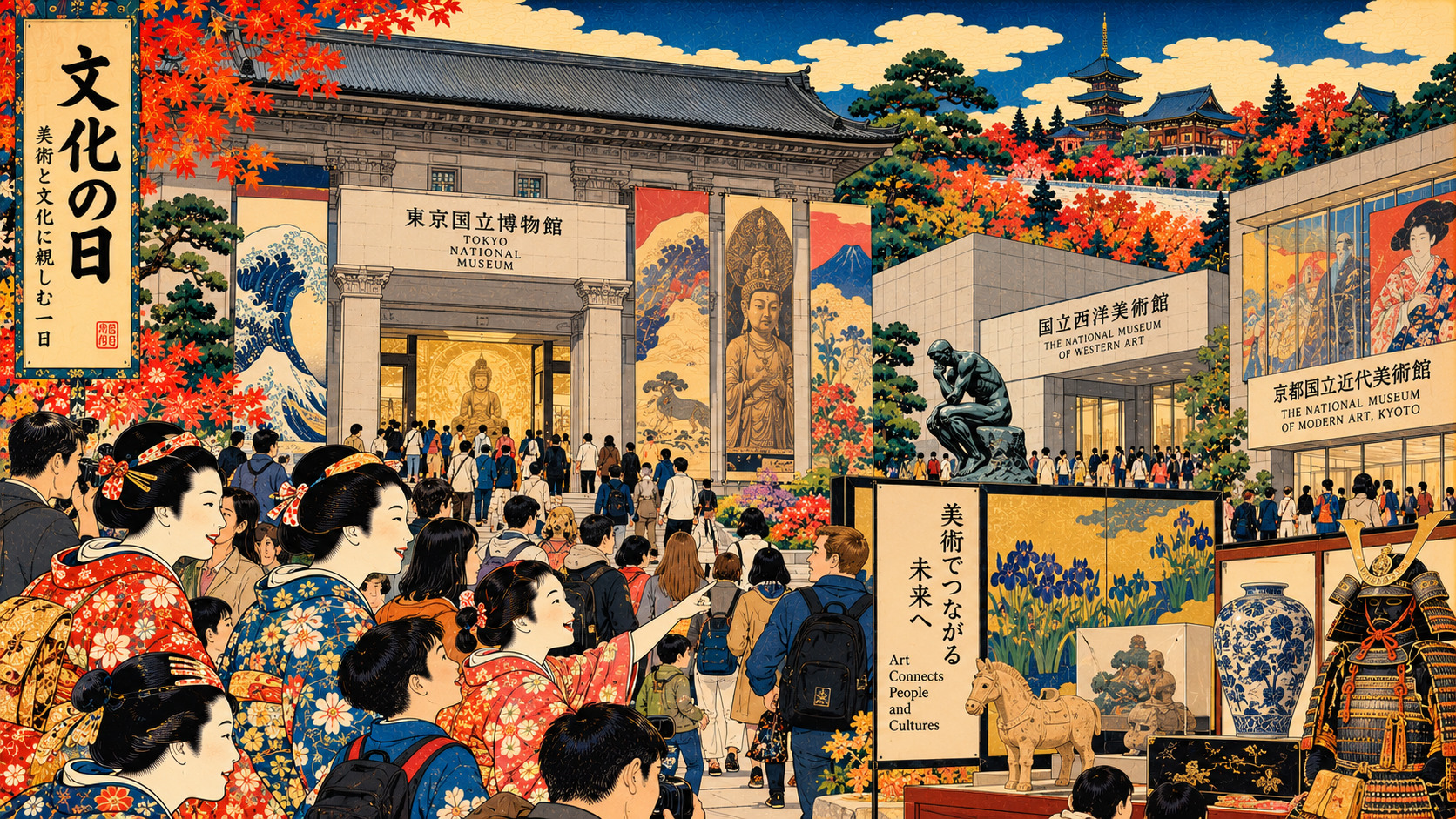
The first question is not where—but what—is free
Japan’s Culture Day falls on Tuesday, November 3, 2026. The national ministry confirms special free access at 11 national museums, galleries and related institutions. But there is a crucial distinction: a museum offering free admission to its collection galleries may still charge for a blockbuster temporary exhibition. Understanding that difference can save visitors from disappointment. This guide focuses on the precise access covered by official notices, and separates Culture Day from regional programs that happen on other dates.
Why Japan has a Culture Day
Culture Day is more than an autumn tourism promotion. The 1948 Act on National Holidays defines November 3 as a day to foster culture while cherishing freedom and peace. Its adoption after the Second World War gives the holiday a civic meaning: art, education and intellectual exploration are public goods, not simply commercial attractions. The Ministry of Education’s Education and Culture Week, November 1–7, extends that invitation beyond one date with lectures, activities and access programs around Japan.
A remarkably walkable museum day in Ueno
Tokyo’s Ueno district offers a particularly strong itinerary. The Tokyo National Museum opens its regular collection display free of charge; the National Museum of Nature and Science waives admission to permanent exhibitions; and the National Museum of Western Art provides free access to its permanent collection. The museums cover very different histories—Japanese and Asian artifacts, the natural world, and Western art—within a manageable area. The Tokyo National Museum confirms November 3 on its own free-admission calendar. Temporary exhibitions may require tickets, and queues can be significant on a public holiday.
Modern art, moving images and nature in Tokyo
The National Museum of Modern Art, Tokyo, includes its collection exhibition. The National Film Archive of Japan covers permanent and temporary exhibitions, not film screenings. At the Institute for Nature Study in Shirokanedai and the Tsukuba Botanical Garden, visitors can explore scientific collections outdoors. These options reward different interests: the history of Japanese modernism, the preservation of film culture, or the botanical life around us. Check weather and individual visitor rules for garden sites, and do not assume a film ticket is covered by a free museum exhibition.
Kyoto and Osaka: contemporary art with important exclusions
In Kyoto, the National Museum of Modern Art makes its fourth-floor Collection Gallery free on November 3. It also lists November 15 as a free day associated with Kansai Culture Day. Its current special jewelry exhibition, however, remains ticketed. In Osaka, the National Museum of Art waives admission to the collection exhibition on November 3, but that does not mean every concurrent special exhibition is free. These distinctions matter: a visitor may be able to spend an excellent afternoon with collection works without purchasing an exhibition ticket, but should check the intended galleries before leaving.
Kanazawa and the craft tradition
The National Crafts Museum in Kanazawa appears on the Ministry’s official free-access list. The museum is a fitting Culture Day destination in a region internationally associated with ceramics, lacquer, textiles and metalwork. Craft collections reveal how knowledge is passed from makers to apprentices and how design evolves with materials and demand. Visitors should verify the covered exhibition rooms on the museum’s own page before traveling. Ishikawa Prefecture’s separate local Culture Day offered resident-specific free admissions on October 18, not November 3; its culture-promotion period running into November should not be mistaken for an extension of that free day.
Hokkaido: a living Ainu cultural experience
At Upopoy in Shiraoi, admission to the National Ainu Museum and the park will be free on November 3, from 9 a.m. to 5 p.m. The program features cultural performances, learning activities and gallery talks. This is an opportunity to engage with Ainu culture as a living tradition carried by people today, not merely an archaeological subject. Parking fees and certain activities remain chargeable; some scheduled programs have capacity limits or may change. The official Upopoy page is the best source for the day’s detailed timetable and any cancellations.
Japan beyond the national institutions
Regional and municipal museums also take part, often showcasing histories overlooked by visitors who concentrate on national collections. The 2026 Internet Museum compilation identifies 122 institutions nationwide with free access of varying scope, including museums in Iwate, Yamagata and Fukushima. The compilation is a useful directory, but not a guarantee that every named exhibition or activity is covered. Local museums may have resident restrictions, separate event fees, or different opening schedules. For each destination, use the museum or municipality’s own notice as the final authority.
The difference between permanent and special exhibitions
A permanent collection or regular exhibition is often the only component covered by a free-day offer. A special exhibition may have a separate ticketing partnership, a fixed visitor capacity or its own admission schedule. Kyoto’s Genji exhibition at Kyoto National Museum, for instance, is not included in the national list of free-admission venues simply because its second display phase begins on November 3. Likewise, cinema screenings, workshops and parking are different products from museum entry. Read the small print about what is free, who qualifies, and whether reservations are required.
How to make the most of the holiday
Plan around one or two experiences rather than racing through a list of buildings. Start with official admission notices, then confirm opening and closing hours, special exhibitions and photography policies. Families may prefer a workshop with scheduled entry; international visitors should check multilingual materials and transit accessibility; art lovers may prioritize collection galleries that normally require a ticket. Allow time for meals, queues and a break. Free entry is most valuable when it creates enough space for a visitor to be genuinely curious.
Other cultural dates worth knowing
November 3 is not Japan’s only opportunity for public access. Education and Culture Week runs November 1–7, and Kansai’s regional Culture Day arrangements include a separate November 15 opening at the Kyoto National Museum of Modern Art. Some prefectures run independent programs for residents on different days: Ishikawa’s free-admission initiative was October 18. Travelers should pay attention to the precise date and eligibility rules rather than treating November as a month of universally free museum entry.
A public invitation, not just a discount
The significance of Culture Day is not exhausted by the admission fee saved. Public access can introduce a child to a scientific collection, give a traveler insight into regional craft traditions, or prompt a conversation about the people whose stories museums preserve. The strongest museum visit may be the one that changes what a person wants to learn next. Japan’s November 3 programs make that discovery easier, provided the boundaries of each offer are communicated honestly.
National museums and galleries: what is free on November 3
The following 11 institutions appear on the Ministry of Education’s official 2026 list. The scope describes free access—not a promise that all galleries or events at each venue are included.
Tokyo
- Tokyo National Museum — Regular collection galleries
- National Museum of Nature and Science — Permanent exhibition
- National Museum of Western Art — Permanent collection
- National Museum of Modern Art, Tokyo — Collection exhibition
- National Film Archive of Japan — Permanent/temporary exhibitions (screenings not included)
- Institute for Nature Study — Garden admission
- Tsukuba Botanical Garden — Garden admission
Kansai
- National Museum of Modern Art, Kyoto — Collection Gallery only
- National Museum of Art, Osaka — Collection exhibition only
Hokuriku
- National Crafts Museum, Kanazawa — Listed as free by MEXT; confirm covered exhibitions
Hokkaido
- National Ainu Museum and Park — Museum and park entry; parking and some programs cost extra
MEXT lists the National Crafts Museum; confirm the exact covered exhibition areas with the museum before visiting.
Sources and editorial notes
This practical guide is based on published national and institutional notices; no onsite visits or direct calls to every museum were conducted. The national list is not exhaustive of regional offers.