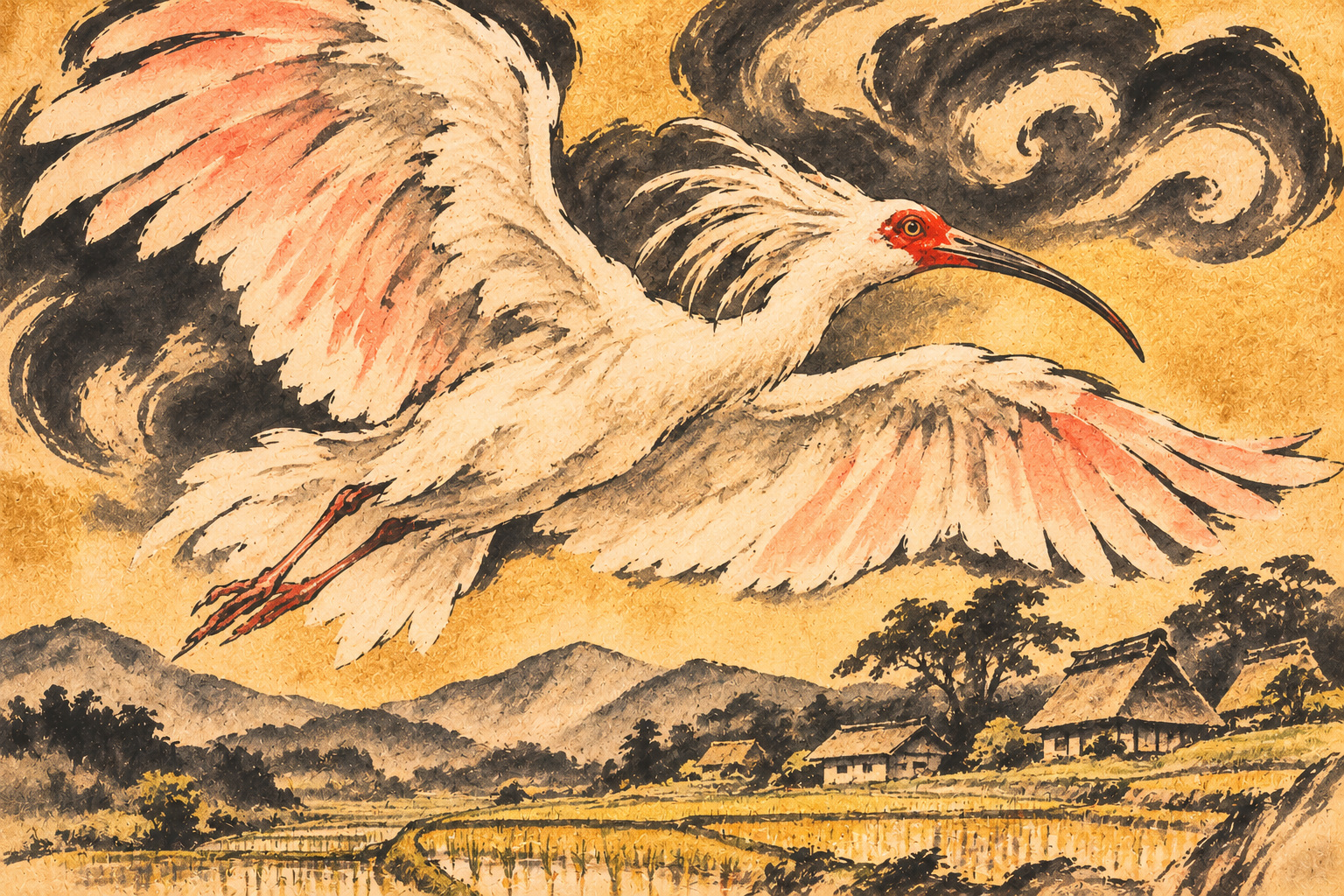
- A bird returns. Can a farming landscape return with it?
- The disappearance that shaped a generation
- An international conservation partnership
- What recovery statistics actually say
- The Sado breeding season in numbers
- Why a rice field can function like a wetland
- The economic question conservation cannot avoid
- Noto becomes the next test
- A network larger than one island
- The next measure of success
A bird returns. Can a farming landscape return with it?
An ibis searching a harvested rice field is an arresting sight. It is also the visible end of an enormous chain of invisible work: irrigation management, soil and aquatic life, captive breeding, monitoring, and farmers who keep fields in use. Japan's crested ibis comeback is no longer simply the story of a species saved from disappearance. It is a test of whether rural communities can sustain the conditions that make recovery possible.
On November 10, Japan's Ministry of the Environment announced that the fifth meeting of the Network Council for Satoyama Landscapes Coexisting with Crested Ibises would take place in Hakui, Ishikawa Prefecture, on November 17. The meeting brings together Sado, Noto municipalities and other regions to share practical problems and responses. It has not yet taken place; no decisions from it are reported here.
The disappearance that shaped a generation
The Japanese crested ibis, Nipponia nippon, once lived across parts of East Asia. Habitat change, hunting and pressures on traditional landscapes devastated its Japanese population. In 1981, the final five wild birds on Sado Island were taken into captivity in an attempt to save them. Japan's wild population was effectively gone.
In 2003, Kin, the last surviving Japanese-born bird from the original domestic lineage, died. That did not mean the species had vanished worldwide. Chinese populations remained, and long-term cooperation with China would eventually make Japanese reintroduction possible. This distinction matters: the modern recovery is not a miraculous rediscovery of birds hiding in the mountains.
An international conservation partnership
A pair provided from China in 1999—Youyou and Yangyang in official Japanese records—produced a chick that year. Additional transfers, husbandry improvements and captive breeding eventually allowed Japan to begin releases on Sado in 2008. Wild-bred chicks were documented in 2012, a turning point after decades without successful wild breeding.
The resulting program links genetics and veterinary care with landscape management. Its achievement belongs not to one institution or country but to sustained cooperation among conservation professionals, public bodies, farmers and local residents. Genetic diversity, disease and long-term survival are still serious management questions.
What recovery statistics actually say
Japan's fifth Red List assessment in 2026 moved the ibis from Critically Endangered to Endangered within its national threat categories. The ministry's cited estimate for wild birds on Sado was 576 at the end of 2024. That is substantial progress, but it is not a current November 2026 census, and Endangered is not the same as secure.
A population count also obscures an essential question: can successive wild-born generations breed and survive without continuing interventions? A strong conservation claim should distinguish released birds, wild-born descendants, breeding pairs and fledglings, rather than mixing numbers from different years.
The Sado breeding season in numbers
The ministry's preliminary 2026 breeding report describes 91 nesting pairs on Sado. Twenty-one of those pairs produced 44 chicks, and 18 pairs fledged 35 young. Forty-six nesting pairs consisted of birds born in the wild; 11 of those pairs fledged 22 chicks. These are striking signs that the reintroduced population has developed a self-reproducing component.
There is still no reason to celebrate without qualification. The published fledging-rate measure refers to the proportion of nesting pairs with confirmed fledging, not the percentage of all hatched chicks surviving. The agency plans further statistical assessment using additional monitoring data. Honest reporting keeps the numerator, denominator and reporting period together.
Why a rice field can function like a wetland
Ibises search wet fields and wetland edges for small animals, including aquatic invertebrates and fish. When agriculture changes the hydrology or reduces prey habitat, birds can lose feeding grounds even if nesting areas remain. Sado City's certified 'Toki to Kurasu Satozukuri' program—literally building a community living with the ibis—tries to connect food production with ecological management.
The city's criteria include biodiversity-supporting cultivation practices, wildlife surveys twice a year, specially cultivated rice and no herbicide application on paddy embankments. One method creates an aquatic refuge within a paddy when the main field is drained midseason; winter-flooded paddies are another. Neither approach is a universal prescription: water, labor, costs and local ecology determine what works.
The economic question conservation cannot avoid
Wildlife-friendly rice can help explain the environmental value of a product and give consumers a reason to choose it. Yet the existence of a certification label does not, by itself, establish that farms earn higher net incomes or that tourism covers conservation costs. Those claims would require farm-level comparisons of price, yields, labor, expenses and consistent access to markets.
The deeper constraint may be demographic. Rural communities are aging, and fewer people may be available to maintain irrigation ditches, paddy edges and winter water management. A conservation project that depends on invisible labor faces a long-term risk even if its flagship bird population grows.
Noto becomes the next test
The recovery moved beyond Sado in a particularly visible way in 2026. Eight ibises were released in Hakui on May 31, followed by ten more after acclimatization on June 14: 18 in total. The releases form part of a broader effort to restore landscapes and are also being discussed in the context of rebuilding Noto after the January 2024 earthquake.
But releasing birds is not establishing a population. Noto's agricultural arrangements, waterways and land-use pressures differ from Sado's. GPS and field monitoring reveal movement, not a promise of permanent settlement or successful future breeding. Environmental officials restrict precise location information so observers do not disturb the birds.
A network larger than one island
The November 17 meeting is expected to include Sado, Ishikawa and nine Noto municipalities, Izumo in Shimane, Tome in Miyagi, Nikaho in Akita, and a Kanto municipal forum. The ministry's Roadmap 2030 provides a longer horizon, while a release in Izumo has been planned for the first half of Japan's 2027 fiscal year.
The ibises themselves are already demonstrating why this cannot be managed purely within administrative borders. In October 2026, officials reported the first post-reintroduction confirmation of an ibis in Shiga Prefecture, apparently from Sado and beyond a 300-kilometer radius. Conservation planning must account for movement across landscapes; a single municipality cannot supply every feeding habitat.
The next measure of success
Japan's ibis program has achieved something that once looked nearly impossible: a wild population and a new generation of wild-born breeders. Its next challenge is less photogenic. It concerns the farmer's margin, the future of village irrigation, how habitat quality is measured and whether conservation remains feasible when local populations shrink.
November 17 may bring useful exchanges and new commitments, but their substance must be checked after the meeting. The question worth carrying beyond it is whether a restored bird population can help build a more resilient working countryside—and whether the countryside can continue supporting that population in return.
Primary sources and verification notes
Based on primary information available through November 10. The November 17 meeting is upcoming; precise economic benefits and permanent Noto establishment have not been verified.