- An unlikely corporate championship in Nihonbashi
- A league drawn from seven business districts
- Why the sport works in small urban spaces
- From a family court in Washington State
- How Japan found a use for an imported game
- The appeal—and limits—of corporate bonding
- What the participation numbers actually establish
- From tenant event to a proposed broader championship
- The real-estate dimension of recreation
- The next measure will be who comes back
An unlikely corporate championship in Nihonbashi
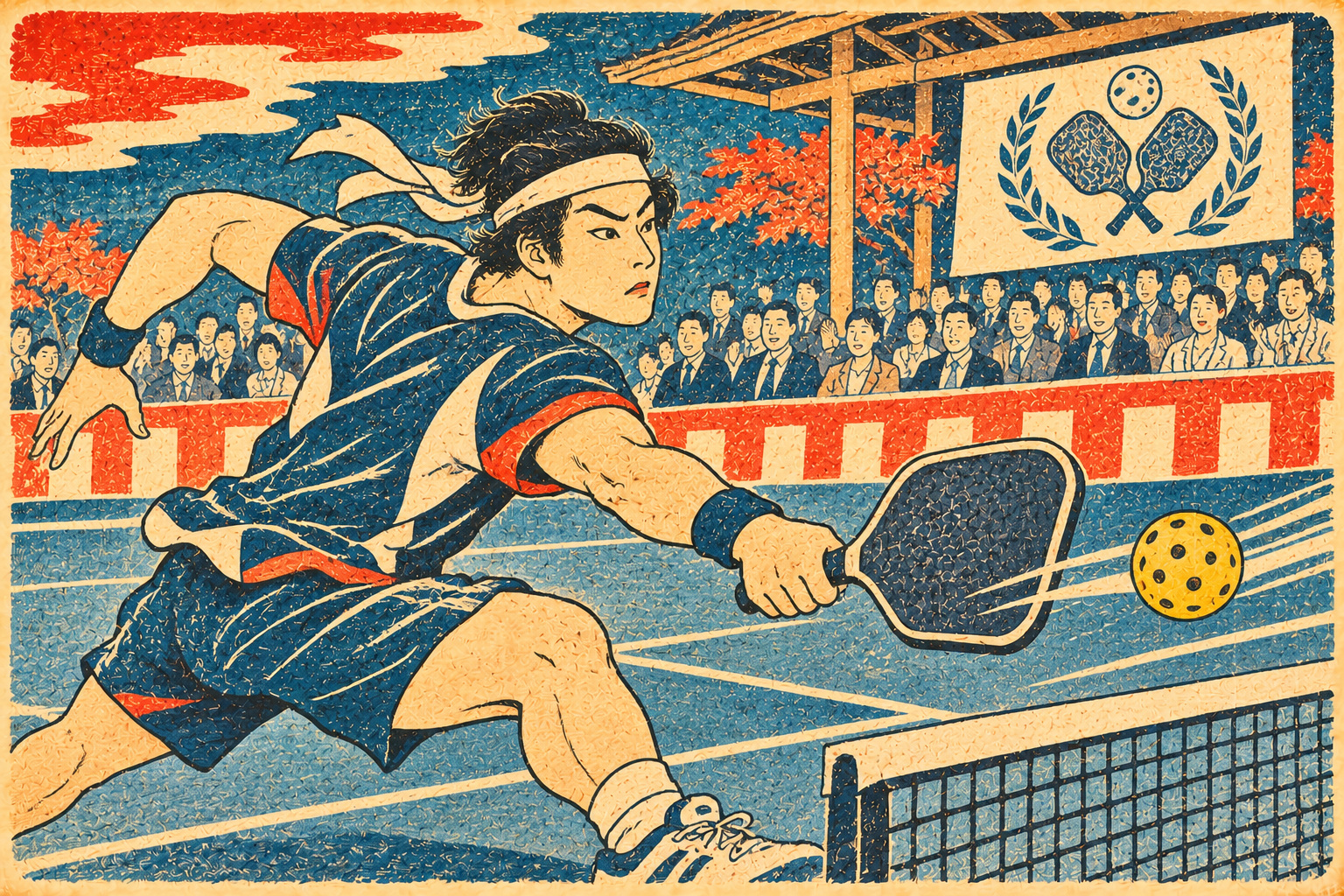
On November 7, employees representing major companies gathered at Nihonbashi Mitsui Hall in Tokyo not for a conference but for the final of a pickleball tournament. PwC Consulting emerged as champion after defeating FLUX, according to organizer Mitsui Fudosan’s November 11 report. The result is small in the world of professional sport but revealing in the world of Japanese offices.
The headline figure—135 teams—describes the entire 2026 qualifying season. Only 18 teams reached the November 7 final. The organizer reports about 500 players and spectators at that event and roughly 3,000 cumulative attendances across the season. Those categories should not be conflated with 135 finalist teams or 3,000 unique individuals.
The event illustrates how a major property company is turning a small-court American sport into a means of tenant engagement. Whether the initiative produces durable workplace relationships is a question worth asking, rather than an achievement that a trophy can prove.
A league drawn from seven business districts
Mitsui Fudosan organized qualifying competition across seven Tokyo areas before bringing 18 finalists to Nihonbashi. The final began with six round-robin groups of three; eight teams advanced to the knockout stage. PwC Consulting and FLUX reached the deciding match, with PwC taking the title. The public results release does not provide a complete point-by-point scoreline, so one is not supplied here.
Teams qualifying for the final represented varied employers: NTT DATA, Fast Retailing, Timee, Hakuhodo, Daikin Industries, Mitsui Fudosan, Sansan, and others. This was not a contest between corporate balance sheets. On a modest rectangle of flooring, precise placement and teamwork matter more than company revenue.
Toray was among the sponsors, alongside Daio Paper, Suntory Corporate Business and Coca-Cola Bottlers Japan. The Pickleball Japan Federation supported the event. Mitsui Fudosan, however, was the organizer: this was its corporate league championship, not an officially sanctioned all-Japan national championship.
Why the sport works in small urban spaces
A regulation pickleball court measures 20 by 44 feet, or about 6.10 by 13.41 meters, for both singles and doubles. Players use paddles and a perforated plastic ball, combining recognizable features of tennis, badminton and table tennis. A small court makes it possible for people with different levels of experience to share a recreational setting.
But pickleball is not simply miniature tennis. The two-bounce rule requires the serve to bounce before being returned and the return to bounce before the serving side strikes it. A seven-foot non-volley zone on each side of the net, commonly called the kitchen, limits volleys close to the net. These rules reward touch, patience and coordinated movement.
The design can make a first game approachable, but competitive play still demands practice and suitable facilities. Assertions that it is inherently injury-free, accessible to every individual without adaptation, or equally easy for all ages would go beyond the evidence in the event announcement.
From a family court in Washington State
Pickleball began in 1965 on Bainbridge Island, across the water from Seattle. Joel Pritchard, Bill Bell and Barney McCallum helped create a family game using an old badminton court, table-tennis-style paddles and a perforated ball. The Bainbridge History Museum and USA Pickleball preserve accounts of those origins.
The game spread through neighborhood play and informal experimentation before organized tournaments developed. The first tournament is generally dated to 1976, while a national association took shape during the 1980s. The history matters because pickleball was built for participation before it was built for spectacle.
Even the name contains a useful historical warning. A popular explanation invokes a dog called Pickles; USA Pickleball instead relays the Pritchard family account that Joan Pritchard named the game after the mixed crews of a “pickle boat,” and that the dog arrived later. The distinction between a catchy anecdote and a documented account is worth retaining.
How Japan found a use for an imported game
As pickleball spread internationally, Japanese enthusiasts, instructors, clubs and governing organizations began building a local playing community. The Pickleball Japan Federation provides historical context on its official site. The recent corporate league adds a distinctive Japanese urban use case: a sport structured around business districts and participating employers.
Mitsui Fudosan announced the competition in April 2026 as an extension of its &BIZ efforts to connect office tenants. The company had been organizing cultural and musical activities and described pickleball as a new way of creating opportunities to meet. Its announcement also discussed an investment in Pickleball One and cooperation on facilities and business development.
This is a commercial strategy as well as a recreational initiative. A property owner hopes to make its buildings and surrounding districts more attractive to the companies that occupy them. The interesting question is whether amenities can become genuine communities instead of temporary event branding.
The appeal—and limits—of corporate bonding
Large offices can isolate employees within teams, job titles and separate buildings. A doubles match changes those conventions: teammates must communicate, opposing employees meet as equals on the court, and spectators can support colleagues who rarely appear on the same work project.
That potential is real but unmeasured here. The November tournament report supplies attendance and competition results, not a longitudinal study of wellbeing, retention, cooperation or job performance. No independent before-and-after employee survey was cited in the primary event release.
Workplace sports also have exclusions that merit attention. If participation becomes an unspoken obligation, or if less athletic employees feel they have no place, the benefits of connection may be unevenly distributed. A healthy program needs voluntary entry, beginner-friendly opportunities, and room for different physical needs.
What the participation numbers actually establish
The organizer reports 135 season entrants, 18 finalists, approximately 500 people at the final, and approximately 3,000 aggregate attendees during qualifying and finals. These are useful indicators of enthusiasm within this particular corporate program.
They do not establish a national participation total for pickleball. Nor does an attendance count necessarily measure unique players: a person appearing at multiple events can contribute more than once to a cumulative total. Other figures—new-player retention, demographic mix, injury incidence, and satisfaction after several months—were not provided.
The championship report is primarily an organizer account. JAPAN.co.jp has not independently observed the final or interviewed team members for this article. Where participant reactions are discussed, they are attributed to the statements released by the organizer rather than reconstructed as eyewitness scenes.
From tenant event to a proposed broader championship
The league grew from a 2025 start and was operated principally among firms occupying Mitsui Fudosan office properties. The company says eligibility will be widened in 2027 to companies outside that tenant network. Its stated ambition is to build a contest that determines the top corporate pickleball team in Japan.
That aspiration should not be converted into a present status. PwC Consulting won the 2026 &BIZ CUP, not a universal national championship encompassing every employer or every independent pickleball organization. Details of future qualifications and participation have yet to be finalized publicly.
A larger competition will encounter familiar challenges: court availability, fair tournament seeding, costs, refereeing, accessible venues, and employee schedules. Expansion can also shift the balance between the league’s social purpose and its competitive ambitions.
The real-estate dimension of recreation
A property company can do something many sports federations cannot: connect a geographically concentrated network of employers and give them reasons to gather. The court becomes an amenity, an event venue, and a point of contact across buildings. In that sense, the product is partly the shared experience of working in a district.
The business incentives deserve equal attention. A tournament can strengthen tenant loyalty and create marketing opportunities. Those motives do not invalidate recreational benefits, but they make openness and continuity important questions. Will the program survive beyond sponsorship cycles, and can employees participate without heavy costs or corporate pressure?
There is no need to pronounce the event a revolution in Japanese work culture. It is a concrete example of how sport, real estate, and office life are being combined, with enough participation to make follow-up reporting worthwhile.
The next measure will be who comes back
PwC Consulting’s team said in the organizer’s statement that it hopes to return and win again in 2027; runner-up FLUX also expressed an intention to keep practicing. The match is over, but that continued participation may ultimately prove more revealing than the championship result.
For a new sport, durable growth is reflected in repeat players, accessible courts, coaches, and groups that continue meeting after an introductory event. For employers, the test is whether people who would not otherwise connect begin to do so, and whether participation remains a choice rather than an expectation.
The 2026 &BIZ CUP produced a winner. Its larger significance will be decided in ordinary weeks after the cheering stops: whether the paddle stays in the bag or comes back onto the court.
Sources and verification
Results and participation figures derive from the organizer; no eyewitness reporting or longitudinal outcome measurement is claimed. The &BIZ CUP is not characterized as an official national federation championship.
- 三井不動産:2026年度企業対抗ピックルボール&BIZ CUP FINAL大会結果(11月11日)
- 三井不動産:企業対抗リーグの発表・&BIZおよびピックルボールワンへの出資(2026年4月7日)
- 三井不動産:大会結果の詳細・企業名と主催者発表(2026年11月11日)
- ピックルボール日本連盟:競技の歴史
- USA Pickleball:1965年からの競技の歴史
- Bainbridge History Museum:ピックルボール誕生の背景
- USA Pickleball:2026 Official Rulebook
- USA Pickleball:競技ルールの解説
- USA Pickleball:競技名称の起源と議論
- World Pickleball Federation:競技と世界での普及