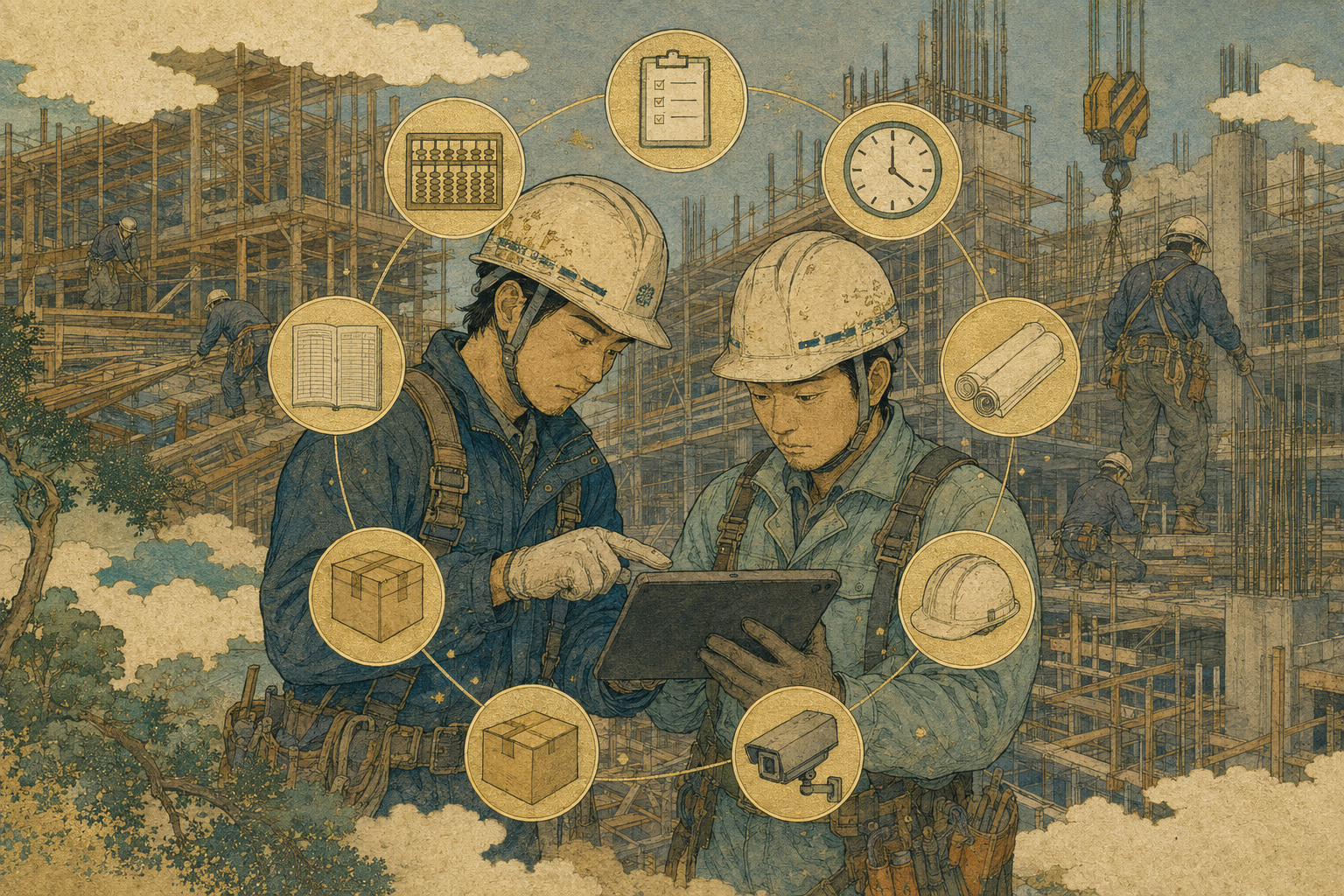
At a construction company, the most expensive missing object may be a sentence. It sits in a meeting that was never transcribed, a veteran’s memory, an email attachment with the wrong name, a rule buried three folders down, or a daily report that reaches the office after the decision it was supposed to inform. Steel and concrete are visible. Information waste is not.
That is why the small tools matter. A draft-minute maker does not pour concrete. A regulation search box cannot judge a cracked beam. An email assistant cannot calm a subcontractor when rain has destroyed the sequence of work. But each can remove a few minutes of searching, copying or starting from a blank page. Repeated across 110 people, those minutes become capacity.
Naito Construction offers a rare public record of how that capacity is made. Founded in Gifu in 1947, the general contractor lists 110 employees and ¥7 billion in sales for the year ended September 2025. It designs, builds and manages architectural and civil works. Its transformation did not begin with ChatGPT. It began with tidying desks, then information, then the routes by which decisions traveled.
The company’s recent recognition is real. Japan’s Ministry of Economy, Trade and Industry selected Naito as one of 11 “excellent cases” in DX Selection 2025, a program for model digital-transformation efforts by small and midsize businesses. The Japan Chamber of Commerce and Industry later documented a path from early groupware to an internally specified core system, no-code applications, wearable cameras and AI.
The company beneath the number
Naito’s public history describes a regional contractor, not a miniature software laboratory. Its 110 employees include architects, construction managers, civil engineers, sales staff and administrative workers. The work is spread among sites, the head office and branches; each project creates a temporary organization of clients, designers, prime and specialist contractors.
That fragmentation explains the company’s early disappointments. It introduced groupware in 2003, according to the chamber-of-commerce account, but software by itself did not deliver the hoped-for gains. A digital screen can reproduce a confused paper process with greater speed. The lesson was to reorganize the work before automating it.
Around 2012, as a construction downturn pressed the business, president Hiroshi Naito restated the company’s philosophy: customer satisfaction, company development and employee happiness were linked. The first practical method was 5S—sort, set in order, shine, standardize and sustain. The language came from physical workplaces, but the next frontier was “tidying information.”
In 2018 the company put a proprietary core system into operation. During the pandemic in 2020, it unified ordering and approvals through that system, adopted electronic receivables and online banking, and eliminated paper promissory notes. In January 2022 it created a DX team reporting directly to the president. The sequence matters: governance, master data and approval routes arrived before the current AI layer.
| Publicly documented element | Function | What it is not |
|---|---|---|
| Proprietary core system | Unifies operational information and supports ordering and approval | Not itself a generative-AI model |
| Electronic orders and approvals | Moves transactions and authorization away from paper | Not proof that every workflow is automated |
| kintone evaluation app | Lets employees enter personnel-evaluation information in a no-code app | Not necessarily custom-coded software |
| Wearable camera | Allows remote confirmation and instruction on residential work | Not an autonomous safety inspector |
| Phones, tablets and PCs | Give employees common access points for digital work | Hardware access does not equal adoption |
| 3D measurement and drawing | Digitizes existing conditions and supports drawing production | Not the same as an AI-generated design |
| General-purpose AI | Supports broad text and knowledge tasks | Outputs still require checking |
| HikariAI | Provides a construction-oriented generative-AI environment, introduced in July 2025 | Not publicly documented as eight separate in-house apps |
The table is deliberately labeled a digital stack, not “the eight AI tools.” It is what can be confirmed from public sources. Counting unlike things as eight products would create a neat story and a false one.
Why six months can suddenly be enough
For most of computing history, an internal application required specialists to translate an employee’s need into requirements, databases, interfaces and code. That translation was slow and expensive. A small contractor could buy a package, commission a vendor or build spreadsheets; it rarely maintained a portfolio of custom software.
No-code platforms lowered one barrier by letting non-programmers assemble forms, lists, permissions and workflows. Generative AI lowered another. It can draft code, explain an unfamiliar API, transform text, classify documents and create a first interface from ordinary language. Cloud identity, storage and hosted foundation models supply components that once demanded an infrastructure team.
This does not mean eight trained “AIs” are created from nothing. Most modern internal tools are thin application layers: a form, a prompt, a retrieval index, an approval rule and a connection to an existing model. The intelligence may be rented by the token; the valuable part is the contractor’s workflow, data definitions, permissions and acceptance tests.
Daiho Construction’s public case shows the new tempo. It moved from an initial LINE WORKS bot in March 2024 to a web approach in October. An 11-person internal working group, joined by one vendor representative, met four times between October 2024 and April 2025. Company-wide deployment began in June. The platform later offered eight preset tasks: proofreading, document checking, minute drafting, minute summarizing, email drafting, Excel-function search, term explanation and translation.
Those are workflows, not eight foundation models. Their ordinariness is the point. Blank pages, recurring checks and document search consume time precisely because they are everywhere. Daiho reported 307 users, more than 32,709 uses in the first eight months of broad deployment and about 250 hours saved through regulation search alone. These are company-and-vendor figures, useful but not an independent audit.
- A managed large-language model rather than a model trained from scratch.
- Secure sign-in, role permissions and logs.
- Prompt templates for a narrow recurring task.
- Retrieval from approved company documents, with citations where possible.
- A human review point before information becomes an instruction, contract, estimate or safety record.
- Usage data that shows whether the “finished” app is actually used.
From mainframes to a tablet in the mud
Construction has never been free of computation. Large contractors used mainframes for accounting, structural analysis and network scheduling when computers still occupied rooms. Critical-path techniques turned projects into linked activities. Computer-aided drafting changed drawing offices in the 1980s and 1990s. Electronic data interchange and construction CALS promised to connect documents across organizational boundaries.
Each wave met the same physical truth: a construction project is built in a changing place by a temporary coalition. The factory does not come to the product; crews, machines, weather and material deliveries converge on the site. Conditions revealed by excavation can defeat a perfect database. Many subcontractors use different systems. A drawing revision must become action in the right hands, not merely a newer file on a server.
Building information modeling shifted the ambition from drawing lines to maintaining information-rich three-dimensional models. In Japanese public works, BIM/CIM trials began in fiscal 2012 and became a general principle in national projects in fiscal 2023. Drones, laser scanners, machine guidance and cloud photo management extended digital information into the field.
The Ministry of Land, Infrastructure, Transport and Tourism launched i-Construction in fiscal 2016 around ICT construction, standardization and leveling the timing of work. In April 2024 it introduced i-Construction 2.0, aiming by fiscal 2040 for at least 30 percent labor saving—equivalent to 1.5 times productivity—through automation of construction, data linkage and construction management.
1950s–70s Large contractors adopt computers for engineering calculation, accounting and project scheduling.
1980s–90s CAD spreads; electronic documents increase, often beside rather than instead of paper.
2003 Naito introduces groupware and learns that installation alone does not redesign work.
2012 National BIM/CIM trials begin; Naito’s management philosophy and 5S work lead toward information reform.
2016 MLIT begins i-Construction, expanding ICT use across measurement, design, construction and inspection.
2018 Naito’s proprietary core system goes live.
2022 Naito establishes a president-led DX team; generative AI’s public breakthrough follows later that year.
2023 BIM/CIM becomes a general principle for national public works.
2024 Overtime limits reach construction; i-Construction 2.0 shifts the goal toward automation and labor saving.
2025–26 Naito introduces HikariAI while Daiho, Toda and Taisei demonstrate different scales of internal generative-AI use.
Why the smaller contractor can move faster
A regional contractor lacks the research laboratories, patent teams and cloud budgets of a super-general contractor. It also lacks some of their delay. The employee who hates copying the same project data may sit one meeting away from the president. The person approving a trial may know the site manager who requested it. A prototype can reach all intended users without a global rollout.
Domain knowledge is concentrated. Construction terminology, local client formats, preferred subcontractors and tacit approval rules may reside in a small number of people. If those people can build or directly supervise an app, fewer meanings are lost between request and implementation.
Naito institutionalized this feedback loop through its annual “DX tournament,” where departments present improvements and spread working practices. The company also continued benchmarking with other small businesses. Its president’s advice, reported by the chamber, was practical: small companies should copy successful examples rather than spending too long reinventing them.
Small size is not an automatic advantage. One enthusiastic employee can become a single point of failure. A no-code app can outgrow its maker. Vendor terms or model behavior can change. Eight prototypes can create eight permission systems, eight data copies and eight maintenance burdens. Speed concentrates risk as well as learning.
That is why the best analogy is not a start-up. It is the jig in a workshop: a small device made close to the work so a repeated operation becomes quicker and more consistent. A digital jig earns its place by fitting the operation. It is replaceable, inspectable and subordinate to the craft.
The work AI can touch—and the work it must not own
Language models are strongest where construction work becomes language: meeting records, emails, specifications, rules, checklists, requests for information, lessons learned and first drafts of plans. Retrieval systems can help an employee find the paragraph before making a decision. Multimodal models can describe photographs or extract fields from drawings, although specialist verification remains essential.
The next layer involves calculation and sequence. AI products now propose draft schedules from estimates and drawings, extract quantities, classify site photos and prepare safety documents. These uses may reduce typing, but their error costs are higher. An omitted task can distort an entire program. A mistaken quantity can become a price. A plausible but nonexistent regulation can become unsafe work.
The proper boundary is therefore not “AI versus humans.” It is reversible draft versus consequential decision. AI may prepare options, flag inconsistencies and expose source material. A qualified person must own structural judgment, statutory interpretation, contract commitment, cost approval and safety instruction.
| Work type | Reasonable AI role | Required human control |
|---|---|---|
| Email and minutes | Draft, summarize, extract decisions and action items | Confirm speaker intent, recipients, deadlines and confidential content |
| Rules and technical knowledge | Retrieve approved passages and show sources | Check edition, jurisdiction, exceptions and authoritative original |
| Estimate and quantity support | Extract candidate quantities and compare documents | Estimator verifies scope, units, assumptions and commercial risk |
| Schedule support | Propose activities, dependencies and draft durations | Manager validates methods, resources, weather, permits and interfaces |
| Safety documents | Generate a draft from known hazards and prior templates | Site leadership assesses the actual day, place, crew and changing conditions |
| Design and engineering | Search precedents, generate alternatives and run bounded checks | Licensed professionals retain analysis, sign-off and liability |
The labor clock behind the software clock
Japan’s construction workforce fell to 4.83 million in 2023, about 2.02 million below its 1997 peak, according to MLIT. Workers 55 and older represented 36.6 percent; those 29 and younger, 11.6 percent. The shortage is not only a missing pair of hands. It is the potential loss of judgment accumulated across weather, materials, clients and near misses.
On April 1, 2024, the long-deferred overtime ceiling reached construction. The general limit is 45 hours a month and 360 a year. Even with special circumstances, combined overtime and holiday work must generally stay under 100 hours in a month and average no more than 80 hours over two to six months, with a 720-hour annual overtime ceiling. Disaster recovery has specific exceptions, but habitual overwork cannot be the production system.
Naito’s reported figures suggest why digital reform can matter before AI becomes dramatic. From 2020 to 2024, annual sales rose to 124 percent of the earlier level and operating profit to 308 percent. Labor-hour productivity rose from ¥5,740 to ¥7,922; average annual overtime fell from 240 to 120 hours; annual holidays increased from 104 to 120.
Those are company-reported outcomes across a broad management program. They cannot be causally assigned to a particular app, and operating profit can move for many reasons. But they are better measures than “tools built.” A useful system changes time, quality, throughput, rework or risk. A tool count measures production by the developers, not value for the users.
The knowledge question is harder. A chatbot can make a manual easier to query, but tacit knowledge is not simply undocumented text. A veteran may notice soil movement by feel, hear a machine bearing change, or recognize that a technically permissible sequence will anger a neighbor. AI can help preserve explanations and cases. It cannot guarantee that the decisive experience was ever recorded.
From eight prototypes to one dependable system
The first prototype often succeeds because its maker and users share context. Scale removes that context. A prompt that worked on ten familiar documents encounters an old scan, a revised template or a table split across pages. A model update changes tone. A new employee trusts a confident answer that an experienced colleague would question.
Portfolio discipline begins with identity. Each tool needs an owner, purpose, approved data sources, user group, model and version record, known failure modes, human approval point, retention rule and retirement test. If two tools do the same job, consolidate them. If no one uses one, remove it.
Evaluation must use the company’s own difficult examples. A regulation assistant should be tested on superseded rules and exceptions, not only easy current paragraphs. A minute generator should face noisy recordings, similar voices and construction vocabulary. A quantity extractor needs damaged scans and contradictory sheets. Accuracy should be measured at the decision boundary, not by whether the prose looks fluent.
Adoption data also needs interpretation. Daiho’s ordinary questions and translation requests formed 60.9 percent of free-talk use. Its case study argues that low-risk everyday questions build the habit required for harder work. That may be true. It also means usage volume alone cannot demonstrate business value.
- Reach: eligible users, weekly active users and repeat use.
- Cycle time: median time before and after, including review.
- Quality: error, correction, override and rework rates.
- Evidence: proportion of consequential answers linked to authoritative sources.
- Risk: sensitive-data incidents, permission failures and unsafe recommendations.
- Economics: model, storage, support and maintenance cost—not just build cost.
- Resilience: whether someone other than the original maker can operate and repair it.
The governance ledger
Construction data can include client plans, security layouts, worker information, bids, subcontract prices, accidents and disputes. Feeding it into an unapproved public service can create confidentiality and privacy problems before the model produces a single word. The first control is therefore a clear list of approved services and prohibited data.
Retrieval adds another risk: permissions. A search assistant must not make a document visible to someone who could not open the original. Citations should lead back to the controlled source, and expired regulations or superseded drawings need conspicuous status. “The AI found it” is not a chain of authority.
Japan’s AI Guidelines for Business, updated to version 1.2 in 2026, organize expectations around human-centered use, safety, fairness, privacy, security, transparency, accountability and literacy. METI’s separate 2025 contract checklist asks practical questions about data use, output rights, responsibility and service terms. In April 2026, the ministry also published guidance on civil liability under existing law.
For a small contractor, governance cannot become a hundred-page shelf document. A one-page rule, enforced sign-in, approved templates, access inherited from source systems, logging, named reviewers and an incident contact will protect more work than a policy no site employee reads. Higher-risk tools need stronger tests and change control.
Responsibility also travels outside the company. An AI-generated email sent to a client becomes the contractor’s communication. A draft schedule shared with subcontractors shapes their labor. An incorrect clause in a purchase order is not repaired by adding “AI may make mistakes.” Tools may be internal; consequences cross the project network.
The ninth tool is the organization
Naito’s most important technology may be the annual meeting where employees show one another what changed. The system teaches that improvement is part of ordinary work, not an IT department’s remote service. It gives a clerk, engineer or site manager a route from irritation to experiment and from experiment to shared practice.
That culture explains why the construction industry’s AI race cannot be read from model rankings. Taisei’s published OpenAI case reports 3,300 custom GPTs, a 90 percent weekly active-user rate and more than 5.5 hours of weekly time saving per person. Toda says its internally built portal had more than 3,000 users by April 2026. Daiho emphasizes a single controlled platform and eight easy entry points. Naito shows the small-company route: improve the process, build the data path, then add AI.
The cases are not directly comparable. Their populations, measurement methods, risk tolerances and definitions of a “tool” differ. A custom GPT, a prompt template, a retrieval service and an integrated application are not equivalent units. The honest question is not who has the largest number. It is which organization can turn a field problem into a controlled improvement and keep doing so after the novelty fades.
For Naito, the history begins long before the six-month clock. Groupware failed to transform the company in 2003. Management philosophy and 5S reframed the problem around 2012. A core system arrived in 2018. Pandemic-era paper elimination accelerated the flow in 2020. A president-led DX team started in 2022. HikariAI joined in 2025. Six months can produce an interface; two decades produced the conditions under which employees might trust and revise it.
At the end of the shift, a tablet is carried out of the site with mud on its case. That is the test. The screen must return the right rule, preserve the right evidence and save enough time to let a person look up at the actual work. Eight icons on a dashboard are not transformation. A company that can make, question and retire its own tools is.
Reporting notes and principal sources
This article uses public information checked through August 11, 2026 at 8:06 AM Japan Standard Time. The assigned headline combines two claims that could not be verified as one public case. Naito Construction is the verified 110-person contractor and long-running in-house DX case. Daiho Construction is the verified case with eight preset generative-AI workflows developed after a working group met from October 2024 through April 2025. They are separate companies. Company performance, usage and time-saving figures are self-reported or appear in vendor case studies and should not be read as independent audits.
- Naito Construction: company profile, 110 employees, sales and qualifications
- Japan Chamber of Commerce and Industry: Naito’s digital history, practices and reported outcomes
- Naito Construction: introduction of HikariAI from July 2025
- METI: DX Selection 2025 and Naito’s selection as an excellent case
- AWS and Daiho Construction: working-group timeline, eight workflows, architecture and usage
- Toda Construction: internally developed Toda-AI-Portal and 3,000-plus users
- OpenAI: Taisei Construction case study and reported adoption figures
- MLIT: April 2024 launch of i-Construction 2.0
- MLIT: fiscal 2025 i-Construction 2.0 program and 2040 target
- MLIT: i-Construction since 2016 and infrastructure DX since 2020
- MLIT Kinki: BIM/CIM as a general principle from fiscal 2023
- MLIT: 2023 construction workforce, age structure and 1997 comparison
- Ministry of Health, Labour and Welfare: overtime limits applying to construction from April 2024
- METI and MIC: AI Guidelines for Business, version 1.2
- METI: checklist for AI use and development contracts
- METI: 2026 guide to civil-liability interpretation in AI use