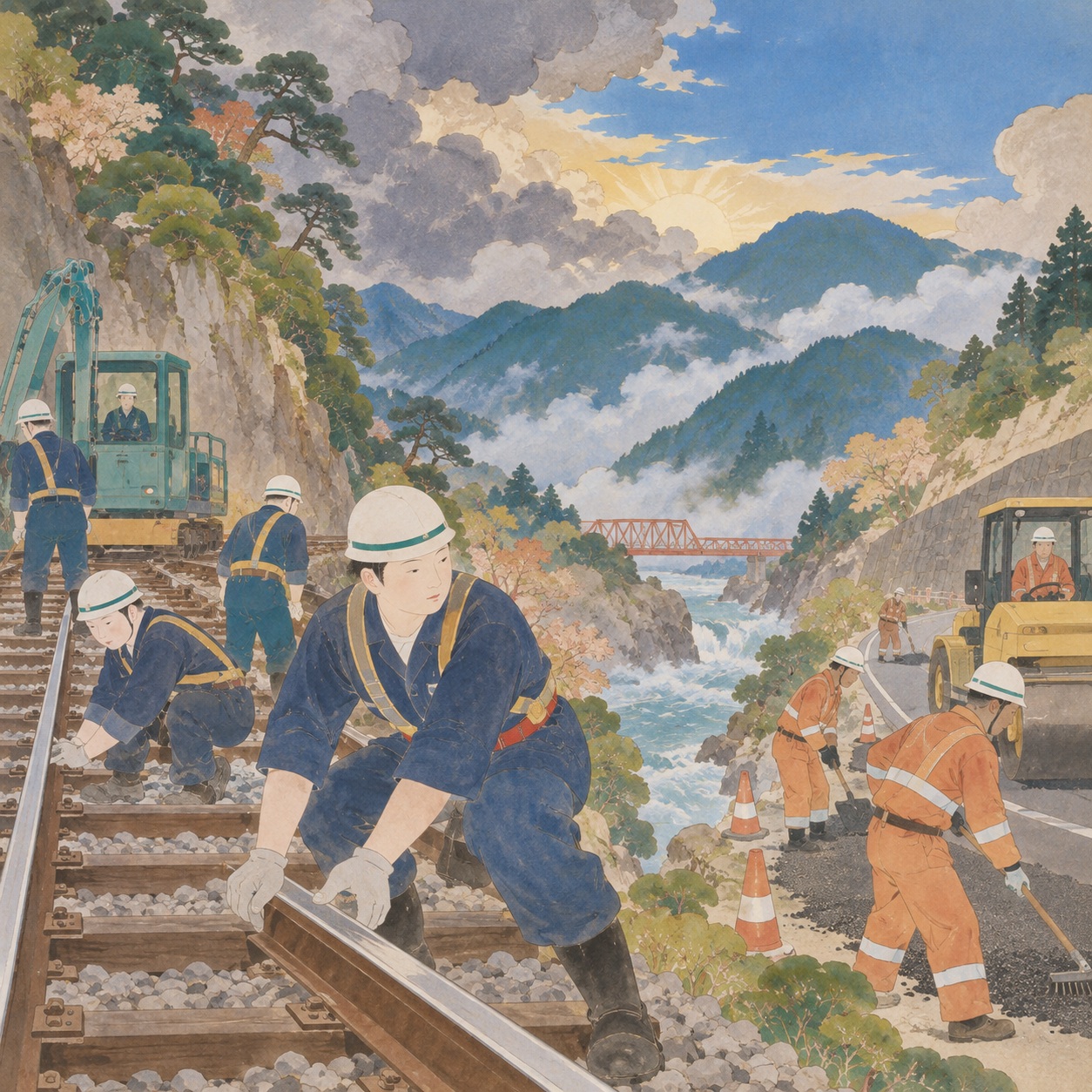
Disaster recovery is usually divided by ownership. A railway company repairs the railway. A prefecture repairs its road. National agencies support each under different laws, budgets and technical systems. That division works reasonably well in normal times. It becomes a liability when a railway and a highway run beneath the same slope and are damaged by the same landslide.
That is the problem now facing Chiba Prefecture. Typhoon No. 25 damaged the JR Uchibo Line and adjacent Prefectural Route 287. JR East says the Anegasaki–Kisarazu rail section is expected to remain out of service for at least about three months. On September 25, JR East’s Chiba Business Headquarters, Chiba Prefecture, MLIT’s Kanto Regional Development Bureau and Kanto District Transport Bureau created a formal coordination meeting for cross-project disaster restoration.[1][2]
The wording matters. This is not merely a railway meeting and not merely a road meeting. The agencies are treating the two damaged assets as interdependent projects in one corridor.
The railway is not the only damaged asset
The official meeting notice identifies the Anegasaki–Nagaura section as a location where soil entered the railway corridor. JR East subsequently closed the broader Anegasaki–Kisarazu section and says restoration will take at least three months.[2][4]
But Route 287 runs alongside the line. Where both systems occupy the same narrow corridor, a slope failure can affect railway access, roadway access, work zones, drainage and the ability to bring heavy equipment to the site. Repairing one asset can physically depend on progress on the other.
That is why MLIT uses the phrase “inter-project coordination.” The railway and road have different owners. The slope does not.
The purpose of coordination is sequencing, not paperwork
The September 25 meeting ran from 4 p.m. to 5 p.m. by web conference. Participants were East Japan Railway Company’s Chiba organization, Chiba Prefecture, the Kanto Regional Development Bureau and the Kanto District Transport Bureau. The formal agenda was the damage to the Uchibo Line and Route 287 and their future restoration schedules.[2]
The most important coordination question in a shared disaster site is not simply “Who pays for which structure?” It is “Who can enter the site, and when?” Slope inspection, stabilization, debris removal, temporary access, drainage work, track reconstruction, roadbed work, retaining structures and final paving can all depend on one another.
In project-management terms, the corridor has a shared critical path. If the slope is not safe, rail crews cannot work below it. If road access is blocked, construction equipment may not reach the railway efficiently. If two owners design slope protection separately, they can create duplicated work or conflicting sequences.
A century-old corridor
This part of the Uchibo Line is not recent infrastructure. Sodegaura City records that the railway between Anegasaki and Kisarazu opened in August 1912. Naraha Station—today’s Sodegaura Station—opened with the line. Nagaura Station followed in 1947, and Naraha was renamed Sodegaura in 1974.[7]
Over the following century, the region gained National Route 16, expressways, the Tokyo Bay Aqua-Line and extensive highway-bus networks. Sodegaura describes its accessibility as having improved dramatically with the Aqua-Line, the Tateyama Expressway and the Ken-O Expressway.[8]
That means the region is not dependent on a single railway in the way it was in 1912. Yet a long rail closure still changes daily life because theoretical transport redundancy is not the same as equivalent commuting capacity.
Even substitute buses are a scarce resource
JR East initially examined substitute-bus service from September 28. By September 27, however, the company said securing enough vehicles remained extremely difficult because charter-bus demand was already high during the autumn travel season and around major events. It said it would announce a start date once sufficient vehicles could be arranged.[4]
This is a useful reminder of how hard it is to replace rail capacity with buses. One train can carry hundreds of passengers. Replacing a rail corridor requires not only multiple buses but drivers, staging areas, boarding space, dispatch staff and road capacity.
And the same storm damaged multiple transport links across Chiba. Disaster recovery therefore creates competition not just for excavators and construction crews, but also for buses and drivers.
When rail and road share the same slope, valley or coastal strip, they can fail together. Two modes do not necessarily equal two independent backup routes.
The efficiency—and vulnerability—of parallel infrastructure
Railways and roads frequently follow the same geography because both seek the same scarce terrain: flat land between hills and the sea, river valleys and historic transport corridors. In peacetime, that concentration is efficient. Stations are accessible from roads, development clusters around both, and logistics connections are short.
In extreme weather, the same geography becomes a common point of failure. A single slope can threaten both assets. In resilience engineering, this resembles a common-cause failure: systems that appear separate can be disabled by one physical event because they share an exposure.
The Uchibo Line / Route 287 restoration therefore raises a question larger than this storm: when two critical networks occupy one corridor, should slope protection, drainage and emergency access be planned jointly before disaster rather than coordinated only after failure?
Recovery is not simply putting everything back where it was
Disaster restoration has two competing clocks. Communities need transport restored quickly. Engineers need enough time to ensure the repaired corridor will survive the next heavy-rain event.
Removing soil and rebuilding track can produce a visibly faster reopening than full slope stabilization. But reopening beneath an unstable slope creates future risk. Permanent drainage, retaining structures, rockfall protection or slope reinforcement may take longer but reduce the chance of repeated closure.
JR East’s phrase “at least about three months” appropriately leaves uncertainty. The timetable depends on ground conditions, slope safety and coordination with road works—not merely replacing rail and sleepers.
A reopening date is only one measure of recovery
The first train through the repaired section will be an important milestone, but it will not by itself mean the corridor has fully recovered. Service frequency matters. Road restrictions matter. Commuting and school travel times matter. Local buses, freight movements and access to stations matter.
As of the latest JR East information checked for this article, service on the line remained reduced on both sides of the closed section, meaning the disruption extends beyond the exact landslide sites.[4]
Infrastructure resilience is therefore better measured as restoration of system capacity, not simply physical reopening.
Why this case matters beyond Chiba
Japan has thousands of kilometers of transport infrastructure built through narrow terrain and exposed to stronger rainfall events. Railways, roads, rivers, power and communications may have different operators, but disasters do not respect institutional boundaries.
The significance of Chiba’s coordination meeting is not that agencies are talking to one another. They do that routinely. The more important step is creating a formal mechanism to coordinate the actual restoration sequence between railway and road projects.
The Anegasaki–Kisarazu corridor has carried people for more than a century. The challenge in 2026 is not simply to reconnect the track. It is to rebuild a shared corridor in a way that recognizes what the storm made obvious: the railway and road may be managed separately, but physically they are part of the same landscape.
Sources
- MLIT Kanto Regional Development Bureau: coordination meeting for JR Uchibo Line / Prefectural Route 287 disaster restoration
- Kanto District Transport Bureau / Kanto Regional Development Bureau: meeting notice and participants, Sept. 25, 2026
- Kanto District Transport Bureau: coordination meeting result
- JR East: Uchibo Line service information
- MLIT: Typhoon No. 25 damage reports
- Chiba Prefecture: restoration status after Typhoon No. 25
- Sodegaura City: history of Sodegaura and Nagaura stations
- Sodegaura City: city profile and transport development
