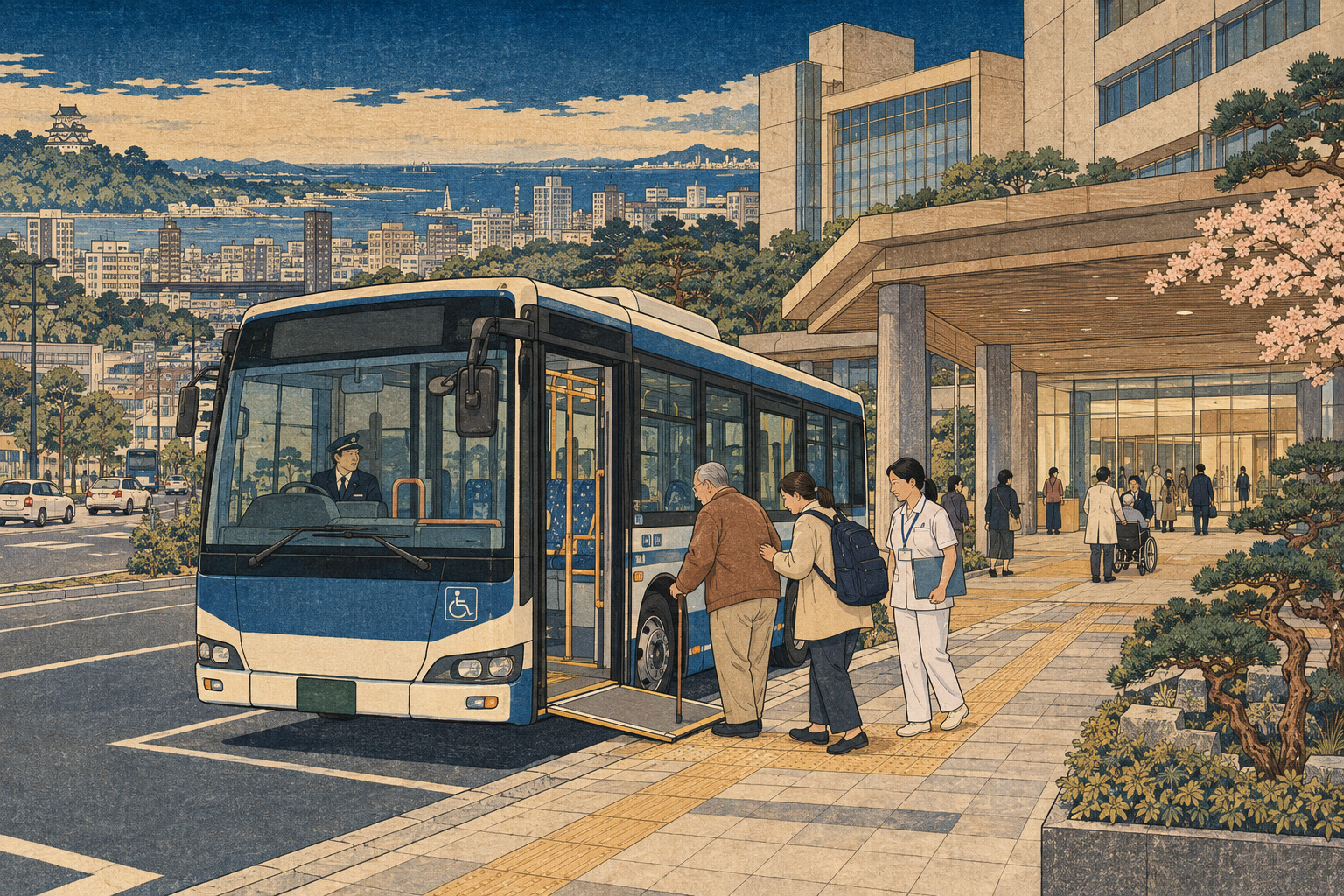
A hospital move redraws more than a map. It changes the journey to an appointment, the route a family uses to visit and the commute that gets staff onto a ward. In Chiba, proposed October bus changes will help connect the relocated municipal hospital to surrounding railway stations—but passengers should not assume that an old hospital-bound bus will take them to the new building.
Keisei Bus Chiba Central’s September 25 notice proposes changes from October 1 and says regulatory approval is still being sought from the Kanto District Transport Bureau. This report treats the changes as planned, using information checked through September 28.[1]
The new institution’s official English name is Chiba Makuhari Kaihin Municipal Hospital. Its address is 3-1-27 Wakaba, Mihama Ward, Chiba. It opens October 1, but outpatient consultations begin October 6. That distinction is the first thing patients need to carry into their travel planning.[2]
Opening day is not the outpatient start date
| Date | Published arrangement |
|---|---|
| September 29 | Last outpatient day at the old Kaihin hospital |
| September 30–October 5 | Outpatient services suspended for the move |
| October 1 | New hospital opens; related bus changes are planned to take effect |
| October 6 | Outpatient care begins at the new hospital |
Patient cards and medical records transfer without a separate migration procedure for patients. The hospital also warns that its main telephone and other lines will be unavailable for about an hour from noon on October 1 during the connection changeover. A functioning transport link does not mean every clinical or administrative service is available on the same date.[2]
Nighttime urgent care has its own transition. From September 30 through October 2, the temporary location is the holiday emergency clinic inside the General Health and Medical Center at 1-3-9 Saiwaicho, Mihama Ward. Registration is 7:30–9:30 p.m., with treatment starting at 8 p.m. This arrangement is specifically for nighttime urgent care; it is not a statement that all hospital emergency services are operating normally. The city publishes separate restrictions on emergency acceptance.[2],[3]
The most useful route is the one that serves the hospital
The city has designated Kaihimmakuhari and Shin-Kemigawa as the principal rail connections. Its walking estimates are 20 minutes from Kaihimmakuhari and 22 minutes from Kemigawahama. For someone attending treatment, accompanying a child or supporting a relative, the bus portion can be an important part of whether that journey is manageable.[3],[8]
| Station | Published route example | Shortest indicative ride |
|---|---|---|
| Kaihimmakuhari | Bay Town Line toward Shin-Kemigawa; alight at 幕張海浜病院 | About 8 minutes |
| Shin-Kemigawa | Bay Town Line toward Kaihimmakuhari; alight at 幕張海浜病院 | About 8 minutes |
| Kemigawahama | Marine Stadium Line toward ZOZO Marine Stadium; alight at 幕張海浜病院 | About 7 minutes |
These are the city’s shortest indicative riding times. They exclude waiting, transfers and movement inside the hospital. They should not be read as a promise that a passenger leaving the railway platform eight minutes before an appointment will arrive on time.
The Japanese hospital-stop name, 幕張海浜病院, is worth keeping with an appointment reminder. More importantly, check the intermediate stops rather than only the final destination. The October Bay Town Line timetable at Shin-Kemigawa specifically identifies services via Wakaba Daini that do not serve the new hospital. A bus heading toward Kaihimmakuhari is not necessarily the right bus.[5]
That timetable also separates weekdays, weekends and holidays, and the year-end/New Year period. A connection that works for a Tuesday appointment should not automatically be assumed available for a Sunday visit. The return journey deserves the same attention as the outward trip.[5]
New links do not simply replace every old journey
The changes include hospital access on the Bay Town Line and new Shintoshin Makuhari Line services: 幕04 from Makuharihongo via High-Tech-dori, and 海53 from Kaihimmakuhari’s park-gate stop. Meanwhile, the old 海浜病院 stop is being removed from routes including the Takasu Line, and the Satsukigaoka Danchi service is planned to end at Kemigawahama.[1]
For existing patients, the question is therefore not merely whether their familiar route still runs. It is where that route now ends and how the rest of the trip connects. A journey can become more complicated without becoming much longer in distance. Familiarity with the former hospital’s name and location can also make an outdated instruction seem reassuringly correct.
The city’s outline map shows direct links from other stations, including Inage, Inagekaigan and Makuharihongo. But direct does not mean frequent. Its planning summary listed just two weekday services and none on weekends or holidays for Makuharihongo. That is an earlier planning indication, not a substitute for the operator’s October timetable; passengers must check the particular departure they intend to use.[4],[12]
A hospital built for a coastal new town
Kaihin’s institutional history begins with the development of the coastal new town. It records a new-town construction plan in 1967 and medical-facility planning in 1971. The hospital opened in October 1984. Its origin was the practical question of how a growing residential district would obtain essential medical care.[6]
Its responsibilities subsequently broadened. The hospital became a designated disaster base hospital in 1996 and received prefectural recognition as a perinatal maternal and child medical center in 2010. The institution’s history links ordinary outpatient journeys with services needed at particularly demanding moments in family and community life.[6]
The city chose relocation and reconstruction to address the aging facility while retaining a core hospital in western Chiba. It adopted a redevelopment concept in 2020, followed by the basic plan and design in 2022. Completion of detailed design and the start of construction were announced in December 2023. The bus changes translate that long capital project into everyday access.[8]
The new hospital is planned with 349 beds, 56 more than the existing facility. The city says it will retain perinatal and pediatric functions while strengthening emergency care and services relevant to an older population. Physical capacity matters, but so does the ability of the intended users to reach it repeatedly.[7]
Three users, three different transport problems
For an outpatient, the critical connection may be an early arrival with enough time to find a department. For a visitor, it may be a weekend service after other responsibilities are finished. For a worker, the decisive departure may be outside the main daytime flow. A single daily bus total cannot describe all three experiences.
The hospital’s published nursing arrangements illustrate the issue. They include an 8:30 a.m.–5 p.m. day shift, a two-shift night duty from 4:30 p.m. to 9:30 a.m., and a three-shift late duty ending at 1 a.m. These are the currently published patterns, not a confirmed roster for every department after the move. They show why a morning-and-evening service summary cannot establish that all staff commutes are covered.[9]
Accessibility likewise extends beyond a bus entering hospital grounds. For a wheelchair user or someone walking with assistance, the station exit, boarding point, vehicle and path to the hospital entrance form one journey. Where assistance is needed, arrangements should be checked with the operator for the intended service. The route announcement alone does not establish the conditions of every vehicle and every connecting path.
Japan.co.jp’s assessment is that the practical test will come after operation begins: whether passengers can identify the right service, make transfers and return home without an unreasonable wait. Useful evidence would include actual waiting times, missed connections and questions repeatedly reaching hospital reception—not simply the number of routes shown on a map.
The information journey also needs to work
There is a separate booking change. In a September 7 notice, the hospital said direct telephone appointment bookings from patients would end after relocation, while bookings from medical institutions by fax and web would continue. This is not an announcement that patients should switch to a general self-service online booking system. Referral and appointment instructions need to be understood before travel is arranged.[10]
The bus operator’s September 25 announcement also said revised PDF schedules were available while the new web timetables were still awaiting publication and did not yet appear in search results. During that transition, the effective date on a timetable matters. An apparently authoritative search result can still describe the service before the move.[1]
The source links below lead to the relocation notice, planned schedules and the operator’s current route-and-fare search. Readers should select the actual travel date and verify both directions. The hospital and bus network are changing together; a successful move requires the public information to connect as carefully as the physical routes.[11]
The larger lesson for hospital planners and transport operators is straightforward. Access is part of delivering care. A new building becomes a working community institution when patients, families and staff can understand how to reach it—and how to get home again.
