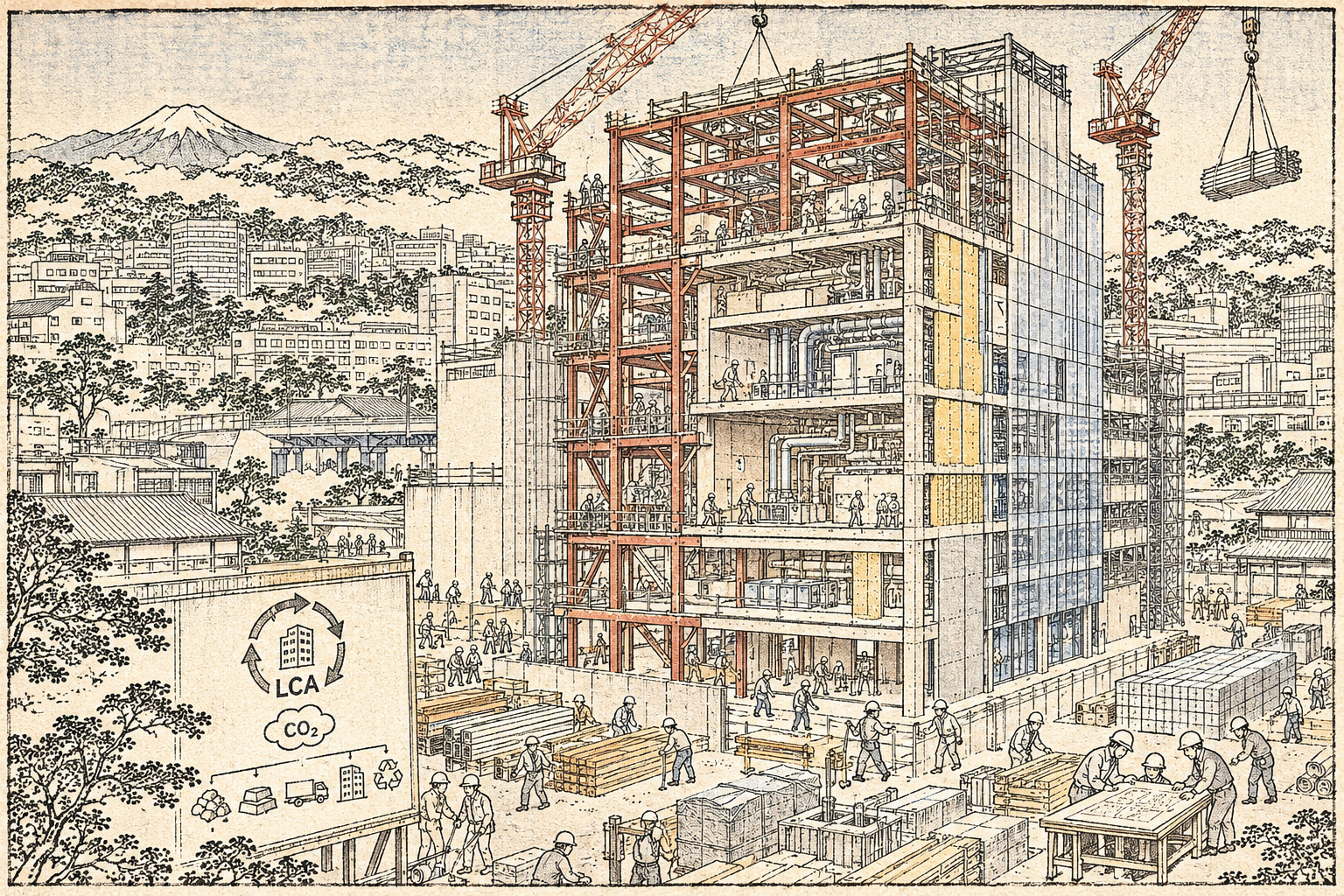
- The building has a carbon history before anyone moves in
- Energy-efficient is not necessarily low-carbon over a lifetime
- A November meeting about the rules that make the numbers credible
- The policy road from carbon neutrality to legislation
- Who may have to calculate, file, explain or certify
- Steel, concrete and product data become part of the design brief
- J-CAT: a Japanese accounting infrastructure already exists
- Seismic resilience and long life cannot be sacrificed to a carbon score
- An unfamiliar accountability problem for the property business
- International comparability—and a distinctly Japanese reality
- What to watch after November 9
The building has a carbon history before anyone moves in
A new office tower may open with efficient lighting, sophisticated heating and cooling, and an impressive energy certificate. Yet by its first day of operation it has already accumulated emissions from steelmaking, cement kilns, glass production, equipment manufacturing, trucking and construction. The emissions associated with a building do not begin when the first tenant switches on the lights.
Japan is now translating that reality into a national system of building life-cycle carbon assessment. On November 4, 2026, the Ministry of Land, Infrastructure, Transport and Tourism announced the ninth meeting of its expert committee, scheduled for November 9, to continue work on uniform calculation rules and implementation details.
The legislative stage is further advanced than a casual reading of the announcement might suggest. An amendment to the Building Energy Efficiency Act was enacted in July 2026, establishing the framework for assessment. The central question is no longer whether the government should consider whole-life emissions, but how consistent measurement and reporting can work in practice by fiscal 2028. The results of the forthcoming meeting are not yet known.
Energy-efficient is not necessarily low-carbon over a lifetime
Japan has spent years encouraging better insulation, more efficient equipment and lower energy consumption in buildings. Those improvements remain essential. But as operating energy becomes cleaner, the emissions arising before a structure opens—and during later renovation or demolition—can account for a more consequential share of the total.
Life-cycle assessment, or LCA, follows environmental impacts through stages: raw materials, product manufacturing, delivery, assembly, operation, maintenance, replacement, demolition and waste treatment. Analysts often distinguish embodied carbon associated with materials and other physical life-cycle activities from operational carbon associated with energy used in the building. Precise definitions and boundaries depend on the methodology.
A high-performance glazed facade may reduce cooling demand but require more carbon-intensive manufacturing. Insulation can save energy over decades while creating an upfront materials burden. Solar equipment can lower operational emissions while also requiring manufacturing and eventual replacement. The right question is not whether a product is labelled green, but how its benefits and costs add up over a defined service life.
A November meeting about the rules that make the numbers credible
The ninth committee meeting is scheduled for November 9 from 9:30 to 11:30 a.m. Japan time, with the agenda covering previous discussions, proposed responses to outstanding issues and an exchange of views. MLIT says the proceedings will be publicly streamed and the materials and minutes subsequently published.
The preceding meeting on October 5 addressed the amended statute, its timetable and preliminary approaches to specific implementation questions. The challenge is practical: if a developer in Osaka and another in Sendai calculate the same kind of building using inconsistent product factors, service-life assumptions or boundaries, their reported carbon totals may say more about accounting choices than design quality.
It is therefore premature to state which final factors, templates or thresholds will emerge from the November meeting. The announcement is a notice of deliberation, not proof that new emissions ceilings or detailed filing rules have already been adopted.
The policy road from carbon neutrality to legislation
Japan declared a national objective of carbon neutrality by 2050 in October 2020. MLIT describes the buildings-related sector as accounting for roughly 40% of domestic greenhouse-gas emissions, a broad sectoral estimate that should not be mistaken for the embodied-carbon share of construction materials alone.
In 2022, a public-private-academic initiative was organized through the Institute for Built Environment and Carbon Neutral for SDGs, known as IBECs, to advance building-life-cycle calculation and data. A trial calculation tool appeared in May 2024; the formal J-CAT tool followed in October that year. A cross-ministry initiative set out its basic concept in April 2025, aiming at a system beginning around fiscal 2028.
MLIT convened technical and policy experts in 2025. An interim report followed in January 2026, with the Social Infrastructure Development Council issuing an advisory response. The government approved its legislative bill in March, and the amendment was enacted in July. The current discussions are thus part of a multi-year shift from voluntary measurement toward regulated disclosure structures.
Who may have to calculate, file, explain or certify
The government’s phased roadmap envisages a disclosure and explanation framework that initially concentrates on larger buildings. Examples in the January interim roadmap included filing by developers of new office buildings of at least 5,000 square meters, and explanations associated with new non-residential buildings of at least 2,000 square meters. The roadmap also envisages third-party certification and disclosure for various new and renovated buildings.
Those size figures are examples in an interim planning document, not a substitute for the final implementing rules. Requirements can differ by building category, development stage, timing and the role of the parties involved. It would be misleading to tell readers that every Japanese house will be required to calculate its entire carbon footprint in 2028.
Just as importantly, measurement and reporting are not the same as a mandatory maximum emissions limit. The proposed approach starts by making emissions visible so that designers, builders and buyers can make better decisions; subsequent stages contemplate broader use and stronger reduction measures.
Steel, concrete and product data become part of the design brief
Consider two structures with similar floor area and energy ratings. They may have different embodied emissions because of steel-production technology, concrete mix design, glazing, insulation, mechanical equipment, transport distances and construction processes. An honest comparison requires credible emission factors and clearly defined measurement boundaries.
Environmental product declarations, or EPDs, can provide verified product-specific information, but they are not automatically comparable if their calculation scope, units, power assumptions or verification methods differ. Generic industry-average data are useful when product-specific evidence is unavailable, yet they can obscure the improvements made by a manufacturer using a cleaner process.
The choice between detailed product evidence and generalized factors matters for competition. Credible numbers could reward lower-emission materials and expose unsupported sustainability marketing. At the same time, policymakers must consider the cost of generating data for smaller suppliers who lack specialized reporting teams.
J-CAT: a Japanese accounting infrastructure already exists
J-CAT, the Japan Carbon Assessment Tool for Building Lifecycle, emerged from work coordinated through IBECs. The formal J-CAT system for general buildings and multifamily housing was released in October 2024, following a trial version. It offers simplified, standard and detailed approaches to calculation at different phases of a project.
IBECs also released a trial version for detached homes in November 2025 and announced in September 2026 that J-CAT could be used in LEED certification. These developments connect Japan’s domestic technical practice to an international certification context, although they do not make every national calculation system identical.
Having a tool is only one step. Building inventories, service-life assumptions, product databases, quality control and reporting forms need to work together. The challenge before the government is to turn a technical exercise into a repeatable process that designers and authorities can check.
Seismic resilience and long life cannot be sacrificed to a carbon score
Japanese buildings must meet demanding performance expectations because of earthquakes, wind, fire and severe weather. A structure made with less material might have lower manufacturing emissions on paper but be a poor choice if it compromises safety or durability. Carbon accounting should inform design, not replace structural engineering.
The trade-off was discussed explicitly in Japan’s Diet in June 2026. Government testimony emphasized seismic and fire performance, longer building life and the need to present several building attributes together rather than allowing a carbon metric to crowd out other necessities.
Renovation raises similar questions. Retaining a sound building can avoid substantial new construction emissions, but reinforcement and energy upgrades use materials of their own. Comparing new construction with refurbishment requires a common functional baseline and a realistic remaining service life, not a slogan that one option must always be greener.
An unfamiliar accountability problem for the property business
Once building-carbon reporting becomes routine, developers may need a better understanding of the emissions locked into procurement decisions. Architects and engineers will have reason to connect quantity takeoffs and building information models with carbon factors. Contractors may need stronger records of substitutions, material delivery and waste handling.
Manufacturers may compete not only on price and structural performance, but also on reliable product data. Investors and tenants could gain a more meaningful basis for comparing buildings, although the mere existence of an assessment or certificate does not establish a measurable property-value premium.
Differences between a model calculated during design and the building actually delivered will be central. If a specified product is substituted, an air-conditioning system changes or the construction schedule lengthens, the carbon estimate can change. A dependable system needs procedures for reconciling forecasts with as-built evidence.
International comparability—and a distinctly Japanese reality
European markets and international certification systems already use variations of whole-life-carbon assessment. Compatibility may help Japanese manufacturers and property developers communicate with overseas investors and customers. Recent J-CAT developments point toward that possibility.
Japan, however, faces its own conditions: significant seismic risk, humid and varied climates, regional differences in electricity supply, and a diverse building stock. Simply importing emission factors or assumed building lives from another market may produce misleading conclusions. Methods must be internationally intelligible without ignoring the structures that Japan actually builds.
Meaningful comparisons also need common functional units. A large office tower and a detached home differ greatly in total emissions; life-cycle emissions per square meter and per year can provide a better basis for some questions, while service quality and building longevity remain essential context.
What to watch after November 9
The next test is specificity. Which calculation boundaries will be required? How will product-level factors be selected and verified? Which project categories will fall into each reporting channel? What will architects have to explain to clients? How will third-party certification and public disclosure operate? What transition time will smaller practitioners receive?
The November 4 announcement confirms a meeting, not the outcome of that meeting. This article is based on published MLIT documents, parliamentary proceedings and materials from the J-CAT administrators. No original interviews with policymakers or project teams have been conducted, and figures that remain examples in the preliminary roadmap are identified accordingly.
Ultimately, the point is not to create a new column in a spreadsheet. It is to help designers, contractors, clients and manufacturers make decisions that lower emissions while preserving safety, comfort and the useful lives of buildings. Japan’s move from energy-efficient buildings toward accountable whole-life carbon is now entering the stage where the rules will determine whether that promise is practical.
Sources and reporting methodology
Document research based on Japanese government announcements, parliamentary records and materials published by J-CAT’s administrators. No interviews were conducted; the November 9 meeting has not yet taken place.
- 国土交通省:第9回建築物LCA制度検討会、2026年11月4日発表 / November 4 meeting notice
- 国土交通省:検討会資料・中間とりまとめ / MLIT policy papers and interim report
- 国土交通省:2026年10月1日、第8回検討会開催案内 / October meeting notice
- 国土交通省:2026年3月27日、改正案閣議決定 / Cabinet bill decision
- 国土交通省:2026年1月29日、社会資本整備審議会第四次答申 / Advisory council response
- 国土交通省:建築物省エネ法と政策の経緯 / Building energy law history
- 国土交通省:2024年10月31日J-CAT正式版公開 / Official J-CAT release
- 住宅・建築SDGs推進センター:J-CAT公式案内 / IBECs calculation tool
- 住宅・建築SDGs推進センター:J-CAT機能と算定方式 / J-CAT methodology
- 衆議院:2026年6月3日国土交通委員会議事録 / Diet debate on durability and seismic safety