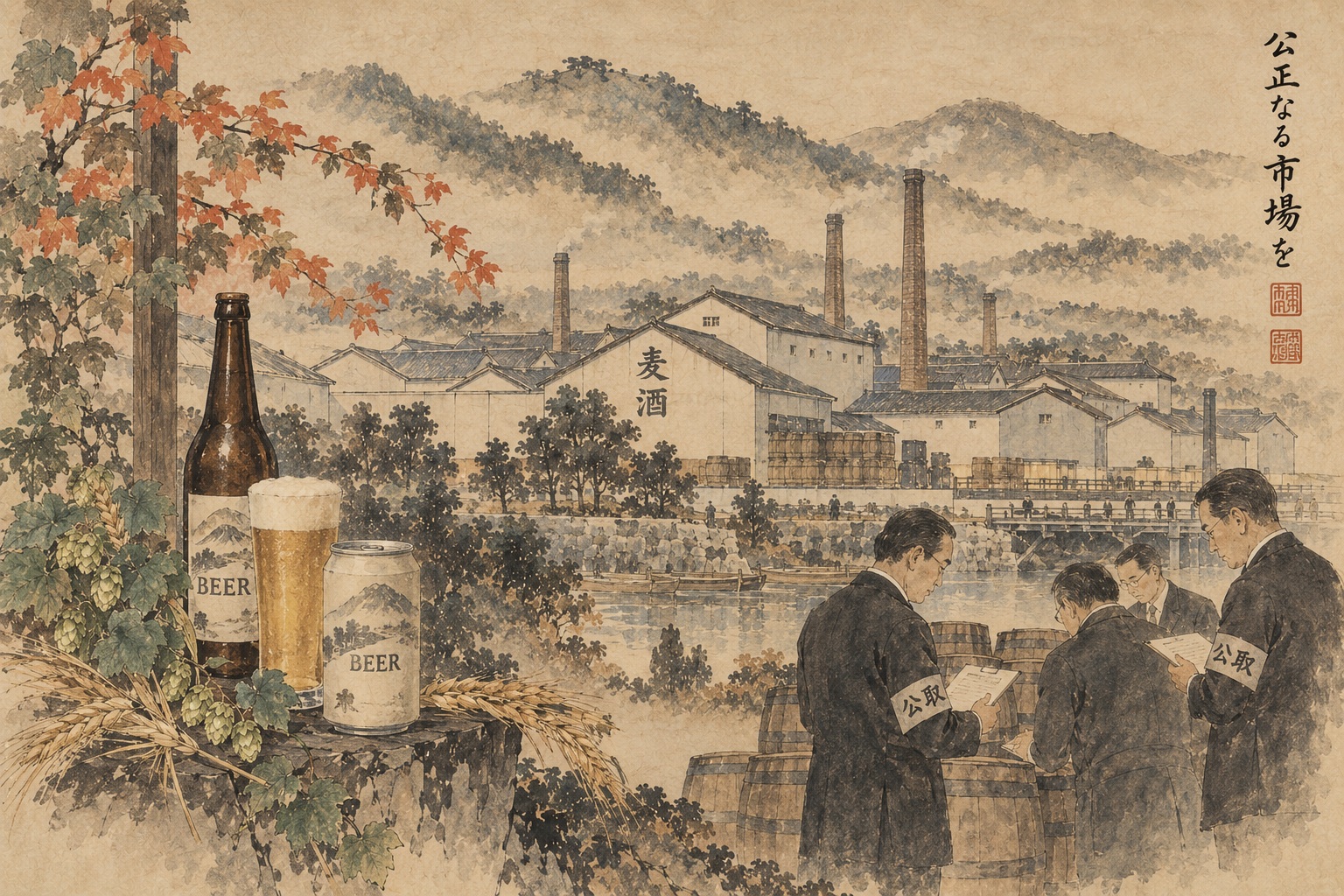
For Japanese consumers, beer price increases have become familiar. Since 2022, brewers have pointed to higher costs for barley, corn, aluminum cans, cardboard, energy and transportation. Those pressures were real, and the country’s largest beer companies publicly announced price revisions as their costs rose.
The antitrust question now confronting the industry is different. Japan’s Fair Trade Commission is investigating whether Asahi Breweries, Kirin Brewery, Suntory and Sapporo Breweries coordinated pricing that each company was legally required to set independently. On October 7, the regulator used its compulsory criminal-investigation powers, a procedure that can involve court-authorized searches and seizures and can lead to a criminal referral to prosecutors.[1][2]
The issue is not that several companies raised prices at the same time
Japan’s Antimonopoly Act prohibits “unreasonable restraint of trade.” The JFTC describes a cartel as competitors communicating and jointly determining matters such as prices or output that each business should decide for itself.[3]
Parallel price increases are not automatically illegal. Companies exposed to the same commodity, packaging, energy and freight markets can reach similar decisions independently. In 2022, Asahi, Kirin and Suntory each published formal explanations for October price increases, citing substantial increases in raw materials, packaging, energy and logistics costs.[4][5][6]
The legal question is whether the companies arrived at those decisions independently — or whether competitors communicated about the timing or scale of the increases.
Why the use of compulsory investigation powers matters
The JFTC distinguishes between administrative investigations and investigations of suspected criminal offenses. For the latter, judges can authorize inspection, search and seizure. The agency says it seeks criminal sanctions in serious cartel cases that are believed to have a broad impact on people’s lives.[2]
At an October 7 press conference, JFTC Secretary-General Hiroo Iwanari acknowledged that the agency was conducting a criminal-procedure investigation into suspected price cartel conduct by four alcohol manufacturers. He also emphasized a basic competition-law principle: price is a fundamental competitive tool and must be determined independently by each company based on its own costs and business strategy.[7]
Investigators are looking at timing and size of price increases
Reuters reported that the four companies are suspected of coordinating prices over several years and said the JFTC was examining price increases around October 2022 and April 2025. Japanese television reports have also said investigators suspect sales personnel exchanged information or coordinated the timing and extent of shipment-price increases.[1][8]
Those remain allegations. Japan.co.jp is not presenting them as established fact. If investigators ultimately demonstrate advance agreement over timing or price increases, however, the conduct could fall squarely within the JFTC’s definition of a price cartel.
All four companies confirmed the investigation
Asahi Breweries said on October 7 that it had undergone a compulsory JFTC investigation on suspicion of violating the Antimonopoly Act and would cooperate fully.[9]
Kirin Holdings said subsidiary Kirin Brewery had been searched and that the group would cooperate fully with the regulator’s investigation and requests.[10]
Suntory Holdings said Suntory Co. was inspected in connection with suspected Antimonopoly Act violations involving alcohol transactions. It apologized for the concern caused and said it would cooperate fully.[11]
Sapporo Breweries likewise acknowledged an inspection involving suspected unreasonable restraint of trade over alcohol sales prices and said the impact on earnings was not yet known.[12]
The cost pressures behind the price increases were genuine
The investigation does not erase the economic environment in which the increases occurred. Asahi’s April 2022 announcement cited expensive malt and corn, aluminum and cardboard, energy and land and sea transportation. Kirin cited rising barley, corn, alcohol, materials, energy and logistics costs. Suntory described global increases in grains, packaging materials, energy and logistics.[4][5][6]
That distinction is central. A company can have a legitimate economic reason to raise prices and still violate competition law if it agrees with rivals on how or when to do so. Common cost pressure does not create an exemption from independent price setting.
A concentrated market with deep historical roots
Japan’s beer industry grew around a small number of powerful national brands. Sapporo traces its roots to the Kaitakushi brewery founded in 1876. Kirin’s predecessor, the Japan Brewery Company, was established in 1885, with Kirin Brewery formed in 1907. Asahi’s corporate lineage reaches back to the Osaka Beer Company founded in 1889. Suntory entered beer later but became a major national competitor, particularly in premium beer.
That history created strong brands, nationwide distribution systems and unusually durable market positions. Reuters reported that the four companies under investigation together control more than 90% of the domestic beer market.[1]
High concentration is not illegal. It does, however, increase the importance of preserving price rivalry. When only a few companies dominate a market, any agreement that weakens competition can affect wholesalers, retailers, restaurants and households nationwide.
Japan’s alcohol tax system has long shaped beer pricing
Beer pricing in Japan has also been shaped by taxation. High beer taxes encouraged manufacturers to develop happoshu and later “new genre” products designed around lower tax categories. Consumers experienced tax differences directly through shelf prices, while manufacturers competed intensely through product formulation.
Reforms have gradually compressed those tax differences. In October 2023, beer taxes fell while taxes on new-genre products rose. Another change took effect on October 1, 2026. Asahi’s official notice said beer taxes fell by ¥26,000 per kiloliter while happoshu and new-genre rates rose, prompting category-specific producer-price revisions.[13]
This is another reason why similar timing does not by itself prove a cartel. Tax changes, commodity costs, wages and logistics can push competitors in the same direction. Investigators must show an agreement or communication that replaced independent decision-making.
The corporate risk extends beyond a surcharge
If a violation is established, the JFTC can issue cease-and-desist orders and surcharge payment orders. Japanese competition law also provides for criminal sanctions in serious cartel cases and creates avenues for damages claims.[14]
The agency has recently emphasized price-cartel enforcement. In fiscal 2025 it issued 11 cease-and-desist orders, seven involving price cartels, and imposed roughly ¥9.55 billion in surcharges across 36 businesses. In April 2026 it referred five companies to prosecutors in a diesel-fuel price-cartel case after conducting a criminal investigation.[15][16]
For major consumer companies, however, the exposure is broader than fines. Boards must examine compliance oversight, industry-association rules, contacts between sales personnel and competitors, document retention, internal reporting and possible leniency issues. A cartel investigation can become a corporate-governance investigation inside the company itself.
When an industry meeting becomes a competition-law problem
Competitors are allowed to meet. Industries legitimately cooperate on recycling, packaging standards, responsible drinking, safety, taxation and other shared policy issues.
The risk begins when conversations move to competitively sensitive information — current or future prices, planned increases, timing, volumes, customer-specific terms or market allocation. Japanese reports have alleged that sales personnel may have held informal discussions after meetings connected with the industry association. That allegation has not yet been adjudicated, but it illustrates why sophisticated companies use strict antitrust protocols for trade-association meetings.[8]
The consumer impact cannot yet be calculated
Higher producer prices can affect retail and restaurant costs, but manufacturer price revisions are not identical to the final price paid by consumers. Wholesaler margins, retailer competition, promotional discounts and individual contracts all influence the outcome.
It is therefore too early to state how much — if anything — consumers overpaid because of the conduct under investigation. Establishing that would require a defined violation period, affected products, transaction data and a credible counterfactual price.
Investors priced the uncertainty immediately
Shares of the three listed groups fell after the news. Reuters reported that Sapporo dropped as much as 3.73%, Kirin a little over 3% and Asahi nearly 2.5% before recovering some of the declines. Suntory Holdings is privately held.[1]
The market reaction does not establish wrongdoing. It reflects uncertainty: how long the investigation will last, whether prosecutors will become involved, whether financial penalties or civil claims could follow and whether management or brand reputation will be affected.
What to watch next
The decisive question is what evidence the JFTC found sufficient to justify a criminal-procedure investigation and what that evidence ultimately proves. Investigators will likely focus on communications among companies, the people involved, the relevant price revisions, whether any agreement was implemented and how strongly it affected competition.
Corporate disclosures will matter too. Investors should watch for updates on earnings impact, internal investigations, compliance changes and board oversight. If the alleged conduct proves to have persisted for years, the governance question may become as important as the underlying pricing question.
Japan’s beer market is famous for intense brand competition. The antitrust investigation asks whether the most basic form of competition — price — remained equally independent. The answer will matter far beyond the beverage aisle.
Sources and references
- Reuters, “Shares of Japan beer makers fall after raids over cartel suspicion,” October 7, 2026.
- Japan Fair Trade Commission, criminal-investigation powers.
- Japan Fair Trade Commission, Antimonopoly Act restrictions.
- Asahi Breweries, 2022 price-revision announcement.
- Kirin Brewery, 2022 price-revision announcement.
- Suntory, 2022 beer and RTD price-revision announcement.
- TV Asahi, JFTC comments on the investigation, October 7, 2026.
- TV Asahi, report on alleged coordination, October 7, 2026.
- Asahi Breweries, statement on compulsory investigation, October 7, 2026.
- Kirin Holdings, statement on search of subsidiary, October 7, 2026.
- Suntory Holdings, statement on JFTC inspection, October 7, 2026.
- Sapporo Breweries, statement on JFTC investigation, October 7, 2026.
- Asahi Breweries, 2026 alcohol-tax price revision.
- Japan Fair Trade Commission, overview of Antimonopoly Act enforcement.
- JFTC, FY2025 Antimonopoly Act enforcement results, June 8, 2026.
- JFTC, criminal referral in diesel price-cartel case, April 17, 2026.
Reporting and verification cutoff: October 7, 2026. Japan.co.jp does not state that a cartel has been proven. The alleged agreement, duration, participants and consumer harm remain subject to investigation.