- A third meeting, and a different kind of test
- 1. Can Japan protect a lead against an elite opponent?
- 2. How much can the returning veterans contribute?
- 3. What does Shio Fukuda’s first call-up really signal?
- 4. Is Brazil’s younger squad a new problem for Japan?
- 5. What would it mean for Japan to take the initiative?
- How Japan’s football relationship with Brazil changed
- Tokyo, October 2025: the comeback was built, not gifted
- Houston, June 2026: a late goal changed the story
- A Singapore stage, not a championship final
- Five things to look for at kickoff
A third meeting, and a different kind of test
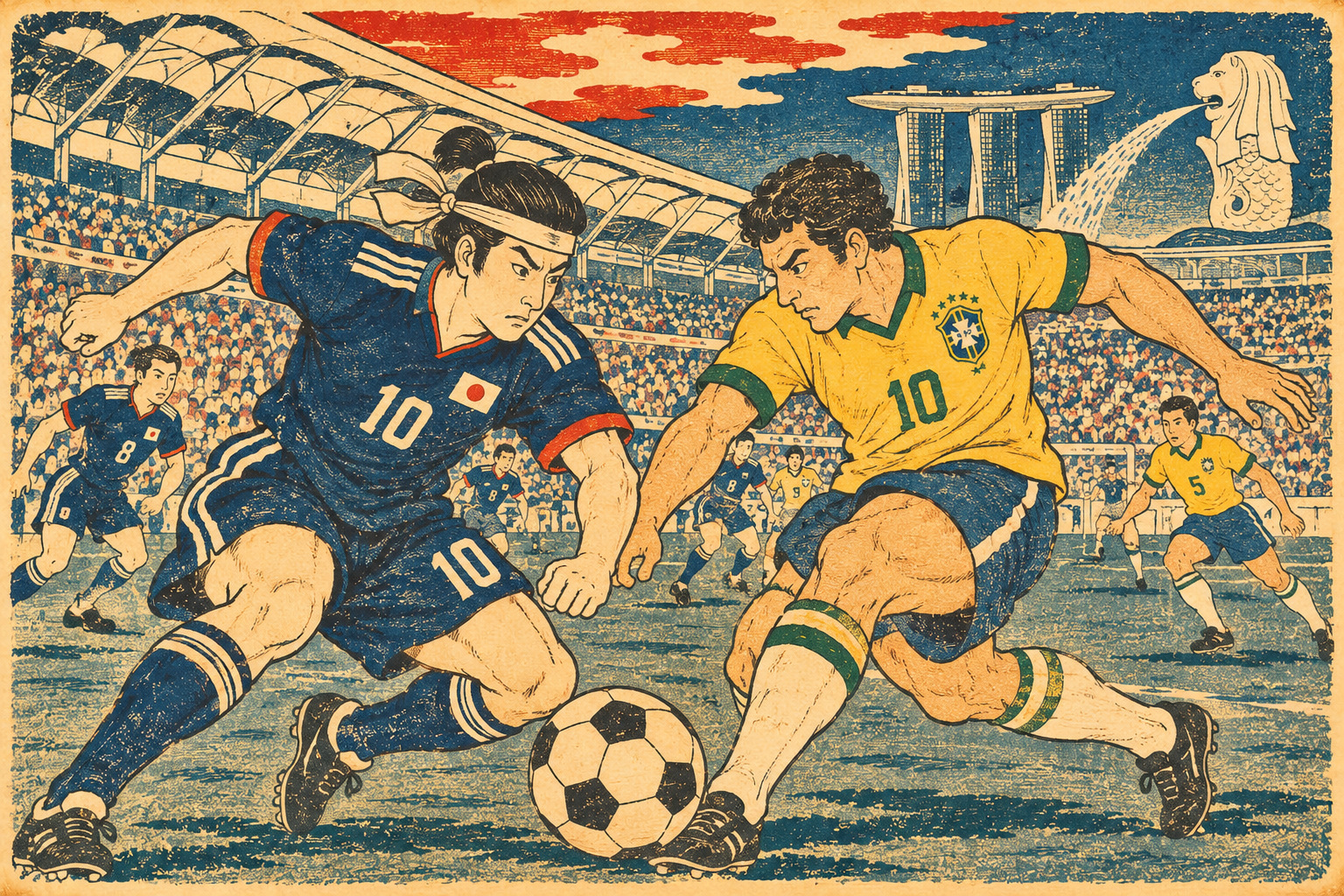
Japan and Brazil will meet on a neutral field in Singapore on November 14 carrying the memory of two extraordinary reversals. In October 2025 Japan came back from two goals down in Tokyo to beat Brazil 3–2 for the first time. Eight months later, at the 2026 World Cup in Houston, Japan took the lead only to lose 2–1 to a Brazilian winner deep in stoppage time. The latest meeting cannot be understood as a routine friendly or a simple rematch of either encounter.
The game is scheduled for 6:15 p.m. at Singapore National Stadium, or 7:15 p.m. in Japan, under the MIZUHO BLUE CHALLENGE THE KALLANG FOOTBALL SERIES SINGAPORE. Japan will also play Paraguay on November 17. The Japanese and Brazilian football federations have confirmed the fixture, but at this reporting cutoff there is no confirmed starting eleven or match result.
That distinction matters to an edition dated November 14. This feature is a documented pre-match analysis, written from federation material available through November 12 Japan time; it should be refreshed after the November 13 media conferences and again before kickoff. Five questions provide a more useful framework than pretending anyone can know the outcome.
1. Can Japan protect a lead against an elite opponent?
Consider the uncomfortable symmetry. In Tokyo on October 14, 2025, Japan trailed 2–0 at the interval, then scored through Takumi Minamino, Keito Nakamura and Ayase Ueda to win 3–2. At the World Cup on June 29, 2026, Kaishu Sano gave Japan a first-half lead against Brazil before Casemiro equalized and Gabriel Martinelli won the game at 90+5 minutes.
The tactical question has moved beyond whether Japan can score against Brazil. It is how Japan regulates risk after scoring, particularly when fatigue raises the cost of defensive errors. Can its midfield preserve access to the ball? Does the defensive line continue to press or retreat into a compact block? Can substitutions prevent a late collapse without eliminating the ability to counterattack?
No single game proves that Japan has solved or failed these problems permanently. But the two recent results offer a sharper basis for judging Saturday than the usual story about a rising Asian team challenging a traditional football power.
2. How much can the returning veterans contribute?
Japan Football Association coach Hajime Moriyasu named 28 players on November 4. His selections include Minamino and defender Koki Machida, both returning from serious anterior cruciate ligament injuries. Neither was available as a player for the summer World Cup. Minamino had traveled with the squad as a mentor; his return to competitive action came in October.
Their value should not be measured simply by whether either starts. Minamino can help connect midfield and attack in crowded areas, while Machida potentially adds balance and a different passing angle to the defensive unit. How much each can play at full international intensity is a matter for fitness assessments and Moriyasu’s decisions, not public speculation.
JFA’s November 5 account says Moriyasu regards even a limited Minamino appearance as potentially helpful. That is not a promise of a starting place or specific minutes. A rigorous preview leaves space for a carefully managed return.
3. What does Shio Fukuda’s first call-up really signal?
Shio Fukuda, 22, is making his first senior Japan squad after building his career in Germany rather than entering the J.League as a professional. He enters an attacking group that includes Koki Ogawa, Daizen Maeda and Keisuke Goto. World Cup striker Ayase Ueda, who scored the winner in Tokyo in 2025, is absent through injury according to JFA.
There is no need to invent a starting lineup to make this interesting. A new forward may be asked to attack space behind a high line, act as a target for long clearances, or lead a coordinated press. Those are not interchangeable tasks. A short appearance, if he makes one, could reveal how the coaching staff assesses him against high-caliber defenders.
Fukuda also belongs to a bigger development story. Japan’s roster includes younger players such as Kodai Sano and Kuryu Matsuki alongside established European-based internationals. The post-World Cup transition is not a clean break between generations: it is a competition for roles that can endure beyond one tournament.
4. Is Brazil’s younger squad a new problem for Japan?
Brazil coach Carlo Ancelotti announced a 26-player group on October 29. Its published names include Vinicius Junior, Raphinha, Endrick and Estêvão, along with players competing for roles across the pitch. These are selections, not an official match-day eleven, and availability can change after the original announcement.
Ancelotti described the selection as an extension of Brazil’s renewal. The Brazilian federation gave an average age of 23.6 for the November group, compared with 29.6 at the World Cup and 24.6 in its preceding international window. Those cohort figures are federation-reported, and they reflect different groups rather than a controlled comparison of tactical quality.
On November 11, the CBF reported a complete-group training session with 25 available players at Jalan Besar Stadium in Singapore. That count differs from the initial 26-man selection; it is a training update, not a verified final squad list. Japan’s challenge is to handle players capable of changing speed and direction without allowing its own lines to become disconnected.
5. What would it mean for Japan to take the initiative?
Moriyasu told JFA he wanted Japan to create more occasions to take the initiative in both attack and defense. That ambition is easily repeated and difficult to put into practice. Pressing Brazil high up the field can produce opportunities, but it can also leave space behind the first wave. Holding the ball can ease pressure, but only if passing options remain available under an aggressive challenge.
Watch the positioning of players such as Takefusa Kubo, Ritsu Doan, Daichi Kamada and Kaishu Sano, should they play. Their work off the ball may be more revealing than any isolated dribble. When one player presses, does the next line advance? When Japan breaks forward, does the rest defense protect against a turnover?
The best evidence of progress is not simply a victory or defeat. It is whether Japan can repeatedly execute a coherent plan against opponents who can punish hesitation. That is a question one can answer from passages of play rather than slogans.
How Japan’s football relationship with Brazil changed
Brazil occupies a singular place in football history: five men’s World Cup titles, a global culture of technical invention, and generations of influential players. Japan’s journey from football outsider to regular World Cup participant followed a different course. The J.League launched in 1993 and the national side qualified for the World Cup for the first time in 1998. Hosting with South Korea in 2002 made international competition a national event.
The pursuit of a more competitive national side has involved youth development, improved professional coaching, and expanding opportunities for Japanese players at European clubs. Encounters with Brazil, including defeats in 2006 and a 1–0 loss in Tokyo in 2022, served as measures of the distance still to travel.
Japan finally recorded its first win over Brazil in its fourteenth meeting in 2025. That breakthrough mattered because it showed a result once considered exceptional was attainable. Yet the World Cup loss in 2026 showed that beating a giant once and remaining competitive over successive encounters are different accomplishments.
Tokyo, October 2025: the comeback was built, not gifted
In Tokyo, Brazil led through Paulo Henrique and Gabriel Martinelli in the first half. Japan responded after the break: Minamino scored in the 52nd minute, Nakamura in the 62nd and Ueda in the 71st. A 3–2 Japanese victory was recorded in the official JFA match report.
The goals tell different parts of a football story. Pressuring possession, finding a player arriving in a dangerous channel and taking advantage of a set-piece situation require different habits. Ueda’s decisive goal was a reminder that dead-ball preparation can matter as much as the most spectacular open-play counterattack.
The historical achievement should not be reduced to Brazil’s mistakes or inflated into proof that Japan had overtaken Brazil. It was a specific performance, at a specific moment, against a particular Brazil lineup. In Singapore, both squads have changed.
Houston, June 2026: a late goal changed the story
The nations met again in the 2026 World Cup round of 32 in Houston. JFA records Japan going ahead through Kaishu Sano in the 29th minute. Casemiro drew Brazil level in the 56th, and Gabriel Martinelli struck in second-half stoppage time. The final was Brazil 2, Japan 1.
A late concession is not evidence that a team lacks courage. It raises concrete questions about workload, defensive positioning, the timing of substitutions, and choices in possession. Japan must be able to review the mechanics without reducing a complex elimination match to a character judgment.
The result added a necessary counterweight to the Tokyo celebration. In one year, Japan experienced both the achievement of taking apart a two-goal Brazilian lead and the pain of losing a lead of its own. Neither result should erase the other.
A Singapore stage, not a championship final
The four-team series features Japan, Brazil, Paraguay and Singapore between November 13 and 17. Japan plays Brazil at Singapore National Stadium on Saturday at 6:15 p.m. local time; Paraguay follows on Tuesday at 9:10 p.m. local time. The CBF has confirmed that Ancelotti’s Brazil will also play Singapore on November 17.
JFA’s tournament rules specify 90-minute matches without extra time or a penalty shootout. A draw remains a draw, and the event does not determine a final champion or tournament ranking. Describing it as a knockout final would be inaccurate.
For viewers in Japan, JFA lists live national coverage by TV Asahi and free live streaming on U-NEXT for the Brazil match. Availability, broadcasting details and lineups should be checked through official channels on match day.
Five things to look for at kickoff
First: Japan’s ability to control the match after gaining an advantage. Second: how the returning Minamino and Machida are integrated. Third: whether Fukuda and other emerging players are given a meaningful role. Fourth: whether Japan’s defensive distances can handle Brazil’s young attackers. Fifth: whether Moriyasu’s call to seize the initiative appears in actual coordinated movements.
These are observable questions, not claims about who will win. Together, they provide a richer way to read the match than a pre-written verdict. The score will settle the result; the performances should also illuminate the direction of Japan’s next national-team cycle.
Production note: This is a pre-match feature built on JFA and CBF material available through November 12, 2026, Japan time. No final starting elevens, November 13 conference updates or match results have been inserted. Check official federation channels immediately before publication and update promptly if the fixture has begun.
Sources and verification
Reporting cutoff: November 12, 2026 (JST). Verified against JFA and Brazilian federation material. This is a pre-match analysis: the November 13 press conferences, starting lineups and match result are not yet confirmed. Refresh before publication.
- JFA: November 2026 squad and first-call-up / 復帰組と初招集(11月5日)
- JFA: full squad and schedule / 代表メンバー・日程(11月4日)
- JFA: tournament rules and dates / 大会概要
- JFA: match broadcast details / 放送・配信
- JFA: historic first win over Brazil in 2025 / 2025年10月14日試合報告
- JFA: 2026 World Cup Brazil 2–1 Japan official match page / W杯公式記録
- CBF: Brazil squad announced October 29 / 10月29日の招集発表
- CBF: Ancelotti on squad renewal / 平均年齢と世代交代
- CBF: November 11 training in Singapore / 11月11日の練習報告