- Three meetings in thirteen months: why Singapore matters
- The tournament's name obscures its unusual format
- Moriyasu's November squad mixes returns and experiments
- Shio Fukuda offers a different model of Japanese development
- The puzzle without Ayase Ueda
- Ancelotti's Brazil: frightening talent, finite preparation time
- From 2006 and 2022 to Tokyo 2025 and the 2026 World Cup
- The first five seconds after losing the ball
- A new cycle, and an unsettled coaching calendar
- How to watch—and what still needs confirmation
Three meetings in thirteen months: why Singapore matters
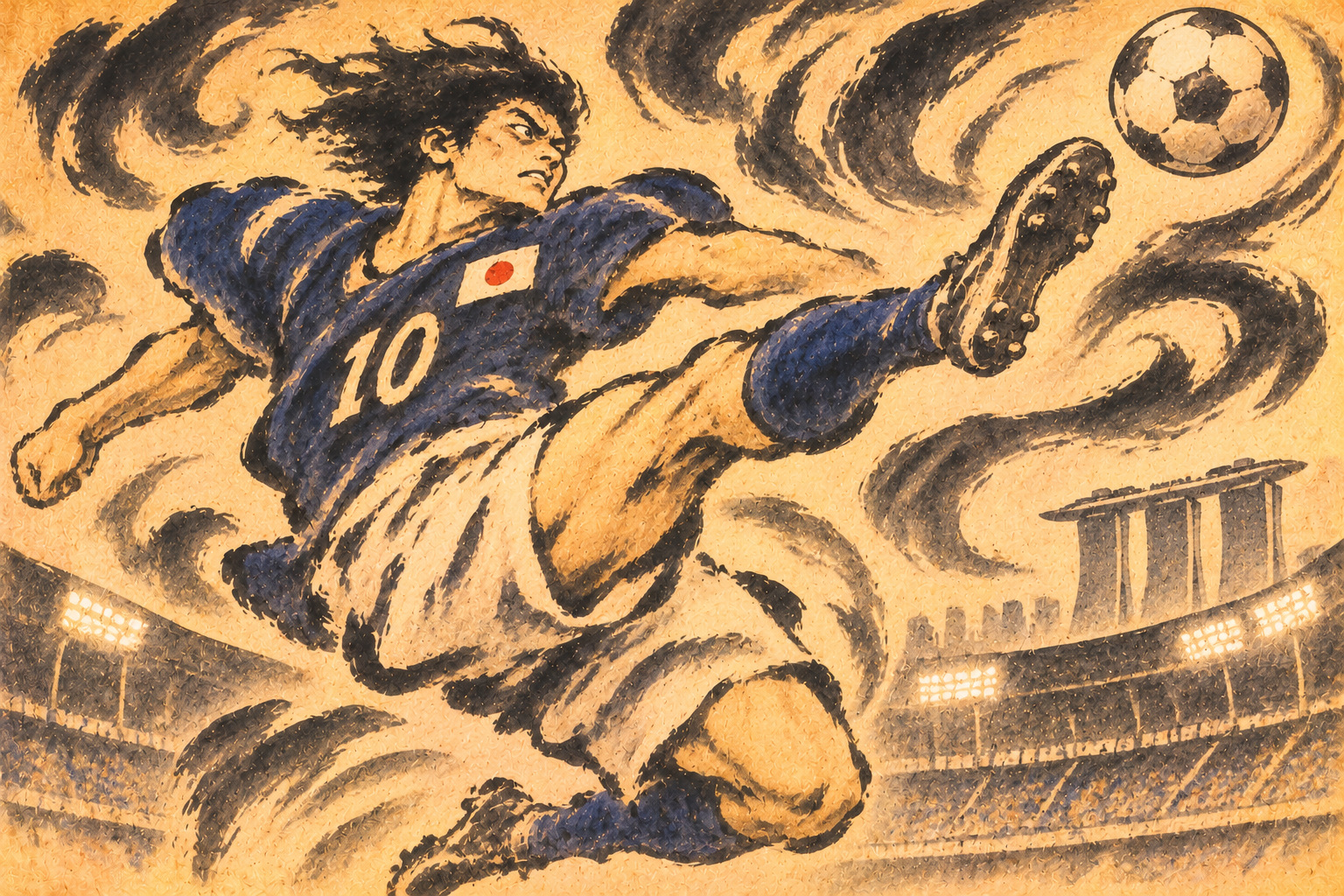
On November 14, Japan will step onto the pitch at Singapore National Stadium to face Brazil at 6:15 p.m. local time, 7:15 p.m. in Japan. The encounter comes only months after Brazil ended Japan's 2026 World Cup campaign with a 2–1 victory in the round of 32. It also follows Japan's landmark 3–2 comeback win in Tokyo in October 2025, its first senior men's victory over the South American nation. Three matches within little more than a year make this a rare, useful sequence of tests.
A fashionable preview might promise revenge. A more informative one asks what can actually be learned from repeated games against the same elite opponent. Can Japan apply pressure higher up the pitch without exposing the space behind its wingbacks? Can a returning playmaker be reintegrated after serious injury? Will the next generation receive meaningful minutes? These are the questions that survive regardless of Saturday's score. This is a pre-match feature drawn from official information available on November 10, not an account of Friday's news conference or Saturday's game.
The tournament's name obscures its unusual format
The fixture belongs to the MIZUHO BLUE CHALLENGE THE KALLANG FOOTBALL SERIES SINGAPORE, held November 13–17. Four nations participate—Japan, Brazil, Paraguay and Singapore—but this is not a conventional round-robin championship. Japan plays Brazil on November 14 and Paraguay on November 17. Singapore plays Paraguay on November 13 and Brazil on November 17. The second fixtures are fixed in advance rather than determined by first-match results.
The Japan Football Association says games conclude after 90 minutes, draws stand without extra time or penalties, and no final tournament ranking is awarded. That detail is important for international readers: a victory over Brazil would be memorable but would not win a tournament trophy. The competition's real purpose is international testing during a compressed national-team window. Japan has only a few days to adapt familiar club players to a shared system and assess what works against two distinctive South American opponents.
Moriyasu's November squad mixes returns and experiments
Head coach Hajime Moriyasu announced a 28-player group on November 4. Two returns stand out: Takumi Minamino of AS Monaco and Koki Machida of TSG Hoffenheim, both back after anterior cruciate ligament injuries that kept them out of this summer's World Cup as players. JFA reports that Minamino resumed club competition on October 15 and Machida on September 12. Recovery from a serious knee injury is not a single date, however; availability for a national-team match is a separate decision.
Tatsuhiro Sakamoto, now at Coventry City, is another returnee, while Yusei Sugawara and Koki Ogawa rejoin the squad. Moriyasu faces a more difficult challenge than simply choosing his strongest eleven. He must judge which combinations create reliable passing lanes, whether defenders can support attacks without sacrificing stability, and which players might be tested against Paraguay three days later. A 28-man call-up is not an official match-day lineup.
Shio Fukuda offers a different model of Japanese development
The first-time call-up of Shio Fukuda (福田師王) is a compelling story within the larger fixture. Fukuda left Japan after high school to develop in German football rather than first building a professional career in the J.League. He is listed by JFA with Karlsruher SC, which credited the 22-year-old with three goals and two assists in eight club matches when the November announcement was issued.
Fukuda's selection says something about how the Japanese talent pipeline is changing. More players are encountering European tactical and physical demands earlier in their careers, but exposure abroad should not be confused with guaranteed international impact. If he plays, the revealing details will be his movement between center backs, ability to apply pressure without losing shape, and touches in confined areas. Even a brief appearance could be instructive. An advance article should not depict him as a confirmed starter or presume he will make a decisive contribution.
The puzzle without Ayase Ueda
Japan's announced attacking options include Takefusa Kubo, Ritsu Doan, Daichi Kamada, Keito Nakamura and Junya Ito. They offer different qualities: Kubo can draw defenders into compact spaces, Doan attacks inward from wider positions, Kamada can connect lines of play, and the wide players alter the speed and direction of an attack. Their coexistence is a tactical challenge, not a guarantee of fluency.
JFA says striker Ayase Ueda was omitted because of injury. That creates a genuine question at the front of Japan's system. Does Moriyasu seek a conventional focal point to hold up play? Does he prefer more mobile forwards to press Brazil's defenders? Or will attacking combinations change across the two scheduled fixtures? The absence does not establish who will play, and the official starting eleven remains unavailable. The more rigorous approach is to identify the options and watch how they are used.
Ancelotti's Brazil: frightening talent, finite preparation time
Brazil coach Carlo Ancelotti named a 26-player squad on October 29. The Brazilian Football Confederation's published group includes Vinicius Junior, Raphinha, Endrick, Estevao and Rayan in attack; Bruno Guimaraes and Joao Gomes among the midfielders; and Gabriel Magalhaes in defense. The names convey the depth of the talent pool but not Saturday's starting eleven. Late changes, fitness judgments and substitutions must be verified separately.
Brazil's individual dribbling is a legitimate threat, yet the more consequential question is how that ability is supplied. A well-organized buildup can isolate a Japanese defender against a fast winger, while a broken attack can leave Japan time to recover into a compact block. The battle is therefore as much about distances between teammates as about one-on-one brilliance. Ancelotti also has limited training time to coordinate players from different clubs. Japan may find opportunities when Brazil's attacking risk leaves spaces to counter into; that remains a tactical possibility, not a prediction.
From 2006 and 2022 to Tokyo 2025 and the 2026 World Cup
For many years, Brazil represented a stubborn barrier in Japan's international development. At the 2006 World Cup, Japan lost 4–1. In a 2022 friendly in Tokyo, Brazil won 1–0. Then came the reversal in October 2025: Japan defeated Brazil 3–2, an achievement that changed the psychological narrative surrounding the matchup. The nations met again at the 2026 World Cup, where Brazil prevailed 2–1 in the round of 32. JFA's November 2026 accounting lists Japan's senior record against Brazil at one win, two draws and twelve defeats.
History matters here not as a forecast but as evidence of change. Japan has shown it can score three against Brazil and that the same opponent can expose weaknesses at a World Cup. Those experiences should sharpen scouting and performance review. The objective in Singapore is not to reproduce either previous result. It is to learn which parts of Japan's football—pressing, possession, defensive recovery and finishing—hold up repeatedly when the opponent knows what is coming.
The first five seconds after losing the ball
One tactical detail could reveal more than the final score: Japan's structure immediately after possession is lost. When fullbacks or wingbacks move high, how many players remain positioned to slow a Brazilian counterattack? Who protects the passing lane into the center? Can an attacking midfielder react quickly enough to stop the first forward pass? Against a side with fast, technically accomplished forwards, the margin for a slow reaction is small.
Japan's own transition deserves equal attention. After regaining the ball, does the team find an early pass into open space, or recycle possession and allow Brazil to reorganize? Does a winger stay wide enough to stretch the defense, or move into a central pocket? Moriyasu's publicly reported emphasis on initiating more attacks and defensive actions provides a useful benchmark, but no pressing statistic or expected-goals number can be invented before the game. Serious tactical reporting starts with observable decisions, not a prewritten verdict.
A new cycle, and an unsettled coaching calendar
The fixtures also sit within an unusual moment for Japanese football governance. JFA reported that the AFC Asian Cup planned for early 2027 had been postponed. Moriyasu had discussed a transition after the tournament, with Tsuyoshi Oiwa—currently leading Japan's U-21 side—part of the succession plan. JFA's national team director Masakuni Yamamoto said at the November briefing that the implications of postponement for the coaching timetable were not yet settled.
It would therefore be careless to describe this as Moriyasu's final match against Brazil or to announce a confirmed handover date. What can be said is that national teams need continuity beyond the tenure of any single coach. Decisions about player development, scouting and tactical vocabulary will shape the next cycle. The Singapore matches may generate useful evidence for those decisions without resolving the institutional uncertainty. That is a more compelling long-term story than speculative personnel drama.
How to watch—and what still needs confirmation
Japan–Brazil is scheduled for Saturday, November 14, at 6:15 p.m. Singapore time (7:15 p.m. Japan Standard Time) at Singapore National Stadium. Japan's TV Asahi network is scheduled to broadcast the game live; U-NEXT also lists a live stream. The November 17 Japan–Paraguay match is fixed regardless of the Brazil result, and JFA has publicized a Japan-side public viewing event at its blue-ing! facility.
As of this reporting cutoff, several facts that will matter to readers do not yet exist in verified form: remarks from the November 13 pre-match conference, the final match-day player list, the starting lineup, any new injury assessment and the final score. Those should be incorporated only when official records become available. Until then, the responsible preview does not promise revenge or describe a win that has not occurred. Instead, it offers a framework for understanding how far Japan has traveled—and what it might still need to solve—against a familiar world power.
Primary documents and verification
Verify the November 13 press conference and November 14 roster, lineup, injuries and score after official release. No advance outcome is assumed.
- Source: 日本サッカー協会:11月4日発表の代表メンバー・日程
- Source: 日本サッカー協会:11月5日代表チーム解説・監督発言
- Source: 日本サッカー協会:大会概要・試合方式
- Source: 日本サッカー協会:放送と配信
- Source: 日本サッカー協会:ブラジルなど対戦国情報
- Source: 日本サッカー協会:2026年ワールドカップ結果
- Source: ブラジルサッカー連盟:10月29日26人招集発表
- Source: ブラジルサッカー連盟:シンガポール国際親善試合の背景
- Source: 日本サッカー協会:代表戦パブリックビューイング
- Source: 日本サッカー協会:2022年ブラジルとの対戦記録