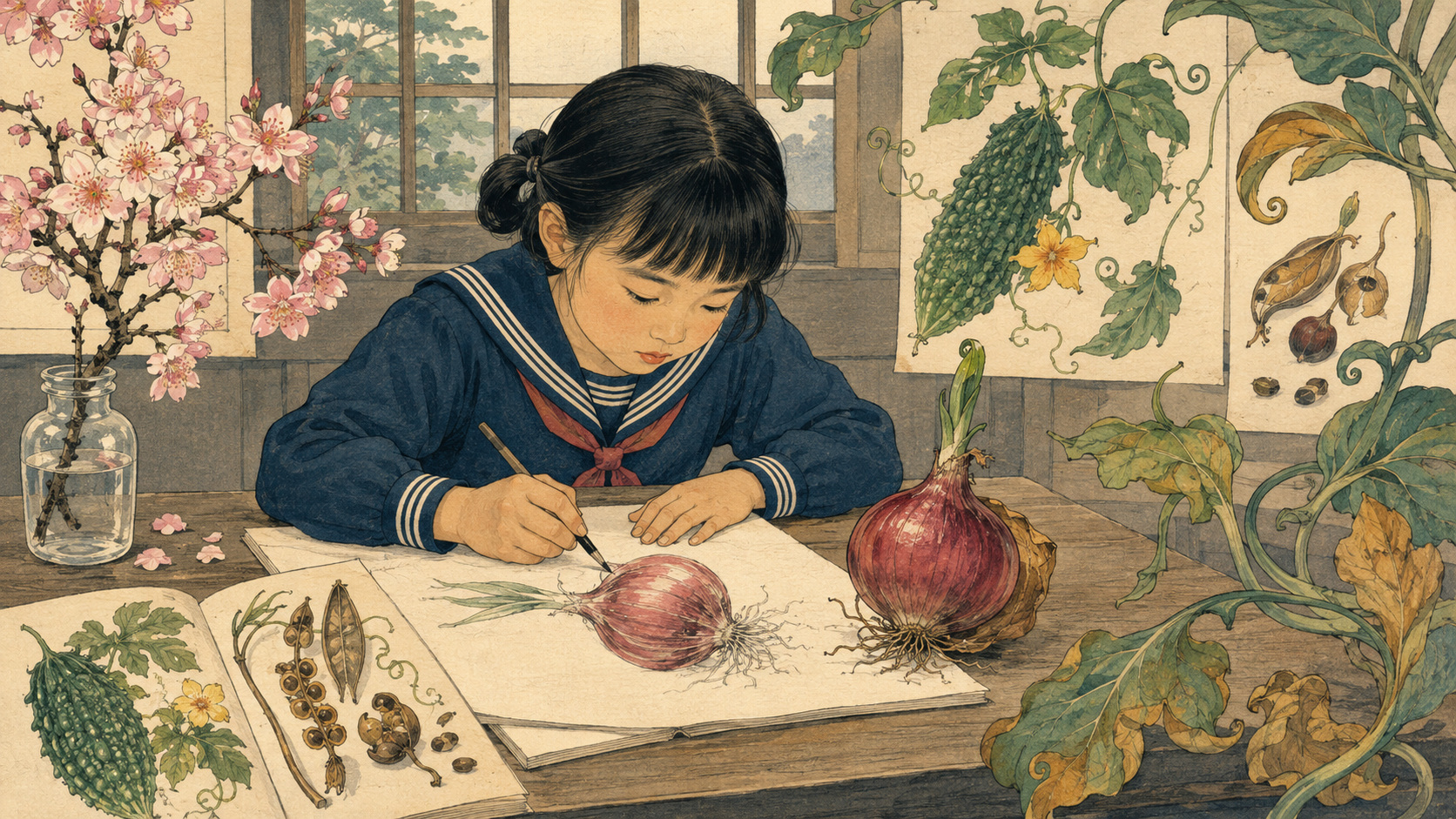
An onion becomes strange when a child is required to tell the truth about it.
The bulb is no longer a purple circle lifted from a kitchen icon. Its skin has thin folds and interruptions. A dry neck records where green leaves once rose. At the base, roots do not form a decorative fringe; each emerges from a compressed stem and moves with its own weight. The student must decide which irregularities describe this particular onion and which structures identify onions at all.
That is the quiet intellectual demand behind Japan’s National Museum of Nature and Science Botanical Art Competition. The 42nd edition received 785 works from elementary, junior-high and high-school students. It selected 33 in the elementary division and 33 in the combined junior-high/high-school division: six top awards, 20 honorable mentions and 40 runner-up mentions. Only about 8.4 percent of submissions entered the official gallery.
The highest elementary honor, the Minister of Education, Culture, Sports, Science and Technology Award, went to a sixth grader’s red onion. The equivalent secondary award went to an oakleaf hydrangea. The other four highest awards recognized Somei-yoshino cherry, bitter melon, onion and stem broccoli. Nothing in that list requires a remote expedition. A refrigerator drawer, school garden, street tree or vegetable plot can contain enough complexity for weeks of looking.
The six top works turn familiar plants into evidence
The museum publishes each child’s work, school, prefecture and grade. It does not give phonetic readings for every name, so the table below preserves the winners’ names exactly as the institution displays them rather than guessing at romanization.
| Division and award | Subject | Student, school year and prefecture |
|---|---|---|
| Elementary · MEXT Minister’s Award | Red onion | 飯田 司音 · Grade 6 · Hyogo |
| Elementary · Museum Director’s Award | Somei-yoshino cherry | 福田 穂乃波 · Grade 5 · Tokyo |
| Elementary · Tsukuba Garden Director’s Award | Bitter melon | 星 美緒 · Grade 3 · Tokyo |
| Secondary · MEXT Minister’s Award | Oakleaf hydrangea | 髙山 琴音 · High school Grade 2 · Tokyo |
| Secondary · Museum Director’s Award | Onion | 庄司 桃椛 · High school Grade 2 · Hokkaido |
| Secondary · Tsukuba Garden Director’s Award | Stem broccoli | 片桐 晴美 · High school Grade 1 · Saitama |
These subjects reveal the competition’s useful refusal to equate importance with rarity. The red onion exposes root, scale leaf, skin and scar. Bitter melon forces the eye to follow ridges across a swelling fruit. Somei-yoshino asks how flowers attach to a twig, how petals overlap and how a named cultivar differs from a generic pink cloud. Stem broccoli turns the supermarket’s anonymous green bundle back into branching plant architecture.
The 60 other selections widen the field: morning glory, artichoke, sesame, Japanese red pine, mangosteen, carnivorous pitcher plant, lotus and mushrooms. Modern biology places fungi in a kingdom separate from plants. The contest’s explanatory page nevertheless includes mushrooms within its broad teaching tradition of shokubutsuga, or botanical pictures. That language should not be mistaken for a taxonomic claim; it reflects the older natural-history practice of learning organisms through visible form.
The rules are closer to a field notebook than a poster contest
The museum’s definition is exacting. A botanical picture must allow a viewer to identify the organism. Color and atmosphere are not enough. The artist must show the count and arrangement of petals and sepals, the form and attachment of leaves, and other diagnostic structures accurately. The museum uses maples as an example: leaf shape varies among species, but flowers and paired winged fruits contain shared information that cannot be blurred away.
The published rules for the next, 43rd edition make that philosophy operational. Entrants may use almost any non-smudging medium, but the work must be an unpublished original rather than a copy from a field guide. Paper must be B4 or Japanese yatsugiri size, one work is allowed per person, a plant name is required and school submissions are capped at 50. Pots, signatures and colored backgrounds are unnecessary. Judges are instructed to consider observational power, accuracy of representation and artistic beauty in deliberation.
Those are not the rules of a botanical journal. The students are not required to provide scale bars, Latin binomials, dissections or a botanist’s written diagnosis. Yet the standard moves them away from “a picture of how I imagine a flower” toward “a visual account another person can test.” Every vein placed, margin serrated or fruit attached is a claim.
- Work from direct observation and submit an original, not a copied illustration.
- Name the subject and show features by which it can be recognized.
- Balance structural accuracy with a living, beautiful composition.
- Use one of two specified paper sizes and submit only one work.
- Accept that the museum may correct a title for botanical accuracy.
A competition born beside a new national garden
The institutional timing matters. The National Museum’s Tsukuba Botanical Garden opened in 1983. The competition began in 1984, when the new research garden was still defining its public role. Today the 14-hectare site holds roughly 7,000 plant species and describes its mission with three verbs: know biodiversity, protect it and communicate it.
A child’s sheet belongs chiefly to the third verb, but depends on the first two. A botanical garden is not only a landscaped park. Living collections allow researchers and visitors to compare related species, observe forms that appear in different seasons and maintain threatened plants outside their native habitat. The garden reported at its 40th anniversary that its collections include about 20 percent of the species listed as threatened by Japan’s Environment Ministry and about 24 percent of Japan’s endemic species.
The contest translated that infrastructure into a task possible at a kitchen table. One did not need laboratory membership to enter; one needed a specimen, paper and time. Annual exhibitions in Tsukuba and Tokyo turned private acts of attention into a national public collection. Selected works can also be lent around the country for learning programs.
The public shape has changed. A 2010 account of the 26th exhibition recorded elementary, secondary and general divisions and 3,889 submissions. The current competition has no adult category and received about one-fifth that total. Recent official counts also fell from 1,070 submissions for the 39th edition to 957 for the 40th, then 783 and 785. Changes in categories and selection rules prevent a clean long-term participation graph, but the numbers make recruitment a real institutional question rather than a guaranteed tradition.
1830–1844 · Iwasaki Kan’en’s Honzō zufu makes an encyclopedic Edo-period visual record.
1888 · Makino Tomitarō begins publishing his illustrated Japanese flora.
1940 · Makino’s Illustrated Flora of Japan brings a lifetime of classification to a wide public.
1983 · Tsukuba Botanical Garden opens as a National Museum research facility.
1984 · The museum begins the Botanical Art Competition.
2026 · The 42nd competition’s student works travel from Tsukuba to Ueno and Shirokanedai.
The lineage reaches back to Edo natural history
Japan did not begin learning plants through pictures in 1984. Edo-period honzōgaku joined medicine, materia medica, collecting, gardening, trade and the classification of nature. Its books absorbed knowledge from China and then revised it through local specimens and observation. Images were not mere ornaments beside the text. They helped a reader connect a name to a form.
Iwasaki Tsunemasa, known as Kan’en, assembled one of the period’s grandest visual works. The 96-volume, 92-book Honzō zufu, published from 1830 to 1844, included about 2,000 kinds of plants. Wild, cultivated and foreign subjects appeared in skilled color images with notes on names and ecology, arranged according to the Chinese Bencao gangmu tradition. Six books covered mushrooms—an illuminating precedent for the broad natural-history vocabulary still visible in the student competition.
The pictures were made in a world without instant color reproduction. To draw was to preserve an encounter and make it portable. Yet copying could also reproduce error. A plant rendered from an earlier image rather than a specimen might acquire structures that no living example possessed. Modern botanical illustration grew partly through a stricter compact: artist, specimen and botanical description had to correct one another.
The 42nd contest contains that history in miniature. It accepts ornamental flowers, crops, roadside species and fungi, much as an illustrated materia medica crossed boundaries now separated into disciplines. But it insists that the named organism constrain the image. The child is free to compose, not free to invent the evidence.
Makino taught modern Japan to trust the drawn line
Makino Tomitarō stands at the difficult transition from Edo natural history to modern taxonomy. Largely self-taught, he entered the world of the University of Tokyo’s botany department in the 1880s, collected throughout Japan and studied the rules of scientific naming. In 1890 he became the first Japanese botanist to publish a new species name under the modern system, according to the National Diet Library’s history.
He also understood that classification needed images. Makino learned lithography and in 1888 began publishing Nihon shokubutsushi zuhen, an illustrated flora, at his own expense. A plate could combine the habit of a plant with details too small, seasonal or fragile to sit together on one pressed sheet. His 1940 Makino’s Illustrated Flora of Japan became a durable bridge between expert taxonomy and public plant knowledge.
Makino was not the only eye or hand in that history. The botanical artist 山田壽雄 produced exact drawings for Makino’s scientific descriptions, reference works and encyclopedias. The Makino Botanical Garden records his conviction that the work was a diagram, not simply a painting. Yet the same institution emphasizes the depth, freshness and beauty of his images. Scientific usefulness did not require aesthetic poverty.
That dual standard survives almost word for word in the competition: accurate form and color, plus art that feels beautiful and alive. The national award does not turn a child into Makino or a professional illustrator. It lets the child practice the same ethical bargain—the page may simplify nature only to make nature clearer.
A camera does not make the illustrator obsolete
Photography altered natural history profoundly, and no serious illustrator needs to diminish it. A photograph can preserve color, habitat, damage and accident with a mechanical relation to one moment. Macro lenses and image stacks reveal structures no unaided eye can resolve. Digital images can be shared and searched at enormous scale.
But a photograph records everything before the lens with roughly equal indifference. Botanical illustration selects. It can remove a confusing background, rotate a flower to expose its structure, place the front and back of a leaf together, enlarge a tiny reproductive part, and combine flower, fruit and seed that never appeared on the same branch at the same hour. Kew’s illustration collection describes that synthesis as the reason drawings continue to complement photographs and specimens.
A good illustration is therefore not “more truthful” than a photograph. It is truthful in a different way. It compresses observations across angle, scale, season and specimen into an intelligible model. Its danger is the same as its power: selection can clarify, but it can also idealize away variation or copy an expectation rather than the plant.
The child’s safeguard is repeated return to the subject. Measure again. Turn the leaf. Look where the root really begins. Compare the left margin with the right instead of drawing a symbol for “leaf.” The image improves not when it becomes photographic, but when every departure from the specimen has a reason.
Drawing is a way of thinking, not merely displaying
Science education often treats a drawing as the pleasant product made after the real learning has happened. Research suggests a more demanding view. Drawing can make thought visible to the learner and teacher—but only when the activity is framed as observation and explanation rather than coloring time.
A 2025 classroom study of eight-year-olds found that effective observational-drawing instruction moved repeatedly between the object and the page. The teacher directed attention to shape, color and species-specific detail, gave feedback during the work and used biological knowledge to ask better questions. Another study of early-primary science found that explicit instruction increased the structures and labels pupils included in post-unit drawings.
The lesson is not that every child learns more whenever handed a pencil. Research results on drawing are mixed, and representational tasks can reward prior art training, patience and teacher expectations. A Japanese study comparing sketches with model-making around leaf arrangement found that constructing models prompted more detailed observations and better later retention. Different questions need different tools.
What drawing uniquely slows down is the jump from recognition to description. “I know an onion” is immediate. “I can show where each root attaches, which surfaces overlap and how the neck narrows” takes sustained comparison. The hand creates a sequence of decisions, and the unfinished page reveals where the eye has stopped asking.
The red onion is an unusually rich lesson
The top elementary subject may look humble, but it concentrates botanical ideas. An onion bulb is not a swollen root. It is largely a set of modified leaves wrapped around a short stem. The dry outer tunic, fleshy scales, basal plate, old leaf neck and adventitious roots tell a story of storage and regrowth. Cutting another onion longitudinally can reveal the nested structure that the intact specimen only suggests.
Color adds another problem. “Red onion” is a market name for hues that can run from crimson-purple through dusty violet to brown. Pigment collects differently across dry and fleshy surfaces. A child must decide whether to match local color, model the curvature of the bulb or preserve the clarity of a boundary. One wash can do several scientific and compositional jobs.
The subject is also democratic only in a limited sense. It is cheap, familiar and available in every season. But a precise drawing still needs uninterrupted time, good light, paper, tools, a place where the specimen will not be cleared away, and an adult or teacher who knows that the root attachment matters. Access to an onion is not the same as access to instruction.
That is why the award should be understood less as proof of innate “talent” than as a record of attention supported long enough to become visible. The child deserves recognition. So do the conditions that allowed looking to continue.
Beauty and accuracy must negotiate
A botanical picture that merely lists features can be unreadable. Composition decides where the viewer looks first, how empty space separates structures and how a curved stem carries attention through a rectangular sheet. Tone gives a pale root presence without making it heavier than the bulb. Repetition can reveal phyllotaxis; overlap can hide it.
The museum’s three-part judging standard—observation, accurate expression and artistic beauty—acknowledges that evidence must be communicated. The Smithsonian distinguishes botanical illustration, which emphasizes scientific accuracy, from botanical art, which gives more weight to aesthetic expression. The competition deliberately uses the Japanese term for botanical pictures across that boundary.
This creates legitimate judging disagreements. Should a technically exact but stiff page outrank a vivid composition with a minor structural error? How much may a child enlarge a flower, clean a damaged leaf or combine growth stages? The current public rules state criteria but do not publish scores or individual jury comments for all 66 works.
More commentary would make the gallery a stronger classroom. A short note beside each top work could identify one observed structure, one compositional decision and one place where scientific naming mattered. That would turn prestige into reusable instruction without reducing a child’s picture to a checklist.
A national contest can reveal unequal access
The official gallery shows wide geographic reach: selected students came from Hokkaido, Miyagi, Yamagata, Ibaraki, Tokyo, Chiba, Saitama, Kanagawa, Nagano, Aichi, Kyoto, Hyogo, Hiroshima, Kagawa, Yamaguchi, Okayama and Aomori. Public and private schools, art-focused high schools and ordinary local schools appear together.
It also shows clustering. Japan.co.jp’s count of the official list finds that 10 of the 33 elementary selections came from 聖徳学園小学校 in Tokyo. Several other schools contributed two selected works. This is not evidence that judging was improper; the public record supplies no such basis. It is evidence that familiarity, organized teaching and repeated participation can concentrate opportunity.
A school that understands the paper specification, seasonal timing and museum standard can build observation into lessons, store works safely and submit many entries. A child working alone must discover the competition, interpret “botanical art,” find materials and package the sheet without folding it. The next edition’s rules recognize institutions further by adding a possible special encouragement award for schools with many selected works.
The museum can honor strong teaching while broadening the entrance. Free online demonstrations, printable observation prompts, sample feedback that distinguishes correction from copying, small regional workshops and lending kits could help schools without an established pipeline. Publishing submission counts by prefecture and school type—not children’s private data—would reveal where outreach is missing.
The archive must protect the children who made it
Selected work acquires a life beyond the classroom. The online gallery displays the image with the child’s name, school, grade and prefecture. The rules for the 43rd edition state that selected works may be used for exhibitions, educational support and publicity for three years. Copyright remains with the entrant, while the organizer receives free permission to use the work. Selected originals are scheduled for return after that period; unselected submissions will not be returned.
Those terms are unusually important because entrants are minors. Publication is part of the award and consent is built into entry, but a child’s school affiliation and grade create a durable identity trail. The museum should keep collection pages secure, explain how long personal information will remain online and provide a clear route for a family to request correction when a name, school or plant title is wrong.
The decision not to return unselected work reduces shipping and storage burdens, yet it should be impossible to miss. Schools and families ought to photograph or scan the original before submission. A work that represents dozens of hours can carry personal value far beyond its juried outcome.
Digital preservation also needs color standards, resolution records and stable metadata. A faded thumbnail proves that a contest occurred; it does not let a future teacher study the vein, root or brush decision that made the work useful. The gallery is becoming a longitudinal archive of how Japanese children have seen plants. It should be managed with the care of an educational collection, not merely a results page.
What remains when the exhibition closes
The 42nd works first appeared at Tsukuba Botanical Garden in February, then all 66 at the National Museum’s Ueno building from June 30 to July 20. From August 15 to September 6, the Institute for Nature Study in Shirokanedai is scheduled to show only the six highest awards. That smaller display sits inside a 20-hectare urban reserve where more than 1,000 plant species have been recorded—an invitation to leave the pictures and test one’s own attention outside.
The 43rd competition opens September 1 and accepts work through October 31. That annual cycle is the program’s durable achievement. The museum does not merely announce that children should care about biodiversity. It sets a deadline by which one child must care about one organism specifically enough to describe it.
The strongest future would connect contest, collection and field more explicitly. Publish judge notes. Offer a worksheet that asks which structures identify the organism. Invite former entrants to redraw the same species years later. Track whether rural and less-connected schools can participate. Pair selected art with a herbarium sheet, living specimen and photograph, so viewers can see what each medium preserves and omits.
Awards inevitably separate a few pages from hundreds. Observation works in the opposite direction. It makes the overlooked significant: the twist of a tendril, the underside of a leaf, the exact place where a root begins. The enduring value of this competition is not that 66 children drew better than 719 others. It is that 785 children were asked to look until an ordinary plant stopped being ordinary.
Reporting notes and principal sources
Counts of works, awards, schools and subjects come from the museum’s official 42nd gallery. The 8.4 percent figure is 66 divided by 785. The school concentration is Japan.co.jp’s count of that public list and is not presented as evidence about jury conduct. Rules on future entries, copyright, use and return apply to the published 43rd-edition guidelines. The Institute for Nature Study’s standard Monday closure should be checked against its live calendar before a visit. Public information was checked through August 16, 2026 at 6:00 AM JST.
- Tsukuba Botanical Garden: competition overview, definition of botanical art and 42nd exhibition schedule
- National Museum: complete 42nd competition gallery, winners, schools and grades
- National Museum, Ueno: 785 submissions, 66 selections and 2026 exhibition record
- 43rd Botanical Art Competition: entry, judging, privacy and copyright rules
- Institute for Nature Study: admission, hours and standard closing days
- Tsukuba Botanical Garden: 40-year history, collections and biodiversity mission
- 41st competition: 783 submissions and 66 selections
- 40th competition: 957 submissions and 66 selections
- 39th competition: 1,070 submissions and 84 selections
- Tsukuba Keizai Shimbun, 2010: 1984 origin and the former three-division competition
- National Diet Library: Iwasaki Kan’en’s 96-volume Honzō zufu and its mushroom books
- National Diet Library: bibliographic and collection record for Honzō zufu
- National Diet Library: early modern Japanese botany and Makino Tomitarō’s illustrated flora
- National Museum: Makino’s specimens, botanical drawings and observational method
- Makino Botanical Garden: 山田壽雄 and scientific art in Japanese plant books
- Royal Botanic Gardens, Kew: why illustration remains useful beside photography
- Smithsonian Gardens: botanical illustration, botanical art and scientific accuracy
- Kew: measurement, dissection and tools used by botanical illustrators
- Journal of Biological Education: observational drawing instruction with primary pupils
- International Journal of Science Education: explicit drawing instruction and student representations