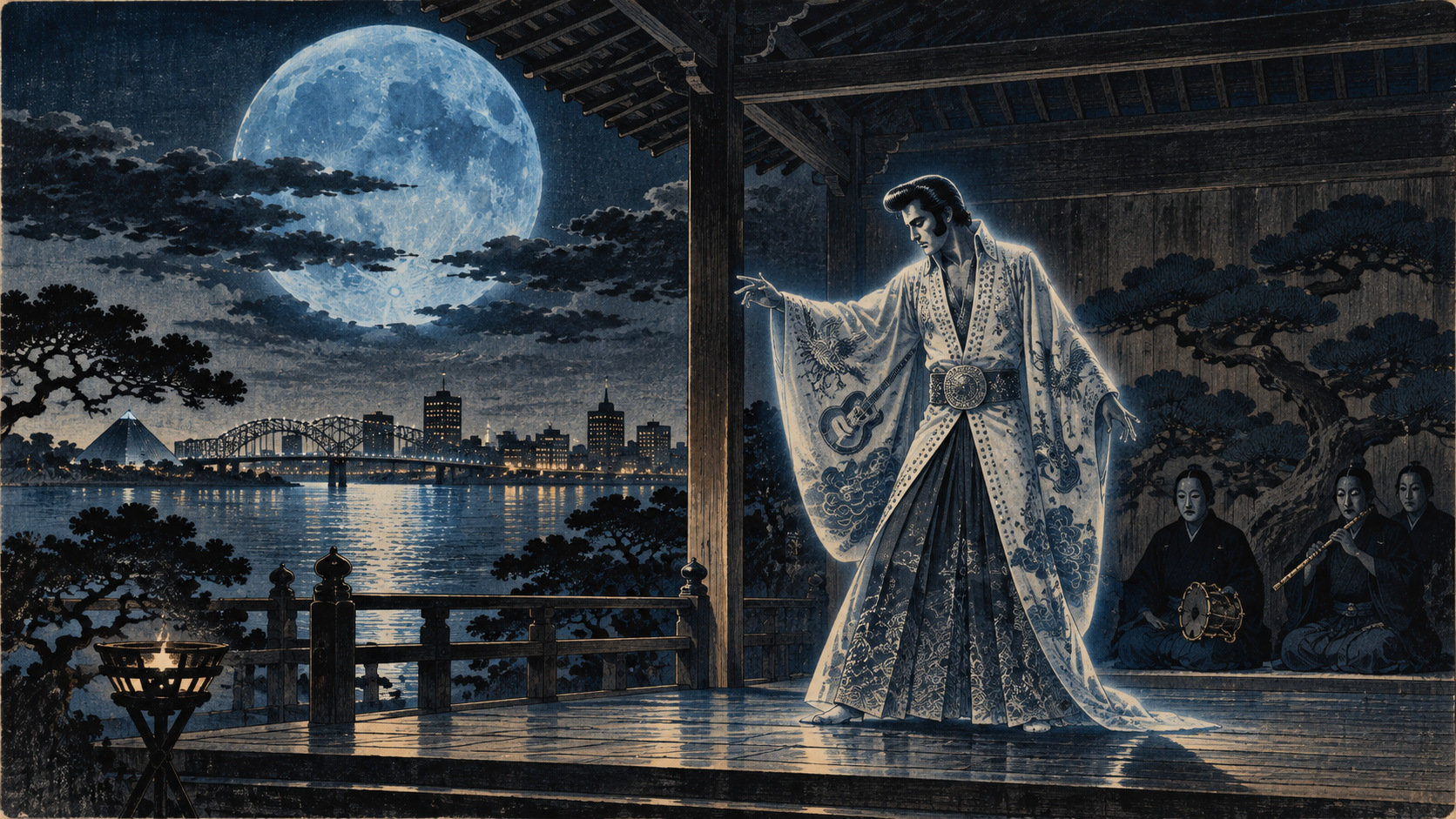
Elvis, a blue moon, and the stage of the dead
A ghostly Elvis Presley on a Japanese Noh stage sounds like an unlikely culture-page curiosity. Yet Theatre Nohgaku’s Blue Moon Over Memphis is built on a serious dramatic correspondence. Noh has long made room for spirits who return to recount the emotions that bind them to the living world. In the English-language work presented at Tokyo’s Autumn Meteorite festival on October 10 and 11, the spirit is a twentieth-century American superstar, and the living visitor is Judy, a fan searching for meaning at Graceland. The crossover is surprising because it is grounded in theatrical logic rather than novelty alone.
At Graceland, a pilgrimage goes wrong
Judy arrives at Graceland on the anniversary of Elvis’s death. The crowds frustrate the visit she imagined, leaving her outside the place where she hoped to approach her idol. A mysterious figure offers entry to the Meditation Garden, where Elvis is buried. Under the blue moon, the encounter takes on the character of a visitation. The story is not about proving that a ghost exists or recreating a rock concert. It asks why a lonely person might need a celebrity’s memory to interpret her own life, and what it means when devotion becomes a substitute for the ordinary connections that remain out of reach.
Why Noh is such a precise fit
The official Japanese program describes the piece as a mugen-nō, often translated as a dream or apparition Noh. In the classical dramatic pattern, a traveler or other living figure encounters someone associated with a place, and the encounter gradually discloses the story of a spirit bound to the past. The shite—the principal role—can carry the emotional burden through chant and dance, while the waki helps frame the encounter. For Tokyo’s production, John Oglevee plays Elvis as shite, with Laura Sampson or Mika Oskarson-Kindstrand as Judy, the waki. The structure turns Presley from a celebrity likeness into a figure through whom grief and memory can be made theatrical.
A work with a history, not a new stunt
American playwright Deborah Brevoort first developed a version of Blue Moon Over Memphis in 1993. Theatre Nohgaku’s repertory history says the earlier play drew on Noh structure while imagining a largely Western naturalistic performance. Collaboration with composer and Noh specialist Richard Emmert helped reshape it into an English-language work designed to be sung and danced by Noh-trained performers. The official Tokyo program dates its premiere to May 23, 2015, at Allan West in Tokyo. This matters editorially: the 2026 dates are a new festival presentation, not the birth of the work. Its unusual artistic vocabulary has been developed and tested across years.
Blues and gospel within a discipline of chant
The production honors recognizably Noh elements: stage architecture, flute, hand drums, chorus, patterned movement and the use of a mask. Yet it introduces American materials—blues, gospel, allusions to Presley’s popular songs, a newly made Elvis-inspired Noh mask and costume elements fashioned from denim. Brevoort wrote the play; Emmert serves as composer and music director; Akira Matsui and John Oglevee share directing credit; Hideta Kitazawa made the mask. These are not arbitrary decorations. They ask how a form defined by concentration and stylization can absorb the sonic and visual abundance associated with Elvis without losing its own discipline.
The company behind the experiment
Theatre Nohgaku was founded in 2000 by Richard Emmert and other English-speaking students of Noh. Its work is part of a longer movement to practice Noh’s techniques beyond the Japanese language, without pretending that translation alone recreates the art. The troupe’s twenty-fifth-anniversary records also describe 2025 performances of Blue Moon Over Memphis in Japan. Those appearances demonstrate a continuing repertory rather than a single festival commission. This history helps explain why the production can be ambitious without being casual: the artists have spent years working within Noh’s musical and movement disciplines.
What Tokyo audiences were scheduled to see
The Tokyo Metropolitan Theatre Playhouse program combines more than the Elvis drama. It begins with a maibayashi excerpt from Takasago, follows with the English-language kyogen The Rewards of Humble Abstinence, and concludes after an intermission with Blue Moon Over Memphis. The official running time was revised to approximately 145 minutes in an October 9 update. Performances were scheduled for Saturday, October 10 at 6 p.m. and Sunday, October 11 at 2 p.m., with a post-show conversation on Sunday involving Emmert, Oglevee and festival artistic director Toshiki Okada. For an October 12 article, those performances belong to the immediate past; this report makes no claims about audience reception without direct observation.
Translation is part of the performance, not an afterthought
The performance’s main language is English, with the Takasago segment in Japanese and Japanese and English stage surtitles. The festival also provides Japanese captioning access for deaf and hard-of-hearing visitors, a hearing-loop system in part of the auditorium, and provisions for wheelchair access and childcare. Accessibility does not settle the deeper challenge of translating a performance tradition, but it makes that challenge public rather than private. An international Noh production must persuade people not only that the form can travel across languages, but that an audience can actually follow it once it arrives.
Why this is a story about America, too
Presley’s image still carries a particular American contradiction: extraordinary celebrity alongside the possibility of deep isolation. A fan’s pilgrimage to Graceland gathers music, mourning, commerce, affection and private memory in one place. Noh lends itself to such contradictions because the dead are often present not as horror figures but as bearers of unfinished feeling. In this play, Judy needs the ghost as much as the ghost needs to be heard. The encounter does not erase the distance between traditional Japan and modern America. It makes that distance artistically productive.
The lasting question of cultural exchange
There is a temptation to declare any cross-cultural production a triumph simply because the ingredients are unexpected. That would be premature without firsthand reporting on the actual 2026 performances. What the verified production history does establish is a more interesting question. Is preserving a classical art a matter of keeping its repertoire unchanged, or of understanding its structure well enough to invite new languages and new memories onto the stage? Theatre Nohgaku’s Elvis does not answer the question on behalf of every Noh performer. It offers a vivid, disciplined experiment: under a blue moon, an American ghost becomes a way to test the expressive reach of a Japanese tradition.