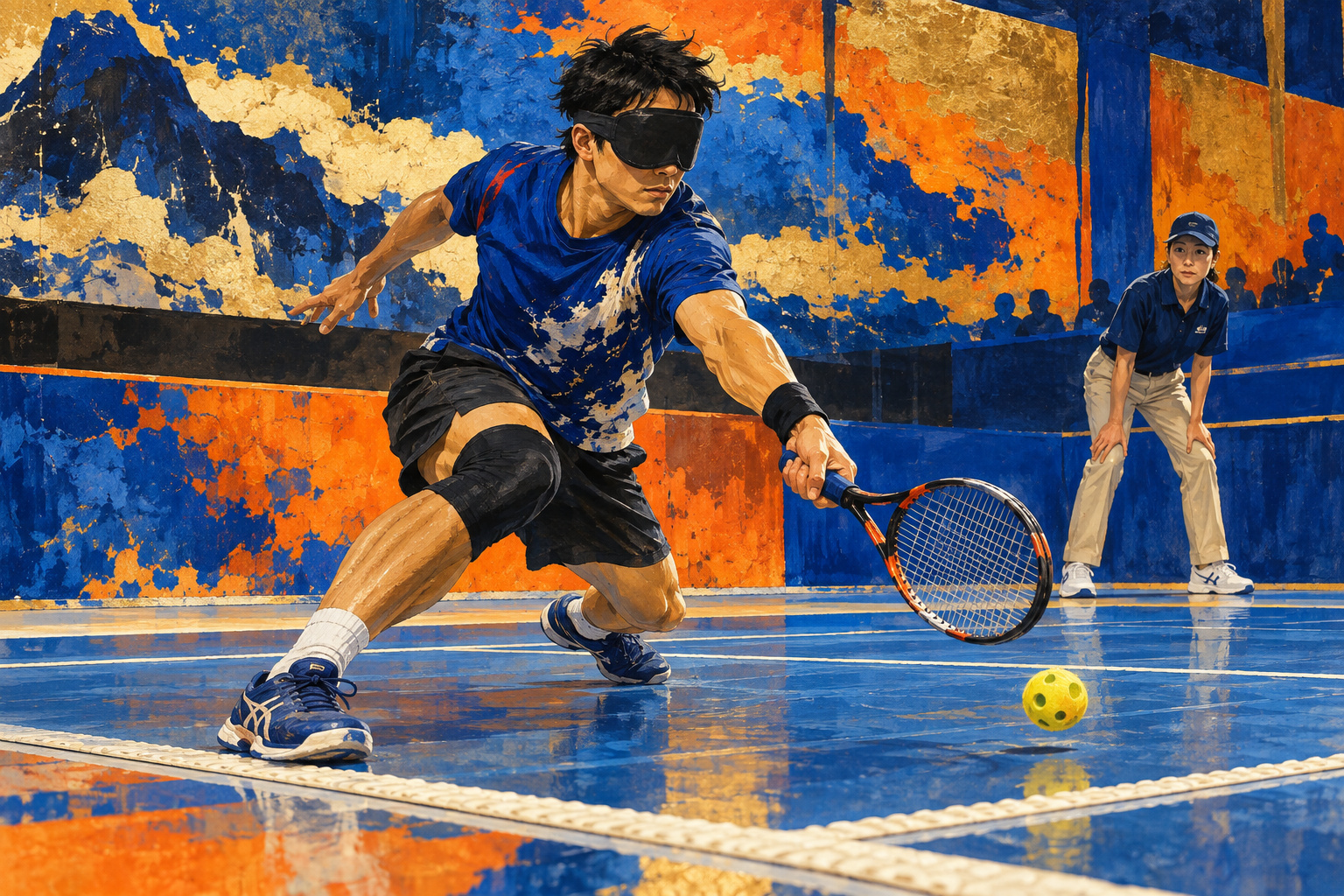
Competitive blind tennis depends on more than a ball that players can hear. Classification rules, court markings and practical assistance all shape the opportunity to train and compete. Documents for Japan’s 36th national blind-tennis tournament and Hiroshima Open 2026 show how those elements fit together.
A national competition across two cities
The Japan Blind Tennis Federation’s published program scheduled B2 and B3 events for September 20 at Hiroshima Prefectural Sports Center’s small arena, and B1 for September 21 at Saiden Chemical Arena in Saitama. It specified men’s and women’s singles by class, with federation ranking points available and no B4 event.[1]
A national tournament gives training a competitive destination. Access to that opportunity also depends on what happens beforehand: finding regular practice, reaching the venue and arriving ready to play.
Classification is distinct from playing ability
The federation’s 2026 rules classify players by visual function. These are not skill rankings. Domestic rules also permit some players to enter a different class under specified conditions; an event label alone does not describe every participant’s sight.[3]
| Class | Permitted bounces | Eyeshades |
|---|---|---|
| B1 | Up to three | Blindfold or eyeshades required |
| B2 | Up to three | No equivalent B1 requirement |
| B3 | Up to two | No equivalent B1 requirement |
The tournament provisions also allow B2 and B3 servers to choose a yellow or black ball, with no change during the same service game.[2]
Sound and touch provide information
The sport uses a sound-producing sponge ball. On a B1 court, cord beneath designated markings, including the baseline, creates a raised surface that players can locate by touch.[3]
These arrangements help make athletic judgment possible. Following a rally means appreciating how players judge distance and timing, move into position and choose a return.
Access also depends on people
The Nippon Care-Fit Education Institute’s volunteer notice for the September 21 event listed court setup, ball-person duties, guiding players and dismantling the courts.[4] The requested roles illustrate the work surrounding the contest, although a recruitment notice does not establish how many volunteers ultimately attended.
In Japan.co.jp’s assessment, useful support from businesses and local authorities can extend beyond equipment to regular practice space, clear travel assistance and training for event personnel. Players themselves should help identify which arrangements are needed.
The lasting measure of access is whether someone can return to practice and enter another competition. A national event offers a focal point; sustained opportunities require attention to the less visible work between tournament days.
