A meeting about the missing links
A cyclist may follow a neatly marked lane for several blocks, only to find it ending at the busiest intersection of the journey. That discontinuity, rather than the absence of bicycle-friendly slogans, is the practical challenge confronting Japan’s planners. On November 19, the Ministry of Land, Infrastructure, Transport and Tourism announced a joint meeting with the National Police Agency for November 24, 2026, to discuss the direction of bicycle-network development and possible revisions to national guidance.
The formal meeting—Japan’s first fiscal-2026 session of the Committee on Improving Safe and Comfortable Bicycle and Related Mobility Environments—is scheduled for 2:30–4:30 p.m. Japan time, online. It will review previous deliberations, consider what should be examined in updated guidance, and set out next steps. The announcement does not approve a new national cycling route, mandate protected lanes, or provide a construction budget.
What a bicycle network actually is
A bicycle network is more than a collection of blue painted strips. It is a connected system linking homes with stations, shops, schools, offices and services. The hard parts are not just the segments of road where space is abundant, but the bridges, intersections, bus stops and narrow corridors where travelers must make unfamiliar decisions.
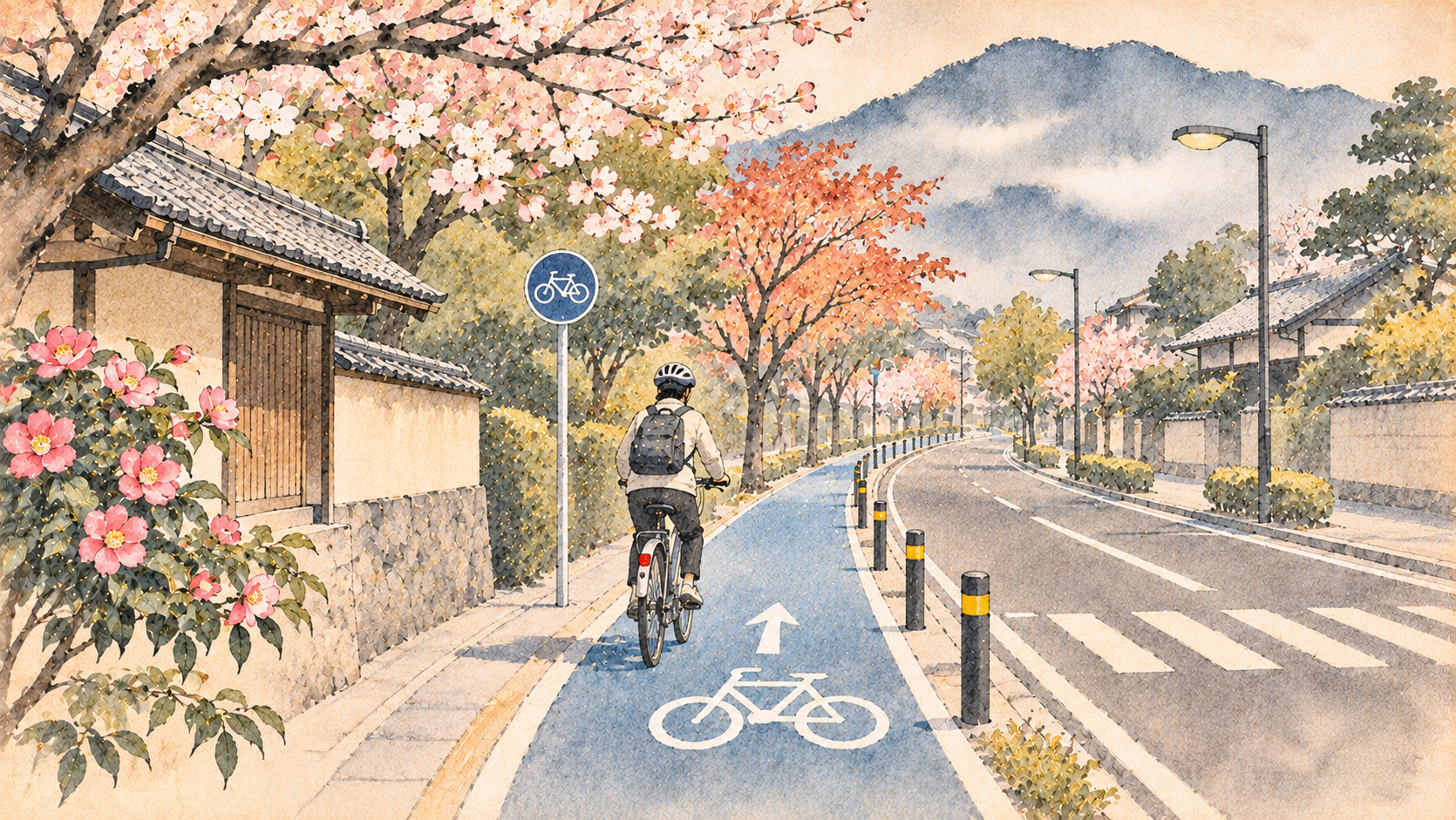
Japan’s design vocabulary includes physically separated cycle tracks, on-road bicycle-only lanes and shared roadways with markings indicating where cyclists should travel. Those options offer different levels of separation and legal protection. The engineering question is which arrangement fits traffic speed, street width, pedestrian activity and the way each road is used—not how many kilometers can be colored blue.
The collision statistics behind the debate
The National Police Agency recorded 67,470 bicycle-involved traffic crashes in 2025, a decline of just 61 from the previous year. “Bicycle-involved” does not mean that cyclists caused all those incidents. The agency says motor vehicles were the other party in roughly three-quarters of fatal or serious-injury crashes involving cyclists, while crossing or turning conflicts remain particularly consequential.
Another NPA analysis found a recorded cyclist violation in about three-quarters of 2025 crashes in which a person cycling was killed or seriously injured. That figure should not be confused with a finding that cyclists were solely responsible in three-quarters of crashes. Road layout, motor-vehicle speed, sight lines, stopping behavior and both parties’ decisions all affect the outcome. Japan recorded 2,547 traffic deaths across all road users in 2025, its lowest total on record, even as serious injuries rose.
The intersection problem
At intersections, a bicycle route has to negotiate with turning traffic and crossing pedestrians. Parked vans can force riders unexpectedly into faster traffic. Bus stops concentrate passengers on a narrow edge of the road. Improvements measured only by the length of a bicycle facility can therefore miss its most dangerous transitions.
Streets also serve people who do not cycle: children, wheelchair users, older pedestrians, delivery operators and transit passengers. Simply moving bikes onto sidewalks may reduce some riders’ anxiety while transferring risks to pedestrians. A network strategy has to address that trade-off, and road-space allocation necessarily involves decisions about vehicle speeds, loading, parking and public transport.
How Japan reached this point
Japan’s approach shifted during the 2010s toward recognizing bicycles as vehicles and planning continuous routes rather than isolated facilities. MLIT and the NPA developed joint guidance on creating safe and comfortable cycling environments, with an updated version issued in June 2024. The Bicycle Utilization Promotion Act, enacted in 2016, provided a wider policy framework linking cycling with mobility, public health and environmental objectives.
The technical conversation continued in 2026. MLIT published a version 1.0 guide to using data in bicycle network planning in January, and a case collection on reallocating road space for cycling in March. These publications indicate an emphasis on choosing sites using evidence and street conditions, though the contents of any future revised guideline remain undecided.
A new enforcement era does not replace engineering
Since April 1, 2026, Japan has applied the traffic violation notification system, commonly called the blue-ticket system, to bicycle riders aged 16 or older. The NPA says guidance and warnings remain the basic approach; serious or dangerous violations can lead to tickets, and more severe offenses follow criminal procedures. The new framework does not mean that every instance of sidewalk riding automatically results in a fine.
Enforcement matters, but design determines how easily people can comply. Cyclists cannot follow a coherent route if the facility disappears at a complex junction without clear guidance. Equally, protected infrastructure does not excuse running red lights or ignoring stop signs. A credible safety strategy gives both street users and road authorities understandable obligations.
One country, several street problems
In a commuter suburb, riders want a direct route to rail stations. In a hill town, electric-assist bicycles may be more important. Near a school, short bursts of intense morning traffic matter; in a historic tourist district, pedestrians may dominate the street. A practical national guideline has to leave room for those differences.
Local governments must weigh collisions, potential trip demand, connections to public transport, road maintenance and trade-offs over space. Where a protected track cannot fit, reducing vehicle speeds or through traffic may be more realistic than adding a narrow stripe. Those are planning judgments, not policies already adopted by the November committee.
How to tell whether it works
Completed kilometers make for a straightforward dashboard, but a safer network needs more demanding evidence. Planners should watch junction conflicts, pedestrian injuries, changes in rider behavior, the reliability of continuous journeys and whether more people—including less confident riders—feel able to travel by bicycle.
Accident numbers alone can mislead: a street may report few collisions because people avoid riding there. Near misses, accessibility, route continuity and resident experiences can be as important as the headline count. Evaluations also need to consider changes in traffic volume before and after a redesign.
The November 24 test
The committee has three especially useful questions to confront. Can Japan connect dangerous fragments of cycling infrastructure into routes people can actually use? Can road authorities reconcile cycling space with deliveries, buses, vehicles and pedestrians? And can local governments measure whether redesigned streets are safer, rather than simply more colorful?
As of the November 19 announcement, the ministry had not published meeting conclusions, specific budget allocations or a timetable for a new nationwide network. Materials and minutes are expected later. The stakes are tangible: the distance between a home and a destination may be short, but a single hazardous intersection can determine whether someone ever chooses to ride.
Primary sources and limitations
Based on published MLIT and National Police Agency documents. The November 24 committee meeting had not taken place at the reporting cutoff. No local street engineering audit, independent collision analysis, participant interview or confirmed future budget is claimed.
- 国土交通省:11月19日報道発表 / MLIT, November 19 announcement
- 国土交通省:委員会開催状況 / MLIT committee archive
- 国土交通省・警察庁:自転車利用環境創出ガイドライン / Cycling design guidance
- 国土交通省:データ活用手引きと再配分事例 / Data and road-space examples
- 警察庁:自転車関連事故 / NPA bicycle accident trends
- 警察庁:事故・違反の特徴 / NPA crash and violation statistics
- 警察庁:青切符制度 / NPA new traffic enforcement system
- 警察庁:交通法規FAQ / NPA bicycle rules FAQ
- 警察庁:2025年交通事故統計 / NPA 2025 national road safety