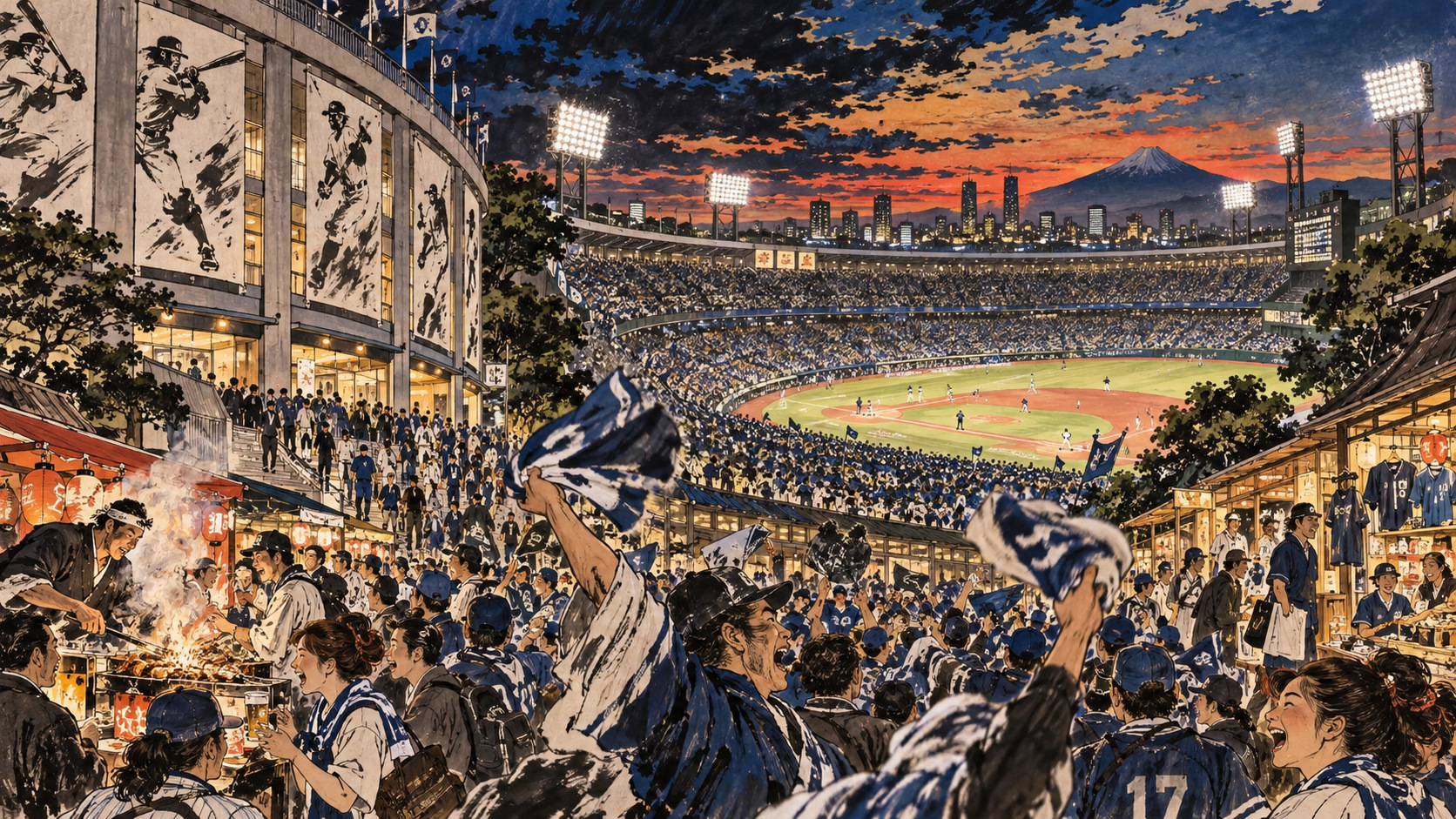
At 2 p.m. on October 10, two baseball stadiums become short-duration economic engines. The Yomiuri Giants host the Yokohama DeNA BayStars at Tokyo Dome; the Saitama Seibu Lions welcome the Hokkaido Nippon-Ham Fighters to Belluna Dome. The games are the opening round of Nippon Professional Baseball’s Climax Series. For fans, the immediate question is who survives. For club executives and businesses around the venues, it is how much economic value a playoff date creates—and how much of it can actually be retained.[1][2][9]
A postseason with multiple sets of winners
A playoff ticket buys a seat, but it also helps sell concessions, merchandise, sponsorship exposure and hospitality. Businesses providing transport, catering, security and local accommodation may benefit as well. These are different markets, with different margins and different beneficiaries. Gross spending across them cannot responsibly be described as club profit.
The first stage can last up to three games beginning October 10. From October 14, the Central League survivor faces league champion Hanshin, while the Pacific League winner meets league champion SoftBank. Home-field allocation means hosting rights are themselves valuable commercial opportunities, although contracts determine who keeps the proceeds.[1][2]
Japan’s extraordinary baseball attendance base
NPB recorded 27,040,286 attendances at 858 regular-season games in 2025, an average of 31,515. The league’s October 7, 2026 update reported 27,134,707 admissions in 857 games, averaging 31,662. These are regular-season figures, not playoff attendance forecasts. They nonetheless show the scale of baseball’s already-existing market.[4][5]
Differences between clubs matter. The Giants averaged 39,762 per home game in the 2026 count, while Seibu averaged 25,604. Selling out Tokyo Dome and filling Belluna Dome would not yield interchangeable revenue results: ticket mixes, capacity, services, location, and arrangements with suppliers differ.[4]
What is an extra playoff home date worth?
Consider a deliberately simple scenario. If 30,000 paying spectators produce average realized ticket receipts of ¥6,000, box-office gross would be ¥180 million. This is arithmetic, not an estimate of either October 10 game. Ticket fees, complimentary access, differing seat types, taxes and hosting expenses are excluded.
If the same 30,000 people spend an average ¥2,000 on food and merchandise, transactions total another ¥60 million. Yet that spending is not equivalent to ¥60 million in club income, much less profit. Restaurant operators, concession managers, licensed merchandise suppliers and venue partners may share or retain revenue. The distinction is particularly important when evaluating public claims of economic impact.
How October became a second baseball season
Japan’s modern postseason evolved through Pacific League playoffs introduced in 2004 and the two-league Climax Series system launched in 2007. In the inaugural Central League edition, second-place Chunichi defeated third-place Hanshin and then league champion Yomiuri, ultimately reaching—and winning—the Japan Series. It supplied a powerful demonstration of how October can produce a storyline separate from the regular-season standings.[6][7]
By preserving competitive stakes for teams chasing a top-three finish, the system helps turn late-season standings into a reason to remain invested. But it also prompts enduring questions about how much advantage league winners deserve. The 2026 rules allow a two-win advantage and an expanded, seven-game final under specified circumstances. That is a competitive rule change with possible implications for the number of games sold, without guaranteeing any particular number of dates.[3]
Pricing urgency without losing tomorrow’s supporters
The Seibu Lions published a dedicated 2026 Pacific League Climax Series ticket-sales plan, illustrating how postseason inventory is marketed separately from normal league dates. Membership windows, categories and purchasing arrangements help extract value from concentrated demand. They also raise a long-term question: can clubs welcome new and family audiences while monetizing scarcity?[8]
Ticket price schedules cannot by themselves establish realized gate receipts. Companies may buy hospitality packages, sponsors may hold allocations and fans may receive concessions. True average yield requires information about the actual ticket mix and how receipts are divided.
Broadcasting rights are not a simple multiplier
Tense knockout games can raise visibility for sponsors and generate audience attention for broadcasters and streaming services. Clubs may benefit through existing deals, exposure and stronger future negotiations. But an additional viewer does not automatically trigger a proportionate increase in rights revenue. Contract scope, rights holders, advertising sales and distribution models vary and are not fully disclosed publicly.
A series that ends in two games creates an especially awkward forecasting problem. Television schedules change, suppliers lose a planned sales day and promotional inventory might never be used. The commercial value of an extra date is contingent on sporting results, and preparation imposes costs even before the first pitch.
The neighborhood question: new spending or displaced spending?
Tokyo Dome sits within a dense entertainment and transportation district. Belluna Dome has a different geography and transport pattern in Tokorozawa. Rail travel, restaurants, shops and some hotels may gain business, but the share of money that remains in local communities must be measured, not assumed. A resident’s playoff dinner might displace another local evening out; an out-of-town visitor may represent genuinely additional demand.
A credible impact study would compare venue-adjacent spending with matched non-game days, identify nonresident visitors, account for public services, and avoid multiplying the same yen through several categories as if it were fresh spending each time. Neither large crowds nor aggregate consumer transactions alone prove net local gain.
The biggest financial test begins after the final out
October can be a profitable moment without making an organization sustainably profitable. A club still carries player payroll, development, stadium-related costs, marketing and administration across the year. The strategic question is whether a postseason appearance leads to longer-term season-ticket commitments, stronger sponsor renewals, more effective merchandising and deeper relationships with supporters.
The Giants, BayStars, Lions and Fighters begin with a chance to advance; Hanshin and SoftBank await the survivors. The money will flow in different directions whether a series lasts two games or three. The lasting winners will be the organizations—and communities—that turn a brief surge of attention into durable economic value.
Sources and references
Research cutoff: October 8, 2026 JST. Actual playoff revenue, individual rights fees, club operating profits and net local economic effects remain unverified.