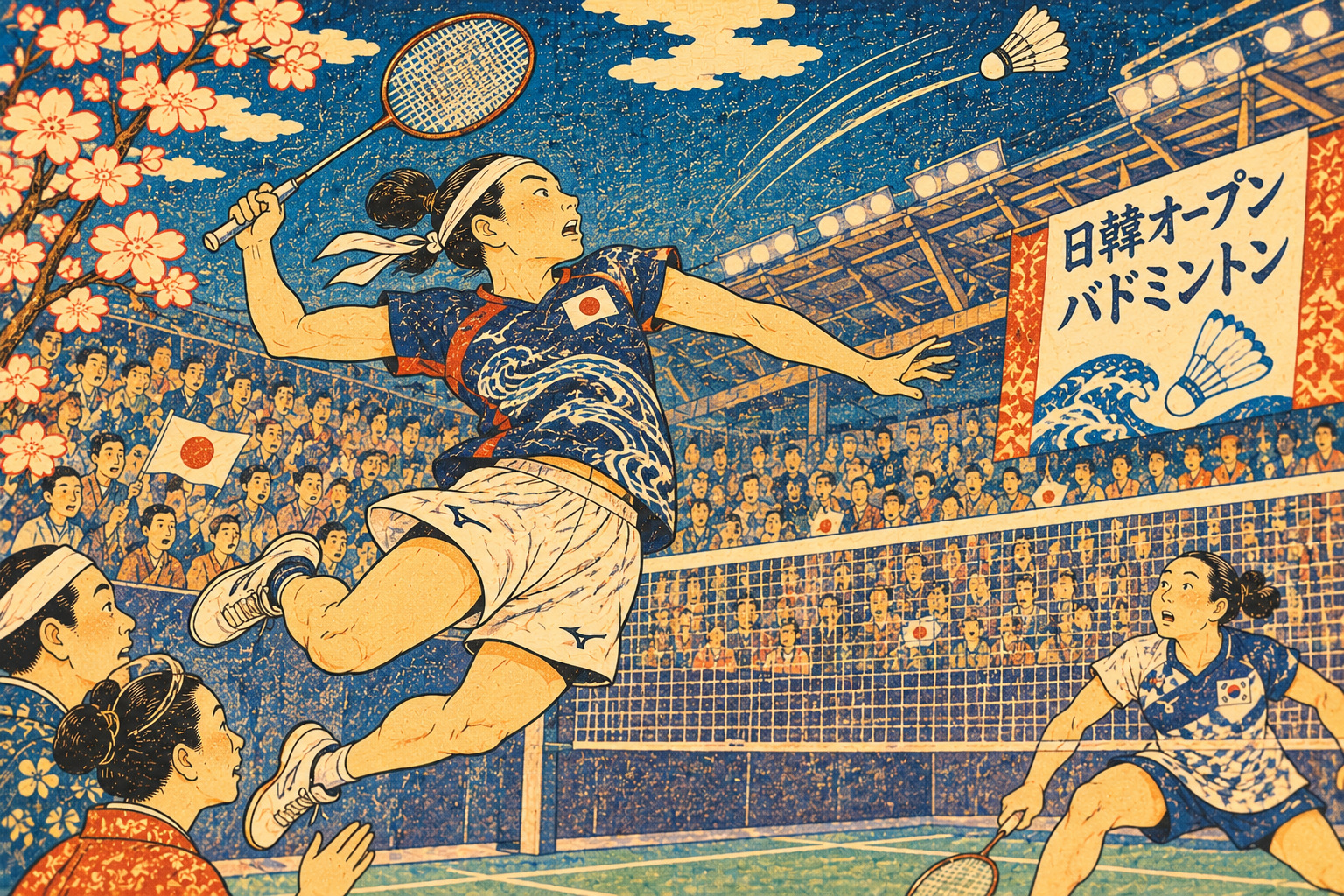
In Yeosu, the first surprise came from a doubles court
On November 3, the Korea Open began in the South Korean port city of Yeosu, and Japan's most intriguing opening-day story was not the performance of an established singles star. It was a pair playing without the benefit of a favored seeding: Tsubasa Yoshida and Takuto Goto defeated the sixth-seeded Chinese combination of Liang Weikeng and Hu Keyuan 21–19, 21–17. Their result was part of a striking Japanese men's doubles opening, with five pairs advancing from five first-round matches played on Tuesday. This was a useful early indication of depth, not a forecast of five podium finishes. The competition runs through November 8; the results in this report are those completed and corroborated for November 3, with November 4 and later rounds still requiring updates before the November 6 edition goes live.
The underdog result deserves more than a scoreboard
Yoshida and Goto's 21–19 opening game left little margin for error. They then took the second 21–17 against a Chinese pair listed as the tournament's sixth seeds in the detailed Japanese results. A two-game win matters because it removes the need for a deciding game, but it does not tell us whether the pair dominated the front court, forced weak lifts, or benefited from errors. Those are match-analysis questions that would require video or event-level evidence. Japan's most compelling sports reporting can distinguish a verified result from an imagined tactical explanation. For viewers unfamiliar with badminton, doubles is exceptionally sensitive to service returns and the first several shots of a rally; a narrow game often turns on a handful of exchanges. The achievement is real, even without invented stroke-by-stroke commentary.
Five Japanese pairs through: depth without a guarantee
The opening-day men's doubles scorelines underline both the strength and the work still to do. Takuro Hoki and Yugo Kobayashi beat South Korea's Kim Gi-jung and Kim Sa-rang 21–16, 21–15. Kakeru Kumagai and Hiroki Nishi needed three games against Chinese Taipei's Lai Po-yu and Tsai Fu-cheng, winning 21–15, 17–21, 21–19. Hiroki Okamura and Kyohei Yamashita recovered from losing the second game to defeat China's He Jiting and Ren Xiangyu 21–15, 14–21, 21–11. Keiichiro Matsui and Kenya Mitsuhashi survived an even tighter deciding game, 17–21, 21–15, 22–20, against Chinese Taipei's Lin Yongsheng and Lin Chiayen. Together with Yoshida and Goto, that is five first-round victories. Each pair faced a different level of pressure; the next round will test whether opening-day resilience can become sustained performance.
The other comeback: Matsui and Mitsuhashi at 22–20
Of those victories, the result of Matsui and Mitsuhashi offers the most compact lesson in competitive margins. After losing the first game 17–21, they won the next 21–15 and then edged the decider 22–20. Under the standard scoring system, a side must win by two points once the score reaches 20–all, up to the game's cap. The final-game number conveys how close elimination was. It does not establish the sequence of the last four rallies, which should not be reconstructed from the final score alone. For Japanese fans, such wins are reminders that international doubles success is not solely the domain of marquee partnerships. New combinations and less familiar names can change a draw before the seeded favorites even reach the quarterfinals.
Hoki and Kobayashi carry a different burden
Hoki and Kobayashi arrived as one of Japan's internationally recognizable men's pairs and were seeded fifth in the event, according to the draw reported by Japanese badminton media. Their straight-games victory over a Korean pairing was efficient on the scoreboard. But reputation should not be mistaken for an exemption from the tournament's rising difficulty. A stronger second-round opponent, the accumulating recovery demands of consecutive matches, and the small margins in service exchanges all remain to be confronted. International badminton is increasingly characterized by opponents who can attack quickly, defend effectively and adjust between games. The appropriate question for Hoki and Kobayashi is not whether a first-round win proves their historical standing, but whether their partnership can reproduce its strengths over a full Super 500 week.
A new chapter for Chiharu Shida
In women's doubles, Chiharu Shida and Ririna Hiramoto defeated Chinese Taipei's Chen Su-yu and Chen Han 21–18, 21–11 on November 3. Their pairing is itself a story. Shida earned an Olympic bronze medal at Paris 2024 with Nami Matsuyama; after that long-running partnership ended, she began building new combinations. Japanese broadcast reporting says Shida and Hiramoto reached the quarterfinals at the October 2026 French Open, their first international tournament together, and are now playing their second. One early Korea Open win does not prove a seamless transition, but it gives the pair a measurable starting point. The match's tighter first game and more comfortable second invite careful questions about how a partnership develops under competitive pressure, not assumptions about what either player privately feels.
Another Japanese women’s pairing meets the other side of the draw
Nanako Hara and Riko Kiyose lost a three-game contest to Chinese Taipei's Chen Yanfei and Sun Liangqing 17–21, 21–19, 17–21, according to Badminton Spirit's recorded scores. That match took 65 minutes. When the same nation's coverage celebrates one partnership's progress and ignores another's close defeat, it can flatten what the competition is actually testing. A competitive loss contains information about endurance and decision-making, even if the available score sheet cannot establish exactly why points were won. It is also a reminder that Japan's doubles roster includes more than a single headline combination. Throughout the tournament, reporting should track competitors fairly while placing appropriate emphasis on meaningful upsets or progress into later rounds.
Takei’s qualifying path shows the work below the spotlight
In the men's singles qualifying rounds on November 3, Riki Takei defeated compatriot Shogo Ogawa 21–14, 21–15, then beat South Korea's Cho Hyeon-woo 21–19, 16–21, 21–14 to earn a place in the main draw. Qualifying matches rarely dominate the international narrative, yet they can be consequential for athletes moving between domestic competitions and the main tour. They also force a different physical calculation: qualification adds matches before the main-draw opponents arrive. Nothing in the published score indicates Takei's fitness, injury status or tactical choices, so those remain unverified. But the result makes a valuable point about Japan's player pipeline: ranking and draw position shape how much work an athlete must complete merely to reach the stage where casual audiences first notice them.
Yamaguchi, Miyazaki and Japan’s singles test
Japan's official October 30 delegation announcement names Akane Yamaguchi, Tomoka Miyazaki, Riko Gunji and Manami Suizu among the women's singles representatives, along with men's players Kodai Naraoka, Yushi Tanaka, Koki Watanabe, Yudai Okimoto, Kenta Nishimoto and Riki Takei. Other players in the tournament draw may be entered through routes not fully reflected in that national delegation list; a federation announcement is not an exhaustive list of every Japanese entrant. The opening-day results used for this report do not establish the outcomes of the Wednesday singles matches. Yamaguchi's stature and Miyazaki's emergence make those contests important, but publishing an imagined win or defeat would turn a live competition into fiction. An updated article must use official match sheets before discussing their competitive position.
Why Super 500 is consequential, but not a world title
The Yeosu tournament is classified as an HSBC BWF World Tour Super 500 event, one tier in an international circuit with tournaments of different ranking-point and prize-money values. Such events offer meaningful competition, and results can influence ranking and qualification ambitions, but a Super 500 title is not a world championship or Olympic medal. Japan's calendar also lists the Kumamoto Masters Japan immediately after the Korea Open, beginning November 8. That compressed schedule can matter for travel and planning, although its effect on any individual athlete cannot be presumed. Reporting should name the competition accurately and resist inflating routine opening-round victories into career-defining triumphs. The draw is a series of increasingly demanding decisions, not one verdict issued on opening day.
A longer history than any one golden generation
The Japan Badminton Association traces organized activity to YMCA-based instruction in cities including Nagoya, Osaka, Kobe and Yokohama in the early twentieth century. The association was founded in 1946, held its first national championship in 1947 and joined the international federation in 1952. Badminton became an Olympic medal sport in Barcelona in 1992. At Rio 2016, Misaki Matsutomo and Ayaka Takahashi won Japan's first Olympic badminton gold, in women's doubles. Japan's later success in multiple disciplines built expectations that each new generation must now negotiate. That history is not a straight line of continuous victory: shifts in coaching, player development, pairings, injuries and international opposition have repeatedly altered the balance. Yeosu is one small but revealing stop in a much longer story of institutional investment and individual achievement.
South Korea is a rival and a useful mirror
Hosting the tournament in South Korea gives Japanese players a demanding regional setting rather than an exotic destination. Korea, China, Chinese Taipei, Indonesia and Malaysia all have established badminton traditions; the field includes opponents with a range of doubles systems and singles styles. Japanese and Korean fans may be drawn to the national rivalry, but an honest account needs to distinguish countries from individual pairings. Hoki and Kobayashi beat a Korean team; that alone says nothing definitive about the comparative strength of two national programs. A better test will be the range of head-to-head results across multiple events and rounds. The Korea Open offers snapshots of competitive interaction, not a conclusive Asian ranking rewritten overnight.
What the next rounds must decide
Three questions remain open. How many of Japan's five surviving men's doubles pairs can turn opening wins into quarterfinal appearances? Can Shida and Hiramoto build on their straight-games start against stronger opposition? And what will the singles draw reveal about Yamaguchi, Miyazaki, Naraoka and the athletes trying to establish themselves alongside them? Those answers depend on matches scheduled after the verified November 3 results. The article's planned November 6 publication date is not evidence that those matches have already taken place in the information reviewed here. An editor should update the day-two and day-three results, draw status, withdrawals and confirmed schedules immediately before publishing. Until then, Yeosu has already yielded one well-supported conclusion: the next layer of Japanese badminton talent is broad enough to make the opening rounds worth watching.
Sources and reporting method
Based on the Japanese national federation, contemporary Japanese match reports, tournament schedules and independently documented badminton history. Draw and lineup information can change during the event.
- Japan Badminton Association: Korea Open 2026 delegation, October 30
- Japan Badminton Association: November tournament calendar
- Badminton Spirit: November 3 opening-day results, November 4 report
- SMASH and NET.TV: detailed November 3 Japanese match results
- Japan Badminton Association: history of badminton in Japan
- Olympics: historical badminton Olympic champions
- Nippon TV report on Shida/Hiramoto pairing, November 3
- Japan Badminton Association: 2026 BIRD JAPAN team
- Tournament draw and order-of-play listing (secondary, subject to changes)