The breakthrough is a faster way to search—not proof that a new hydrogen-storage alloy is ready for use.
The bottleneck was the experiment itself
Hydrogen can be produced, moved and used in many ways, but its storage remains an engineering trade-off. Some metal alloys can absorb hydrogen into their structure and release it under controlled conditions. The challenge is finding formulations that do so at useful temperatures and pressures without becoming too heavy, costly or hard to manufacture. Researchers in Japan now report a change in how that search can be conducted: an automated laboratory platform that compresses a test sequence taking two to three days per sample into approximately two to three hours. The October 23 announcement is about speeding discovery—not announcing a commercially ready hydrogen-storage material.
Five partners, one integrated workflow
The project brings together the National Institutes for Quantum Science and Technology (QST), Tohoku University, the Institute for Molecular Science within the National Institutes of Natural Sciences, and two Japanese companies, R-DEC and A-VS. According to the Japanese-language joint research announcement, the system integrates thin-film alloy preparation, hydrogen absorption treatment, composition analysis and hydrogen-release evaluation. Previous automated deposition systems existed; the claimed novelty is bringing these specific stages into a single automated hydrogen-materials workflow. The team's description of a world first should be understood in that defined context, rather than as a claim that no materials laboratory has ever been automated.
A metal that can hold hydrogen
Metal hydrides form when hydrogen interacts with a metal or alloy and is retained within its structure. Unlike simply storing a gas in a pressure vessel, this approach may offer compact storage at certain operating conditions. But the mass of the storage medium matters, as do the energy and temperature needed to charge and discharge it. Material availability, cost, cycling life and heat transfer can determine whether a promising sample makes sense for a real application. A material that absorbs a lot of hydrogen under ideal laboratory conditions might still perform poorly in a working system.
How the machine is arranged
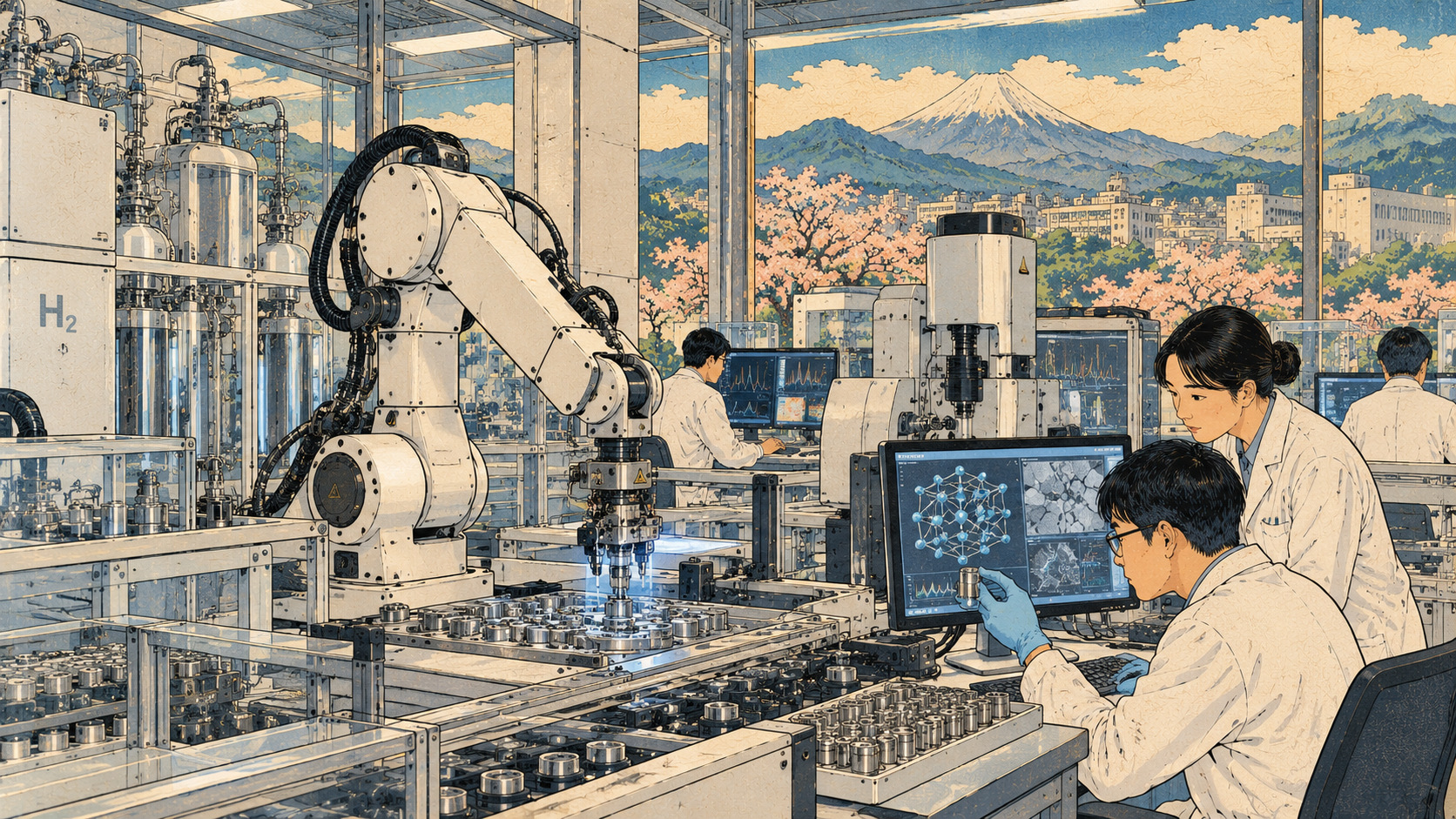
The platform links a substrate-loading chamber, a three-source sputter deposition chamber, a hydrogen-absorption chamber, composition analysis, and a station for evaluating hydrogen desorption. A robotic transfer mechanism carries specimens between them. One unusually difficult part was integrating high-vacuum film deposition with the pressurized hydrogen environment used for absorption. The researchers addressed this by maintaining vacuum around the treatment chamber while placing an independent pressure-resistant vessel inside, pressurizing hydrogen only within that smaller vessel. That engineering solution enables operations that previously required separate instruments and transfers to occur in sequence.
Ten candidate compositions, one sequence
The researchers report that the apparatus can evaluate up to ten different alloy compositions consecutively. After preparing thin-film samples and exposing them to hydrogen, it assesses composition and sends hydrogen-absorbing candidates on for a heating-based desorption-temperature measurement. Screening out unsuccessful candidates before the final step also saves time. It is important not to misread the numbers: the quoted two-to-three-hour duration concerns a sample's experimental process; the capacity to run ten compositions consecutively is a separate capability, not proof that ten complete experiments are all finished within a single two-hour interval.
Hydrogen alloys have a much longer history
The underlying materials science predates today's clean-energy investment boom by decades. Research on magnesium-based hydrides and other intermetallic compounds expanded in the 1960s and 1970s, including alloys such as TiFe and LaNi5. Japan's Sunshine Project, launched in 1974 after the oil shocks, helped institutionalize research into alternatives to petroleum. Metal-hydride chemistry also found a major practical application in nickel-metal-hydride batteries, which became important in hybrid vehicles. These achievements demonstrated usefulness in specific settings without solving every challenge of hydrogen storage for the wider energy system.
Why the periodic table creates a vast search space
Changing an alloy's elemental ingredients or proportions can change how tightly it binds hydrogen, the temperature required for release and the pressure at which it operates. A higher storage capacity may come with the penalty of greater weight or more demanding operating conditions. Scarce or expensive elements create supply-chain constraints. Researchers therefore need to compare multiple properties rather than optimize a single impressive number. Experimental throughput is one part of that problem: the faster comparable compositions can be evaluated, the more systematic the search can become.
Thin films are not commercial tanks
The new equipment prepares and tests thin-film alloys. A promising thin-film composition is a research clue, not proof that a full-scale, durable storage system is ready. Bulk production, heat removal during absorption, heat supply during release, cycling degradation, safety certification and cost all remain separate problems. For investors and hydrogen developers, the distinction is fundamental: a more productive materials laboratory is potentially valuable even if no particular new material has yet met commercial requirements.
Automation is not the same as autonomous AI
The team intends eventually to link the platform with artificial intelligence so new experiments can be selected using preceding results. In the present announcement, however, automated execution of established procedures is the demonstrated achievement. There is no public evidence here of a fully autonomous closed-loop AI system selecting compositions, validating them and revising its own plan. Separately, a Tohoku-led team has reported DigHyd, a curated hydrogen-storage research database drawn from thousands of publications. Together, such datasets and controlled experiments could support more capable research tools, if their reliability and limitations are properly evaluated.
Watching atoms while hydrogen moves
Another proposed step is collaboration with QST's synchrotron-based in-situ observation work. That could allow scientists to connect measured absorption and desorption behavior with structural changes taking place within the material. The aim is not only to identify a winner but to understand why a given alloy works and feed that insight into the next design. Whether the combined approach leads to faster discovery of commercially useful compounds remains a question for future experiments and independent evaluation.
A research instrument heads toward customers
According to Tohoku University, R-DEC has commercialized the experimental system, with a corporate exhibition planned from October 26 at the 19th International Symposium on Material-Hydrogen Systems in Sendai. This is a meaningful distinction: the laboratory instrument itself has reached a product stage according to the institutions, even as the novel hydrogen-storage materials it might help discover remain a future objective. Publicly available material reviewed for this report does not establish sales volume, purchase price, customers or independent reliability benchmarks.
The value of asking more questions per week
Hydrogen is not intrinsically a cheap or zero-emissions answer to every energy problem. Its value depends on how it is made, delivered and used, and on the alternatives available. Metal-hydride storage will likewise be most useful where its full engineering trade-offs are favorable. This Japanese project does not overturn those realities. Its significance is more practical: it can give scientists more chances to ask carefully controlled questions, with consistent measurements and less manual delay. If useful new compositions exist in that enormous search space, better experiments may help researchers find them sooner.
Sources and verification
Based on public materials available October 24, 2026. Time reductions and the defined “world-first” claim are attributed to the collaborating organizations. Commercial alloy performance, equipment pricing, installations and independent replication were not established. No original interviews were conducted.