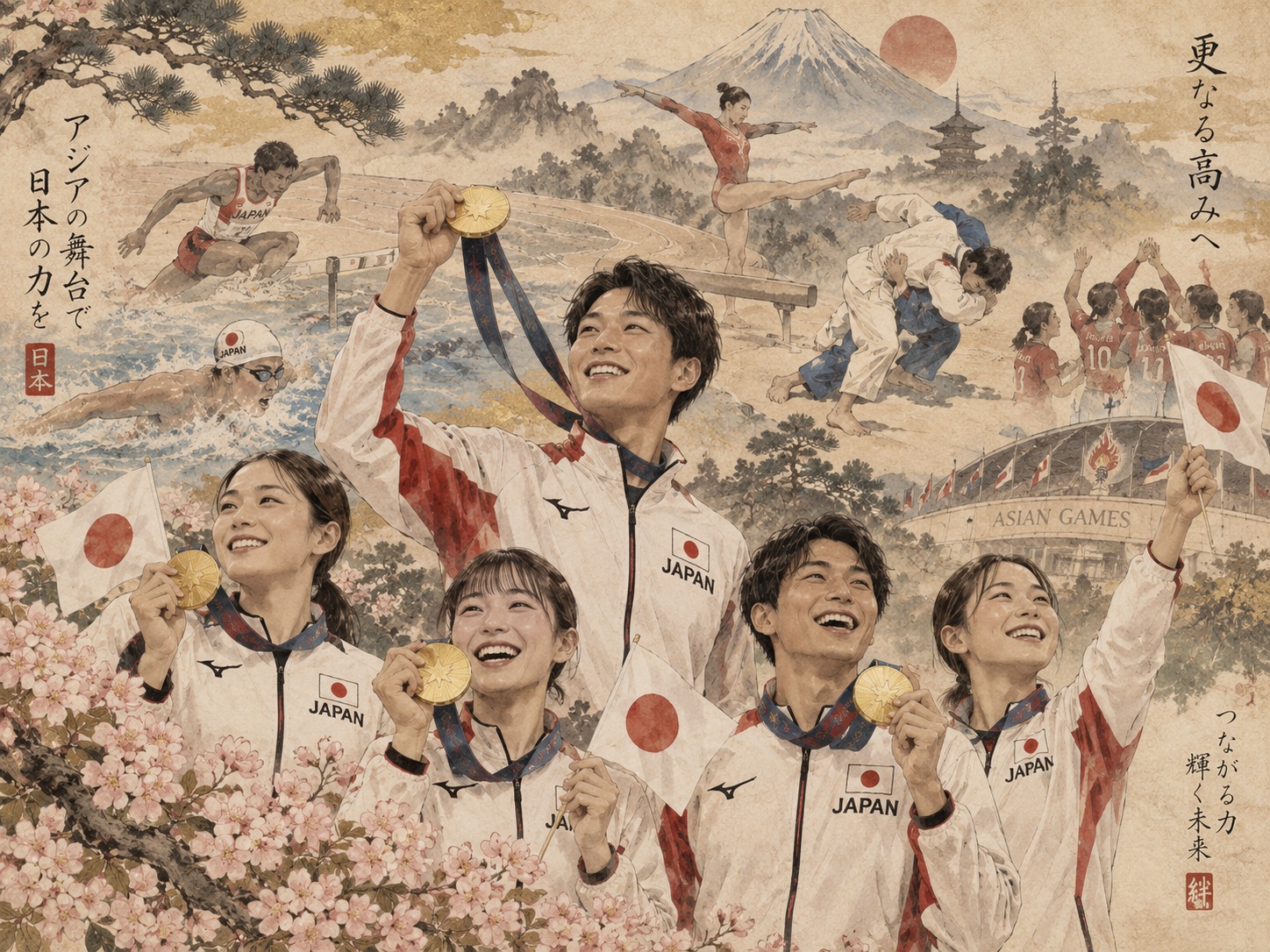
Japan ended its home Asian Games with a number that had survived for six decades finally erased: 83 gold medals.
TEAM JAPAN finished Aichi-Nagoya with 83 gold, 95 silver and 91 bronze medals — 269 in total. The Japanese Olympic Committee says both the gold count and overall medal count were national Asian Games records. The previous gold record was 78, set at the 1966 Bangkok Games. Japan finished second in golds behind China’s 169 and well ahead of South Korea’s 39.[1]
It is tempting to read 83 as a forecast for Los Angeles 2028. That would be too simple. The Asian Games program is much larger than the Olympic program, includes non-Olympic sports, and gave Japan every advantage of competing at home. But the result still offers a unusually broad snapshot of Japan’s athlete-development pipeline two years before LA.
A 60-year record finally fell
The 78 gold medals Japan won in Bangkok in 1966 had become one of the durable markers in its Asian Games history.
The competitive landscape changed dramatically after that era, above all with China’s rise. Japan returned to the 70s in 2018, winning 75 gold medals in Jakarta and Palembang. At Hangzhou 2022, held in 2023, the count fell to 52.[2][3]
Aichi-Nagoya moved the record to 83. But the program also expanded: 469 gold-medal events were contested, including sports such as esports, teqball and padel that are not part of the Olympic medal program. Reuters reported China’s 169 golds still put it far ahead of the host nation.[4]
How much of the result was home advantage?
Hosting matters. Athletes avoid long-haul travel and time-zone adjustment. They know the food and environment. Friends, family and sponsors can attend. Some competitors train regularly at the same venues used for competition.
JOC materials listed 932 athletes in a delegation of 1,430 athletes, coaches and officials at the time of the team ceremony.[5] That scale itself demonstrates the breadth of Japan’s elite-sport system.
But it also means 83 cannot simply be projected onto an overseas Olympics. The better question is which performances were world-class rather than merely Asia-leading.
A 17-year-old world record is different from an Asian Games record
The clearest example came in men’s swimming.
Seventeen-year-old Shin Ohashi won the 200-meter breaststroke in 2:04.83, breaking Qin Haiyang’s world record by 0.65 seconds. It was his second breaststroke gold of the Games.[6]
The distinction matters. This was not simply an Asian Games title or a home-meet breakthrough. A world record is directly comparable with the standard needed to contend for an Olympic medal.
Fifteen-year-old skateboard champions show generational depth
Japan’s youth pipeline was equally visible in skateboarding.
Mizuho Hasegawa, 15, won women’s park. Iori Nagahara, also 15, won men’s park, while Aori Nishimura and other Japanese skaters added podium finishes. JOC also lists 16-year-old Ginwoo Onodera among the gold medalists in men’s street.[7][8]
For a young Olympic sport, the key signal is not one champion but multiple teenagers already competing at elite international level. Domestic selection pressure can become a development advantage.
Cycling showed the value of multiple medal pathways
Japan’s cycling program produced medals across BMX and track.
Asuma Nakai won men’s BMX racing with Hyoga Kiuchi second, while Sae Hatakeyama won the women’s title. On the track, Kaiya Ota repeated as men’s sprint champion, Tsuyaka Uchino and Maho Kakita defended the women’s Madison title, and Kanta Umezawa won the men’s omnium.[9][10]
Before the Games, track rider Kazushige Kuboki explicitly said the team was looking toward Los Angeles 2028 across both sprint and endurance disciplines.[11]
That is the kind of program depth that can create more than one Olympic medal opportunity from a single federation.
Judo and wrestling remain core Olympic pipelines
Judo champions included Sotaro Fujiwara, Rin Maeda and Narumi Tanioka, while wrestling produced golds including Nonoka Ozaki.[10]
For Japan, these are traditional Olympic medal sports. Yet Asia itself contains much of the global elite in judo and wrestling, making the Asian Games a meaningful competitive test.
There is another complication: winning the Asian Games does not guarantee an Olympic berth. Japan’s domestic selection in both sports can be as difficult as the international event.
Surfing converted gold into an Olympic pathway
Kanoa Igarashi and 18-year-old Mirai Ikeda won the men’s and women’s surfing titles and secured conditional Los Angeles 2028 qualification benefits under the relevant pathway.[12]
That is a much more direct LA indicator than a medal-table total. When evaluating the pipeline, Olympic quota implications matter as much as color of medal.
Hockey showed the limits of a record medal haul
Japan’s hockey teams illustrate the opposite case.
The women entered with a chance to qualify directly for LA 2028 by winning the Asian Games but finished third. JOC closing comments explicitly noted that the Olympic berth was not secured and that the team would need to pursue qualification through later routes.[13]
That matters because a record national gold total can conceal sport-specific weaknesses. A country can dominate the overall Asian Games tally while still missing critical Olympic qualification targets.
Women’s football demonstrated second-line depth
Japan won a third consecutive women’s football gold, defeating North Korea on penalties. The squad was built largely from domestic WE League players rather than Japan’s full group of Europe-based stars.
Reuters reported that Yuzuho Shiokoshi hoped the success would translate into stronger domestic attendance and visibility for women’s football.[14]
From a high-performance perspective, the result suggests depth below the first-choice national team — an important factor in sustaining international competitiveness through injuries and generational change.
A first sepak takraw gold measures something other than Olympic readiness
Japan also won its first Asian Games gold in sepak takraw since the sport entered the Games in 1990.[15]
That medal has no direct LA 2028 value because sepak takraw is not an Olympic sport.
But it reveals why the Asian Games should not be reduced to Olympic preparation. The event also measures Japan’s position across Asian sporting culture and supports sports that would otherwise receive little international attention at home.
The 83 golds can be separated into two categories
For LA 2028 analysis, the medal haul is easier to understand in two groups.
The first contains Olympic-transferable performances: swimming, athletics, cycling, judo, wrestling, skateboarding, surfing and other sports where world standards, Olympic qualification or elite global opponents provide useful evidence.
The second contains Asian Games-specific disciplines or events with limited Olympic transfer. Those medals demonstrate national breadth but should not be treated as Olympic projections.
What changed from 2018 and Hangzhou?
Japan’s 75 golds in 2018 came two years before the Tokyo Olympics. That event became a major platform for a generation that would shape Tokyo 2020. At Hangzhou 2022, Japan won 52 golds during a period of transition.[2][3]
Aichi-Nagoya came in a different phase: after Paris 2024 and as a new Olympic cycle begins to mature. The prominence of teenagers such as Ohashi, Hasegawa, Nagahara and Onodera makes that generational shift especially visible.
Two years is still a long time in elite sport
Los Angeles is roughly two years away. A 17-year-old will be 19. University athletes will become professionals. Veterans will retire. Qualification systems and domestic selection can change.
The Aichi-Nagoya roster will not simply become the LA team.
The more valuable signals are depth, age profile, internal competition and whether athletes are producing performances that survive comparison beyond Asia.
Delegation leader Kosei Inoue emphasized the collective level
At TEAM JAPAN’s mid-Games press conference, delegation leader Kosei Inoue praised athletes across sports for strong performances and for delivering inspiration to the public.[16]
Inoue is a former Olympic judo champion and national-team coach. His perspective reflects one of the Asian Games’ strategic roles: it allows Japan to expose a very large group of athletes to a multisport environment before the Olympics.
China’s 169 golds are a reminder of the global step still ahead
Japan set its own record and still finished with fewer than half of China’s 169 gold medals.[1]
That does not diminish the achievement. It does show the scale of Asian competition. At Los Angeles, Japan will also face the United States, European powers, Australia, African nations and the rest of the world.
Second in Asia is not second in the world.
The deeper number may be 732, not 83
The medal count attracts attention, but JOC’s final results list 732 Japanese athletes as top-six finishers across the program.[17]
Olympic medalists emerge from that wider base. A high-performance system needs more internationally competitive athletes than the final Olympic team can accommodate.
In that sense, 83 golds show the top of the pipeline. The much larger group of finalists and medalists shows its depth.
The record is a dataset, not a destination
Japan won more Asian Games gold medals than ever before and more medals of every color combined than ever before.
For JOC and the national federations, however, the work now becomes selective. Which teenage champions can become world champions? Which Asian winners can beat Olympic fields? Which sports missed qualification opportunities? Which home advantages cannot be reproduced abroad?
The 83 gold medals are not a prophecy for Los Angeles. They are a vast mid-cycle dataset.
Aichi-Nagoya made Japan’s strengths unusually visible. The task between now and 2028 is to separate the performances that were excellent for Asia from the performances that can win against the world.
Sources and references
- Japanese Olympic Committee, record 83 gold and 269 total medals, October 4, 2026.
- JOC, Japan finishes Jakarta-Palembang 2018 with 75 gold medals.
- JOC, Hangzhou 2022 medal and placing list.
- Reuters, “Asian Games close after fortnight of turmoil and teenage triumph,” October 4, 2026.
- JOC, TEAM JAPAN delegation ceremony and roster scale.
- JOC, Shin Ohashi 200m breaststroke world record, September 24, 2026.
- JOC, Japanese sweep of skateboard park titles.
- JOC, Ginwoo Onodera athlete profile.
- JOC, BMX racing medal sweep.
- JOC, track cycling, judo and wrestling gold-medal results, October 1, 2026.
- JOC, TEAM JAPAN opening comments, cycling and LA 2028.
- JOC, surfing golds and conditional LA 2028 qualification, September 29, 2026.
- JOC, closing comments from hockey athletes and Olympic qualification status.
- Reuters, Japan women’s football gold and domestic development implications.
- JOC, Japan’s first Asian Games sepak takraw gold.
- JOC, TEAM JAPAN mid-Games press conference.
- JOC, final Aichi-Nagoya medal and placing list.
Reporting and verification cutoff: October 7, 2026. The Asian Games medal total cannot be directly converted into an LA 2028 Olympic medal forecast because the event program, qualification rules, competition field and home advantage differ substantially.