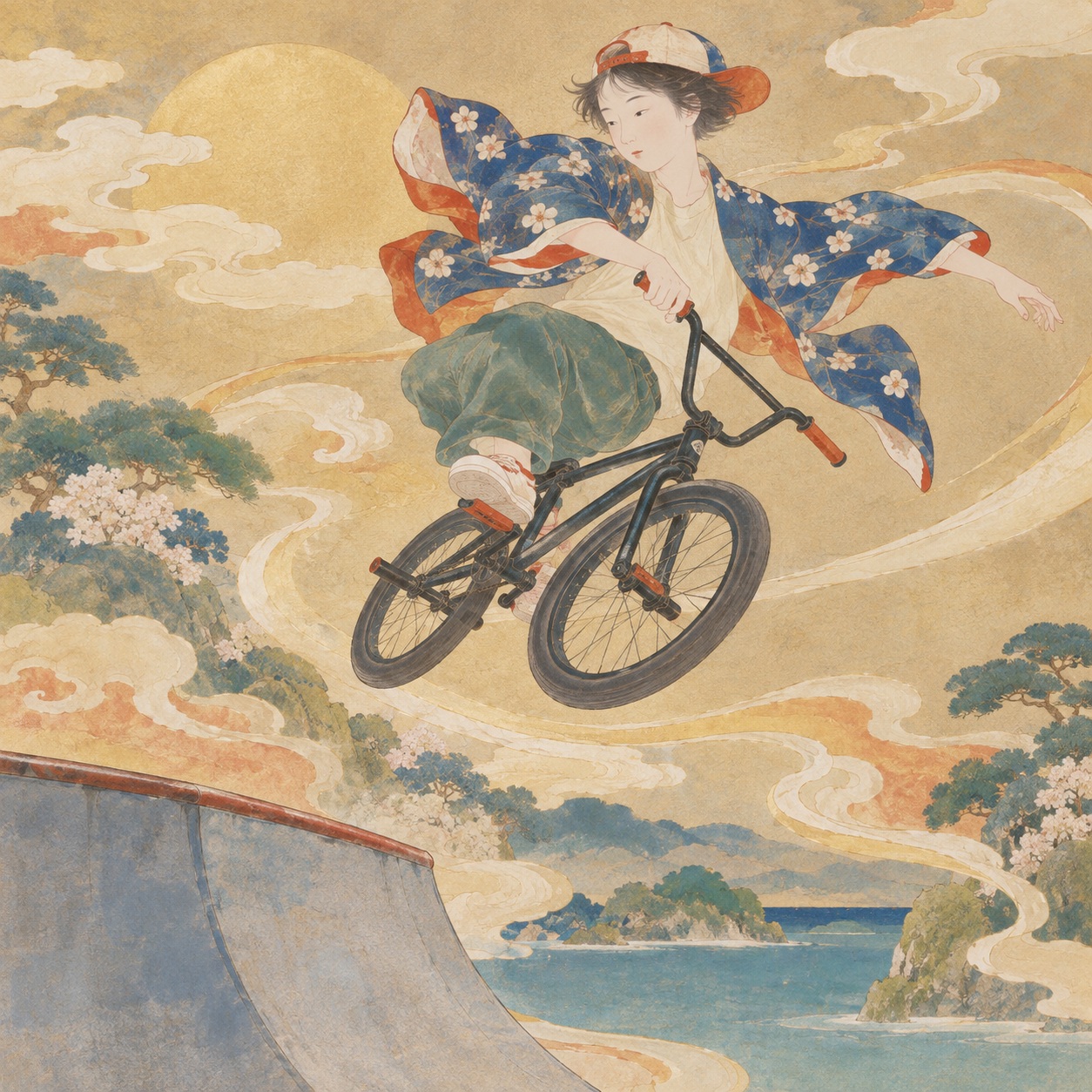
Few sports look as young as BMX freestyle park. Riders attack an artificial landscape of quarter pipes, ramps and jumps, throwing the bicycle into spins, rotations and releases that last only seconds. A run is judged not merely by how difficult the tricks are, but by execution, originality, use of the course and the way the entire sequence flows.
At the Aichi-Nagoya Asian Games, that discipline entered the Asian Games program for the first time. On September 27 at Aichi Sky Expo in Tokoname, Japan turned the debut into a statement of depth: Rimu Nakamura won the men’s gold, Kaede Ozawa took men’s silver, and Miharu Ozawa won women’s silver.[1][9][10]
Flag bearer Nakamura becomes the first men’s Asian Games champion
Nakamura entered the home Games as the established face of Japanese men’s BMX freestyle. Born in 2002, he competed at both Tokyo 2020 and Paris 2024 and finished fifth in the men’s park event at each Olympics. He also served as one of Team Japan’s flag bearers at the Aichi-Nagoya opening ceremony.[4]
Domestically, he has been the benchmark for years. In 2025 he scored 93.80 to win a seventh consecutive national park title and his eighth overall.[7]
The Asian Games gold therefore matters on two levels. It rewards an athlete who has spent years near the Olympic podium, and it writes Nakamura into the event’s history as the first men’s BMX freestyle park champion at the Asian Games.
Kaede Ozawa’s silver shows Japan is no longer a one-rider program
The men’s result was more significant because Kaede Ozawa finished second. Japan did not merely win; it occupied the top two positions.
Ozawa had already shown that he could challenge Nakamura domestically. He won a Japan Cup event in Nagoya as a teenager in 2024 and finished second to Nakamura at the 2025 national championships.[8][7]
In a relatively small discipline, having one world-class athlete and having a pipeline are very different things. A gold-silver finish suggests that Japanese men’s BMX is moving toward the second category.
Miharu Ozawa is 16—and already proven internationally
Kaede’s younger sister Miharu also won silver, putting both siblings on the Asian Games podium on the same day.[9]
Her age makes the result eye-catching, but age alone understates her status. In November 2025, at 16, Miharu Ozawa won her first BMX freestyle park World Cup event and finished the season ranked No. 1 overall. In July 2026 she won X Games Chiba with 93.33 points.[5][6]
Silver in Aichi-Nagoya therefore should not be framed simply as a promising teenager falling short of gold. Japan now has a 16-year-old who has already won major international events, her rising older brother, and a two-time Olympic finalist in Nakamura on the same national team.
Tokyo 2020 brought freestyle BMX into the Olympic system
BMX had existed for decades as a global youth and action-sports culture before freestyle park entered the Olympic program at Tokyo 2020. Once it became an Olympic medal discipline, however, the institutional environment changed: national federations had stronger incentives to develop athletes, qualification pathways became more structured, and training facilities acquired new strategic value.
In park competition, riders use ramps, walls and jumps to construct a run. Difficulty matters, but so do execution, originality and course use. The Aichi-Nagoya organizers describe a sport in which crashes and foot-downs can heavily reduce a score, even as riders are rewarded for attempting highly original big tricks and combinations.[3]
It is not a race in which the clock provides the answer. Style and risk are part of the competitive language.
An Asian Games debut signals institutional maturity
Aichi-Nagoya held BMX freestyle qualifying on September 26 and the women’s and men’s finals on September 27 in Hall C at Aichi Sky Expo. The organizing committee’s ticketing material explicitly described BMX freestyle as making its Asian Games debut.[2][3]
Adding a sport to a continental multi-sport program does more than create two more medal ceremonies. National Olympic committees send athletes. Federations build qualification systems. Host cities construct or adapt competition facilities. Broadcasters and sponsors allocate space to a discipline that may previously have lived largely in specialist events.
That is one measure of how far freestyle BMX has moved from street culture into formal international sport.
Aichi Sky Expo became a laboratory for newer sports
Aichi Sky Expo opened in 2019 next to Chubu Centrair International Airport. During the Games it is hosting BMX freestyle, breaking, esports, fencing and skateboarding.[2]
Putting those sports together is revealing. Fencing represents a long Olympic tradition. BMX, skateboarding and breaking arrived much later. Esports occupies an even newer place in the multi-sport movement.
The venue therefore does more than solve a logistics problem. It creates a cluster of sports that speak to different audiences, often rely heavily on music, social media and individual style, and fit naturally into exhibition-hall spaces rather than traditional stadiums.
Japan’s skateboarding success offers a comparison—but not a template
Japan has also been highly successful in skateboarding, including gold medals at these Games for 15-year-olds in the park events. The success of both disciplines points toward a wider Japanese ecosystem of urban and action sports.
But BMX and skateboarding should not be collapsed into one youth-sport category. BMX requires a bicycle, equipment maintenance, larger riding structures and significant safety management. Training access can be expensive and geographically limited.
For Japan to turn its current competitive strength into a sustainable program, it will need not only stars but accessible beginner facilities, junior events, coaching and safe progression pathways.
Youth is an advantage, but it should not become the whole story
Action sports often produce elite teenagers. Flexibility, rapid skill acquisition and a willingness to learn new tricks can favor younger athletes.
But the “fearless teenager” stereotype misses the work behind the performance. Big tricks are built through repeated failure, injury management, physical preparation, video study, bike setup and detailed planning of how to use each park.
Nakamura’s longevity helps make that point. Two Olympic fifth-place finishes and years of domestic dominance are evidence that high-level BMX freestyle is not simply a temporary advantage of youth.
Los Angeles 2028 is the next test
An Asian Games gold medal and an Olympic medal are different achievements. The global men’s field includes powerful riders from Europe, Australia and the Americas. Nakamura has twice reached fifth place at the Olympics, but Japan has not yet converted that consistency into an Olympic men’s medal.
The Aichi result nevertheless changes the shape of Japan’s opportunity. The country is no longer relying on a single athlete. Nakamura, Kaede Ozawa and Miharu Ozawa represent different career stages but all left the first Asian Games BMX freestyle competition with medals.
The next challenge is turning that depth into a durable system through Los Angeles 2028 and beyond.
What the first Asian Games podium leaves behind
September 27, 2026 is now a date in BMX freestyle history: the day the Asian Games awarded its first park medals. Nakamura became the first men’s champion. Kaede and Miharu Ozawa each took silver.
The story is bigger than three medals. One athlete brought Olympic experience and domestic dominance. Another showed Japan has a successor capable of standing beside him. A 16-year-old woman arrived already carrying World Cup and X Games victories.
BMX freestyle is still a young medal sport. In Japan, though, it is becoming less of a novelty with every major Games. Tokyo 2020 brought it into the Olympics. Aichi-Nagoya 2026 brought it into the Asian Games. Los Angeles 2028 is next—and Japan will arrive with more than one rider capable of mattering.
Sources
- Japanese Olympic Committee: Aichi-Nagoya Asian Games schedule, Sept. 27
- Aichi-Nagoya 2026: Aichi Sky Expo venue information
- Aichi-Nagoya 2026 ticketing guide: BMX freestyle makes its Asian Games debut
- Japanese Olympic Committee: Rimu Nakamura athlete profile
- JOC: Miharu Ozawa wins first World Cup event and season title, Nov. 30, 2025
- JOC: Miharu Ozawa wins X Games Chiba, July 4, 2026
- JOC: Nakamura wins seventh straight national BMX park title, Oct. 5, 2025
- JOC: Ozawa siblings win Japan Cup, April 28, 2024
- Gifu Shimbun: Ozawa siblings win Asian Games silver, Sept. 27, 2026
- Cyclowired: Nakamura gold, Kaede and Miharu Ozawa silver, Sept. 27, 2026
