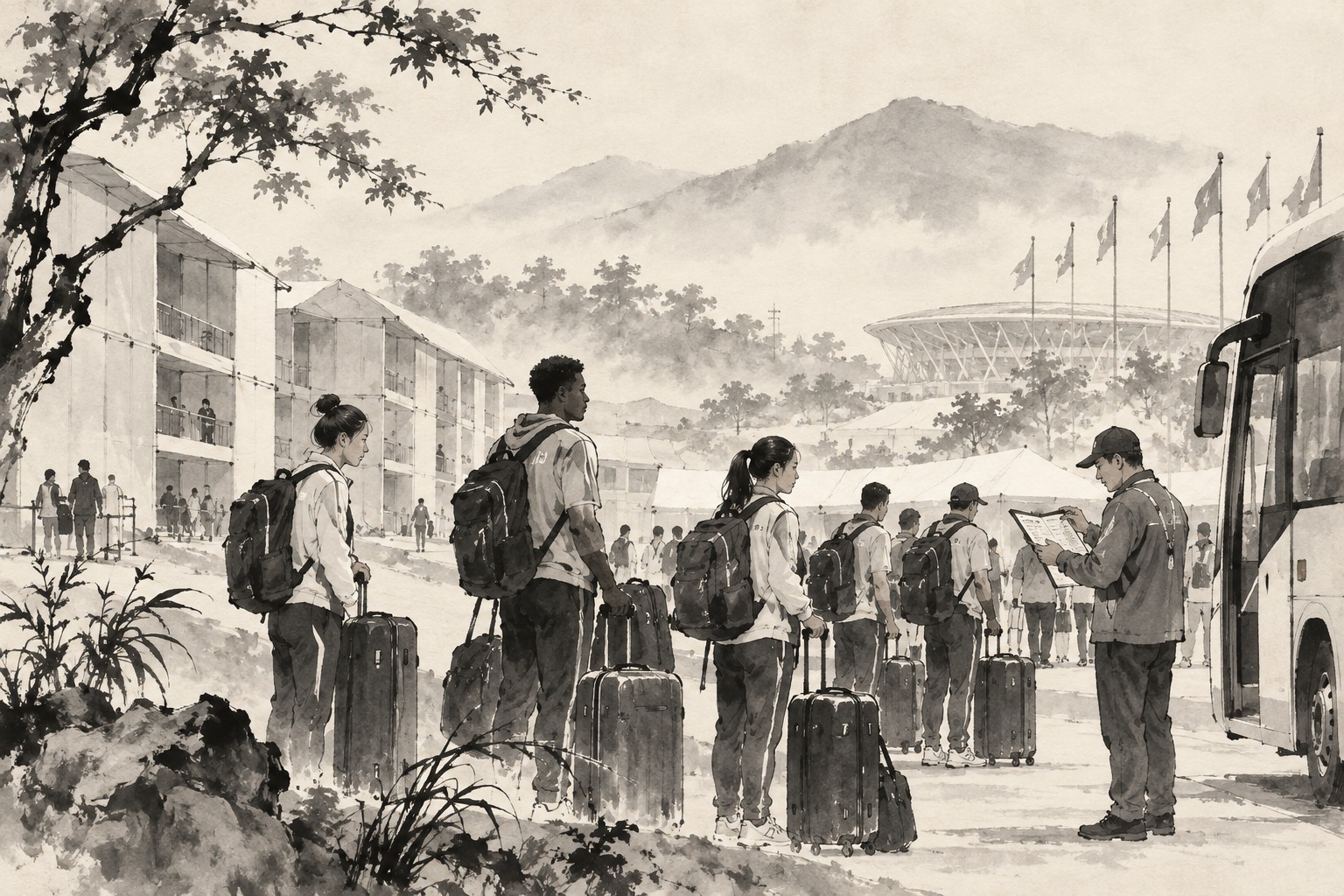
Accommodation and transport complaints at the Aichi-Nagoya Asian Games are putting the distinction between emergency workarounds and lasting corrections under scrutiny. Reuters reported September 22 that South Korea sought concrete preventive measures, while organizers defended overall operations and attributed a missing bus to human error.[1]
Japan’s delegation prepares alternatives
Japan’s deputy chef de mission, Hisashi Mizutori, described efforts to renegotiate room assignments and the possible use of backup accommodation secured by Team Japan. The Indian Express reported his explanation September 17, drawing on Reuters reporting. The problems included assignments that placed athletes and support staff together without adequately accounting for their different needs.[2] The Japanese Olympic Committee’s roster confirms Mizutori’s delegation role.[3]
Those arrangements are a delegation’s contingency response. They do not demonstrate that the organizing committee has corrected allocation problems for every team. A proposed room change also needs to be distinguished from a completed move with transport arrangements updated.
Travel time matters alongside room availability
In a separate September 17 report, The Indian Express cited an Indian shooting-team member describing a journey of nearly two hours to the range, including bus delays. The same report carried a positive assessment of accommodation and check-in from India’s women’s cricket coach.[4] The contrasting accounts caution against treating every sport or delegation as having the same experience.
From an athlete’s perspective, lodging and travel form a connected service: changing hotels can solve a room problem while creating a new pickup requirement. Time lost waiting is also time unavailable for planned preparation or rest.
A cost rationale is not a service-performance measure
The Olympic Council of Asia defended the use of hotels, a cruise ship and temporary accommodation as an alternative to building facilities that might be underused after the event, AP reported September 18.[5] That argument does not, by itself, settle whether individual services were delivered adequately.
Japanese planning material from a September 4 transport-management meeting describes highway-based routes, alternatives for disruptions and traffic demand management, or TDM, to reduce congestion.[6] These were advance arrangements, rather than newly announced remedies to the complaints. A road-congestion plan cannot alone establish that each scheduled vehicle reached its pickup point.
How to assess corrective action
Japan.co.jp’s proposed checks are completed room changes, late or missed pickups, disruption to training and the time taken to resolve a complaint. These are editorial evaluation criteria, not published performance results.
The useful test is whether a reported fault has an accountable owner, a completion time and a verified outcome for the affected athletes. An apology, an alternative booking and reliable service are different stages of that process.
Sources
- Reuters: South Korean complaints and organizers’ response (September 22)
- The Indian Express: Japanese room-allocation problems (September 17; Reuters-based)
- JOC: official delegation roster, Hisashi Mizutori (Japanese primary source)
- The Indian Express: Indian teams’ travel and accommodation experiences (September 17)
- Associated Press: officials defend accommodation model (September 18)
- NEXCO Central: September 4 transport-management meeting results (Japanese primary-source PDF)
