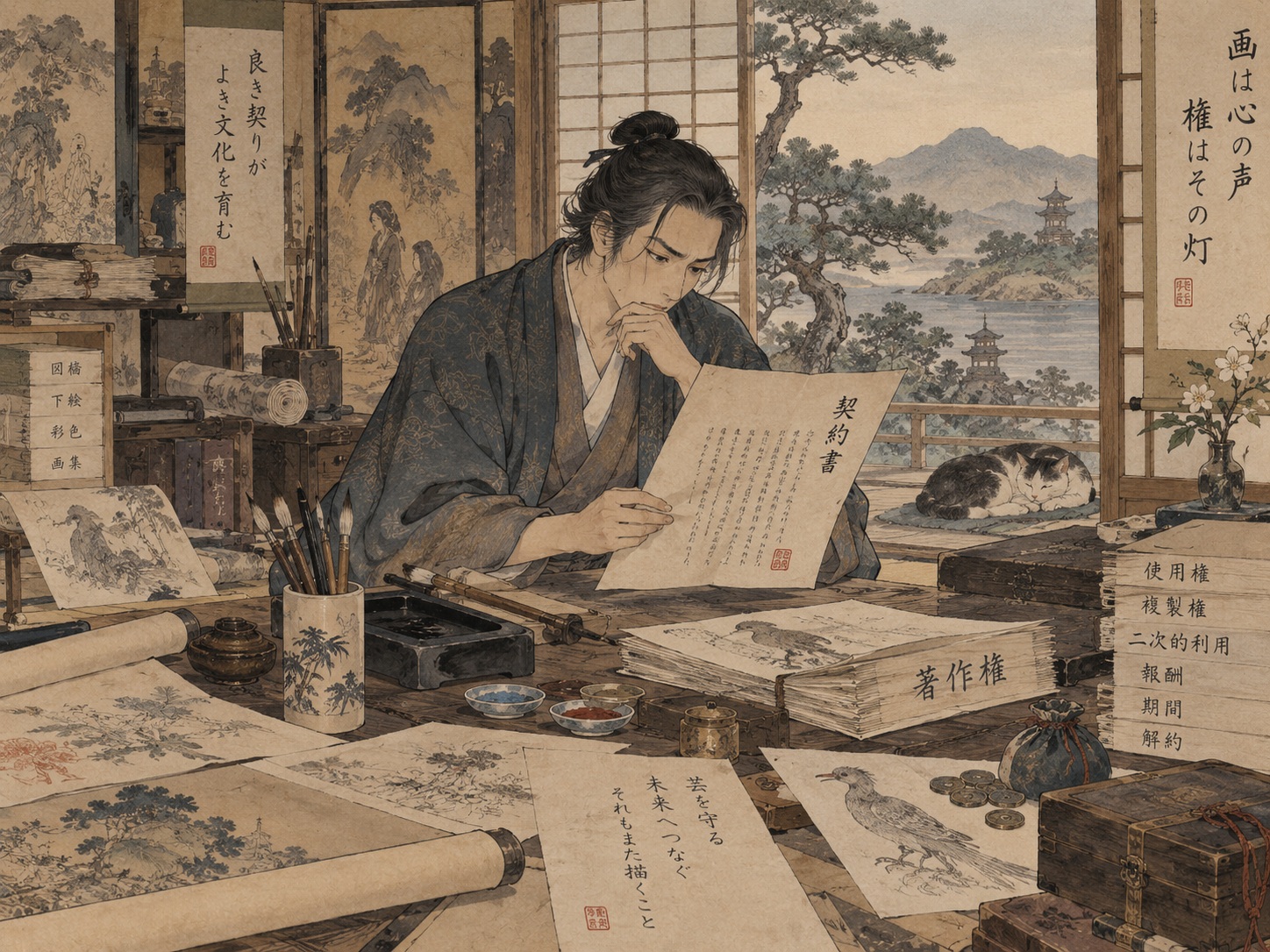
“We’ll work out the fee later.” “The rights are handled the usual way.” “Please make whatever revisions are necessary.” In Japan’s cultural industries, phrases like these have often functioned as substitutes for contracts.
The Agency for Cultural Affairs is trying to change that. Its Legal Consultation Service for Cultural and Artistic Activities gives artists, creators, production staff and cultural businesses access to lawyers for disputes and questions involving contracts, payment, copyright, Japan’s freelancer law, invoice rules and AI-related copyright issues. The service continues in fiscal 2026, with an on-site consultation event scheduled at Kyoto City University of Arts from November 1 to 3.[1]
The problem is not simply that artists do not know the law
Creative-industry contract problems are often rooted in bargaining power rather than ignorance.
A freelancer may know that a term is vague but fear that asking too many questions will cost the job. Copyright transfer, revision limits, cancellation fees, credit, travel expenses, payment dates and secondary use can therefore remain unsettled until after work begins.
In 2021, the Agency for Cultural Affairs created an expert group on appropriate contractual relationships in the cultural sector. In July 2022, it published formal guidelines encouraging written agreements and more balanced contracting practices.[3]
The 2022 guidelines marked a policy shift
The Agency for Cultural Affairs published its Guidelines for Building Appropriate Contractual Relationships in the Cultural and Arts Sector in July 2022.
The purpose was to improve contracting practices, provide sample agreements and explanations, and help create sustainable working conditions for artists and cultural workers.[3]
The issue is not that oral agreements are always legally invalid in Japan. They may be binding. The problem is proof: once parties disagree about what was promised, an undocumented agreement becomes difficult to enforce.
The legal consultation desk followed in 2023
Guidelines cannot solve a real dispute by themselves.
In 2023, the agency launched the legal consultation service. The work is handled by the Lawyers Network for Intellectual Property, a nationwide organization supported by the Japan Federation of Bar Associations and involving more than 1,000 registered lawyers.[1]
The original program was designed to answer inquiries primarily by email, generally within 10 business days, with telephone or online consultation where appropriate.[4]
The definition of “artist” is intentionally broad
The agency’s eligibility examples span almost the entire cultural production chain.
They include musicians, singers, composers, dancers, actors, voice actors, models, writers, manga artists, translators, editors, animators, illustrators, painters, craft artists, photographers, traditional performers, film directors, screenwriters and staff working in production, direction, art, lighting, sound, cinematography and makeup.[1]
This is not a legal service designed only for famous performers. It explicitly includes the workers around the performer.
Getting paid is a legal issue too
Copyright attracts attention in creative industries, but payment disputes are often more basic.
Japan’s Act on Ensuring Proper Transactions Involving Specified Entrusted Business Operators — commonly called the freelancer law — took effect on November 1, 2024. It requires commissioning businesses to clearly state transaction terms such as the scope of work, compensation and payment date in writing or electronically. Oral-only disclosure is not sufficient.[5]
For covered transactions, payment dates must generally be set within 60 days of receiving the work, within as short a period as practicable, and payment must be made by the agreed deadline.[5]
The freelancer law also reaches price cuts and endless revisions
The Japan Fair Trade Commission lists prohibited practices for certain continuing freelancer relationships, including unjustified reductions in compensation, returns, forced purchases, improper demands for economic benefit and unreasonable reworking.[5]
The revision issue is particularly relevant to illustration, design, video and writing. If a client repeatedly demands substantial changes that were never part of the agreed scope and does not pay more, the effective compensation can collapse.
Delivering an artwork does not automatically transfer every copyright
Delivery and copyright ownership are separate legal questions.
Contracts may need to specify which rights are transferred, whether secondary uses are allowed, whether an image can be adapted, reused in advertising, posted to social media, distributed abroad or provided to an AI system.
The agency now explicitly includes AI and copyright among the topics covered by its consultation service.[1]
AI has become a new legal-pressure point
Generative AI creates difficult questions at both input and output stages.
The Agency for Cultural Affairs’ legal FAQ explains, for example, that copyright analysis for retrieval-augmented generation can depend on whether copyrighted works are copied only for non-enjoyment information analysis or whether the system is designed to reproduce creative expression in its answers.[6]
Those questions are highly fact-dependent, which is precisely why a general FAQ cannot replace advice on an actual project.
Credit can be part of economic survival
For many creators, attribution is not only recognition; it is marketing for the next job.
Whether a creator will be named, how joint authorship is presented, whether anonymous use is permitted and how moral-rights issues are handled can all become contractual questions.
What happens when a project is cancelled?
Film, theater, exhibitions and live performance frequently involve long preparation periods before the final event occurs.
If a project is cancelled after weeks of work, a worker can lose substantial time and expenses even if no final performance takes place. Cancellation compensation, payment for work already completed and reimbursement of costs are therefore important contract terms.
Harassment is not outside the contract system
Japan’s freelancer law also requires commissioning businesses to establish systems to address harassment.
Creative industries can have unusually concentrated power. Casting, future assignments and access to networks may depend on a small number of producers, directors, agencies or clients. Workers may therefore fear retaliation if they object.
A legal support system aimed at sustainable cultural activity has to account for those power relationships, not only copyright clauses.
The guidelines were updated when the freelancer law arrived
On October 29, 2024, the Agency for Cultural Affairs revised its contract guidelines to reflect the freelancer law and related regulations before the law took effect on November 1.[7]
That update connected two policy tracks: what cultural contracting should ideally look like, and what commissioning businesses are legally required to do.
Taking legal advice into an art university
The 2026 program includes an on-site consultation event at Kyoto City University of Arts from November 1 through 3.[1]
That is a meaningful extension. Young artists are among those most likely to have limited contract experience and to wonder whether a problem is “serious enough” to ask a lawyer.
Placing legal consultation inside an arts environment lowers the psychological distance between creative practice and legal advice.
The service is advice, not full legal representation
The program also has limits.
The agency says participating lawyers provide advice on possible responses to problems. The consultation desk is not automatically a litigation or negotiation representation service, and repeated consultations may be limited so the program can serve more users.[1]
Serious disputes may still require a separate formal engagement with counsel.
Why this service is different from general legal aid
Japan already has general legal-aid services, labor consultation and freelancer-dispute resources.
The cultural consultation program’s distinctive value is sector knowledge. Film, publishing, performance, animation, manga and traditional arts have unusual chains of rights and highly specific production customs.
A lawyer who understands those customs can identify issues that might be invisible in a generic commercial dispute.
Cultural policy is shifting from protecting works to protecting workers
Japanese cultural administration has traditionally focused on preserving cultural property, funding artistic activity and supporting institutions such as theaters and museums.
The contract guidelines and legal consultation program broaden that focus toward the conditions under which cultural work is produced.
A culture cannot be sustainable if creators regularly lose rights, go unpaid or accept indefinite uncompensated work simply to remain employable.
Do written contracts make creative work less human?
Some cultural sectors still value trust-based relationships and may view detailed contracts as hostile or overly corporate.
But written terms do not necessarily signal distrust.
Defining the work, payment, deadline, number of revisions and permitted uses can reduce conflict during the creative process rather than increase it.
The real test is whether commissioning organizations change
Legal consultation can help individuals protect themselves, but systemic change cannot rest entirely on freelancers.
Publishers, broadcasters, film companies, theaters, production houses, advertising agencies, municipalities, arts institutions and talent agencies also need standard contracts, predictable payment practices and clear rights policies.
The Agency for Cultural Affairs’ policy is therefore aimed not only at resolving disputes after they occur, but at making disputes less likely.
Moving beyond the model in which talent is expected to endure
Creative work is often intertwined with ambition, identity and opportunity. That makes it unusually easy to frame poor conditions as the price of gaining experience or exposure.
A sustainable cultural economy needs something less romantic: ordinary rules about money, rights and responsibility.
Japan’s sequence of reforms — the 2022 guidelines, the 2023 consultation service, the 2024 freelancer-law update and the 2026 expansion into on-site support — reflects a larger change in thinking. Cultural work is not too special for contracts. It is important enough to deserve good ones.
Sources and references
- Agency for Cultural Affairs, Legal Consultation Service for Cultural and Artistic Activities.
- Agency for Cultural Affairs, strengthening the foundations of cultural and artistic activity.
- Agency for Cultural Affairs, Guidelines for Building Appropriate Contractual Relationships in the Cultural and Arts Sector, July 27, 2022.
- Agency for Cultural Affairs, launch of the legal consultation service.
- Japan Fair Trade Commission, Freelancer Act guidance.
- Agency for Cultural Affairs, FAQ on legal issues in cultural and artistic activities.
- Agency for Cultural Affairs, October 29, 2024 update to the cultural-sector contract guidelines.
Reporting and verification cutoff: October 7, 2026. This article provides general policy and legal background, not legal advice for any individual dispute. The legal outcome of a specific contract or conflict depends on its facts and should be reviewed by a qualified professional.