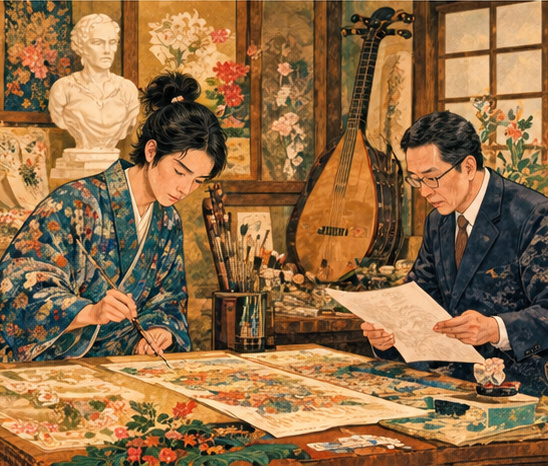
A lawyer at the art-school festival
A festival of performance and creative experimentation is an unlikely setting for a discussion of late invoices, canceled commissions, unauthorized reproductions and rights transfers. Yet that is precisely the pairing Japan’s Agency for Cultural Affairs has chosen. During Geidaisai 2026 at Kyoto City University of Arts, specialist lawyers will offer face-to-face consultations on legal questions arising from cultural work. The modest service offers a window into a larger shift: Japan increasingly recognizes that creative achievement depends on the basic protections of working life.
What the consultation actually provides
The outreach clinic is scheduled for November 1–3, 2026, from noon to 6 p.m. each day in room D-101, Building D, at Kyoto City University of Arts, 57-1 Shimo-no-cho, Shimogyo-ku, Kyoto. Consultations are free and last 25 minutes. Two consultation desks will operate concurrently, with capacity for up to 24 appointments a day. Advance reservations are available until 6 p.m. on October 29; visitors should check the Agency’s official notice for booking details and remaining places. Artists, cultural workers, students, amateurs and qualifying representatives are eligible, provided their question concerns cultural activity. This is an opportunity for advice, not a guarantee of legal representation or resolution.
The contract that nobody wrote
Creative projects routinely begin with trust: a phone call, an emailed fee, an informal request for an illustration or a performance. A dispute can emerge later over the number of revisions, cancellation payments, credit, recording rights, ownership of a physical object or reuse on other platforms. An oral agreement is not automatically invalid, but its terms may be difficult to prove. Japan’s culture ministry has argued that clearly identifying the scope of work, compensation, payment timetable and intellectual-property arrangements is essential to healthier professional relationships. That is particularly significant where an independent creator negotiates with a much larger commissioner.
How Japan reached this point
The issue did not arrive with the current consultation. The Agency convened an expert process in 2021 and released guidelines in July 2022 promoting fairer contractual relationships in the cultural sector. It revised the guidance in October 2024 in light of the Act on Ensuring Proper Transactions Involving Specified Entrusted Business Operators, commonly called Japan’s freelance law, which took effect on November 1, 2024. The history reflects a progression from advice about industry practices toward legally enforceable requirements for qualifying business-to-freelancer transactions. The distinctions matter: the cultural guidelines are not themselves identical to statutory obligations, and coverage depends on the actual form of the transaction.
What the freelance law changes—and what it does not
Japan’s Fair Trade Commission explains that relevant commissioning businesses must promptly specify transaction terms in writing or electronically. Under applicable conditions, the payment due date must fall within the shortest practicable period, no later than 60 days after receiving the contracted deliverable or service. There are conditional exceptions, including for certain re-commissioned work, as well as other prohibitions and protections whose reach varies with the commissioning relationship and duration. It would be misleading to promise that every artist, in every situation, must receive payment within 60 days of issuing an invoice. The practical question is which legal provisions govern the specific job.
A painting, a file and the rights to reuse it
Physical possession and intellectual-property ownership are not interchangeable. Paying for a design or receiving its final file does not automatically answer whether it may be printed on merchandise, modified, licensed overseas or reused in advertising. Performers and producers may face additional questions about recording and neighboring rights. The Agency for Cultural Affairs publishes sample agreements and detailed FAQs to help parties negotiate these issues in advance. Actual rights and remedies must be determined from the applicable law, the creator’s contribution and any contract terms; blanket claims that a creator always keeps or always transfers every right are equally unreliable.
Artificial intelligence adds new uncertainty
Questions surrounding training data, outputs resembling existing works and AI-assisted commissions have expanded the agenda for creative lawyers. In March 2024, Japan’s Agency for Cultural Affairs published an analysis of AI and copyright under existing law, while emphasizing the need to consider specific facts and unresolved interpretive questions. Its standing legal-consultation service expressly includes AI and copyright concerns. Neither an administrative guidance document nor a brief meeting with counsel can settle all disputed legal questions. But creators who understand which facts to preserve—files, licenses, prompts, dates, contracts and correspondence—are better placed to obtain meaningful advice.
Why this Kyoto venue matters
The university traces its fine-art origins to the Kyoto Prefectural School of Painting established in 1880, and moved from Kutsukake to the eastern Kyoto Station area in 2023. Its new campus was conceived as a place for public encounter between artists, students and the city. The 2026 festival theme is “Netsugen,” or a source of heat. Placing legal consultation amid exhibitions and performances makes a pointed argument: it is not enough to celebrate artistic passion if the people supplying it cannot negotiate dependable terms. Kyoto’s reputation as a cultural capital rests on the ability of artists to sustain careers, not only on the inheritance of celebrated traditions.
The real measure comes afterward
The outreach event has not yet taken place, and no credible figures are available for turnout, client satisfaction, cases resolved or changes in business practice. Even a fully booked schedule would show demand for advice, not success in reforming creative-industry contracts. Meaningful progress would require fairer commissioning practices, clearer payment terms, more carefully negotiated licenses and accessible continuing support. For an artist preparing to seek help, the most useful documents may be ordinary ones: the original brief, proposed fee, written changes, delivery records and correspondence. The larger promise of the Kyoto clinic is that creators may be treated not simply as sources of inspiration but as professionals whose work and rights deserve careful handling.
Practical information
| Item | Official arrangement |
|---|---|
| Dates | November 1–3, 2026 |
| Hours | Noon–6 p.m. JST daily |
| Location | Kyoto City University of Arts, D-101 |
| Advance booking | Until 6 p.m. JST, October 29 |
| Consultation | Free; 25 minutes; two desks; up to 24 per day |
This is reporting, not individual legal advice. Consult the official Agency notice for eligibility, booking availability and any changes before attending.
Sources and further reading
- 文化庁・出張相談会 / Agency for Cultural Affairs, Kyoto consultation
- 文化庁・法律相談窓口 / Cultural Affairs legal consultation service
- 文化庁・契約ガイドライン改訂 / 2024 guideline revision
- 公正取引委員会・フリーランス法 / JFTC freelance law
- 文化庁・法律相談FAQ / Legal FAQ
- 文化庁・AIと著作権 / AI and copyright
- 京都市立芸術大学・2023年移転 / University relocation history
- 文化庁・活動基盤強化 / Strengthening artists’ working conditions
Sources checked October 10, 2026. The November clinic is upcoming; attendance and outcomes are not yet known.