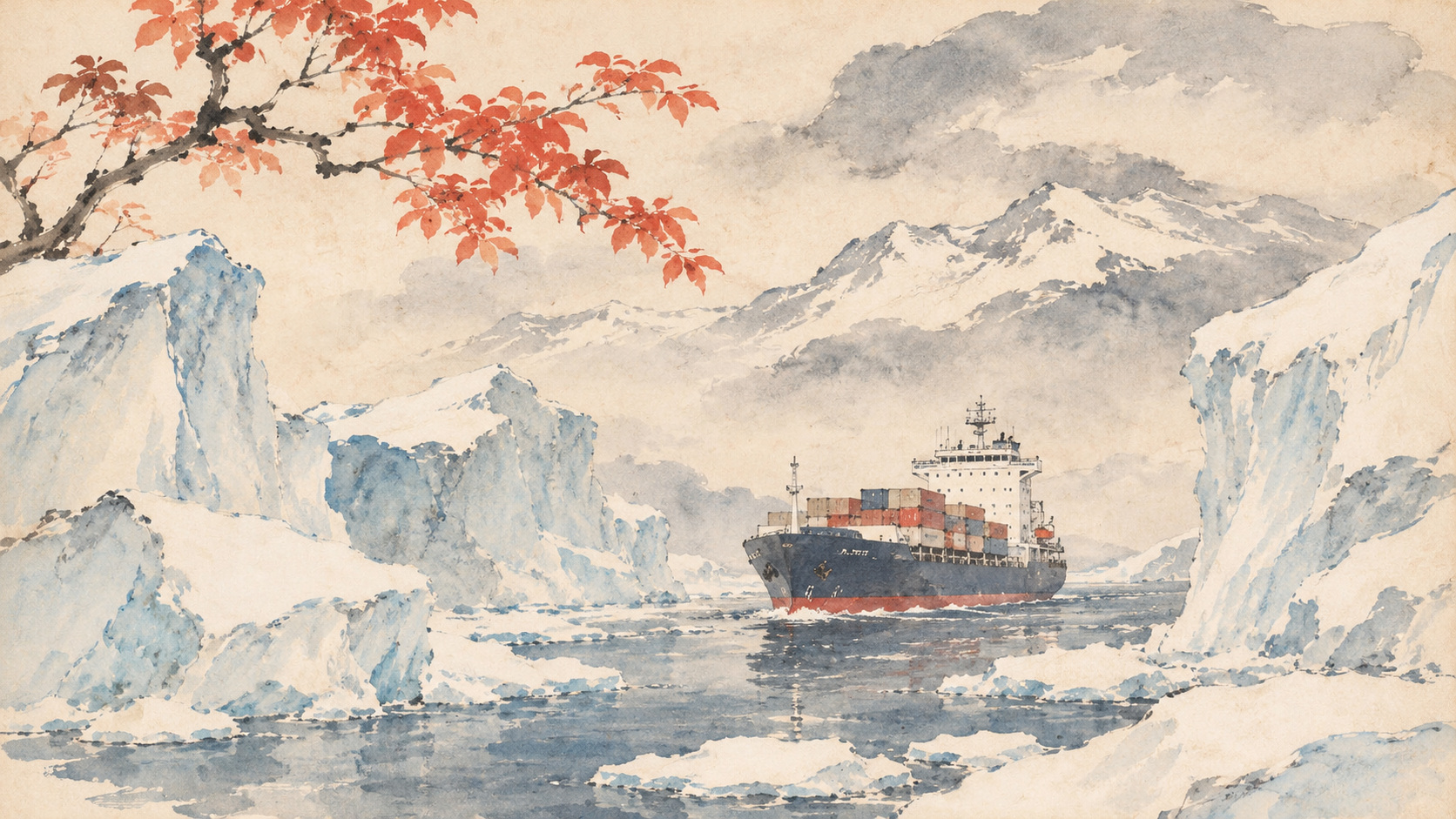
- A meeting in Tokyo, not an Arctic shipping launch
- Forty percent shorter on a map—far more complicated at sea
- A Japanese debate stretching back more than a decade
- The ice has changed; danger has not disappeared
- Arctic traffic is rising—but what counts as a transit?
- The rulebook: Polar Code and fuel restrictions
- Russia, international politics and the missing assumption
- What Japan’s researchers and companies can actually contribute
- A route worth examining, not romanticizing
A meeting in Tokyo, not an Arctic shipping launch
For anyone tracing a cargo ship from Japan to northern Europe on a map, the temptation is obvious: why sail through Southeast Asia and the Suez Canal if a vessel might cross the seas north of Siberia? Japan is revisiting that question. On November 19, the Ministry of Land, Infrastructure, Transport and Tourism (MLIT) announced that its 12th industry–academia–government council on the Arctic shipping route will meet in Tokyo on November 24, from 2:30 to 4 p.m. Japan Standard Time.
The announcement is deliberately narrow. Ministries, researchers and shipping specialists will exchange information; the meeting is not an approval for a new service, a declaration that the passage is open year-round, or an announcement of an ice-class container fleet. Proceedings are generally closed, with materials and a summary due for publication afterward, subject to confidentiality limits. The November 21 edition falls before the meeting, so its outcome cannot yet be known.
The participant list nevertheless says something important. Japan’s foreign, transport and education ministries appear alongside the Okhotsk Sea Ice Science Center, the University of Tokyo, the Japan Organization for Metals and Energy Security (JOGMEC), Mitsui O.S.K. Lines and the National Maritime Research Institute. Each brings a different question: Where is the ice? Can a ship navigate safely? What might be shipped? Would the economics survive real-world disruption?
Forty percent shorter on a map—far more complicated at sea
Japan’s Hokkaido Regional Development Bureau describes the potential voyage from Asia to Europe via the Northern Sea Route as roughly 40% shorter than a southern voyage through the Suez Canal. An earlier Japanese government comparison used approximate route lengths of 13,000 versus 21,000 kilometers. These are illustrative route comparisons, not a uniform saving for every origin, destination or season.
Distance is only one component of shipping cost. An ice-strengthened vessel may carry higher capital costs, face operating-speed restrictions, need icebreaker assistance and pay specialized insurance, navigation or support charges. Sea ice can force waiting or diversion. Even when a ship arrives sooner on one voyage, a carrier cannot assume those savings translate to a 40% reduction in freight rates or emissions.
Container networks operate on schedules that depend on multiple ports, hundreds of customers and dependable vessel rotations. Resource shipments between particular terminals are different. That distinction explains why profitable individual polar voyages do not prove that a year-round Eurasian container corridor exists. Reliability, not just geography, is the decisive variable.
A Japanese debate stretching back more than a decade
This is not a sudden discovery by Japanese officials. MLIT’s archive dates the first Arctic-route public–private council meeting to May 30, 2014. Eleven sessions were held by July 28, 2021, gathering information on science, ship technology, markets, and LNG transport. The newly announced twelfth meeting marks a return to that formal forum after a gap in the ministry’s published list.
Japan became an observer in the Arctic Council at the 2013 Kiruna ministerial meeting. It adopted a comprehensive national Arctic policy in October 2015, and its third Basic Plan on Ocean Policy, approved in May 2018, gave Arctic issues a distinct place. That historical sequence matters: Japan’s involvement includes climate research and multilateral engagement, not only commercial aspirations.
Mitsui O.S.K. Lines and other Japanese maritime companies have long assessed high-latitude transport tied to energy production. But an LNG carrier on a purpose-built route and a conventional container vessel serving a weekly Europe–Asia service are not equivalent businesses. What works for one cargo contract cannot be generalized to every kind of ocean freight.
The ice has changed; danger has not disappeared
According to the US National Snow and Ice Data Center, Arctic sea ice likely reached its 2026 annual minimum on September 12 at 4.60 million square kilometers, tied with 2008, 2010 and 2025 for the tenth-lowest minimum in the satellite record. Its October assessment also described unusually cool, stormy summer conditions in parts of the Arctic and an uneven ice pack.
The annual minimum is a basin-wide measurement; it is not a route-by-route navigability certificate. Wind can push floating ice into constricted passages, while fog, storms, seasonal darkness and extreme remoteness complicate ship operations. A vessel in trouble may be far from repair yards, response equipment or medical assistance.
Sea-ice decline also imposes severe costs on Arctic ecosystems and communities. Treating global warming solely as a source of shipping opportunity would erase the people and environments bearing its consequences. The same changing environment that may open more water at particular times can create new and unpredictable operational hazards.
Arctic traffic is rising—but what counts as a transit?
In February 2026, the Arctic Council’s Protection of the Arctic Marine Environment working group published a revealing long-run statistic: 1,812 unique vessels entered the Arctic Polar Code area in 2025, 40% more than in 2013. Their cumulative distance sailed grew 95%, from 6.1 million to 11.9 million nautical miles over that period.
These numbers reflect a real increase in Arctic maritime activity. They do not mean 1,812 Europe-to-Asia voyages occurred. The dataset includes vessels performing many activities across a large geographic area: local supply operations, resource-related shipping, research and other traffic. A unique ship is also not the same thing as one voyage.
A proper test of the Northern Sea Route as an international trade corridor would separately measure complete through-transits, cargo volume and composition, departure season, actual speed, delays, support costs and insurance. The council’s value may lie in bringing that evidence together rather than amplifying a single impressive traffic number.
The rulebook: Polar Code and fuel restrictions
The International Maritime Organization’s mandatory Polar Code entered into force on January 1, 2017. It addresses specialized ship construction and equipment, crew training, voyage planning, search and rescue, and pollution prevention for vessels covered by the rules. Navigating polar seas is a regulated undertaking, not simply a matter of choosing a different line on an electronic chart.
An additional MARPOL regulation generally prohibits the use and carriage for use as fuel of heavy fuel oil in defined Arctic waters from July 1, 2024. There are exceptions for qualifying safety and response vessels; certain protected-fuel-tank vessels have a transition until July 1, 2029. Reporting the restriction as an immediate universal ban without qualification would be inaccurate.
The environmental balance requires particular care. A shorter distance may reduce fuel consumption under some conditions, but slower ice navigation, special vessels, icebreaker support and emissions such as black carbon may change the calculation. Oil spills are particularly challenging to respond to in remote, icy waters. A claim of guaranteed emissions savings cannot be supported by distance alone.
Russia, international politics and the missing assumption
The commonly discussed Northern Sea Route runs along Russia’s Arctic coast. Commercial plans must contend with Russian regulatory and service arrangements, the applicable international maritime framework, and the effect of sanctions, export controls, payments and insurance rules on particular companies and cargoes. Those requirements cannot be reduced to one universal yes-or-no answer.
Nor is every Arctic passage the same. The Northeast Passage along Eurasia, the Northwest Passage through the Canadian Arctic and theoretical transpolar routes have distinct geography and legal or practical conditions. Japan’s council announcement should not be presented as granting access across all three.
Shippers planning supply chains also evaluate concentration risk. If avoiding one chokepoint replaces it with dependence on a single provider of icebreaker support, route permissions or critical infrastructure, resilience may not improve. More options can be valuable, but only if those options remain usable under stress.
What Japan’s researchers and companies can actually contribute
One long-running Japanese contribution has been measurement. The Hokkaido Regional Development Bureau has worked with Japan’s space agency JAXA and other partners to explore how satellite Automatic Identification System (AIS) signals might reveal vessel movements and support route research. Better knowledge of vessel tracks, speed and sea-ice conditions can reduce uncertainty without eliminating it.
The November 24 agenda names organizations associated with sea ice science, ocean engineering, energy resources and commercial shipping. Their presence does not tell us what confidential estimates they will bring or what positions they will endorse. Until the material is published, attributing precise forecasts or private company decisions to any participant would be speculation.
After the meeting, concrete questions deserve answers: Are the latest through-transit and cost datasets available? How much seasonal variation is incorporated? What assumptions do economic models make about insurance, icebreaker fees and fuel types? What safeguards address accidents and local ecological impacts? Readers should be able to distinguish scientific observations from a shipping company’s commercial projections.
A route worth examining, not romanticizing
Japan’s economy depends heavily on maritime transport for energy, raw materials and manufactured products. Studying alternative routes is rational, especially when global trade is vulnerable to disruption. But the Arctic is a place where the apparent rewards of a shorter journey can be outweighed by severe operational, environmental or political constraints.
The resumption of the formal council, last listed in 2021, is newsworthy precisely because it brings back a long-standing national discussion in a changed environment. It is not proof that the government has committed to constructing an Arctic shipping corridor, and no regular Japan–Europe service is established by the November 19 announcement.
Ultimately the useful question is not whether the shortest line on a globe looks attractive. It is whether Japanese shippers can make decisions using credible, openly explained evidence about cost, safety and environmental consequences. The most valuable result of the November 24 meeting would be a better map of the uncertainties—rather than an easy promise that the ice has finally surrendered.
Primary sources and reporting limitations
Based on MLIT’s November 19 announcement and historical council records, IMO rules, Arctic Council traffic statistics, NSIDC observations and Japanese government policy materials. The November 24 meeting has not occurred at this editorial cutoff. No private company cost estimates, insurance contracts or unpublished policy decisions were independently obtained; no interviews or voyage-cost model were conducted.
- MLIT: 12th Arctic shipping council announcement, Nov. 19, 2026
- MLIT: Arctic shipping council history and materials, 2014–2021
- Hokkaido Regional Development Bureau: Arctic route distances and satellite AIS
- MOFA Diplomatic Bluebook 2020: Japan’s Arctic policy
- Arctic Council: Japan’s observer status since 2013
- Arctic Council/PAME: Arctic ship-traffic update, Feb. 2026
- International Maritime Organization: mandatory Polar Code
- IMO: Arctic heavy fuel oil restriction and exceptions
- NSIDC: Arctic sea-ice minimum in 2026
- NSIDC: October 2026 analysis of unusual sea-ice conditions