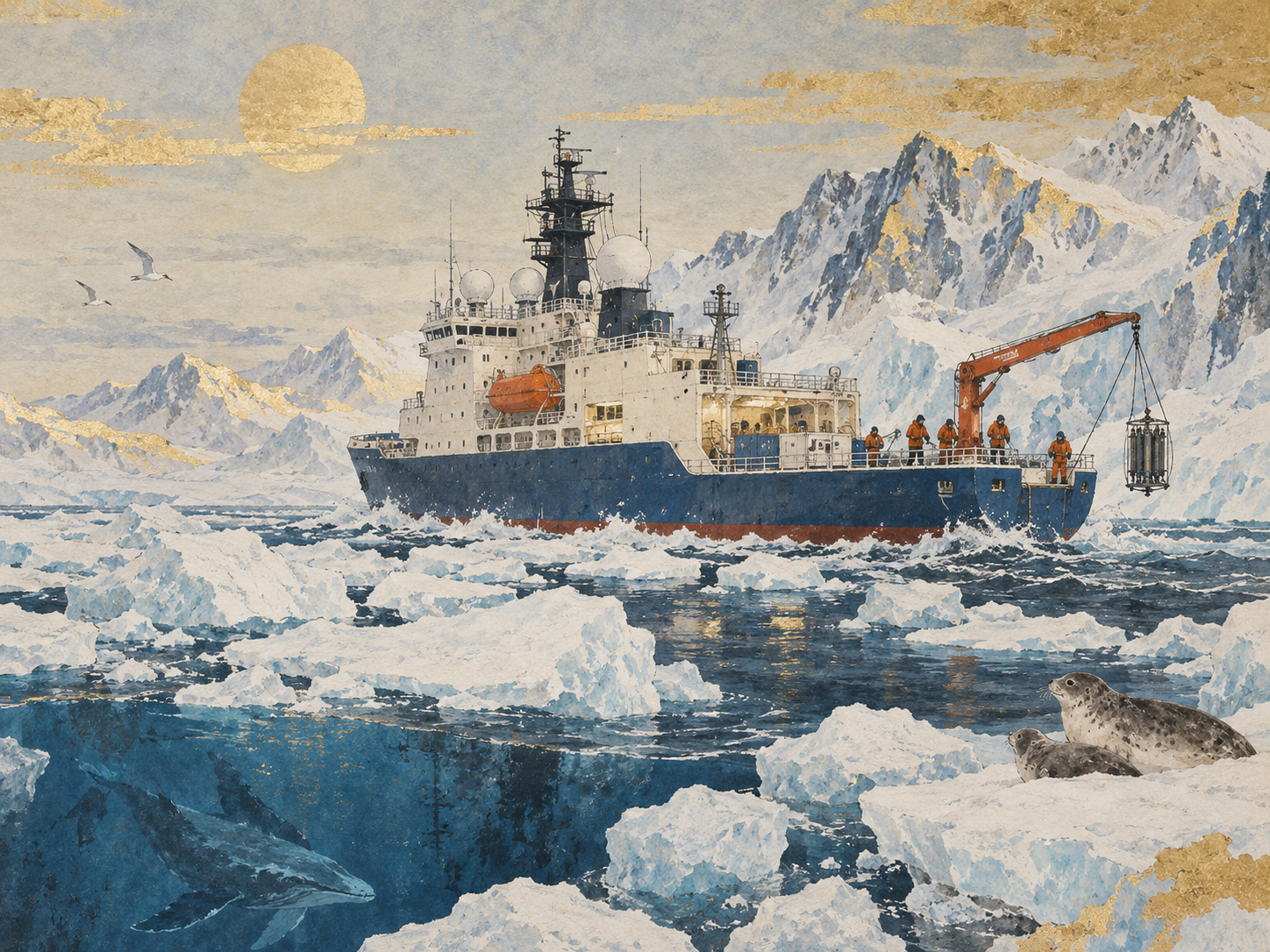
Japan's Arctic research capability is about to cross a physical boundary: from working mainly along the edge of the ice to operating inside it. On September 29, the Japan Agency for Marine-Earth Science and Technology confirmed that its new Arctic Research Vessel Mirai II will be delivered on December 18, 2026, followed by three familiarization cruises that culminate in ice-navigation trials in the Sea of Okhotsk.
Mirai II is the first Japanese research vessel designed with true icebreaking capability. It is 128 meters long, 23 meters wide and about 13,000 gross tons. It meets Polar Class 4 and is designed to continuously break 1.2 meters of flat first-year ice at 3 knots.
Delivery is followed by months of learning how to use the ship
The vessel will not head directly for the high Arctic after handover. JAMSTEC's first priority is to integrate the ship, crew and scientific systems into a working research platform.
The first familiarization cruise is scheduled for December 28 through January 6 in waters including Sagami Bay and Suruga Bay. It will focus on checking equipment and practicing observation procedures.
A second 25-day cruise, from January 10 to February 3, will operate south of Japan around the Mariana region, testing continuous water sampling, Doppler weather radar and other observing systems.
The third cruise, February 11 through March 9, moves into the drifting ice of the Sea of Okhotsk. There, the ship is scheduled to conduct icebreaking navigation trials and observation training under real ice conditions.
Polar Class 4 does not mean “go anywhere”
The word “icebreaker” can suggest unlimited capability. Polar ships are actually built to defined classes and operational limits.
The International Association of Classification Societies divides Polar Class from PC1 through PC7. JAMSTEC describes PC4 as permitting year-round operation in thick first-year ice that may include some old-ice inclusions.
But the performance figure attached to Mirai II is more specific: continuous progress through 1.2-meter flat first-year ice at 3 knots. Pressure ridges, large old-ice floes and converging pack ice are different conditions. Satellite ice information, forecasts, ship structure and experienced ice navigation remain central to safe operations.
The original Mirai spent 28 years documenting the Arctic's edge
The name deliberately carries forward a long scientific record. The oceanographic research vessel Mirai entered service in October 1997 and retired in December 2025 after 28 years.
It completed more than 250 voyages, traveled roughly 2.3 million kilometers—about 58 times around Earth—and carried more than 8,100 participants. Its first Arctic cruise came in 1998. By retirement it had made 23 Arctic expeditions, and from 2012 it sailed north every summer-to-autumn season.
Those cruises documented ocean warming, sea-ice loss, freshening, acidification, circulation, material transport, ecosystems and atmosphere-ocean interaction across the Pacific sector of the Arctic.
But Mirai could not simply force its way into persistent sea ice. It did exceptional science in open water and near the ice edge. That constraint is exactly what the new ship changes.
Before Mirai, the hull was Japan's nuclear ship Mutsu
The history goes back further. The original Mirai was built from the hull of Japan's first nuclear-powered ship, Mutsu.
Mutsu was launched in 1969. A radiation-leak controversy during its 1974 experimental program produced years of delay, modification and political conflict. After the nuclear program ended, the reactor section was removed in 1995. The hull was cut, rebuilt and rejoined as a conventional oceanographic research vessel.
The converted ship was launched as Mirai in 1996 and entered service in 1997. A vessel associated with one of Japan's most difficult nuclear-technology episodes ultimately became one of its most productive environmental research platforms.
Why icebreaking matters when the Arctic is losing ice
The need for an ice-capable ship may sound paradoxical at a time of declining Arctic sea ice. But understanding the loss requires measurements where ice still exists.
Sea ice regulates heat exchange between ocean and atmosphere. When it thins, fractures or disappears, heat and moisture can move more readily upward. Snow and ice also affect how much sunlight is reflected or absorbed by the ocean.
Biology is coupled to those physical changes. Ice algae, phytoplankton, zooplankton, fish, seabirds and marine mammals respond to the timing and geography of ice formation and retreat.
For Japan, the research question also extends southward: how Arctic ocean and atmospheric changes connect to weather and climate at mid-latitudes. JAMSTEC and Japan's science ministry explicitly frame Arctic observation as relevant to climate and weather beyond the Arctic itself.
A moving laboratory, not merely a stronger hull
Mirai II is designed as a multidisciplinary floating laboratory. Its research program includes ocean heat, water and material circulation; atmosphere-sea ice-ocean interaction; biological production and ecosystem change; weather and climate; atmospheric material transport; technology for under-ice observations; and reconstruction of past Arctic environments and geological history.
Of the vessel's 97-person accommodation, 63 places are for scientists and engineers. The original Mirai had room for 46 researchers. That larger science complement allows multiple disciplines to operate simultaneously on the same cruise.
In the Arctic, that matters. A sea-ice change observed today may be linked to ocean heat below, atmospheric moisture above and biological response within the same days or weeks. Coordinated observations are far more powerful than measurements separated by years or geography.
The next frontier is under the ice
Breaking into sea ice does not automatically reveal what lies beneath it. JAMSTEC has also been developing under-ice technologies, including the COMAI drone intended for future use from Mirai II. Current planning targets field testing during the 2027 Arctic cruise and operational use beginning around 2028.
The underside of sea ice is difficult to observe from satellites and difficult to access from the ship itself. Autonomous or remotely operated systems could measure ice geometry, temperature, salinity and biological conditions below the ice, adding a three-dimensional view to shipboard observations.
Mirai and Mirai II
| Attribute | Mirai | Mirai II |
|---|---|---|
| Service | 1997–2025 | Delivery planned Dec. 2026 |
| Length | 128.5 m | 128.0 m |
| Beam | 19.0 m | 23.0 m |
| Gross tonnage | 8,706 | 13,000 |
| Researchers/engineers | 46 | 63 |
| Ice capability | Ice-resistant, not a continuous icebreaker | PC4; continuous 1.2 m first-year ice at 3 kt |
| Main mission | Open-ocean environmental change | Marine environmental change including ice-covered seas |
Eleven years from Arctic policy to delivery
The new ship grew out of policy rather than a routine fleet-replacement decision. In October 2015, Japan adopted its first comprehensive national Arctic policy and explicitly called for consideration of an Arctic research vessel.
The policy combined science, international cooperation and the strategic consequences of a changing Arctic—including shipping and resource activity. Japan is not an Arctic coastal state, but it is a northern Pacific country affected by Arctic environmental change and interested in contributing scientific evidence to international decision-making.
JAMSTEC spent the following years on studies, design work and coordination with academia and industry. Construction began in August 2021. The vessel was named and launched in March 2025, outfitted with scientific systems, and entered sea trials from June 2026.
7,075 proposed names, then Mirai II
JAMSTEC opened a public naming process in 2023 and received 7,075 proposals. After review by a committee including outside experts and approval by the agency's board, the new vessel was named Mirai II.
The official English designation is Arctic Research Vessel (ARV) "Mirai II." The home port also carries forward the original ship's geography: Mutsu in Aomori Prefecture.
Mutsu remains the land-side half of the vessel
JAMSTEC's Mutsu Institute supported the original Mirai and will continue as the new ship's home-port research base, maintaining equipment, preparing observation systems and supporting analysis.
Public open-ship events are planned for April 3, 2027 at the Mutsu Institute and April 18 in Hakodate. That public-facing role is part of a larger strategy to make the ship not only a research platform but also a training and outreach platform.
The first observation period is 2027–2029
The National Institute of Polar Research and JAMSTEC have defined fiscal 2027 through fiscal 2029 as the first mid-term observation period for Mirai II.
Planned science themes include evaluation of ocean warming and its influence on sea-ice decline; rapid seasonal changes during the Arctic's “Polar Morning” and “Polar Evening”; transport of heat, water and material by atmospheric rivers; evidence for conservation and use of marine resources; high-resolution sediment records of past Arctic change; and exploration of poorly mapped Arctic seafloor geology.
The ship's value therefore will not be measured by one dramatic first voyage. It will come from repeated observations that can be connected to satellites, land stations, numerical models and other nations' polar vessels.
An international platform, not only a Japanese ship
Arctic science is too geographically large and operationally expensive for one country to cover alone. JAMSTEC has repeatedly described Mirai II as an international research platform.
International workshops in 2023 and 2025 discussed science priorities alongside ship operations, technology, policy, collaboration with Indigenous communities and training of young researchers. The intention is to bring foreign researchers aboard, coordinate with international observing programs and make the data part of a broader Arctic record.
Science becomes more important as shipping and resource interest grows
Sea-ice decline has increased interest in Arctic shipping and resource development. That does not make the Arctic simple or safe.
Less average ice can increase seasonal access while leaving hazards from mobile floes, ridging, extreme weather, limited charting and sparse rescue infrastructure. Increased activity also raises environmental risks in ecosystems that can be slow to recover.
A research vessel's role is not to advocate for more development or less development. It is to measure the system well enough that governments, communities and industries can make decisions with better evidence and smaller uncertainties.
1969: Japan's nuclear ship Mutsu is launched.
1995: The reactor section is removed and the hull is rebuilt as an oceanographic vessel.
1997: Mirai enters service.
1998: First Arctic research cruise.
2015: Japan's national Arctic policy calls for study of a dedicated Arctic research vessel.
2021: Construction begins.
2024: The vessel is officially named Mirai II.
March 2025: Naming and launch ceremony; the original Mirai retires that December.
Dec. 18, 2026: Scheduled delivery of Mirai II.
2027: Familiarization and the beginning of the first Arctic observation period.
The real mission is filling data gaps
Satellites are essential in the Arctic, but they cannot measure everything. Clouds, polar night and ice complicate remote sensing, while many important variables lie below the surface: ocean heat, salinity, nutrients, carbon chemistry, biological production and seafloor records.
Sea ice itself has historically created the observation gap. The places scientists most need to measure can be the places ordinary research vessels cannot enter.
Mirai II matters because it is designed to turn some of those inaccessible seasons and locations into repeated measurements.
What to watch after delivery
- Whether the Okhotsk Sea ice trials confirm expected handling and icebreaking performance.
- The exact regions and seasons selected for the first Arctic cruises.
- Field performance of under-ice systems such as COMAI.
- How international researchers are selected and data are shared.
- How PC4 operating experience feeds Japan's wider polar engineering capability.
- How scientists bridge the long observational record of the original Mirai with measurements from the new vessel.
Taking 28 years of Mirai beyond the ice edge
The first Mirai was not even born as a research ship. Yet after reconstruction it spent 28 years measuring oceans and atmosphere around the world and became one of Japan's central environmental research platforms.
Mirai II was designed for Arctic science from the keel up. The name is continuous, but the mission reaches further: not simply watching the retreat of sea ice from open water, but entering ice-covered seas and observing what happens above, within and below them.
December 18 is not the completion of that mission. It is the moment training begins in earnest—when ship, instruments, crew and scientists must become one working system.
When the vessel finally heads north, Japan's long Arctic record will gain something it has largely lacked: a research platform able to follow the science across the ice edge.
Sources & Reporting Notes
- JAMSTEC, Sept. 29, 2026: Delivery date and operational schedule for Mirai II — Latest primary release confirming Dec. 18 delivery, three familiarization cruises, Polar Class 4 and planned ice-navigation testing.
- JAMSTEC Arctic Research Vessel Mirai II overview — Official specifications: 128 m length, 23 m beam, 13,000 gross tons, PC4, 97 people aboard and continuous icebreaking through 1.2 m first-year ice at 3 knots.
- JAMSTEC Arctic Research Vessel Project — Primary description of science objectives and the plan to use the vessel as an international Arctic research platform.
- NIPR/JAMSTEC First Mid-term Plan for Arctic Ocean Observations with Mirai II — Primary planning document covering the first 2027–2029 observation period, international cooperation and research priorities.
- JAMSTEC: Oceanographic Research Vessel Mirai 1997–2025 — Official history of Mirai's 28-year career, 23 Arctic cruises, roughly 2.3 million km traveled and more than 8,100 participants.
- JAMSTEC, Feb. 22, 2024: Naming of Mirai II — Primary source on the public naming process and official English designation Arctic Research Vessel (ARV) Mirai II.
- MEXT Arctic Challenge for Sustainability II — Japanese government background on rapid Arctic warming, sea-ice loss, global climate impacts and economic/policy significance.
- JAMSTEC Mutsu Institute — Primary source on Mutsu as the vessel's home-port support base.
- JAMSTEC Second International Workshop on Arctic Ocean Observation — Research themes, international collaboration and cruise-planning discussions for Mirai II's first operating years.
This article is based on public material available through September 30, 2026. The Dec. 18 delivery date, three familiarization cruises and later Arctic observation plans remain subject to construction, testing, weather and operational changes. The final route and timing of the first Arctic observation cruise, operational deployment of COMAI and the selection of international research projects were not yet fully fixed when this article was prepared.
Image rights: © 2026 Japan.co.jp. AI-assisted scientific editorial illustration. Permission is required for reuse. Contact.