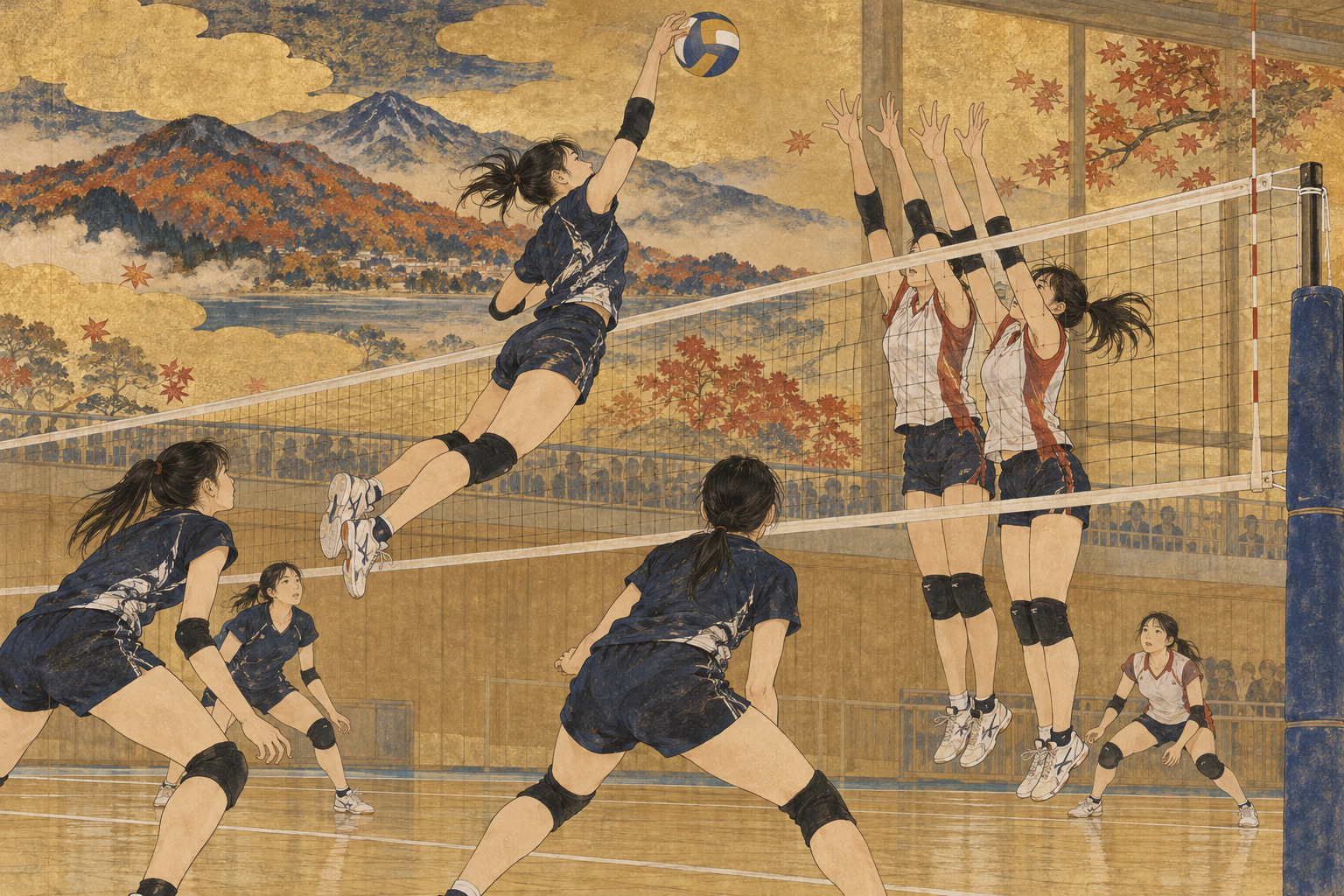
A national stage beyond the professional spotlight
The first matches of the 80th Japan Games volleyball tournament began on October 11 in Aomori. At Maeda Arena in Aomori City, teams represented prefectures in the adult men’s and youth boys’ divisions. Women’s matches are staged in Goshogawara and Tsugaru, making this a multi-city sporting event rather than one arena’s weekend program.
The official opening-day results tell an engaging story without needing to invent an emerging superstar. Hiroshima beat Shiga in straight sets, 26–24 and 25–22. Yamaguchi survived Fukushima 27–25, 20–25, 25–20. The host prefecture’s boys lost to Yamanashi 17–25, 20–25. These outcomes are verified team records, not proof of any particular athlete’s future professional potential.
The drama in a narrow scoreboard
Hiroshima’s two-set win was close in both frames; its opening set passed the usual 25-point target because teams must win by two. Yamaguchi’s three-set contest illustrates a different quality: a team can win a close first set, surrender the second, and still find a way to close. A scoreboard establishes the sequence and result, but not who delivered a decisive serve or block.
For a serious profile of a breakthrough player, a reporter would need the official roster, game video, individual statistics where available, and interviews. The temptation to attach a dramatic hero’s name to an exciting team score should be resisted until the evidence supports it.
A host’s defeat does not define its sports culture
Aomori’s youth boys were eliminated in their opening game by Yamanashi. A disappointing home result can be important news, but not a verdict on an entire prefecture’s development system. A tournament entrant’s composition, prior preparation and matchup characteristics all matter.
Hosting a national event can also have effects invisible in the bracket: volunteers gain experience, schools see high-level competition, and young spectators can discover a sport they had not considered. Those possibilities are worth reporting as questions, not announced as proven legacies without participation or follow-up data.
A tournament of schools and selections
Japan’s regional sports system produces varied team models. Some prefectural entries are drawn chiefly from one strong school, while others assemble players from several institutions. Contemporary tournament listings identify Ibaraki’s boys with Tsuchiura Nihon University High School and Miyagi’s with Tohoku High School, contrasting with multiple representative selections.
The school-based approach can bring established teamwork; a broader selection may combine talent that seldom practices together. Neither structure guarantees victory. This is one reason the national event offers international readers a window onto a Japanese sports ecosystem often overshadowed by professional leagues and the national team.
The women’s competition deserves equal attention
Aomori City’s official program covers adult men and youth boys at Maeda Arena, but adult women compete at Goshogawara Civic Gymnasium and youth girls at Ito Kogyo Arena Tsugaru. That distribution matters to regional identity: Aomori’s national event reaches beyond the capital city.
The Japan Volleyball Association recorded a 2–0 opening victory for Hokkaido over Wakayama in youth girls’ play, and a three-set win for Aichi over Fukuoka. There is no sound basis from these results alone to claim an individual player has been scouted or offered a professional contract.
Why the Japan Games began in 1946
The competition was born amid the hardships of postwar reconstruction. The first National Sports Festival took place in 1946 around Kyoto and neighboring cities, with broader participation, national fitness and local sporting life among its ambitions. As Japan rebuilt, the event became an annual rotating contest between prefectures, creating a recurring showcase for sports beyond the major commercial disciplines.
In 2024, the former National Sports Festival took the name National Sports Games, officially branded in English as the Japan Games. This is more than a change of words: its organizer, the Japan Sport Association, continues debating costs, facilities and the future relationship between nationwide competition and regional sport.
How a player reaches this court
Before the first whistle at a national tournament, a player’s development commonly depends on teachers, coaches, families, local clubs, gyms and the availability of meaningful competition. In Japan, schools still play a conspicuous role alongside other community structures. Elite play is built through thousands of less visible practices.
But the existence of a pathway does not identify its individual beneficiaries. No named prospect is described here as the next national-team player. That would demand independently confirmed biographical and sporting evidence, rather than inference from one team result.
A sport decided by chains of action
A volleyball spike attracts attention, but it depends upon reception and setting. A disciplined block may redirect an attack, and a libero can keep a difficult rally alive. The Aomori organizers distinguish adult and youth match formats: adult competition uses best-of-five sets; youth early-round matches use shorter best-of-three formats.
This can affect tactical risk. In a shorter match, one poor stretch may carry greater consequences. Yet it would be misleading to describe a particular substitution or coaching strategy from match results alone. Those observations require verified play-by-play evidence.
Public access is part of the event’s promise
The Aomori City organizer says entry to Maeda Arena is free and requires no advance reservation. The main arena has approximately 2,300 spectator seats and the sub-arena 350. Because ordinary spectator parking is unavailable at the facility, a shuttle service is planned from a temporary parking location.
Access arrangements can help a regional event attract younger visitors and families. That is a practical opportunity, not measured proof of a long-term participation increase. Attendance and demographic figures for these matches were not independently available at this reporting cutoff.
What an October 14 account must still establish
The tournament runs October 11–14. Its official program schedules finals and placement matches on the last day, but the full outcomes after October 11 were not verified for this report. A story published on October 14 should check the most recent Japan Volleyball Association results, identify the confirmed finalists and avoid suggesting the champions are already known before those games conclude.
If a new player has truly broken through, the most valuable next reporting step is to verify the athlete’s name, school or team, role, performance and background. The right question is not simply who scored the most, but what sporting structure gave the player a chance to develop.
The talent that rarely makes national headlines
Many Japan Games competitors will never become professional stars. Some will continue in university sports, community clubs or entirely different careers. That does not diminish what they have achieved. A regional sporting culture is measured partly by how many people can participate meaningfully, not only how many reach the top.
The verified early results already offer suspense, contrasting team structures and hometown stakes. The next step for journalism is to learn the athletes’ lives directly, making this national event a source of genuine discovery rather than attaching premature labels to unknown young competitors.
Sources and methodology
- 日本バレーボール協会:2026年10月の国内大会
- 日本バレーボール協会:第80回国民スポーツ大会の大会案内
- 日本バレーボール協会:10月11日の公式試合結果
- 日本バレーボール協会:少年男子トーナメント表
- 青森市実行委員会:バレーボール(6人制)
- 青森市実行委員会:競技日程
- 日本スポーツ協会:国民スポーツ大会の概要
- 日本スポーツ協会:国スポ改革の議論
- 日本バレーボール協会:少年女子10月11日結果
Source cutoff: October 12, 2026, JST. Later tournament results were not verified for this version.