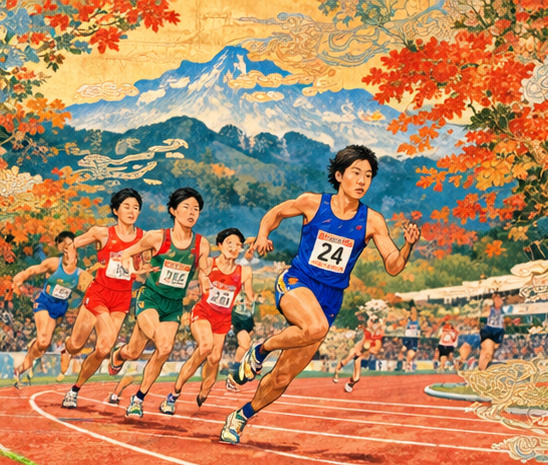
Japan’s largest domestic sports gathering returns north
A generation has passed since Aomori last welcomed Japan’s national multi-sport competition. Now the 80th National Sports Festival, officially the National Sports Games in Japanese and Japan Games in English, has returned under the banner Ao no Kirameki Aomori Kokuspo. The main competition phase began October 10 and continues through October 20.
The Japan Sport Association said its October competition phases involve 14,170 registered athletes and coaches from all 47 prefectures, across 26 official sports and a special high-school baseball competition. This is a participation figure for those phases, not an attendance estimate and not a claim about every event staged earlier in the year.[2]
Behind the races and championships lies a larger question: what does hosting an enormous domestic sporting festival mean for a northern prefecture facing the same challenges of mobility, aging, youth retention and access to facilities confronting many regional communities?
A sporting institution born from the ruins of war
Japan established the predecessor National Athletic Meet in 1946, with competition centered on the Kyoto–Osaka–Kobe region. Sport provided a way to restore social contact after the destruction of World War II. By the 1948 edition in Fukuoka, prefecture-versus-prefecture competition was established, along with the Emperor’s Cup for overall standings and the Empress’s Cup for women’s standings.[1]
This is not exactly a Japanese Olympics. The regional units are prefectures, the events take place across numerous communities and age divisions, and the achievement of a team is tied closely to the breadth of the sporting system that produced it.
Legislation adopted in 2018 paved the way for the 2024 renaming from the National Athletic Meet, or Kokutai, to the National Sports Games, or Kokuspo. Organizers now describe the English name as Japan Games. The shift offers an invitation to examine mass participation and local sporting culture, not merely the medal table.[1]
Aomori’s extraordinary 1977 precedent
The previous Aomori edition was the 32nd National Athletic Meet, nicknamed the Asunaro Kokutai, in 1977. Organizers describe it as the first complete meet in the competition’s history to stage winter, summer and autumn events in the same prefecture. Aomori won the Emperor’s Cup that year.[5]
Photographs preserved by the prefectural organizers show ceremonies at Hachinohe and Aomori during the three seasons. They document a moment when a region used the national competition to project confidence and build a shared public event.
Yet nostalgia cannot answer the present-day questions. A 49-year gap spans enormous changes in transportation, population and the economics of maintaining athletic facilities. Whether the 2026 edition leaves a legacy requires evidence about activity after the visitors go home.
From football grounds to climbing walls: a dispersed festival
Aomori’s October program spans far more than a single stadium. The official schedule places women’s football in Towada and Gonohe and boys’ football in Hachinohe. Other events include table tennis, rugby, tennis and sport climbing, with locations distributed among municipalities.[3]
Track and field takes place October 15–19 at the Kakuh Group Athletic Stadium in Aomori City, according to the Japan Association of Athletics Federations. A story dated October 13 must not claim that those scheduled track finals have already been contested.[6]
The overall calendar needs equally careful handling: an early preliminary phase took place September 3–13, a second October 2–9, and the main phase runs October 10–20. Describing the whole festival as having first begun on October 13 would mislead readers.[2][9]
The people who make local champions possible
Sporting success seldom begins under the lights of a major stadium. In smaller towns, the critical infrastructure may be a school gym, an available coach, a volunteer official, a parent with a car or an employer willing to accommodate training time. These everyday conditions are especially important where population density is low and travel between communities is costly.
Aomori’s prefectural athlete-development headquarters documents programs that connect competitive athletes with employers, support young talent and invite businesses to participate in athlete-support initiatives. Its October 8 update underscores that local development is an ongoing administrative concern, not something invented for a two-week festival.[7]
A credible assessment of the event will therefore ask whether participation rates, coaching capacity and access to facilities improve after 2026. A festival can inspire children, but it cannot by itself guarantee that they will still have somewhere to train a year later.
What hosting means beyond the scores
The competition is spread across a broad northern region, which can create opportunities for hotels, businesses and volunteers while also complicating logistics for spectators and families. How people travel between venues and whether residents can continue to use facilities after the event are questions with direct public consequences.
The official organizing website publishes transport restrictions and limitations around the Shin-Aomori prefectural sports complex. It also warns that the opening and closing ceremonies will not have public viewing. That is not a blanket ban on attendance at sporting events, whose individual spectator arrangements must be checked separately.[10]
Major sporting events often prompt projections about economic benefits and urban pride. Those forecasts should not be confused with independently established returns on public expenditure. Capital investment, operating expenses, maintenance obligations and actual participation over time all matter.
The separate disability sports festival deserves its own attention
Aomori will also host the 25th National Sports Festival for People with Disabilities, locally called Aomori Shospo, from October 23–26. It is a distinct competition with its own calendar, not an event already under way during the October 13 edition.[8][9]
Organizers list athletics, swimming, archery, table tennis and sound table tennis among the events in Aomori City. The program provides another opportunity to examine the accessibility of sporting spaces and whether events leave behind better opportunities for people with disabilities.[9]
The two festivals are related by their host prefecture and commitment to sport, but their athletes, rules and schedules should not be casually merged. Accurate names and dates are basic parts of respectful reporting.
A legacy measured after the closing ceremony
This is a background feature based on official announcements available through October 10. It does not invent October 11–13 winners, attendance figures or an overall prefectural championship. Results must come from the official competition record after they are certified.
In a country confronting regional depopulation, access to sport is increasingly connected to questions of transport, schools, health, work and volunteer infrastructure. Aomori can be a national showcase while still needing to confront the costs of sustaining its sports culture.
In 1977 the prefecture celebrated its remarkable Asunaro Games. In 2026 the most durable victory may be harder to photograph: a local club still functioning, a young competitor still training and a community finding space for sport long after the final medal has been awarded.
Sources and reporting notes
- 青の煌めきあおもり国スポ・障スポ実行委員会 — official source
- 日本スポーツ協会 — official source
- 大会公式サイト — official source
- 大会公式サイト — official source
- 大会公式サイト — official source
- 日本陸上競技連盟 — official source
- 青森県 — official source
- 青森市実行委員会 — official source
- 青森市実行委員会 — official source
- 大会公式サイト — official source
Primary materials checked October 10, 2026. Results and attendance from October 11–13 require verified post-event updates and are not assumed here.