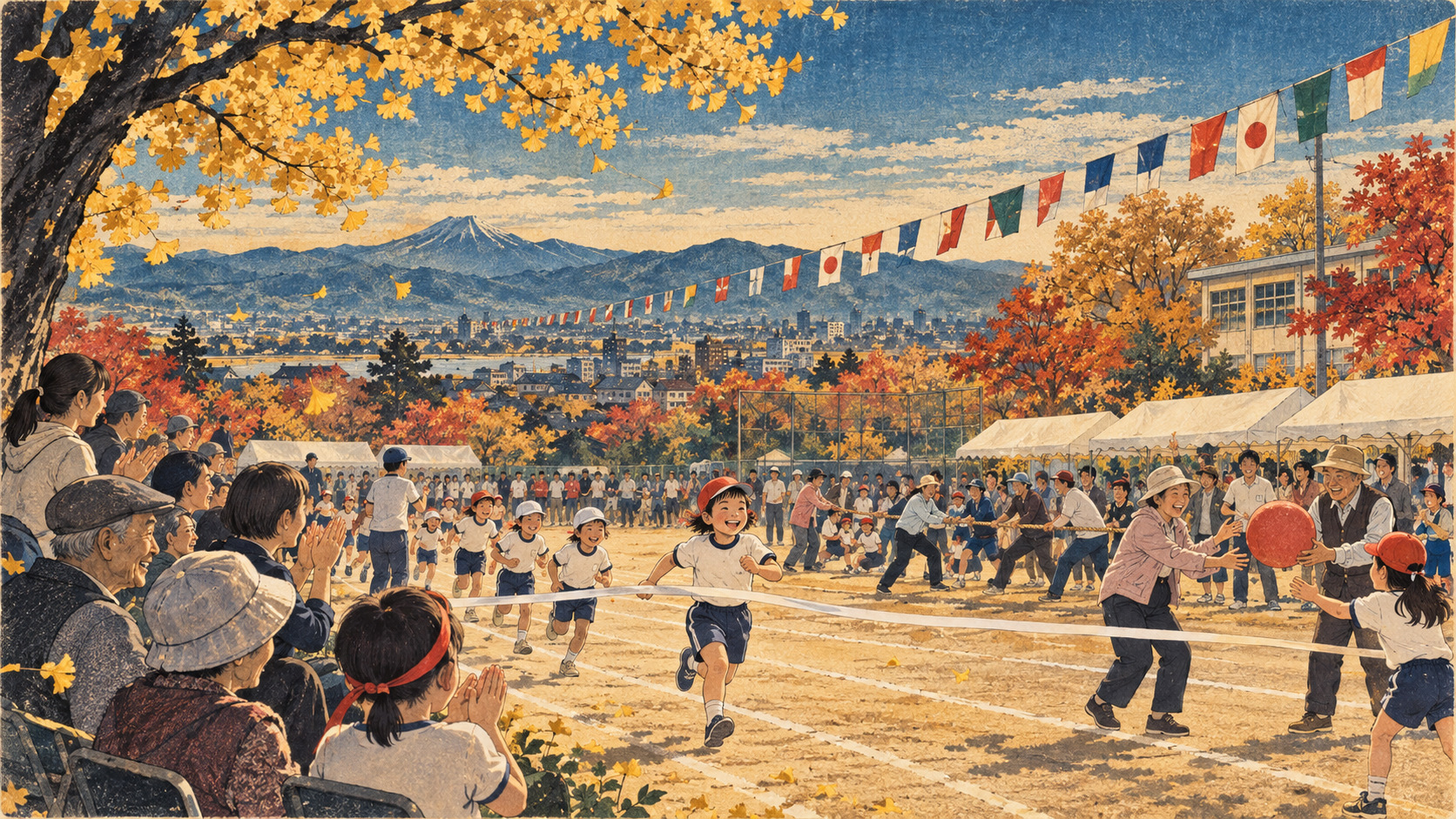
A national holiday without an admission price
On Monday, October 12, Akishima City in western Tokyo plans to open a broad selection of sporting experiences through its Citizens’ Sports and Recreation Festival 2026. The invitation is unusually simple: participation is free. Residents and visitors can try everything from short-distance running and lawn games to badminton, table tennis and swimming. Yet free admission is not the same as unlimited access. Some activities have age limits, fixed capacities, timed tickets or advance reservations. The city’s detailed rules are part of the story: a public event only becomes genuinely accessible when people can work out exactly how to take part.
Two kinds of sporting space
The outdoor venue is Showa Park, where the athletics ground is scheduled to offer 50- and 100-meter running, physical-fitness tests, kick targets, ground golf, target bird golf, Mölkky and other accuracy games. The S&D Akishima Stadium municipal ballpark is scheduled to host a softball home-run contest. Indoor activities take place at the General Sports Center, including racket sports, climbing, fitness classes, archery and the heated pool. The city warns that only the Showa Park outdoor program is canceled in rain, so participants should consult its official notice before traveling.
The fine print matters
The umbrella invitation is open to everyone, but individual activities have important eligibility rules. Badminton and table tennis are for elementary-school-aged participants and older. The archery experience is for people aged 15 and up, excluding junior-high students. The training room is for high-school age and above, while the heated pool permits children aged three and older who are no longer in diapers; additional adult-accompaniment restrictions apply to children through junior high school. Tennis courts are free for the day but require use of the public-facility reservation system. These details are not barriers to hide in the footnotes: they determine whether a family’s outing succeeds.
A timetable built for participation
Several indoor classes have limited places. Beginner yoga runs from 3 to 4 p.m., with 20 places and tickets distributed at the main reception from 2:30. Self-defense instruction runs from 5 to 6 p.m. for elementary-school children and older, also with 20 places; tickets start at 4:30. Flow yoga, Zumba and relaxation yoga have separate check-in times and caps. Climbing is divided into five sessions starting at 12:30, 1:30, 2:30, 3:30 and 4:30 p.m., each with 20 places and registration from 11:30 a.m. The event is not a single stadium spectacle; it is a collection of small opportunities that residents can fit into different parts of their day.
Childcare as sports infrastructure
One of the less conspicuous offerings is temporary childcare at the General Sports Center. The city lists supervision for children from age two through second grade, between 9:30 a.m. and 5 p.m., with capacity of approximately ten and a maximum of two hours per visit. For a parent, access to an exercise room may be less important than having someone safely care for a child during that time. Childcare therefore belongs in a discussion of inclusive sports policy, alongside facilities and equipment. That does not mean a place is guaranteed: families should check the conditions and availability at the venue.
From an Olympic commemoration to an everyday holiday
Japan’s Sports Day traces its origins to the opening date of the 1964 Tokyo Olympics. A 1966 change to the national holiday law established October 10 as Health and Sports Day, known in Japanese as Taiiku no Hi. The holiday moved to the second Monday of October in 2000, and its name became Sports Day in 2020. The Cabinet Office explains that its contemporary purpose includes enjoyment of sport, respect for others and the pursuit of a healthy, energetic society. This shift in language matters: the holiday is no longer framed only around physical training. It also celebrates shared experience and participation.
Beyond the professional sports spotlight
Elite competitions receive television time, sponsorship and enormous crowds. A public sports center can deliver something equally meaningful on a smaller scale: the first successful badminton rally for a child, an older resident trying Mölkky with neighbors, or someone discovering that they enjoy swimming. There is no evidence yet that Akishima’s event will produce long-term increases in participation. Its design nevertheless illustrates a public-policy choice to remove one obvious obstacle—the admission fee—while offering familiar and unfamiliar activities in a communal setting.
Access is more complicated than price
A no-fee event can still be difficult for some residents. Travel costs, work schedules, disability-related needs, age restrictions, capacity limits and equipment requirements all affect participation. Akishima asks visitors to wear suitable athletic clothing and bring indoor sports shoes. It also discourages arriving by car because parking is limited. Such details show the tension between welcoming the widest audience and managing facilities safely and fairly. An evidence-based follow-up would ask who actually attended, whether first-time users felt welcome, and which groups remained underrepresented.
Pools, rackets and time limits
The indoor training room and heated pool are scheduled to be free from 9 a.m. to 9:30 p.m., generally for visits of up to two hours. Badminton and table tennis run from 9:30 a.m. to 9 p.m., with 40-minute playing periods and final check-in at 8:30 p.m. In a crowded public sports center, limits can be a way of distributing scarce court and pool capacity instead of allowing the earliest arrivals to monopolize it. The practical value for participants is knowing those rules before they arrive.
What October 12 will—and will not—prove
The festival offers a modest but distinctive model of a national holiday: local public facilities serving people who are not necessarily competitive athletes or ticket-paying spectators. It remains a scheduled event, not a documented success. As of this advance report, the city has not released attendance totals or evaluations of its 2026 festival. Any claim that thousands participated, that the program increased exercise rates or that particular age groups benefited would require subsequent evidence. For now, the best measure of the day’s promise is the range of people it is explicitly trying to invite—and the clarity of the practical information that can help them show up.