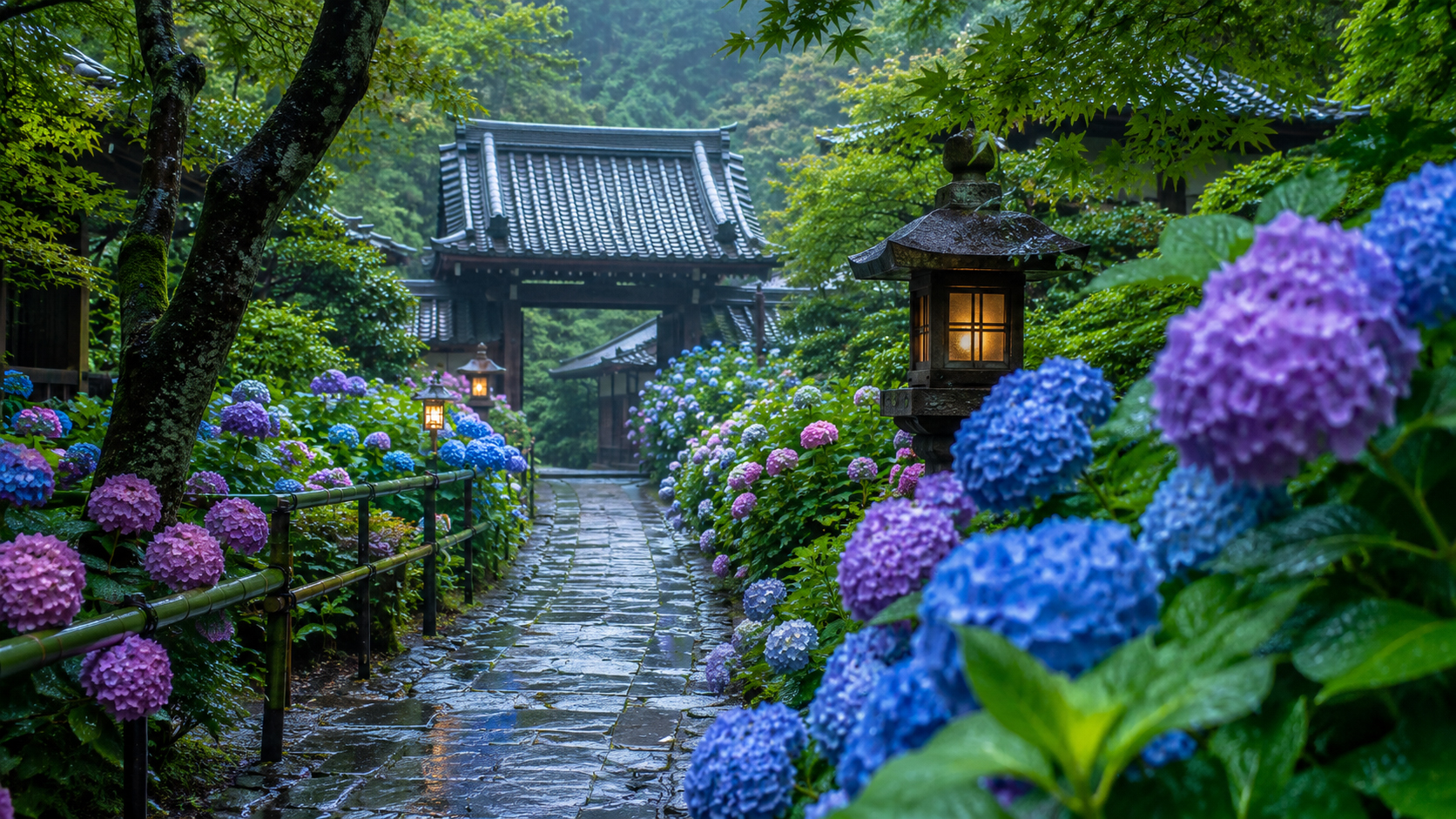
Why go flower-viewing in the rain?
Japan’s rainy season is not the easiest thing to sell. The sky is pale, the humidity is rude, umbrellas become personal architecture, and shoes begin to negotiate with puddles. It is not cherry blossom season. It is not fireworks season. It is the damp corridor between spring and full summer. And yet, in that corridor, Japan has a flower that makes the rain feel intentional: ajisai, the hydrangea.
Hydrangeas look better when the world is wet. Leaves deepen. Blues become bluer. Purple becomes more wistful. Pink floats softly under a gray sky. If cherry blossoms are Japan’s flower of beginning, hydrangeas are its flower of the in-between. Spring is gone. Summer has not yet started shouting. The country pauses, opens an umbrella, and looks down a temple path lined with blue.
In 2026, hydrangea season runs through June and into July across Tokyo, Kamakura, Kyoto, western Japan and many regional gardens. This is not the roaring Japan of giant matsuri crowds. It is a smaller, slower Japan: a shrine slope, a stone stairway, a quiet garden, a train ride after rain, tea after a walk. It may be one of the most Japanese travel moments of the year precisely because it refuses to yell.
From ancient poetry to Edo gardens and the global hydrangea
Hydrangeas are not a modern tourism invention. They have deep roots in Japanese culture and appear in old literary memory, including references associated with the Manyoshu, the eighth-century poetry anthology. For early Japanese observers, a flower that changed color in the rain naturally suggested shifting feelings, unstable moods and the beauty of impermanence.
The Japanese name ajisai is often explained through an image of gathered blue or indigo color. Etymology is never as tidy as a travel brochure, but the idea feels right: small pieces of color collected into a soft globe. Botanically, much of what we call the flower is actually decorative sepals. But travelers do not go to temples to pass a botany exam. They go because the scene is beautiful.
During the Edo period and after, Japan’s gardening culture helped hydrangeas spread into temples, shrines and private gardens. Through Nagasaki and the broader history of botanical exchange, Japanese hydrangeas also traveled outward, becoming part of European horticulture. The rainy-season flower of Japan became a garden flower of the world.
Bunkyo Ajisai Festival: wet quiet in the middle of Tokyo
In Tokyo, the classic hydrangea stop is Hakusan Shrine and Hakusan Park in Bunkyo Ward. The 42nd Bunkyo Ajisai Festival runs from June 6 to June 14, 2026, with around 3,000 hydrangea plants in bloom. It is free to attend, close to Hakusan Station and easy to combine with a walk through old Tokyo neighborhoods.
The charm of Hakusan is that the flowers do not feel isolated from daily life. Local residents, families, office workers, photographers and visitors all move through the same damp lanes. Everyone slows down a little. That is no small thing in Tokyo, a city that usually teaches the body to move quickly. Hydrangeas apply the brakes.
Bunkyo also makes sense as a half-day Tokyo itinerary. See the flowers, walk toward Yanaka or Nezu, find an old slope, eat soba or something sweet, and let the rain make the city softer. It is not a blockbuster travel day. It is better than that. It is a day that sneaks into memory.
Kamakura: the invention of “Meigetsuin Blue”
Kamakura may be Japan’s most famous hydrangea destination. Meigetsuin, often called an ajisai-dera or hydrangea temple, is known for its pale blue flowers lining the approach and stone steps. The phrase “Meigetsuin Blue” has become shorthand for a certain rainy-season image of Japan: quiet, old, damp and impossibly photogenic.
Hasedera adds another version of the experience, with hillside hydrangea paths and coastal views. Other Kamakura temples and shrine lanes bring the flower together with the Enoden railway, old roads and sea air. Kamakura’s advantage is density. Flowers, temples, ocean, trains and cafés sit close enough that a visitor can drift rather than commute.
There is one catch. It gets crowded. Very crowded. The search for rainy-season quiet can become a line of people all searching for rainy-season quiet. The best strategy is simple: go early, go on a weekday, accept the rain, and do not make one famous view carry the whole day. Kamakura rewards wandering.
Kyoto and Uji: temple time in bloom
In Kyoto, hydrangeas belong to temple time. Mimurotoji in Uji is one of the great Kansai hydrangea spots, with a large flower garden that comes alive from early June into early July. Kyoto is known globally for cherry blossoms and autumn leaves, but rainy-season Kyoto has its own quiet force. Wet stone, living moss, dark wood, old tile and saturated green make the city feel older.
Hydrangeas in Kyoto do not merely decorate the scene. They raise its humidity. They make the stones look heavier, the gardens slower, the temple corridors more intimate. Sunshine can flatten Kyoto. Rain gives it depth.
The trick is not to overplan. A morning in Uji, a quiet temple outside the central crush, tea after a wet walk — that is the right rhythm. Hydrangeas are kind to travelers who leave space in the schedule.
Western Tokyo and regional Japan: when the flower becomes a landscape
In western Tokyo, around Akiruno and the Akigawa Valley, hydrangeas become a hillside experience. Minamizawa Ajisai Mountain, introduced by Nippon.com, is said to contain around 10,000 hydrangea plants cultivated over decades by local caretaker Minamizawa Chuichi. That story changes the way one sees the flowers. They are not just seasonal color. They are work made visible.
This is the hidden economy of flower travel. Visitors arrive for one day and say, “beautiful.” Someone else pruned, planted, cleared paths, watched the soil and waited for rain all year. The brief travel moment rests on long local care.
Across Japan, from Kanagawa’s Kaisei Town to Kyoto, Nara, Fukuoka, Nagasaki, Miyagi and Akita, hydrangea spots offer a gentler form of regional tourism. They do not need to be monumental. Rain, flowers, an old road and a local lunch are often enough.
The flower that changes color, the season that changes mood
Part of the hydrangea’s appeal is color change. Soil conditions and variety can shift the flower’s appearance through blue, purple, pink and white. Japan’s rainy-season imagination leans strongly toward blue, but modern gardens offer a wide range of shapes and tones.
That changeability fits Japan’s seasonal culture. Cherry blossoms move people because they fall. Autumn leaves move people because they turn and drop. Hydrangeas move people because they shift while staying. They continue, but never quite the same. That is a very rainy-season form of beauty.
They also make bad weather useful. Rain is not a failure. It is the filter. Wet paths, umbrellas, darker leaves, softer light — everything the travel planner fears becomes part of the picture.
The value of quiet tourism
Japanese tourism can become loud: giant festivals, fireworks, famous crossings, crowded temples, restaurant lines and social media pilgrimages. Those things are fun. But they are not the whole country. Hydrangea season reminds travelers that Japan also works at low volume.
People lower their voices in front of flowers. Umbrellas close and open. Rain smells of stone and leaves. A photograph takes a little longer. The best memory of a trip is often not the main event, but the small hour between events when the country unexpectedly becomes itself.
Rainy season is not merely an off-season. It is another frequency. Before the heat, before the fireworks, before the summer matsuri drumbeat, Japan offers a blue flower beside a wet path.
Go see it. Bring an umbrella. Walk slowly.
- Ajisai season runs from June into July, making it Japan’s signature rainy-season flower trip.
- Tokyo’s Bunkyo Ajisai Festival at Hakusan Shrine and Hakusan Park ran June 6–14 in 2026 with around 3,000 hydrangeas.
- Kamakura’s Meigetsuin and Hasedera remain two of the most photogenic rainy-season temple walks in Japan.
- Kyoto and Uji show the flower in a deeper temple context, where rain, moss and old stone become part of the experience.
- The best hydrangea trip does not fight the rain. It lets the rain do its job.
Sources and references
This article draws on public information from the Tokyo Convention & Visitors Bureau, the official Bunkyo Ajisai Festival page, Japan Guide, Tokyo Weekender, Nippon.com, Rakuten Travel and Kyoto tourism sources.
- Tokyo Weekender: 10 Best Hydrangea Festivals in Japan To Visit in 2026
- 42nd Bunkyo Ajisai Festival official information
- GO TOKYO: The 42nd Bunkyo Hydrangea Festival
- Japan Guide: Japanese Hydrangea / Ajisai
- Rakuten Travel: Kamakura hydrangea guide
- Nippon.com: Touring Four Kamakura Hydrangea Temples
- Nippon.com: Minamizawa Ajisai Mountain
- Kyoto Tourism: Hydrangeas in Kyoto