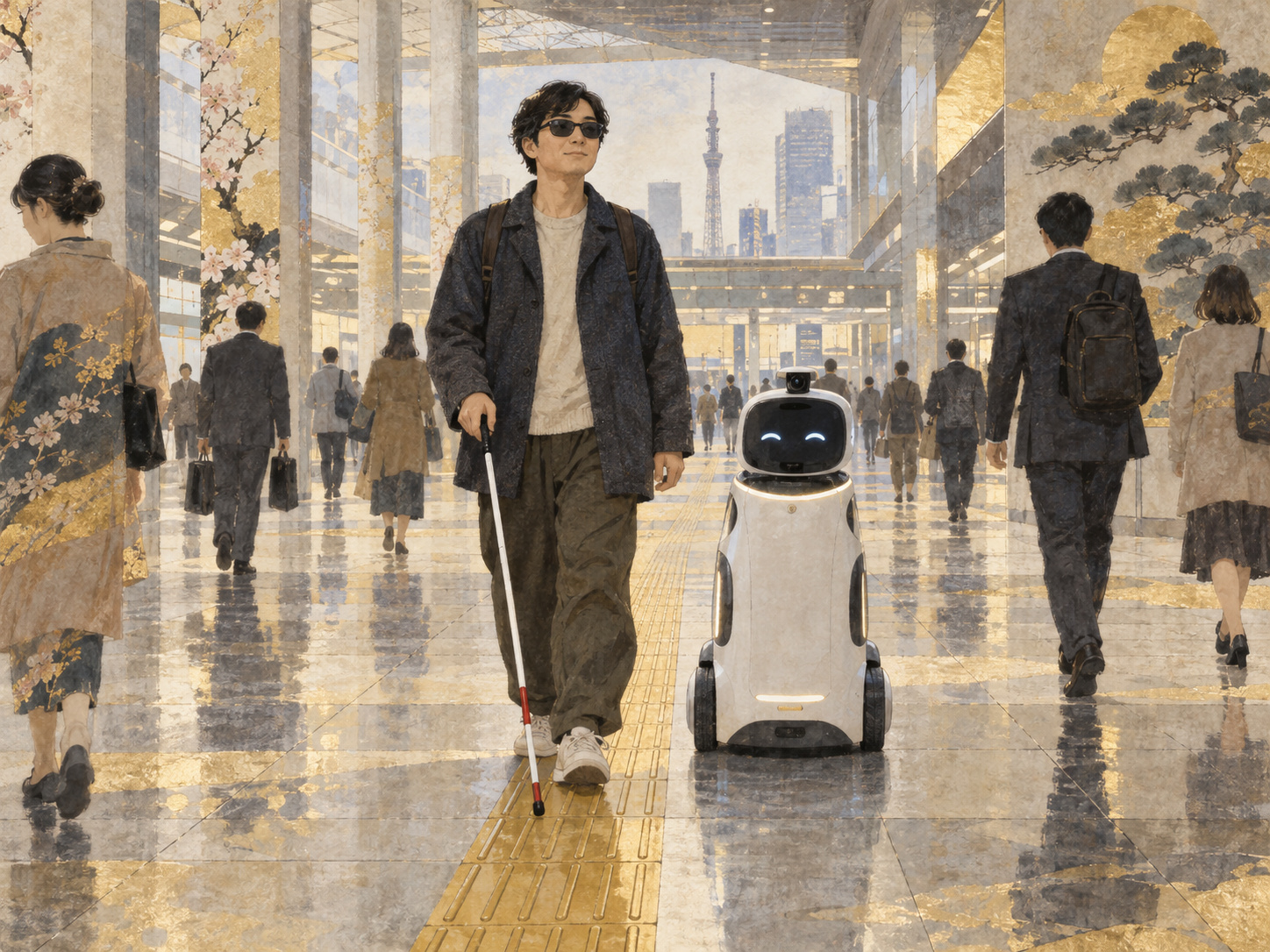
A suitcase moves a half-step ahead of a blind traveler. The user holds the handle and selects a destination on a smartphone. The machine identifies people, walls and exhibits, chooses a path around them, signals direction through the hand and, increasingly, can describe parts of the surrounding environment by voice.
At Miraikan—the National Museum of Emerging Science and Innovation in Tokyo's Odaiba district—this scene is no longer an occasional laboratory demonstration. The autonomous navigation robot known as the AI Suitcase has been in routine trial operation inside the museum since April 2024. Visitors can join daily experimental tours on most opening days.
The project moved far beyond a small museum test in 2025. During Expo 2025 Osaka, Kansai, the system operated throughout the event. Japan's Ministry of Economy, Trade and Industry later reported that more than 4,800 people experienced it. In 2026, the research agenda has moved beyond basic obstacle avoidance toward denser problems: crowd flow, social interaction, group tours and richer AI-generated descriptions of the visual world.
Why make it look like a suitcase?
The origin is personal. Miraikan's director, Chieko Asakawa, is a blind computer scientist whose career has focused on accessibility. Miraikan says the idea grew from a thought she had while traveling: what if a suitcase could move by itself and guide her?
Development began around 2017 through the Carnegie Mellon University research group where Asakawa served as a professor. The suitcase form was more than visual branding. It was familiar in airports and public spaces, large enough to contain sensors and computers, and—most importantly—already came with a physical interface humans understand: a handle.
The user does not need to chase a robot or follow an intermittent voice instruction. The robot and traveler remain mechanically linked through the handle, allowing the person to feel changes in direction and movement.
That matters because sound is already valuable information for blind travelers. Traffic, station announcements, footsteps and voices all compete for attention. Moving some guidance into touch leaves the auditory channel freer.
Inside the luggage is a small autonomous vehicle
The exterior may resemble carry-on baggage, but the system contains distance sensors, cameras, a computer, power supply, drive system, accelerometer, communications hardware and a tactile interface.
A user selects a destination through a dedicated smartphone application, by touch or voice. Pressing the start control and holding the grip activates navigation. Releasing the grip stops the robot, giving the user a direct physical way to halt motion.
The robot combines maps with real-time sensing to estimate its location, recognize people and obstacles, and adjust its route. Newer versions use technologies including LiDAR, depth cameras and, for outdoor operation, high-precision satellite positioning. An onboard GPU processes perception and navigation data.
Yet guiding a person is harder than driving an empty cart. The system must account for human walking speed, the user's arm position, people cutting across the route, crowded corridors and socially acceptable paths through a shared space.
A cane detects the immediate world; the robot reasons about a route
The white cane is an extraordinarily mature technology. It is light, inexpensive, battery-free and gives direct tactile information about the ground, edges and nearby obstacles. A guide dog adds a highly adaptive living partner capable of intelligent obstacle avoidance.
The AI Suitcase is trying to add a different layer: route selection. It can connect current location to destination, decide where to turn, avoid moving obstacles and potentially describe visually available information along the way.
That means success cannot be measured only by collision rates. Researchers also have to ask whether users trust the machine, whether it preserves a sense of agency, whether it supports spontaneous changes of plan and whether interacting with other people becomes easier or harder while using it.
Asakawa's research moved from information access to spatial access
Asakawa joined IBM Research in Tokyo in 1985. She developed a Japanese digital Braille system in 1992 and, in 1997, the IBM Home Page Reader, an early practical voice web browser that made the rapidly visualizing internet far more usable for blind people.
The underlying research question was access to information: how can a computer translate a visual interface into another form?
Over time, the same question moved into physical space. In 2017 Asakawa's work included NavCog, a smartphone-based indoor navigation system for blind and visually impaired users. Instead of translating a webpage, it translated a building into navigational instructions.
The Home Page Reader helped make an invisible screen readable. The AI Suitcase is an attempt to make an invisible city independently navigable.
CaBot turned navigation software into a physical guide
One of the direct technical ancestors was CaBot, published by Carnegie Mellon and collaborators in 2019 as an autonomous navigation robot designed and evaluated with blind users.
That same period saw industry partners begin organizing around real-world deployment. Companies including IBM Japan, Alps Alpine, OMRON and Shimizu joined the development effort, contributing AI, sensing, electronics, building integration and service design.
When Asakawa became Miraikan's director in April 2021, the museum became both a research partner and a living test site. That was strategically important. A public science museum is far messier than a robotics laboratory: children run, groups stop unpredictably, wheelchairs and strollers share corridors, exhibitions change and congestion varies by the hour.
From offices to airports, underground passages and parks
Miraikan's development timeline records a first user trial at an IBM facility in March 2021 and a test at Pittsburgh International Airport that November.
In 2022, experiments expanded to Miraikan, New Chitose Airport and the underground passages and commercial buildings of Tokyo's Nihonbashi-Muromachi district.
In 2023, the project moved outdoors around Miraikan and the adjacent promenade. A later route combined indoor and outdoor travel, a road crossing and elevator use.
Fourteen blind or visually impaired participants joined the September 2023 test. Their average System Usability Scale score was 83.2. Obstacle avoidance, pedestrian avoidance and handle vibration cues scored well. Curbs and crosswalks scored lower. Even with 20-centimeter wheels, the system could become unstable or stop on elevation changes, and higher speed increased impact discomfort.
This is the gap between robotics demos and mobility infrastructure: a three-centimeter curb can matter more than an impressive AI model.
In 2024, the experiment became “operate it every day”
On April 18, 2024, Miraikan began routine in-museum trial operation. The museum described it as the world's first daily operation of a navigation robot for visually impaired people within a single facility.
Routine operation exposes problems that a scheduled demonstration can hide. Crowd density changes. A child suddenly crosses the route. A tour group blocks a hallway. An exhibit moves. A sensor gets dirty. Batteries need charging. Staff change shifts.
At that point the research question becomes less “Can the robot navigate?” and more “Can an institution reliably operate a mobility service every day?”
Expo 2025 was the largest stress test
The consortium redesigned the system for Expo 2025 Osaka, Kansai, adding new wheel mechanisms, sensors and an updated exterior. The robots operated throughout the exposition.
An interim report covering the first 108 days through July 29 recorded 1,692 sessions involving 2,837 participants. Groups that included a visually impaired person accounted for 311 sessions. Online respondents reported 92.5% satisfaction.
Success created an unexpected access problem: reservations filled so quickly that visually impaired users—the people the system was fundamentally intended to serve—sometimes struggled to secure slots. The project responded by creating dedicated reservation capacity.
After the Expo, METI reported a final total of more than 4,800 participants. The exercise tested not only navigation but booking systems, charging, attendants, maintenance, user briefing and the logistics of operating multiple robots as a service.
In 2026, the hard problem is the crowd
The current research agenda has moved beyond following a predefined route in a mostly static environment.
Work presented around ICRA 2026 includes HiCrowd, which models hierarchical crowd-flow alignment in dense human environments, and trajectory-prediction research designed to reason from noisy robot-centered observations.
In a dense station or museum, avoiding people one by one can be the wrong behavior. Humans move in flows: toward an exit, around an exhibit, into a queue. A socially competent robot needs to understand those collective patterns and move with them rather than constantly making abrupt local evasive maneuvers.
CHI 2026 work from the broader team examines robot-assisted group tours for blind people and how delegation in social interactions changes over time when a blind traveler navigates with a robot. These questions sound softer than localization accuracy, but they are central to whether a mobility robot actually fits human life.
Generative AI may become a second set of eyes—but not the safety controller
The AI Suitcase program is also exploring richer spoken descriptions of the environment. Hironobu Takagi, Miraikan's deputy director and a long-time accessibility researcher, described work using generative AI to explain surrounding situations and supplement visual information.
That creates a sharp safety distinction. If an AI describes a sculpture imprecisely, the consequence may be minor. If it incorrectly says a crossing is clear, the consequence can be catastrophic.
For practical mobility systems, open-ended language generation therefore needs to be separated from deterministic safety functions. Generative AI can describe; perception and control systems must still be engineered to fail safely.
Six problems the AI Suitcase has to solve at once
| Area | Current capability | Deployment challenge |
|---|---|---|
| Localization | Maps plus onboard sensing | Map updates, indoor/outdoor transitions, GNSS-denied spaces |
| Obstacle avoidance | Detects people and objects, reroutes or stops | Dense crowds and sudden motion |
| Human guidance | Guides through a physical handle | Curbs, crossings, construction, rain and uneven surfaces |
| Information | Audio and tactile cues | Information overload and AI hallucination |
| Operations | Routine trials at Miraikan | Maintenance, charging, remote support and liability |
| Social navigation | Group-tour and interaction research | Conversation, queuing, yielding and social norms |
The city has to become robot-readable too
Better robotics alone will not solve mobility. Buildings and transport systems also need to expose information in machine-readable ways.
If elevators can communicate with the robot, it can change floors. If digital building maps follow common standards, deployment at a new venue becomes easier. If construction closures and temporary barriers are published in real time, the robot can re-route before reaching a dead end.
If every facility has a unique mapping format, elevator interface and safety procedure, each deployment becomes a custom engineering project.
Social implementation therefore means more than selling a smart suitcase. It requires coordination among buildings, transport operators, communications providers, insurers, maintenance organizations and users.
Japan has a long history of putting navigation information into the street
Japan's accessibility landscape offers an important historical contrast. The tactile paving now seen across stations and sidewalks began in Okayama in 1967 and spread nationally and internationally.
Tactile paving embeds guidance into infrastructure. The AI Suitcase carries sensors and intelligence with the traveler.
The two models do not need to compete. Tactile paving, audible signals, smartphones, canes, guide dogs, digital maps and autonomous robots each work under different conditions. Accessibility improves when users have more reliable choices, not when one tool declares all the others obsolete.
Independence does not mean doing everything alone
Technology stories often use the word “independence” too casually. Independent mobility does not mean refusing human help.
A person may ask station staff for directions, travel with a friend, use a cane, walk with a guide dog, listen to smartphone navigation or use a robot. The meaningful freedom is being able to choose among those options and go where one wants, when one wants.
The AI Suitcase's potential is therefore not that it makes a cane “old technology.” It adds another mobility option—particularly in large stations, airports, museums and shopping complexes where route finding and visual information can be overwhelming.
1997: Chieko Asakawa develops IBM Home Page Reader, advancing nonvisual access to the web.
2017: NavCog indoor navigation work and early research toward the AI Suitcase.
2019: CaBot research is published and an industry consortium begins to take shape.
2021: User trials at IBM and Pittsburgh airport; Asakawa becomes Miraikan director.
2022: Trials at Miraikan, New Chitose Airport and Nihonbashi-Muromachi.
2023: Outdoor, crossing and elevator trials around Odaiba.
April 2024: Routine trial operation begins at Miraikan.
2025: Expo 2025 Osaka, Kansai becomes the largest sustained field trial.
2026: Research expands into crowd flow, social interaction, group tours and AI-generated environmental description.
The final one percent can be the hardest part
A laboratory robot can fail five times in a hundred and still produce valuable research. A daily mobility aid lives under a different standard.
One rare mistake near a platform edge, one delayed reaction at a crossing or one localization error at an elevator can destroy trust in the entire system.
That is why the long field-testing period should not simply be interpreted as slow commercialization. The last stage is about reliability and graceful failure: not only how often the robot does the right thing, but what it does when it cannot.
What to watch before broader deployment
- Safety standards and responsibility in stations, airports and public streets.
- Reliability on crossings, curbs, construction zones and wet surfaces.
- The cost of creating and maintaining digital maps.
- Who provides remote monitoring and user support.
- Fail-safe behavior during communications or hardware failure.
- Whether the business model is personal ownership, rental or facility-based mobility service.
- Purchase price, insurance, repair and battery-life economics.
- How generative-AI descriptions are separated from safety-critical control.
The robot has to learn people, not just roads
Autonomous navigation began as a geometry problem: move from point A to point B on a map. Nearly a decade of AI Suitcase research suggests that may have been the easy part.
People stop, turn suddenly, form queues, walk in groups, hold conversations and yield to one another. Streets have curbs and construction. Elevators have doors. Maps become outdated.
And behind the robot is a person, not cargo. That person chooses the destination, wants to understand the surroundings, may stop to talk and may change plans halfway there.
For the AI Suitcase to become ordinary infrastructure, it has to master more than autonomous movement. It has to learn how to walk with a human being through a human city.
Sources & Reporting Notes
- Miraikan: About the AI Suitcase — Primary source for current daily field trials, operation, development history and major demonstrations.
- Miraikan Accessibility Lab — Primary source for the research program, 2026 CHI/ICRA/IROS work and collaborating institutions.
- Miraikan, Apr. 5, 2024 — Primary Japanese announcement of routine in-museum trial operation beginning Apr. 18, 2024.
- Miraikan and consortium partners, Jan. 22, 2025 — Primary announcement of the redesigned Expo model with new wheels, sensors and functions.
- Miraikan: Toward Social Implementation of the AI Suitcase — Detailed Japanese technical article on Expo operations, user feedback, outdoor trials and remaining deployment challenges.
- METI, June 2026: Expo 2025 results — Government review reporting more than 4,800 AI Suitcase participants over Expo 2025 and validation of implementation issues.
- AI Suitcase Consortium: Technology — Current system overview covering sensors, cameras, tactile interface, visual recognition, localization/navigation and mobility service.
- AI Suitcase Consortium: Publications — Research lineage from CaBot through field trials, map-less exploration, crowd navigation and 2026 human-robot interaction studies.
- IBM: Chieko Asakawa — Background on Asakawa's accessibility work and the AI Suitcase concept.
- Miraikan technical article on outdoor development — Reports 2023 outdoor trials, 400-meter route, 14-user September test and SUS score of 83.2.
This article is based on public material available through September 30, 2026. The AI Suitcase remains a research and field-trial system. Its commercial launch date, price, ownership-versus-facility-service model, general-street operating scope, liability structure and final use of generative-AI environmental description had not been fixed publicly when this article was prepared. Miraikan's 'world first' characterization refers to its own 2024 announcement about routine daily operation within one facility.
Image rights: © 2026 Japan.co.jp. AI-assisted editorial illustration. Permission is required for reuse. Contact.