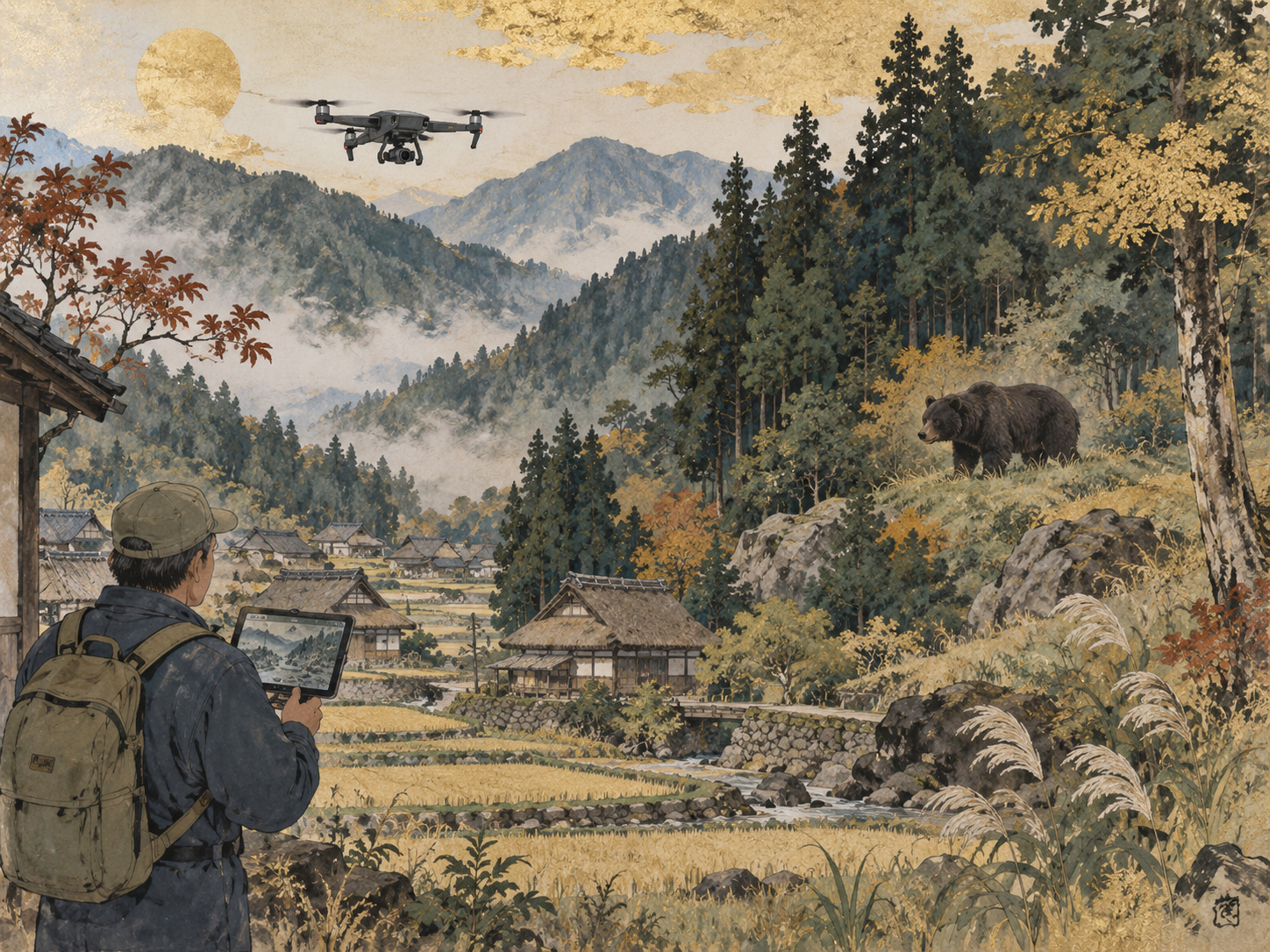
The phrase “a bear came down from the mountains” no longer fully describes what is happening in Japan. The boundary between mountain and settlement has changed.
Rural populations have fallen. Farmland has been abandoned. Satoyama woodlands are used less intensively. Persimmon, chestnut and other fruit trees remain around thinning settlements. Rivers and green corridors connect forest edges to towns. In some areas bears have expanded their range and become established closer to people. When autumn nuts fail, pressure toward low elevations can increase further.
In fiscal 2025 those forces converged in a record year. The Environment Ministry recorded 47,038 bear sighting reports from April through November. From April through December there were 214 human-injury incidents involving 236 victims, including 13 deaths.
The boundary between forest and village has thinned
Urban bear encounters did not appear overnight. After a major 2004 outbreak of Asiatic black bear appearances around Hokuriku, the Environment Ministry already identified unmanaged satoyama, abandoned fruit, garbage, access corridors into settlements and shortages of trained response personnel as policy problems.
A national mammal-distribution survey went further. It linked expanding distributions of large mammals to declining and aging settlement populations, abandoned cultivation and contraction of the zones in which people routinely work.
The ministry's 2024 bear policy explicitly described a similar mechanism for Asiatic black bears: population decline and aging reduce human activity; abandoned fields and fruit trees increase; use of satoyama falls; and the zone immediately around communities becomes more suitable habitat.
One persimmon tree can become a feeding site
Long before AI appears in Japan's bear policy, another phrase does: management of attractants.
Unharvested persimmons, chestnuts and apples, livestock feed, garbage and compost are small features of human settlements but concentrated calories for bears. When natural forest foods are poor, their value rises further.
A bear that successfully feeds near houses may return. That is why Japan's national roadmap includes removal or management of abandoned fruit trees, brush cutting, electric fencing and garbage controls alongside capture.
A bear policy based only on what happens after an animal enters town begins too late.
FY2025 was a step change
Environment Ministry figures show 19,350 bear sighting reports in FY2024. In FY2025, the April-November total alone reached 47,038.
Human incidents rose from 79 incidents involving 82 victims and three deaths in FY2024 to 214 incidents, 236 victims and 13 deaths in FY2025.
Bear activity fluctuates greatly by year. Autumn production of beech, oak and other hard mast can strongly influence movement, and poor crops can send animals farther. But mast failure alone does not explain the long-term geography. Changes in bear populations and changes in the human landscape are occurring together.
“Urban bear” becomes an official policy phrase
On July 17, Environment Minister Hirotaka Ishihara announced a new City Bear Appearance Countermeasure Team, commonly called the Urban Bear Countermeasure Team. It began with 20 ministry and regional-environment-office staff under the director-general of the Nature Conservation Bureau.
Ishihara described two main tasks: strengthening safety measures for bears entering populated areas and accelerating introduction of countermeasure technology.
He specifically cited wider sharing of municipal response practices, stronger drone-based monitoring, technology for capture and surveillance, automated brush-clearing equipment and testing of deterrent products.
The language itself is revealing. Bear policy is no longer only wildlife management in remote forest. It is becoming urban-edge emergency management.
In September, the government opened the door to drones, robots and sensors
On September 8 the ministry opened applications for its FY2026 “Technology Introduction Demonstration Project for Bear Countermeasures in Urban Areas and Other Locations.” Companies, research institutes and local governments can apply through October 7.
The eligible technologies include drones, monitoring cameras, sensors, robots and apps. Suggested uses include surveillance, patrol, tracking, deterrence, immobilization and capture, public alerts and evacuation guidance. The program also covers identifying and managing brush, movement corridors and other conditions that help bears reach settlements.
The logic is larger than replacing people with machines. A camera can watch all night. A drone can reduce the need to send a person into brush where a bear may be hidden. Automated alerts can help scarce specialists focus on the places that actually require a response.
AI bear detection is already moving into municipal operations
Artificial intelligence is not only an item in a future national program.
In Hida, Gifu Prefecture, a June 2026 training session for local-government staff demonstrated AIBeS, a system in which an automatic camera identifies a bear and triggers bear spray as a deterrent.
In Yakumo, Hokkaido, the town began a September field trial with TOPPAN using AI image analysis to detect bears, send alerts and centralize response status. The stated purpose includes reducing workload on municipal employees as well as detecting animals earlier.
Himi in Toyama Prefecture has also used AI-enabled trail cameras that send images to cloud analysis and notify officials when a bear is detected.
AI's most useful first job may be triage
A wildlife camera does not see only bears. It sees deer, boar, dogs, people and vegetation moving in wind. Without automation, somebody has to inspect large numbers of images.
Image-recognition AI can reduce that burden by forwarding likely bear detections immediately. Municipal officials, police or trained responders can then decide whether the image and other evidence justify a field response.
But both false positives and false negatives matter. Too many false alarms lead people to ignore alerts. Missed detections undermine the safety value of the system. Darkness, snow, rain, foliage, distance and partially hidden animals make outdoor classification much harder than curated image recognition.
For that reason, AI makes most sense as a first filter in a response network, not an unquestioned final authority.
Drones become the eye—and sometimes the tracker
One of the hardest questions after a sighting is simple: where is the bear now?
Did it return to forest? Follow a river? Hide in brush behind houses? Searching on foot can expose responders to danger, while vehicles cannot see into many corridors.
A drone can rapidly scan riverbanks, farmland, slopes and settlement edges from above. Thermal cameras can add value under some night-time and low-visibility conditions.
Yamagata is already listed by the Environment Ministry as using drones in spring bear-management capture. The 2026 national demonstration program explicitly extends potential drone use into urban monitoring, pursuit and deterrence.
A drone cannot see through a forest
Technology does not remove physical limits. Dense foliage can hide a bear from an overhead camera. Thermal imaging becomes less useful when vegetation blocks line of sight or environmental temperatures reduce contrast.
Drones also face wind, weather, battery, communications and aviation restrictions. Low-altitude flights in residential areas raise privacy and noise questions.
The realistic role of a drone is not to eliminate skilled responders. It is to reduce the dangerous search area and improve situational awareness.
“There are fewer hunters” needs a more precise explanation
Japan's pool of hunting-license holders has indeed fallen dramatically over the long term. The national total was roughly 530,000 around 1970 and declined to around 200,000 in the 2000s.
But the trend is not a straight line downward. Environment Ministry data show partial recovery from the early 2010s, reaching about 219,000 in FY2020, with some growth among younger license holders.
The composition also changed. Firearms once dominated. By FY2020, trapping licenses accounted for about 54% of license holdings, while the population of hunters remained comparatively old.
For an urban bear emergency, the relevant capacity is not simply the number of license holders. Municipalities need people with appropriate firearms skills, large-animal experience, safety discipline and the ability to work under a police-and-government command structure. That capacity is unevenly distributed.
Japan changed the law in 2025
For years, strict limits on firing guns in populated areas created a difficult gap between wildlife law and urban emergency response.
On September 1, 2025, amendments to the Wildlife Protection and Management Act created an emergency shooting system. When bears or boar enter areas of daily human life, municipalities may, under specified safety conditions, have authorized personnel conduct shooting.
This does not mean firearms may simply be used anywhere a bear appears. Evacuation, firing direction, backstops, command arrangements and the competence of the shooter all matter.
The legal change and the technology push are therefore connected. Better location data from cameras and drones can narrow an evacuation zone and help responders determine where a safe intervention is possible.
Bears became “Specified Managed Wildlife” in 2024
A second major policy change came in April 2024, when brown bears and Asiatic black bears—except for the endangered Shikoku population—were added to Japan's category of Specified Managed Wildlife.
The designation does not mean conservation ends. It allows prefectures to conduct population management under scientific plans with national financial and technical support.
That regional distinction is essential. Japan simultaneously has bear populations that must be actively reduced or contained and a Shikoku population whose conservation status remains precarious.
The 2030 goal is to rebuild separation
Japan's Bear Damage Countermeasure Roadmap, adopted March 27, 2026, runs through fiscal 2030 and describes the desired future as reestablishing separation between people and bears.
For Tohoku, Kanto and Chubu, Environment Minister Ishihara said provisional capture targets were set at 20% of estimated populations—above the 14.5% natural growth rate used in the roadmap. Achieving those targets, he said, would bring populations in those regions to roughly 65% of current levels by FY2030. Hokkaido's target direction is roughly 70%.
But population estimates themselves contain uncertainty. Methods and survey frequency have varied among prefectures. The government now plans more standardized estimation using tools such as automatic-camera images and genetic analysis of bear hair.
In other words, cameras are becoming relevant not only to emergency alerts but to the population estimates behind policy.
Bear management works in four layers
| Stage | Traditional tools | What technology can add |
|---|---|---|
| Prevent entry | Fruit removal, brush cutting, electric fencing, garbage controls | Mapping movement corridors, automated vegetation management |
| Detect early | Patrols and citizen reports | AI cameras, sensors, apps and 24-hour monitoring |
| Track position | Police, municipal and hunter searches | Drones, thermal imagery and shared location data |
| Respond safely | Deterrence, capture, emergency shooting | Evacuation alerts, live video and command support |
Rural decline can feed the wildlife problem back into rural decline
Wildlife damage creates a feedback loop. Japan's agriculture ministry stresses that damage is more serious than the crop-loss number alone because it can reduce farmers' willingness to continue, accelerate abandonment and increase withdrawal from farming.
A bear, deer or boar damages crops. A farmer stops cultivating. The field becomes brush. The brush becomes cover or a movement corridor. Wildlife access becomes easier.
Depopulation therefore does not simply mean that rural land “returns to nature.” It often produces unmanaged human landscapes: empty houses, old orchards, irrigation channels, roads and former fields. Those are not pristine ecosystems. They can be highly attractive mixed environments for wildlife.
Not every bear near people is the same bear problem
When incidents rise, it is tempting to treat every bear as equally dangerous. Wildlife management needs finer distinctions.
A bear moving through remote forest is different from an individual repeatedly entering a neighborhood, feeding on garbage or fruit and showing reduced avoidance of people.
More monitoring data could help identify repeated routes, high-risk sites and possibly individual behavior. Camera imagery, genetics and location information can support decisions about where deterrence, landscape changes or removal are justified.
Better technology can therefore reduce unnecessary intervention as well as enable faster intervention.
AI cannot assume policy responsibility
Even if an AI system correctly detects a bear, it cannot decide by itself whether the animal should be deterred, captured, killed or simply observed.
Image classifiers make mistakes. Population estimates have confidence ranges. Bear behavior is not deterministic. As technology increases, the human operating system becomes more important: who verifies the alert, who commands the response, who warns residents, and who has authority to act?
A sensor installed in a field is not a bear-management system. A 2 a.m. alert becomes useful only if government, police, wildlife responders and local institutions know what happens next.
2004: Major Hokuriku bear appearances prompt national analysis of satoyama, attractants and response capacity.
2000s onward: Depopulation, aging, abandoned land and expansion of large-mammal ranges become established policy concerns.
FY2023: Asiatic black bear injuries reach a then-record level.
April 2024: Bears, except the endangered Shikoku population, become Specified Managed Wildlife.
September 2025: Emergency shooting system takes effect.
FY2025: Sightings, human incidents, victims and deaths reach record levels.
March 2026: Government adopts a bear countermeasure roadmap through FY2030.
July 2026: Environment Ministry launches its Urban Bear Countermeasure Team.
September 2026: National call opens for drone, camera, sensor, robot and app field demonstrations.
The challenge is not sending bears “back to the mountain.” It is rebuilding the boundary.
Whenever a bear enters a community, one common reaction is that it should simply be returned to the mountains. But in many parts of rural Japan, the line between “mountain” and “town” is no longer where it used to be.
Houses empty out. Fields turn to brush. Fruit trees remain. River corridors run into built-up districts. To a bear, those places can form one connected usable landscape.
That means the next generation of bear management needs more than technology for finding an animal after it appears. Japan must manage attractants, restore buffer zones, identify high-risk individuals, maintain trained response teams and decide scientifically where population control is necessary.
AI and drones cannot rebuild that boundary for Japan.
But in communities with fewer people available to patrol it, they can become persistent eyes—watching where bears move, where they return and where the boundary is failing. In a depopulating countryside, that may be one of the most important things technology can provide.
Sources & Reporting Notes
- Ministry of the Environment: Bear information and measures — Primary hub for bear sightings, injuries, captures, the 2026 roadmap and emergency-response measures.
- Environment Ministry, Sept. 8, 2026: Urban bear technology demonstration program — Primary source for the call to test drones, cameras, sensors, robots and apps for urban bear monitoring, tracking, deterrence and public alerts.
- Environment Ministry: 2026 Bear Damage Countermeasure Roadmap — Government roadmap through FY2030 covering emergency response, prevention near residential areas and population management.
- Environment Minister Hirotaka Ishihara, July 17, 2026 press conference — Announcement of the 20-person Urban Bear Countermeasure Team and plans to expand drone monitoring and technology trials.
- Environment Ministry: 2026 Environmental White Paper — Official summary of record bear sightings, human incidents, victims and deaths in FY2025 and the government's policy response.
- Environment Ministry: FY2025 bear incidents — Official summary reporting 47,038 sightings through November, 214 human-injury incidents, 236 victims and 13 deaths through December.
- Environment Ministry: Policy for preventing bear damage — Primary background on depopulation, aging, abandoned fields, unmanaged fruit trees, reduced satoyama use and green corridors as factors near settlements.
- Environment Ministry mammal distribution survey — Long-term official analysis linking population decline, aging and abandoned farmland with expansion of large mammal distributions.
- Environment Ministry: Hunting-license holders by age — Long-term data showing a large decline from the roughly 530,000-license-holder peak, partial recovery since the early 2010s and an older age structure.
- Environment Ministry: Emergency shooting system — Primary description of the system effective Sept. 1, 2025 allowing municipalities to authorize contracted shooting under safety conditions in daily living areas.
- Environment Ministry: Specified Managed Wildlife case studies — Examples including Iwate's bear-reporting app and Yamagata's use of drones in spring management capture.
- Hida City, July 2026 — Municipal report on AIBeS, which uses automatic camera recognition to trigger bear-deterrent spray.
- Yakumo Town, Hokkaido, Sept. 18, 2026 — Municipal trial of AI image analysis for bear detection, alerts and integrated response management.
- Ministry of Agriculture, Forestry and Fisheries: Wildlife damage countermeasures — Government background on wildlife damage contributing to lost farming motivation, abandonment of cultivation and withdrawal from agriculture.
This article is based on public material available through September 30, 2026. FY2026 bear-incident and sighting totals are still provisional, so the principal year-on-year comparison uses the Environment Ministry's FY2025 figures. Performance of AI and drone systems varies by terrain, weather and deployment design; there is no established nationwide accuracy level. Bear population estimates also contain methodological uncertainty, and the 2030 capture levels are described here as government policy targets rather than precise population forecasts.
Image rights: © 2026 Japan.co.jp. AI-assisted editorial illustration. Permission is required for reuse. Contact.