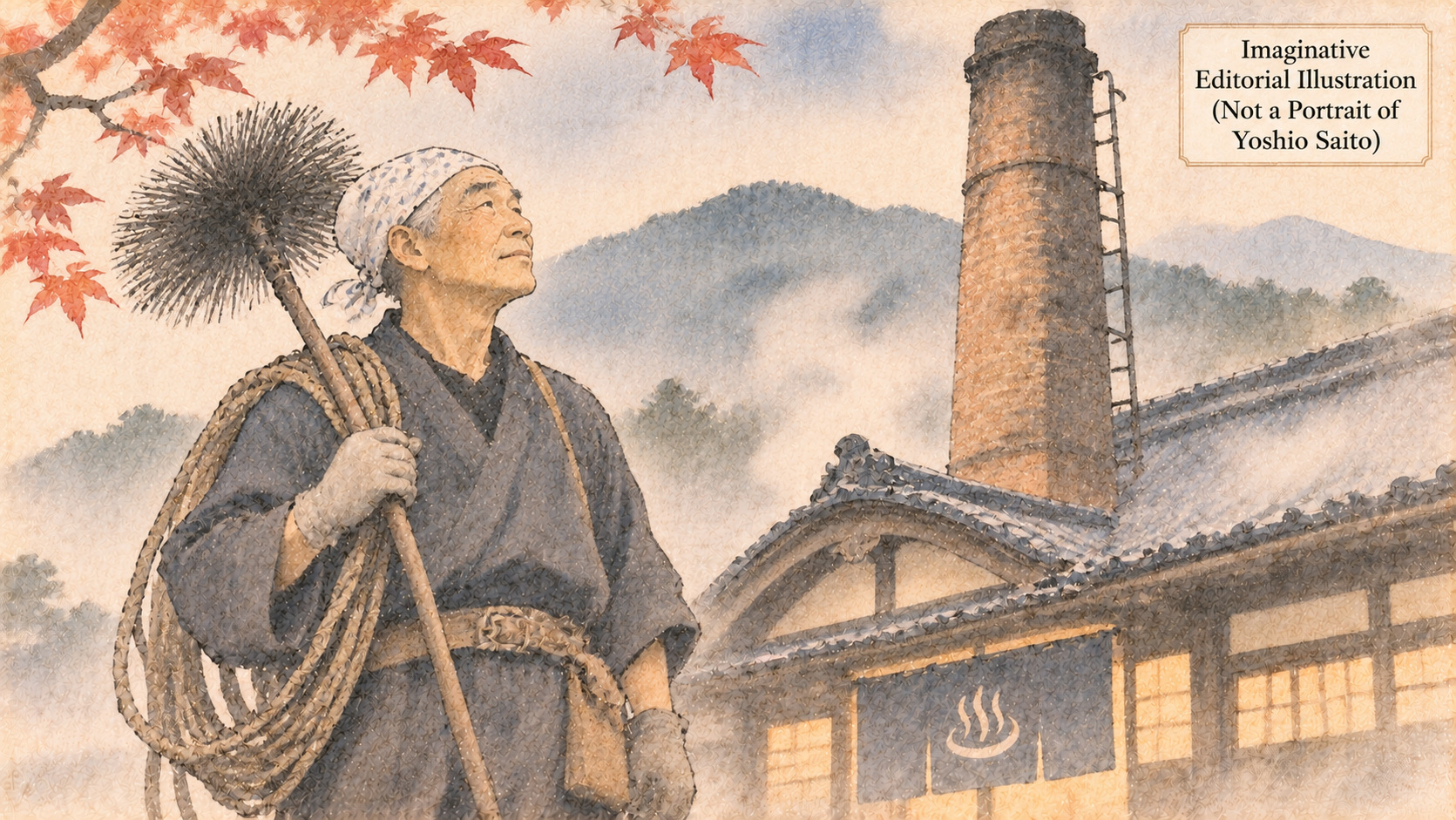
- After the bathhouse closes, another shift begins
- A lifetime above the city
- Why a chimney mattered to the public bath
- Tokyo’s shrinking network, in numbers
- The invisible labor of care
- A connection reaching as far as disaster-hit Noto
- A documentary still taking shape
- The Yanaka screening: what visitors can expect
- What it means to preserve a trade
After the bathhouse closes, another shift begins
A public bathhouse is most visible while it is full of life: conversation, steam, the sound of water, a neighborhood ritual repeated across generations. But when the bathers leave, another kind of work may begin. Above the tiled roofs rises a chimney whose upkeep is essential to the operations of bathhouses that still rely on traditional combustion systems. Yoshio Saito, 86, is among the specialists who maintain that disappearing piece of urban infrastructure.
His work and family are the subjects of The Chimney Sweeper (Entotsu Seisōnin), a documentary in production by director Shingo Ota. On December 19, an audience of just 100 people in Tokyo’s Yanaka neighborhood is invited to see roughly 70 minutes of unfinished footage followed by a 20-minute discussion with the filmmaker. The event is free, though advance registration is required. It is not the premiere of a completed feature film.
What makes this more than a film calendar listing is the question at its heart: when a city loses the people who maintain its everyday institutions, how much more than a building is at risk?
A lifetime above the city
Saito’s career is unusually well documented for a trade that often takes place out of sight. A report on a December 2024 work-in-progress screening by the Sumida River Sumi-Yume arts project described him at age 84, working on bathhouse chimneys after closing time. He had started as a teenager and had spent roughly seven decades in the occupation, especially around Sumida Ward.
The report describes him climbing a chimney, covering his face with a cloth, and sweeping out soot with a broom. It describes the occupation as involving work at height with a safety line. Those descriptions come from the earlier screening and associated reporting; JAPAN.co.jp has not inspected his current equipment or work procedures.
One proprietor interviewed for the 2024 project, at Kusatsu-yu in Arakawa, said the furnace burned differently after Saito cleaned the chimney and worried who would do the work after him. That is testimony from a particular bathhouse owner, not a controlled engineering study. Yet it expresses a practical fear familiar to small businesses: a trusted service provider may be irreplaceable.
Why a chimney mattered to the public bath
For bathhouses heating water by burning wood or other fuels, flues and chimneys carry combustion gases away from the furnace. Deposits and obstructions can complicate the safe, efficient operation of the system, making inspection and maintenance important. Not every bathhouse uses a tall chimney today; fuel changes and equipment modernization have altered that distinctive skyline.
Historically, the chimney was an urban signpost. In an era when many Japanese homes lacked a private bath, a sentō was more than an affordable place to wash: it was a shared institution of hygiene and neighborhood life. Tall stacks rising between close-set houses marked a place where hot water, routine and companionship were available.
There is a temptation to preserve the chimney as an attractive visual relic. Ota’s film suggests a more demanding question: who kept it functioning, and under what conditions? The craft resides in people as much as in bricks.
Tokyo’s shrinking network, in numbers
The Tokyo Bathhouse Association says the city’s bathhouses peaked at 2,687 in 1968. A separate Tokyo Metropolitan Government statistical series records 417 public bathhouses at the end of 2025, down from 766 in 2011. Because the historical association count and the modern metropolitan series differ in method and coverage, they should not be treated as a perfectly continuous dataset. Their broad message, however, is unmistakable: the network has contracted sharply.
Yet use of the remaining establishments has not simply vanished. The metropolitan government counted an estimated 21.185 million annual visits in 2025, up from 20.854 million in 2024. Beginning in August 2026, Tokyo’s regulated adult admission ceiling for ordinary public baths became ¥600. Operators balance controlled pricing against heating, repairs, staffing and property costs.
The Ministry of Health, Labour and Welfare identifies the spread of private household baths, proprietor aging and a lack of successors among the reasons conventional public bathhouses have dwindled. The same succession dilemma reaches beyond ownership to the workers supplying specialized maintenance services.
The invisible labor of care
Ota is not making a simple portrait of an extraordinary elderly worker. In a January 2026 interview about filmmaking, he traced the project partly to childhood memories of prejudice directed at a relative who worked as a cleaner. Later, he encountered an elderly chimney sweep whose pride in his work inspired a film about aging, dignity and care.
The 2024 Sumi-Yume report also records Ota reflecting on the public infrastructure erected during Japan’s high-growth years. Instead of focusing only on demolition and replacement, he asked what it means to maintain aging places so they remain usable. That notion of care connects a soot-covered broom with the neighborhood bath, the apartment complex and other familiar facilities.
It is important not to romanticize hazardous labor. Saito’s age makes the story arresting, but does not answer questions about workplace safety, occupational health, insurance, earnings, physical demands or how the work could pass to a younger generation. These are reporting questions, not facts that can responsibly be assumed from a promotional announcement.
A connection reaching as far as disaster-hit Noto
The film’s earlier incarnation ventured beyond Tokyo. According to the Sumi-Yume account of the 2024 preview, footage followed a relationship between Saito and the proprietor of Kaihin Amida-yu in Suzu, Ishikawa Prefecture, a community struggling after the 2024 Noto Peninsula earthquake. The two had met through the world of neighborhood baths; a visit to the peninsula emerged through a conversation about chimney cleaning.
That earlier account described the bathhouse as a place where residents could gather amid recovery from a major disaster. It shows how one maintenance trade intersects with social life and disaster resilience. The account describes material screened in 2024, and it is not independently established whether the same sequence will appear in the December 2026 program.
A bathhouse matters not only because someone can get clean. It can provide routine, a reason to leave home, a place for conversation and an element of continuity when ordinary life is disrupted.
A documentary still taking shape
The project has a history of sharing unfinished work with the communities it depicts. A short-form work-in-progress screening took place in Sumida in December 2024. The December 2026 event in Taitō is another, this time offering an excerpt from the longer documentary and a discussion with Ota. These screenings are parts of the production process rather than releases of a definitive finished film.
Ota has directed or worked on films including The End of the Special Time We Were Allowed, Kaihōku and Numakage Municipal Pool. His interest in the loss and maintenance of shared spaces is visible across these projects. In a January 2026 interview he said the chimney-sweep documentary was aiming for completion in 2027 and was being developed as an international coproduction. A target completion year is not an announced theatrical release date.
The producers’ publicity supplied to JAPAN.co.jp describes involvement from Japan, France, South Korea and Taiwan. The precise contractual structure and contributions of those partners have not been independently established; the four-country description should be understood as the producers’ account.
The Yanaka screening: what visitors can expect
The work-in-progress screening is scheduled for Saturday, December 19, 2026, from 3 to 4:30 p.m., at the second-floor multipurpose hall of Yanaka Community Center, 5-6-5 Yanaka, Taitō-ku, Tokyo. Doors are scheduled to open at 2:45 p.m. The program comprises approximately 70 minutes of footage and a roughly 20-minute director conversation; timings are subject to change.
Admission is free but restricted to advance web reservations, with a 100-person capacity on a first-come, first-served basis. The event is organized by the general incorporated association HydroBlast as a project supported under Taitō City’s arts and culture assistance scheme. The city and organizers both publish the registration details.
Crucially, organizers call this a rush or work-in-progress screening. The material may change before the completed documentary. A viewer is being invited not merely to consume a finished film, but to encounter a project while decisions about its final shape remain open.
What it means to preserve a trade
An occupation can disappear long before anyone thinks to record its precise gestures: how a worker judges soot accumulation, handles tools, climbs, checks the condition of an old structure or coordinates with the proprietor who keeps the furnace running. Capturing the motions on film is not the same as training a successor, but it may preserve evidence for future generations to understand what the work involved.
Saito’s story invites an uncomfortable form of curiosity. Many people are willing to celebrate “traditional culture”; fewer ask whether its least visible workers are paid, protected and succeeded. The 86-year-old chimney sweep and the family around him make that question difficult to ignore.
Above the warmth of a neighborhood bath rises a structure maintained by hands most visitors never see. The filmmaker’s challenge—and ours as readers—is to look upward, then beyond the chimney to the people who kept the bathhouse alive.
Sources and reporting limitations
Built from the 2026 city and organizer notices, the independently published 2024 Sumi-Yume work-in-progress report, official Tokyo statistics and the director’s recorded comments. We have not interviewed Saito or Ota for this article, attended a chimney-cleaning job or viewed the unreleased 2026 footage. The reading of Saito’s given name and the formal financing or contractual details of the international coproduction have not been independently confirmed.
- 台東区・上映案内 / Taitō City event notice
- 一般社団法人ハイドロブラスト・開催要項 / HydroBlast screening information
- すみゆめ・2024年制作途中上映会の記録 / Sumi-Yume 2024 screening report
- 東京都・公衆浴場の統計 / Tokyo metropolitan bathhouse statistics
- 東京都浴場組合・銭湯Q&A / Tokyo Bathhouse Association history
- 厚生労働省・公衆浴場業概要 / MHLW public bathhouses
- 2026年1月・太田信吾監督インタビュー / January 2026 interview
- 城崎国際アートセンター・監督紹介 / Director biography
- 台東区・11月11日の広報 / Taitō City November publicity