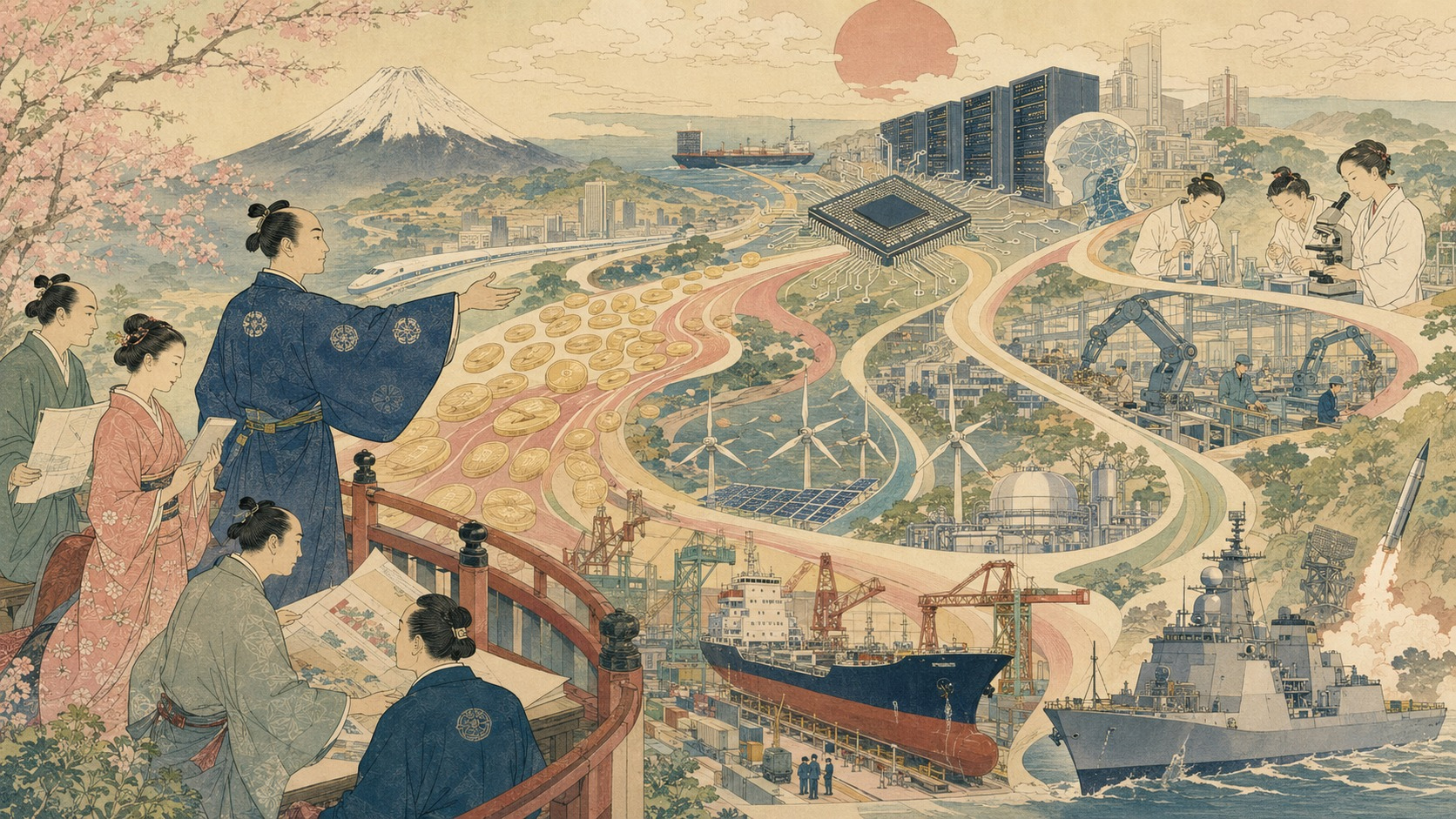
Stand on the bridge, point toward the factories, and send rivers of capital into the distance. The conceptual nishiki-e illustration above captures the governing idea behind the Japan Growth Strategy approved by the Cabinet on July 21, 2026. It is not a promise that Tokyo will spend ¥370 trillion. It is an attempt to make the state an architect of expectations—aligning the investment decisions of companies, banks, universities and local governments around a shared map of technologies, markets, regulation and infrastructure through fiscal 2040.
The map covers 17 strategic fields and 62 “major products and technologies”: AI and semiconductors; digital systems and cybersecurity; quantum technology; defense; aviation and space; shipbuilding; biotechnology; advanced medicine; energy; food technology; content and more. The government’s public-private road map estimates cumulative investment of more than ¥370 trillion, after removing overlap among the 62 items. At the exchange rate recorded for this edition—¥163.84 to the dollar—that is roughly $2.26 trillion.
Its scale is historic, but its meaning requires discipline. ¥370 trillion is not an appropriation, a legally binding corporate commitment or a flat annual spending schedule. It combines company interviews, existing plans, market-growth assumptions and modelled public participation at different stages of development. The government says the figures will be refined through budgeting and a continuous plan-do-check-act cycle. This is not a photograph of Japan in 2040. It is a blueprint that must be redrawn as evidence arrives.
How to Read ¥370 Trillion
The road map’s technical appendix is unusually candid about how the number was built. Working groups in each of the 17 fields identified a Japanese “path to winning” and the bottlenecks that prevent investment. Ministries then interviewed major companies and industry bodies about planned or expected capital expenditure. Where future plans were not yet firm, officials extrapolated from market size and investment growth. They also made mechanical assumptions about the public role as a technology moves from research to demonstration, commercialization and mass production.
Numbers with very different confidence levels therefore sit in the same table. The ¥24.5 trillion assigned to games through FY2033 rests on the expansion of an established global business. The ¥3.1 trillion for fusion assumes a single demonstration power plant and depends heavily on technical progress. For naval vessels, the table gives about ¥340 billion of defense procurement-related investment in the FY2026 budget, then says more is expected after Japan revises its three national-security documents. Investment in LNG carriers remains “to be refined.” The grand total looks precise, but its components have broad error bars.
Overlap is the second trap. The ¥20.8 trillion for biopharmaceuticals and regenerative-medicine products appears under both synthetic biology and advanced medicine. The ¥4.2 trillion for green steel appears in both materials and energy security/GX. The government says it removes duplication from the ¥370 trillion total, but adding field subtotals will double-count. The same warning applies to estimated economic effects. The appendix assigns ¥443.3 trillion of ripple effects to core semiconductors and ¥127.5 trillion to quantum computing, but explicitly says item-level effects overlap and must not be summed.
The 17 Fields: What Japan Is Betting On
AI and semiconductors form the largest block: ¥10.5 trillion for physical AI, ¥68 trillion for the chips at the center of physical-intelligent systems and ¥23.1 trillion for vertical, domain-specific AI—a total of ¥101.6 trillion, about 27% of the entire program. Digital and cybersecurity include ¥32.7 trillion for cloud, data centers and batteries, ¥8.2 trillion for autonomous driving and ¥7.4 trillion for secure national and local-government digital infrastructure. Japan is defining AI not as a single software industry, but as an industrial stack joining electricity, compute, robots, communications, medicine and mobility.
| Strategic field | Selected investment assumptions | Horizon and caveat |
|---|---|---|
| AI and semiconductors | Core chips ¥68tn; vertical AI ¥23.1tn; physical AI ¥10.5tn | Through FY2040; ¥101.6tn field total |
| Digital and cyber | Cloud, data centers and batteries ¥32.7tn; autonomous driving ¥8.2tn | Through FY2035 and FY2040 respectively |
| Communications and quantum | Next-generation wireless ¥20.5tn; quantum computing ¥10.3tn | Through FY2040 |
| Biology and medicine | Biomanufacturing ¥12.8tn; breakthrough drugs ¥23.4tn; biologics and regenerative products ¥20.8tn | The ¥20.8tn item appears in two fields |
| Resources, energy and GX | Hydrogen ¥6.2tn; offshore wind ¥5.1tn; advanced reactors ¥5tn; next-generation solar ¥4.1tn | Through FY2040; connects with existing GX policy |
| Aviation and space | Satellites and services ¥6.4tn; lunar and low-orbit technology ¥5.6tn; civil aircraft ¥3.5tn | Through FY2040 |
| Defense industry | Dual-use technology ¥4.3tn; small unmanned aircraft ¥0.4tn | Future vessel and defense-plan totals remain incomplete |
| Content | Games ¥24.5tn; anime ¥3.3tn; music ¥3tn; manga ¥1.6tn; live action ¥1.3tn | Through FY2033; ¥33.7tn field total |
| Food technology | Plant factories ¥4.6tn; land-based aquaculture ¥2.9tn; food machinery ¥1.2tn | Through FY2040; ¥9.7tn field total |
The 62 items also form a time portfolio. Thirty-seven are already commercialized or in mass production—the current earners. Twenty are at demonstration stage—the next profit engines. Five remain in research—the seeds of future growth. Games and chip fabs can generate cash now while quantum networks, fusion and lunar technology preserve options for tomorrow. It makes sense not to judge them on a single payback period. It does not make sense to exempt long-horizon projects from evaluation; each stage needs a different test.
The Postwar Memory: When the State Helped Make Markets
Japan has done expectation-setting before. When the Ministry of International Trade and Industry was formed in 1949, capital and foreign exchange were scarce. Government finance, tax incentives, foreign-currency allocation, technology licensing and industry coordination pushed resources toward steel, electric power, chemicals and machinery. The 1956 Temporary Measures Law for the Promotion of the Machinery Industry helped parts makers modernize equipment, with effects that spread into the quality and price of finished products. The 1960 Income Doubling Plan became the emblem of an era when public infrastructure and private capital expenditure reinforced each other.
That success was never simply a matter of bureaucrats picking winners. Domestic demand was surging, young workers were moving to cities, world trade was expanding and Japanese firms competed ferociously. Policy provided complementary assets—standards, finance, roads, ports, power and access to technology—at the same time. Repeating the names of favored industries and offering subsidies in 2026 will not recreate high growth. Japan’s population is shrinking, capital crosses borders, global platforms set standards, and electricity and specialized labor are binding constraints.
The Semiconductor Rise and Retreat
The VLSI Technology Research Association of the 1970s remains the iconic example of public support combined with corporate collaboration. Japanese companies accumulated strengths in process engineering, yields, materials and equipment, and by the late 1980s held roughly half of the global semiconductor market. Then several forces converged: the U.S.-Japan chip dispute; brutal memory cycles; the horizontal structure of the personal-computer era; the rise of fabless designers and dedicated foundries; restructuring among Japanese electronics groups; and delayed capital decisions. Japan’s global share fell below 10%.
That history leaves two opposing lessons. Industries requiring huge scale, shared facilities and long development cycles can benefit from patient public capital and precompetitive research. But protecting yesterday’s production model is dangerous when design, software, customers and standards migrate to a new layer. Japan’s Fifth Generation Computer Systems project generated sophisticated research in the 1980s, yet did not capture the center of the personal-computing and internet markets that followed. Technological achievement and commercial control are not the same thing.
The 2026 strategy repeats “path to winning,” “social implementation” and “global market” because policymakers remember this gap. The phrases will matter only if every project identifies who carries it from laboratory to pilot line, from pilot line to customer, and from a domestic standard to an export market.
From a Market-Led Era to a Mission-Oriented State
After the asset bubble collapsed, Japan emphasized bad-loan cleanup, deregulation, corporate restructuring and fiscal restraint. Directly sectoral industrial policy receded. Abenomics after 2013 combined monetary easing and flexible fiscal policy with a “third arrow” of growth reform, but corporate governance, investment conditions and deregulation were more prominent than national capital allocation. In a deflationary economy, companies accumulated cash, wages and demand stayed weak, and executives hesitated to build capacity they feared would not be needed.
The pandemic, chip shortages, U.S.-China rivalry, Russia’s invasion of Ukraine, energy shocks and the generative-AI boom changed the calculation. A supply chain optimized around one country or one factory could become a national vulnerability. The 2022 Economic Security Promotion Act created mechanisms to support critical goods including chips, batteries, cloud services, minerals and ship components. The 2024 AI and Semiconductor Industrial Infrastructure Framework promised more than ¥10 trillion of public support through FY2030 to induce over ¥50 trillion of public-private investment. The GX program offers about ¥20 trillion of early public support to mobilize more than ¥150 trillion over a decade.
The ¥370 trillion strategy overlays these missions on one map. Its novelty is less the existence of subsidies than the attempt to connect 17 fields to two purposes—crisis management and growth—and then link technology stages with demand creation, regulation, people, finance and regional clusters.
AI and Chips: The Biggest Bet Is More Than a Fab
The ¥68 trillion semiconductor line is the eye-catcher, but the strategic core is the full system: models, robots, sensors, clouds, data centers, all-photonics networks, batteries, grids and cyber defense, deployed in factories, logistics centers, hospitals, care homes and farms. Physical AI could use Japan’s strengths in production equipment, industrial robots, precision components and real-world operational data. Vertical AI offers a path to compete through deep expertise in medicine, materials, design and maintenance rather than through a generic model alone.
The starting position is uncomfortable. The OECD’s 2026 Japan survey says 55% of Japanese businesses used generative AI in 2024, compared with more than 90% in Germany and the United States. Cumulative Japanese business investment in AI from 2013 through 2024 was $5.9 billion—just 1.3% of the U.S. level. Japanese companies were also far more likely than U.S. peers to cite a lack of AI talent as a barrier. Compute capacity cannot create productivity if workflows, data quality, procurement and accountability remain unchanged.
Chip plants need electricity, water, maintenance engineers, housing and transport. Data centers need generation and transmission. An AI strategy is therefore an energy strategy, a regional strategy and an education strategy. Groundbreaking ceremonies are the wrong finish line. The scoreboard should include utilization, domestic sourcing, skills transferred, customers won, exports and compute delivered per unit of power.
Biotechnology and Medicine: Building the Bridge from Science to Business
Japan is strong in basic science, precision instruments, fermentation, cell culture and materials, yet has often struggled to carry discoveries into large clinical programs, industrial manufacturing and global sales. The road map assigns ¥12.8 trillion to biomanufacturing, ¥23.4 trillion to first- or best-in-class medicines, ¥7.2 trillion to infectious-disease products and ¥11.6 trillion to advanced medicine using AI and robotics.
A factory alone cannot measure success here. Trial speed, interoperable patient data, predictable regulation, reimbursement, intellectual property, experienced management and foreign distribution must form one bridge. The same ¥20.8 trillion for biologics and regenerative medicine appearing in two fields is an accounting warning, but it also reflects the policy reality: science, manufacturing and health markets cannot be separated by ministry boundaries.
There Is No Digital Powerhouse Without Power
AI, chips, clouds and data centers consume electricity, and the cost and reliability of that electricity determine where investment goes. Japan places hydrogen, offshore wind, perovskite solar cells, advanced nuclear reactors, next-generation geothermal and fusion in the same strategy. This is not only decarbonization. It is an answer to dependence on imported fuel, geopolitical exposure and the risk of insufficient industrial power.
Yet the existing ¥150 trillion GX mobilization program overlaps in policy and project terms with the new ¥370 trillion road map. The same battery, green-steel line or advanced power source must not become “new investment” every time it appears under a different label. The OECD’s 2026 review emphasizes additionality—whether public support creates investment that would not otherwise occur—along with permitting reform and grid improvement. The useful metrics are not yen alone, but additional capital, carbon reduction, energy security and power cost together.
Defense, Ships and Space: Where Civil and Security Markets Meet
Defense is one of the least complete entries in the ¥370 trillion table. It includes ¥4.3 trillion for dual-use technology and ¥0.4 trillion for small unmanned aircraft. Naval-vessel investment is shown only as roughly ¥340 billion in the FY2026 budget, with more expected after revision of Japan’s national-security documents. A clean “defense share” of the ¥370 trillion therefore cannot be calculated.
Shipbuilding, marine drones, submarine cables, satellites, launch vehicles, quantum communications and cybersecurity cross the civil-defense boundary. Predictable government procurement can justify investment in equipment and skills, but the system also needs security clearances, export controls, allied development rules, intellectual-property arrangements and a fair allocation of inflation risk. More orders will not strengthen the base if small suppliers lose money and engineers burn out.
Why Manga and Plant Factories Belong Beside Semiconductors
Putting ¥33.7 trillion of content investment and ¥9.7 trillion of food technology on the same page as chips and defense is a defining feature of the strategy. Games, anime, manga, music and film can earn foreign income with relatively little imported material, using talent and intellectual property. The government aims for ¥20 trillion of overseas content sales a year by 2033, comparable to automobile exports. But if low pay, punishing schedules, weak rights allocation, piracy and dependence on foreign platforms continue, higher sales will not translate into durable creator income.
Plant factories, land-based aquaculture, food machinery and new foods connect climate adaptation and labor scarcity with food security and exports. Their economics depend on electricity and water, distribution, safety regulation, insurance and consumer trust. They are clear examples of a single project serving both crisis management and growth.
From Tokyo to All 47 Prefectures
The government plans strategic-industry clusters, regional-industry clusters and local-industry growth plans, supported by a regularly updated domestic investment map. A semiconductor plant draws materials, equipment, logistics, schools, housing and power. A shipyard anchors steel, engines, repair and port services. Supporting the surrounding system can leave more value in a region than a grant to one famous company.
Not every prefecture needs a leading-edge fab. Regions can specialize in design, testing, components, maintenance, data, tourism content or food processing. There is also a danger that local governments compete away land and tax revenue, then inherit an empty site if a project closes. National reporting should include local procurement, wages, skills, university partnerships and exit obligations—not jobs announced on groundbreaking day.
If SMEs Cannot Join, ¥370 Trillion Becomes a Narrow River
Large investment announcements are told through the names of large corporations. Yet thousands of mid-sized and small firms build the equipment, machine parts, write software and perform maintenance. Japan spends 3.3% of GDP on research and development, among the highest shares in the OECD, but SMEs account for only about 6% of total R&D—far below an OECD average near 40%. Knowledge and productivity do not diffuse easily across the corporate divide.
The answer is not more complicated grant applications. Smaller firms need access to shared test facilities, standards support, intellectual-property advice, cybersecurity, long-term purchase agreements, technology-literate regional banks, university talent and the bargaining power to pass through costs. If capex rises at prime contractors while supplier margins and wages do not, the promised cycle of investment and pay increases will fail.
The Financing Vessel: Multi-Year Budgets and Bridge Bonds
The government will establish a “Strong and Prosperous Japan Investment Framework.” Measures expected to raise potential growth and induce private capital can be requested without the usual across-the-board ceiling at the budget-request stage and should generally follow multi-year plans. Particularly important economic-security fields may be managed separately in special accounts and financed initially with bridge bonds backed by identified redemption resources. Grants are to be combined with DBJ and JIC capital, guarantees, procurement, tax measures, regulation and private asset management.
This responds to a real problem: factories and laboratories cannot plan around uncertain year-end supplementary budgets. But an uncapped request framework is not an uncapped entitlement. Japan’s gross public debt remains the highest in the OECD, while monetary normalization raises debt-service costs. The OECD’s 2026 survey puts 2024 general-government gross debt near 206% of GDP and calls for stronger medium-term fiscal planning and less reliance on supplementary budgets. A project becomes “investment,” rather than merely debt, only if it raises future productive capacity and revenue.
People Are the Scarcest Form of Capital
By 2040 Japan will need semiconductor process engineers, AI researchers, grid specialists, biomanufacturing technicians, naval architects, clinical-development leaders and cybersecurity professionals at the same time. If every field writes a separate “talent plan,” they will compete for the same small pool.
The strategy correctly makes reskilling, university support, foreign talent, labor mobility and reduced household burdens cross-cutting themes. Counting course participants will not be enough. Japan should measure employment, wage gains, demonstrated skills, regional retention, and whether women and foreign professionals advance into research and management leadership. Expanding short-term competitive grants while weakening universities’ stable base funding would make long-horizon science less attractive to young researchers.
The World Is Already in an Industrial-Policy Race
Japan is not alone in returning the state to the investment table. The European Chips Act mobilizes more than €43 billion of policy-driven investment and seeks to double Europe’s global semiconductor share to 20% by 2030. The United States treats domestic capacity in chips, AI, energy and critical minerals as a security issue. South Korea, Taiwan and China compete with tax policy, land, power, R&D and dense industrial clusters.
The useful question is therefore not whether Japan should use incentives, but where, for how long and under what conditions. Matching rival subsidies for the same factory can become an auction in which the host country bears the cost while gains flow to global shareholders. Japan should demand durable benefits: secure supply, skills, intellectual property, equipment-and-material linkages, export customers and an ecosystem that creates the next firm.
Permit Failure, Not Permanent Drift
Technology investment fails. A plan assuming all 62 items will succeed has already abandoned reality. Good governance must tolerate research failure while refusing commercial-stage inertia.
- Additionality: Would the investment have occurred without public support?
- Milestones: Are research, demonstration, first customer, volume production and export separated by deadlines?
- Spillovers: Did domestic sourcing, SME profits, wages and transferred skills rise?
- Market proof: Do customers and operating profits remain after support ends?
- Security: Does the project diversify supply and deepen allied networks rather than merely localize?
- External costs: Are power, water, carbon, land and housing burdens visible?
- Exit: Can a weak project shrink, pivot or close while preserving its useful knowledge?
The government promises KPIs, evidence-based policymaking and continuous review. Publishing project-level public support, private capital actually spent, schedule variance, employment, wages, exports, power use and reasons for revision would make the ¥370 trillion claim testable. Commercial confidentiality can be protected without hiding what additional public value was created.
The 2040 Numbers Are Scenarios, Not Prophecy
The strategy presents a model in which annual private domestic fixed investment reaches ¥230 trillion and nominal GDP approaches ¥1.1 quadrillion in FY2040. Separately, it establishes ¥250 trillion of annual private domestic fixed investment as a public-private goal. The first is a model output; the second is an ambition. They should not be confused. A 2025 METI scenario had used ¥200 trillion of investment and nominal GDP of ¥975 trillion. The higher horizon one year later expresses ambition, but also shows how sensitive long-term results are to assumptions.
Nominal GDP rises with prices as well as real output. If investment grows because imported machinery and construction cost more, productive capacity may not rise proportionately. The harder tests are real income per person, labor productivity, domestic value added in exports, business entry and exit, energy efficiency and regional real wages.
What Would Make Japan’s Bet Work
¥370 trillion is large enough to command attention. Japan’s industrial history says the combination matters more than the headline. Postwar machinery grew because finance, parts, standards, power, ports, demand and exports connected. Semiconductors showed that manufacturing excellence can erode when industry architecture changes. Research programs can produce papers and prototypes without capturing customers or standards.
The 2026 strategy will face the same test. Put power and talent beside AI factories. Join university science to clinical trials, management and capital. Make defense procurement reach the margins of small suppliers. Return overseas anime revenue to creators. Do not quietly preserve a failed project; move its people and knowledge to the next technology.
A government cannot buy the future. It can share early risks no single company can carry, build common infrastructure, create a first market and enforce competition and exit. Whether ¥370 trillion becomes an industrial turning point or an immense spreadsheet will not be decided in 2040. It begins with the projects selected for the FY2027 budget, the first public KPI report—and the first decision to stop.
Primary Sources and Method
This article is anchored in the Japan Growth Strategy approved on July 21, 2026; the 62-item public-private investment road map and its methodology appendix; the June 24 preparatory materials; and statements by the prime minister. METI materials on industrial policy, GX and AI/chips, Cabinet Office economic-security records, RIETI policy history, and OECD and IMF external assessments provide the historical and analytical checks. We do not add overlapping field totals or item-level ripple effects. The dollar equivalent uses the exchange-rate record displayed at the top of this edition.
- Cabinet Office: July 21 Council on Economic and Fiscal Policy materials
- Japan Growth Strategy, July 21, 2026
- Public-private road map for 17 fields and 62 items
- Road-map appendix: investment estimates and technology stages
- Prime Minister’s Office: July 21 joint meeting
- Prime Minister’s Office: Cabinet approval record
- Prime Minister’s Office: June 24 meeting and investment explanation
- METI: Fifth Interim Report on the New Direction of Economic and Industrial Policies
- METI: The 2040 Industrial Structure Led by Growth Investment
- METI: AI and Semiconductor Industrial Infrastructure Framework
- METI: GX Economy Transition Bonds and investment support
- Cabinet Office: Economic Security Promotion Act
- Cabinet Office: Critical goods and supply-chain resilience
- RIETI: Mechanization and Industrial Policy
- RIETI: History of industrial technology policy, 1980–2000
- OECD Economic Surveys: Japan 2026
- OECD: Productivity, AI investment and innovation diffusion in Japan
- IMF: 2025 Article IV consultation with Japan
- European Commission: European Chips Act