- The people who might translate the first warning
- Why the program is divided into three sessions
- When the ground shakes: the skills that cannot wait
- The word hinanjo is a piece of emergency infrastructure
- Food that is delivered but cannot be eaten
- An interpreter can be a neighbor, not just an official
- The promise—and danger—of disaster influencers
- A local experiment with a history dating to 2023
- From Kobe in 1995 to modern multilingual disaster support
- A larger foreign-resident population changes the definition of a helper
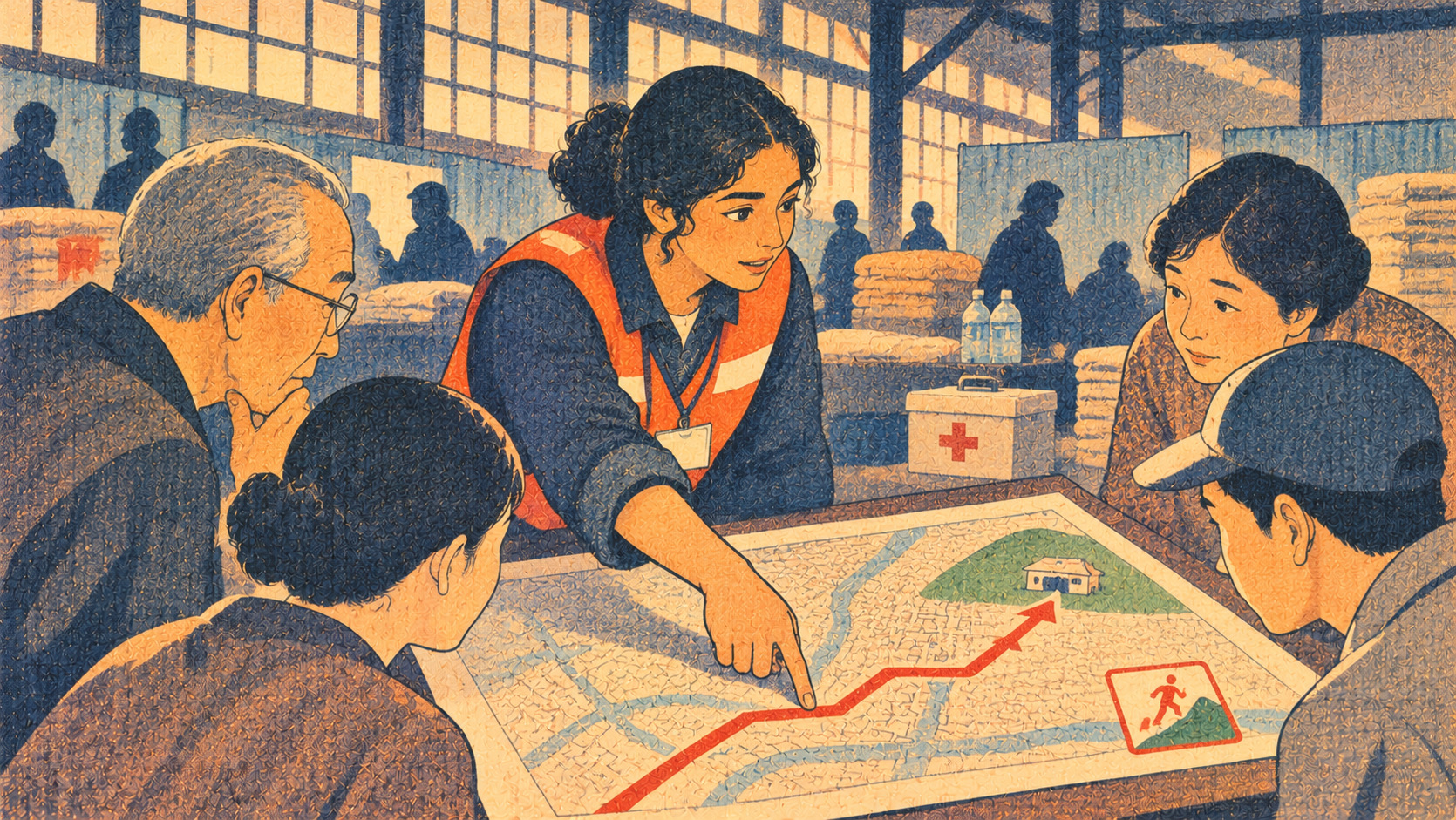
The people who might translate the first warning
A disaster can turn an ordinary Japanese phrase into an urgent question. What is a hinanjo? Is the school gym a place to escape immediate danger or somewhere to sleep? Who decides whether a route is safe? Izumiotsu, a city south of Osaka, has designed an exercise around those questions—and around a change in how local authorities see foreign residents. The goal is not simply to teach international students to receive help but to prepare some of them to provide it.
On October 30, 2026, Izumiotsu City announced a drill for November 5 involving approximately 170 students from First Study Japanese Language School's Osaka Izumiotsu campus, alongside teachers and municipal crisis-management staff. The program was scheduled at Texpia Osaka and a city emergency-supply warehouse. The public material establishes a planned program, not a verified head count or an evaluated outcome. This article is based on documentary research rather than interviews or on-site observation; no student quotations or experiences have been invented.
Sources: City announcement
Why the program is divided into three sessions
The city described three groups: around 70 students from 10 a.m. to noon, approximately 50 from 1:10 to 3:10 p.m., and another 50 from 2:40 to 4:40 p.m. The second and third sessions overlap in the official schedule. They are presented here as published, without assuming that the timing was subsequently revised. Each group was expected to work through essentially the same activities.
For disaster education, numbers do not tell the whole story. A lecture delivered to 170 people can reach many listeners while leaving practical misunderstandings intact. Smaller groups can allow participants to practice a protective movement, follow an evacuation route, assemble basic shelter equipment and ask questions. But without post-exercise evaluation, the announced scale offers no evidence that any particular learning outcome was achieved.
When the ground shakes: the skills that cannot wait
The first planned activity was a surprise shakeout drill. Participants would practice getting low and protecting themselves during a simulated earthquake. The scenario addresses an often-overlooked reality: migrants arrive with different experiences of natural hazards and different expectations of public warnings. A person who has not lived through a major earthquake may never have practiced reacting to falling objects or moving furniture.
Effective instruction must go further than a command to get beneath a desk. A safe response depends on where someone is standing, surrounding hazards and the availability of shelter. In a classroom, apartment, train station or workplace, the crucial question is whether someone can recognize danger and act promptly. It is also a question Japanese residents must continue to practice; nationality does not determine competence.
Sources: City announcement · Municipal archive
The word hinanjo is a piece of emergency infrastructure
A shelter is not only a building. It is a point in a network where evacuation decisions, information, food, sanitation and temporary living arrangements intersect. The announced program called for students to confirm the route from their school to a shelter and learn what such facilities do. In Japan, designated emergency evacuation sites and designated shelters have related but different functions: escaping immediate danger is not necessarily the same as finding accommodation after a disaster.
For a newcomer, distinctions built into municipal planning may be invisible. A sign that uses technical Japanese can be perfectly official yet practically incomprehensible. Plain Japanese, translated guidance, symbols and rehearsed routes must work together. Authorities should ask what information a first-time visitor needs at each point: where to go, whether a site is open, what assistance is available and how to obtain updates if the situation changes.
Sources: City announcement · Municipal archive
Food that is delivered but cannot be eaten
Izumiotsu included an opportunity to try emergency food prepared to meet Islamic dietary requirements. The choice highlights a practical failure mode: distribution systems may count meals delivered without accounting for whether recipients can consume them. Religious observance matters, as do allergies, medical diets, infant needs and preferences connected with disability. Accommodating food needs is not a special foreign-resident exception but part of responsible shelter planning.
The municipality's previous training materials also described halal-certified emergency meals. A halal label is not a blanket assurance about other dietary requirements or every step of preparation. Ingredient information, storage practices and options for those who cannot eat the standard ration are still necessary. A well-designed exercise reveals these issues before the emergency, when there is still time to revise supplies and procedures.
Sources: City announcement · Municipal archive
An interpreter can be a neighbor, not just an official
One defining feature of the 2026 plan was peer interpretation. Students with stronger Japanese were expected to explain municipal instructions to their classmates. In the minutes after an emergency, trusted social networks can become a practical communications channel. They can also reveal the expressions that professionals use without recognizing their ambiguity. Translating a warning is meaningful only when the listener understands the next action.
Yet this model carries limits. A bilingual student is not automatically trained to interpret clinical instructions, legal matters or complex official warnings. Municipal authorities retain responsibility for reliable original information, accessible corrections and appropriate professional support. Community language skills should add resilience, not become a reason to shift public obligations onto unpaid students.
Sources: City announcement · Municipal archive
The promise—and danger—of disaster influencers
After the exercise, participants were expected to share what they learned through social media. The idea is compelling because a multilingual message from a classmate may travel to people who rarely follow a local government account. It is also risky. Emergency instructions can change by the hour, while an old screenshot can spread long after it has ceased to be accurate.
The answer is not to discourage community voices. It is to give them a dependable chain back to official warnings, publication timestamps, corrections and clear location labels. Japan's national evacuation-information guidelines were updated in March 2026; municipalities and residents must be able to translate not only the words but the action associated with each warning. Effective communication measures understanding, not merely views or reposts.
Sources: City announcement · Municipal archive
A local experiment with a history dating to 2023
Izumiotsu's approach did not begin with this week's event. According to an official municipal account published in August 2024, the city entered a comprehensive cooperation agreement in September 2023 with Infinite Growth, the company operating the Japanese-language school. Previous activities included an introductory shelter experience and the preparation of a plain-Japanese disaster guide.
For September 2024 the city announced a roughly 30-student course framed around becoming a foreign-resident evacuation influencer. It combined earthquake basics, evacuation-route awareness, temporary shelter living and posting verified lessons online. These are the previously announced plans, not proven participation totals. The contrast with the 2026 plan suggests an effort to broaden a sustained relationship rather than deliver a one-off public-relations event. The essential test is whether institutions document the skills retained and the problems discovered.
Sources: City announcement
From Kobe in 1995 to modern multilingual disaster support
Japan's response to major disasters has evolved through painful experience. The Hyogo-ken Nanbu earthquake of January 17, 1995, caused the Great Hanshin-Awaji Earthquake disaster and became a defining event in modern disaster policy. Later emergencies, including the 2011 Great East Japan Earthquake and the 2016 Kumamoto earthquakes, sharpened attention to shelter quality, prolonged displacement and communication with people whose needs may be missed by standard procedures.
The Council of Local Authorities for International Relations, known as CLAIR, publishes multilingual disaster-support guidance and resources for municipalities. Its guidance has been revised using lessons from successive earthquakes and floods. Japan's Fire and Disaster Management Agency also describes multilingual information sheets and practical guidance for foreign visitors. Such tools are useful only if residents know they exist and local staff can deploy them in moments of confusion.
Sources: City announcement · Municipal archive · CLAIR guidance
A larger foreign-resident population changes the definition of a helper
Japan had 4,281,026 registered foreign residents at the end of June 2026, according to the Immigration Services Agency. That national population includes people with very different languages, life histories, visa statuses and levels of knowledge about Japanese disasters. It should not be confused with international-student enrollment or Izumiotsu's local population. National origin alone cannot predict whether someone will need assistance or be able to give it.
The deeper significance of Izumiotsu's exercise is its challenge to a one-way model of aid. A newcomer might need information about earthquake safety today and translate for a frightened neighbor tomorrow. Whether that potential becomes a durable community capability remains unproven. Actual participation, the quality of interpretation, participants' feedback, subsequent social-media accuracy and the city's documented improvements would be the evidence needed to evaluate success. Those are the questions worth returning to after the cameras and training materials have gone away.
Sources: City announcement
Source documents and verification
The municipal announcement date and the scheduled event date are distinguished. The event outcomes and participation count are not inferred from an advance release.