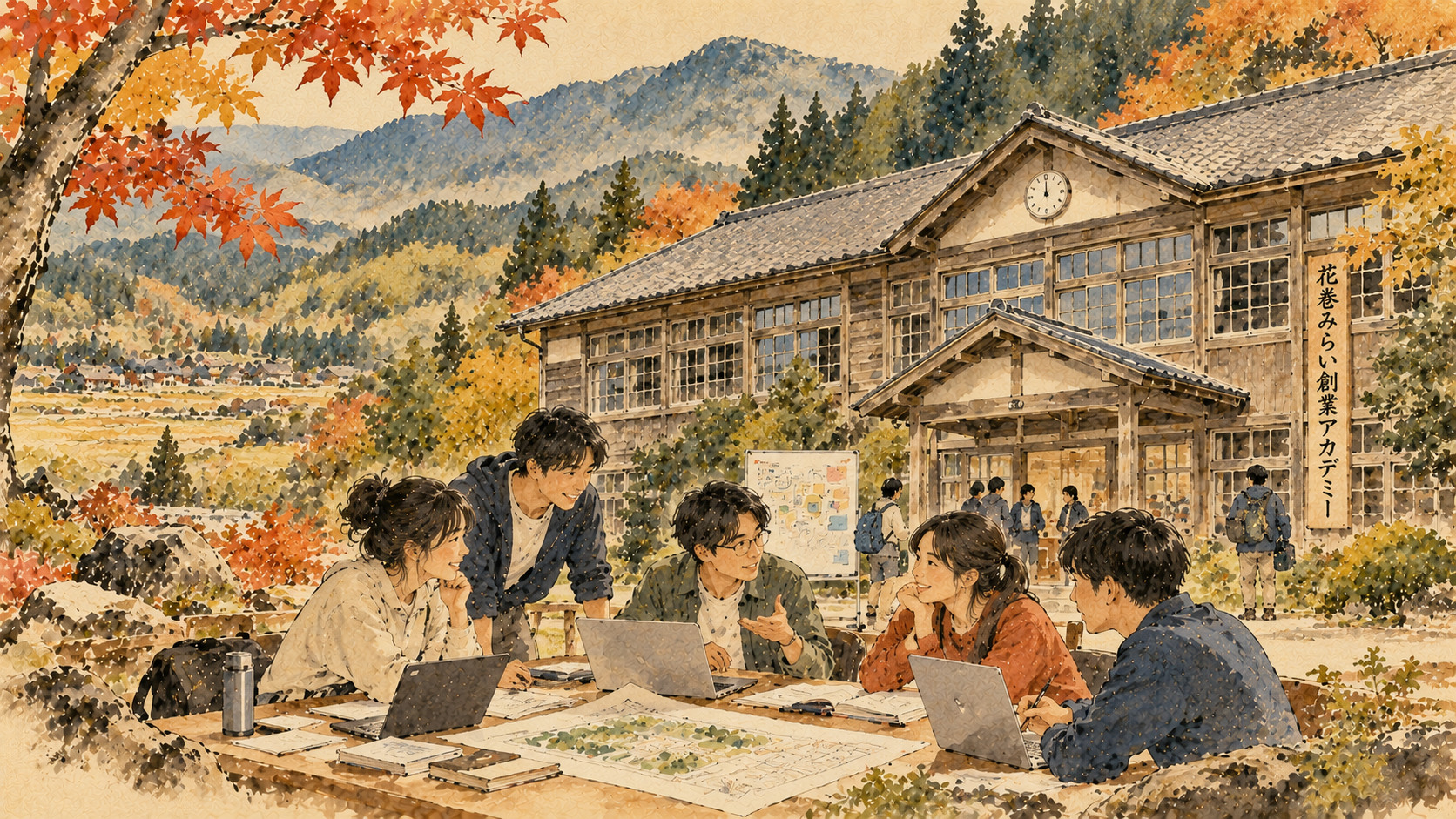
Turning an old school into a gateway to Asia will take more than a signature.
An empty classroom, an international ambition
In Hanamaki, Iwate Prefecture, a former public high school is being considered for a second life as a training campus connecting Japan and Southeast Asia. The proposed partner is Singapore-based venture capital firm Insignia Ventures Partners. Iwate’s official convention program schedules the signing of a basic agreement concerning an Insignia Ventures Academy on October 29. That is a significant step toward a potential project—not evidence that the campus has opened, the property has been sold, or the financing has been secured.
A former school with a measurable footprint
The Iwate Board of Education’s March 2024 surplus-property inventory identifies the former Towa High School at Ahibara, Towa, Hanamaki. It lists a site of 41,895 square meters, a classroom building built in 1972 with 3,239 square meters of floor space, and a gymnasium dating to 1969 with 1,328 square meters. The high school ceased operations in April 2010. The classroom building is described as seismically reinforced, but its suitability for a modern international residential or training program has not been established by that statement.
Not all parts of a closed school are abandoned
The same official inventory records ongoing public use of the gymnasium and martial-arts facilities and youth-sports use of an indoor practice area and field. That complicates the appealing phrase “turning a closed school into a campus.” Any redevelopment would need to account for existing users, building and fire requirements, maintenance liabilities and the relationship between publicly owned land and a privately operated educational venture.
Why a Southeast Asian investor would look to rural Japan
Kyodo reporting traces the relationship to a meeting between Iwate Governor Takuya Tasso and Insignia founding managing partner Yinglan Tan at the 2024 Summer Davos gathering in Dalian, China. The academy concept aims to connect younger professionals from Southeast Asia and Japan, pairing regional market knowledge with an understanding of Japanese commercial practice. Iwate, meanwhile, is seeking channels through which local startups, universities and established businesses can reach international capital and customers.
What the academy already teaches
Insignia Ventures Academy says its venture-capital certificate program runs for 12 weeks and covers sourcing startups, diligence, valuation, investment committees, portfolio governance and exits. Its existing courses are delivered online, with a global mentor network. A physical campus in Tohoku could create a different experience: field visits to local companies, collaboration between investors and founders, and learning that depends on being in the same place. But neither its tuition nor its selection standards, curriculum, language policy or enrollment capacity for Iwate have been confirmed.
A signing ceremony is not a campus opening
The Iwate International Innovation Convention runs October 29–30 in Morioka. Its official schedule places a basic-agreement signing concerning Insignia Ventures Academy in the opening session alongside appearances by Governor Tasso and Tan. The conference itself is designed to link local founders with international investors, with sessions on agrifood, health technology and artificial intelligence. Whether a memorandum will specify a binding sale, a construction budget or enforceable performance milestones will depend on its contents, which were not available for this report.
The financial questions behind the attractive rendering
Kyodo reported that Iwate was considering selling the old school property to the Singapore firm and potentially supporting renovation. As of the October 21 publication date, publicly verified documents do not establish a purchase price, final contract, renovation cost, taxpayer contribution or opening date. The difference matters: restoring a decades-old building can require costly work on accessibility, communications, heating, plumbing, fire protection and accommodation. A financially viable campus would need more than a prestigious announcement.
Five kilometers from the Shinkansen is not the whole journey
The prefecture’s property inventory puts Shin-Hanamaki Shinkansen station roughly five kilometers from the site and Hanamaki Airport about 12 kilometers away; the Towa interchange is approximately one kilometer distant. Those connections give the area access to Japan’s wider network, but international trainees also need practical last-mile transport, lodging, food, interpretation and a winter-ready campus. Infrastructure for occasional conferences is different from infrastructure for recurring residential cohorts.
Regional revival is a difficult equation
Official prefectural data put Iwate’s population at 1,126,813 on October 1, 2025, compared with a peak of 1,449,324 in 1961. A startup campus alone cannot reverse decades of population decline. The more credible test is whether it generates durable business relationships, outside investment, useful skills for residents, new local firms and repeat engagement with Iwate employers. Counting foreign visitors would be far easier than measuring these outcomes—but far less meaningful.
A long history of innovation beyond the capitals
Japan’s modern growth relied heavily on manufacturing and technical learning outside Tokyo. Today, venture finance is concentrated in major urban networks, while rural regions possess industry knowledge and applied problems that are poorly represented in pitch decks. Iwate’s agriculture, manufacturing, medical institutions and local enterprises could supply the real-world assignments for a new type of venture education. That would require investors to learn from the region rather than merely import a curriculum into it.
What would make the experiment worthwhile
An academy earns its place in Hanamaki if local companies gain access to investors and collaborators, international participants stay engaged beyond a single course, and the site remains useful to residents. Public disclosure of land terms, renovation support, operating economics and measurable outcomes would help establish legitimacy. Until those details emerge, this is a notable, specific plan—supported by a scheduled agreement and a real site—not a finished model of regional revival.
Sources and reporting notes
Based on official prefectural records, program descriptions and attributed news reporting. No executed sale, final construction budget or opening date has been independently verified as of October 21, 2026.