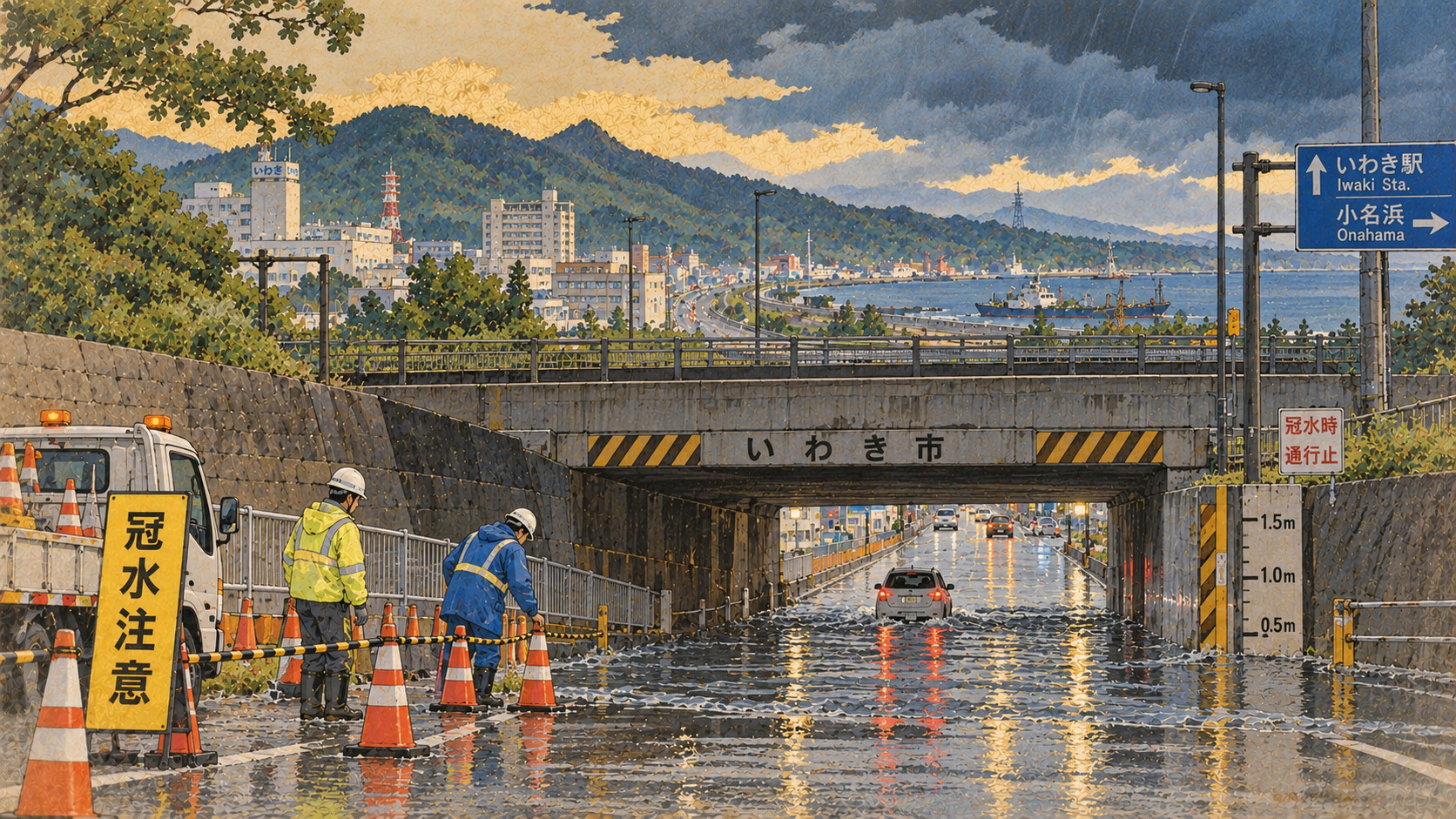
A road beneath a road—and a deadly September morning
On September 7, heavy rain flooded the Komoda underpass on the Numata–Baba municipal road in Iwaki, Fukushima Prefecture. Two vehicles were submerged and a woman in her sixties died. On October 27, Mayor Hiroyuki Uchida announced emergency measures for all 24 underpasses managed by the city: warning messages painted directly onto the road surface by the end of Japan’s fiscal year in March 2027. Work at the fatal accident site may begin in November. These are plans, not evidence that construction is complete. The broader question is whether drivers can be kept out of a low-lying road before it becomes a trap.
Why underpasses are efficient—and vulnerable
Underpasses allow roads to cross beneath railways and other roads without a conventional intersection. Their engineering advantage comes with an elevation disadvantage: runoff naturally travels toward the lowest point. Japan’s Ministry of Land, Infrastructure, Transport and Tourism counts roughly 3,800 underpasses nationwide as of March 2025. Their vulnerabilities differ considerably. Drainage catchments, terrain, pumping capacity, traffic patterns and how quickly authorities can close the road all matter. No single hazard rating can responsibly describe every underpass.
The pumps were running
A city emergency team reported that an unusually heavy concentration of rainwater met terrain that naturally funnels runoff toward the Komoda roadway. The national transport minister said September 8 that Iwaki had checked the pumps on August 28 and found no abnormality. Subsequent reporting said both pumps operated but could not remove the incoming water quickly enough. The distinction is fundamental: functioning equipment can still be overwhelmed by conditions beyond its effective capacity. This is an infrastructure and operational question, not simply a story about a broken machine.
The dangerous interval between detection and closure
An October 7 Kyodo News account reported that a sensor detected approximately 15 centimeters of standing water around 7:30 a.m. on September 7, and that it took roughly 40 minutes for personnel to close the road. Water reportedly rose rapidly during that period. Those figures should not be taken as a completed determination of legal fault. They do show why systems that depend exclusively on detecting flooding and then dispatching people to a location may act too late. The safest closure can be the one made before an underpass floods.
Iwaki now specifies advance closure triggers
An October 28 city notice sets out the current conditions for preventive restrictions at the Komoda underpass. The road may be closed when Iwaki issues its designated Level 3 heavy-rain alert, when hourly rainfall reaches or is forecast to reach 30 millimeters, or when road authorities judge that flooding is possible using meteorological information. Other municipal underpasses are also subject to advance restrictions under specified warnings or management judgments. These criteria are unusually important for residents—but they do not constitute a live report of whether any road is presently open. Drivers must consult the city’s latest traffic notices.
Twenty-four locations, an emergency budget
Local newspaper Iwaki Minpo reported that the city would mark underpasses with phrases equivalent to “Flooding Caution” and “Underpass Ahead,” backed by a ¥40.518 million allocation from reserve funds. Painting warnings can improve recognition but does not reduce runoff or substitute for physical access controls. Longer-term possibilities include remotely controlled barriers, electronic information boards, red warning lights and prioritized closure systems. The city has not yet confirmed that every one of the 24 locations will receive every device.
A national policy shift after deadly floods
On October 6, Japan’s transport ministry published guidelines urging road managers to prevent vehicle entry before flooding, rather than relying only on pumps or post-flood emergency response. The approach combines advance restrictions, barriers or equivalent entry-prevention measures, drainage management and fail-safe procedures for equipment or operational problems. Iwaki’s September disaster followed other serious incidents, including heavy-rain underpass flooding in Chiba in August 2026. A local tragedy has become part of a national change in how road risks are managed.
What residents say official systems miss
Local residents and volunteer fire personnel discussed prevention measures in October, including whether people with immediate knowledge of an area could help accelerate closures. Their concern is understandable: a road can become impassable faster than a centralized response reaches it. Yet informal intervention cannot replace clear authority, safe procedures, training and coordination with police and firefighters. The challenge is to design a system that benefits from local knowledge without asking unprotected volunteers to enter dangerous floodwater.
A technical review remains underway
Iwaki established its emergency underpass flooding prevention team on September 30, led by Professor Takuro Kikuchi of the Department of Civil and Environmental Engineering at the National Institute of Technology, Fukushima College. The team includes representatives of relevant public agencies and was tasked with examining the causes and proposing countermeasures. Its term runs through March 31, 2027; local coverage indicates a final report is expected around March. Initial findings and interim plans should not be mistaken for that final assessment.
A practical warning, and an accountability test
For drivers, the immediate advice is simple: do not enter a flooded underpass, even along a familiar route. Review current city road restrictions and weather alerts before travel, and use a safer alternative when severe rain threatens. For government, the test is more demanding. When will signs be installed? Which locations require physical barriers? Can closure systems function during power or communication failures? What training and public notification will accompany them? These questions are measurable and deserve follow-up reporting.
The meaning of a safer road
The promise of Iwaki’s response is not that a painted phrase can stop floodwater. It is that danger might be recognized earlier, warnings might become harder to miss, and a risky road might be closed before anyone drives into it. Preventive shutdowns can inconvenience traffic. They can also save lives. The lasting measure of this response will not be how many projects the city announces, but how its 24 underpasses perform the next time rain arrives faster than expected.
Sources and reporting notes
Based on official Iwaki and MLIT notices, cross-checked with local reporting. No direct interviews with family members, officials or witnesses were conducted.
- いわき市・冠水事故防止緊急対策チーム / Iwaki emergency response team
- いわき市・市道アンダーパスの通行規制 / Iwaki closure criteria
- 国土交通省・冠水事故防止ガイドライン / MLIT guidelines
- 国土交通省・道路の冠水対策 / MLIT road flooding
- 国土交通大臣会見・9月8日 / Ministerial press conference
- いわき民報・10月27日の市長会見 / Iwaki Minpo
- 福島放送・10月27日 / KFB Fukushima Broadcasting
- 福島テレビ・対策チーム発足 / Fukushima TV
- 共同通信・10月7日の検証 / Kyodo News
- 福島テレビ・市長の発表 / Fukushima TV