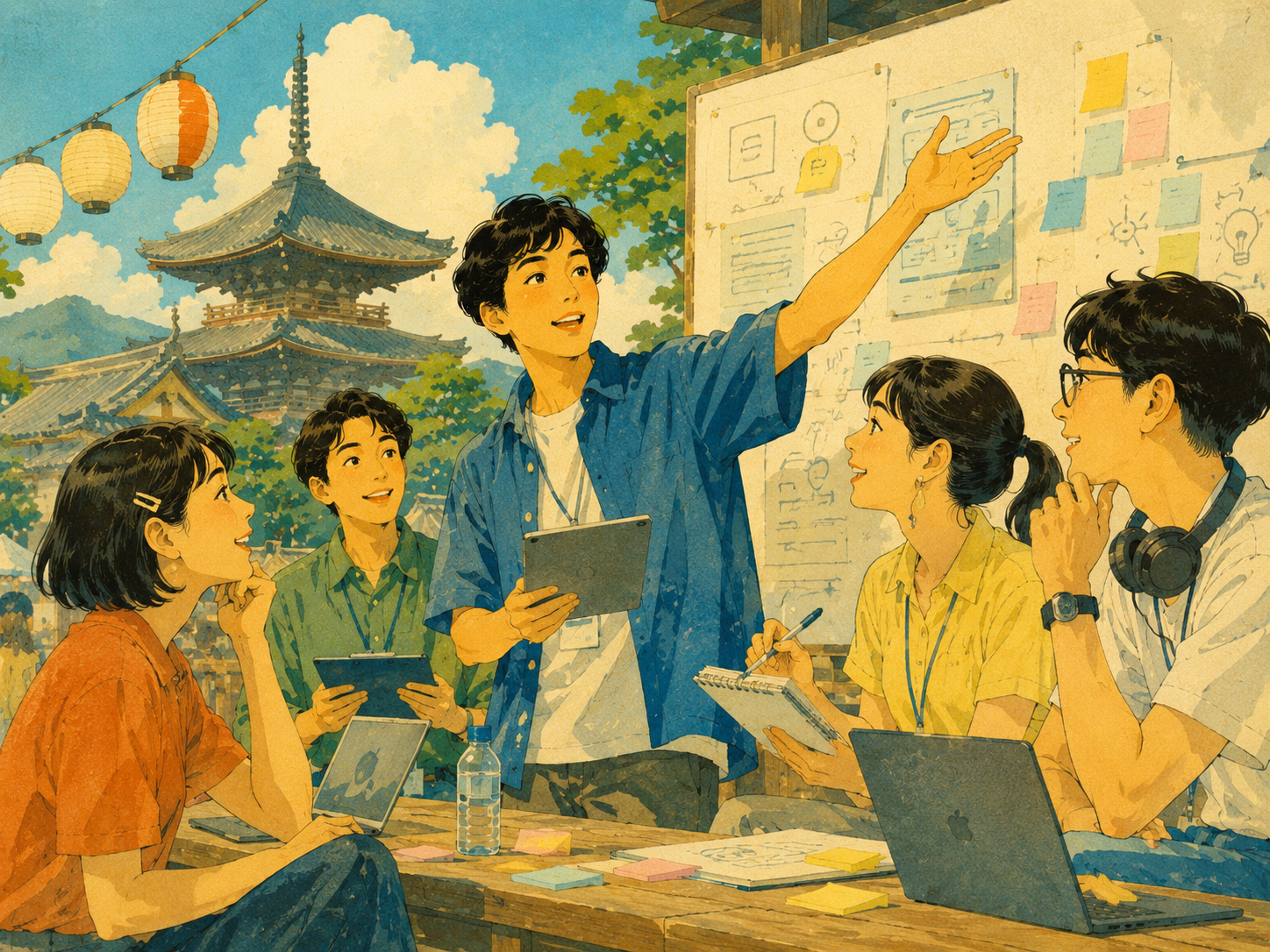
In Kyoto this summer, a different kind of student is walking into the startup conversation. Not only the student in a recruiting suit, not only the researcher waiting for graduation, not only the intern hoping to join a famous company. These are students carrying pitch decks, customer interviews, prototypes, market hypotheses and the nerve to ask investors for time. Inside IVS2026, the student startup festival SPIKES is trying to give them a stage that feels less like a school event and more like the first door to the market.
The SPIKES official site calls it a festival for sharp, unusual students: entrepreneurs, leaders, creators and geeks gathered for three days inside IVS2026 Kyoto. The venue is Miyakomesse B1F, and the project advertises a scale of more than 2,000 students. According to PR TIMES and official contest information, the centerpiece, SPIKES Student Startup Pitch, holds its final stage on July 2, 2026, inside IVS2026. Twelve student founders present for six minutes each. There is no Q&A in the final. The pitch itself must carry the business.
The format matters. This is not designed to end with applause and a certificate. Main partner Nahato says the winner will receive an opportunity for investment of up to ¥100 million, subject to individual review and negotiation rather than a guaranteed check. Around 50 venture capital and investor judges each hold two “meeting offer votes,” which they cast for the student founders they actually want to meet. That turns investor curiosity into part of the scoring. It is a small design choice, but a serious one.
Why putting students inside IVS matters
IVS2026 runs from July 1 to July 3 in Kyoto, with venues including Miyakomesse, Hotel Okura Kyoto and ROHM Theatre Kyoto. The official site describes it as one of Japan’s largest startup conferences, drawing more than 10,000 participants. Its 2026 theme is “Japan is Back,” a deliberate statement that Japan wants to show founders, investors, corporations, government and international startups a new confidence in its startup ecosystem.
Placing SPIKES inside IVS is not just a scheduling convenience. It puts student founders near the adult capital market. Instead of a closed campus contest, students breathe the same air as venture capitalists, executives, founders and policy makers. They can see how founders talk when money, hiring, users and competition are real. Japan’s student entrepreneurship culture has long needed exactly that bridge.
For decades, the default Japanese life story was told as a straight line: good school, good company, stable career. That route still has value. But an aging society, AI disruption, global competition, regional decline and the need to commercialize research have made new company creation a public interest, not just a personal gamble. SPIKES turns that option into a visible stage.
Why student entrepreneurship has been hard in Japan
Japan has always had student founders and young entrepreneurs. Rakuten, CyberAgent, DeNA, Mixi, Mercari, Preferred Networks, SmartHR, LayerX, Spiber and ispace all belong to a broader Japanese startup story. But Japan has not produced the same campus-to-company rhythm that appears around American university hubs, where students can start companies before graduation, fail, rejoin the ecosystem and try again without permanently damaging their social standing.
The reasons are structural, not only cultural. Recruitment schedules, parental expectations, university credit systems, access to early capital, the stigma attached to failure, difficulty finding co-founders, a shortage of mentors, limited understanding of equity compensation and the distance to English-speaking global markets all made entrepreneurship a harder student choice. Starting a company could seem like something for extraordinary people, or for people who had somehow stepped off the normal track.
That atmosphere is changing. In 2022, Japan announced its Startup Development Five-year Plan. JETRO describes the plan as an effort to accelerate startup creation and promote open innovation between startups and large established companies. The government’s plan places startup talent and networks, funding and open innovation among its main pillars. For the first time in a long while, startups are not a side topic in Japanese economic policy. They are closer to the center.
The long road from university research to student founders
The SPIKES story is also part of a longer university entrepreneurship history. In 1998, Japan passed the Act to Facilitate Technology Transfer from Universities to Private Business Operators, commonly understood as part of Japan’s TLO framework. In 2004, national universities became national university corporations, giving them more room to manage research, intellectual property and industry collaboration. Inspired partly by the American Bayh-Dole experience, Japan tried to create a path from university knowledge to commercial use.
Since then, programs such as EDGE, EDGE-NEXT, university venture support, J-Startup, regional startup hubs, university venture funds, accelerators, startup visas and overseas founder programs have tried to turn research and talent into companies. MEXT’s EDGE-NEXT, for example, supported university consortia that built practical entrepreneurship education through workshops, lectures, mentoring, pitch events and international networks.
University startups have two faces. One is the research-based venture that commercializes faculty research, deep technology or patents. The other is the student-driven company that begins with a social problem, a software product, a consumer experience, a local issue or a student founder’s market insight. A University of Tokyo-linked paper argues that student-driven startups can create economic value roughly equal to faculty-driven research-based startups. That means student entrepreneurship is not a cute extra. It is one of the main channels through which universities can create economic renewal.
Why Kyoto is the right stage
It also matters that SPIKES happens in Kyoto. Kyoto is not only the old capital. It is a city of universities, craft, research and long-lived technology companies. Nintendo, Kyocera, Murata Manufacturing, Omron, Horiba and Shimadzu all show how the region can combine deep technical competence with patient company-building. Kyoto University, Doshisha, Ritsumeikan, Kyoto Institute of Technology and other institutions keep the city full of students and researchers.
Kyoto’s advantage is not that it is the largest market. Tokyo owns that role. Kyoto’s advantage is density of another kind: old culture, advanced research, manufacturing memory, tourism, local government and student life sit close together. For a founder, a city is not just an address. It shapes who you meet, what you think is possible and what kind of ambition feels acceptable.
IVS staying in Kyoto signals that Japan’s startup story is no longer only a Tokyo story. It can draw on regional identity, local universities and city brands. For students, the image is powerful: build something new in a city that has survived by renewing tradition for more than a thousand years.
The small invention of the “meeting offer vote”
One of SPIKES’ most interesting details is the judging method. Alongside top-judge scoring, venture investors cast “meeting offer votes” for student founders they genuinely want to meet. That is practical. For a young founder, winning a trophy is not the only useful outcome. A serious meeting with an investor, mentor or operator can change the next six months of the company.
Many student pitch contests in Japan have ended as polished presentations: good slides, a polite award, a group photo and then uncertain follow-through. SPIKES tries to fix that weakness. It moves the student pitch closer to the real investor process. The question becomes not only “Who presented best?” but “Who made serious people want the next conversation?”
Entrepreneurs do not build companies to win stages. They build them to find customers, recruit teammates, raise capital, improve products and survive markets. The meeting is often the first real unit of that journey. In that sense, the meeting offer vote may be more useful than the ranking itself.
What Japan does with its “protruding nails”
SPIKES uses a provocative phrase: “Let the protruding nail break through.” It plays against the famous Japanese proverb that the nail that sticks out gets hammered down. Startup culture asks society to do the opposite: do not hammer the nail flat; help it rise high enough to become useful.
Not every student should start a company. Large companies, public service, research, local work and family businesses all matter. But if entrepreneurship alone is treated as dangerous, strange or embarrassing, a society leaves too much talent unused. A stronger Japan would let young people start, fail, learn and return to the economy with more skill, not less dignity.
SPIKES matters because it refuses to tell students they are too early. Instead, it says: come early, show the unfinished thing, test it against the market, and meet people who can help. That is education, but it is also cultural change.
Japan.co.jp view
SPIKES will not transform Japan’s economy by itself. Twelve student pitches, a few investor meetings and perhaps one funding process are small things. But startup cultures are built through small mechanisms repeated often enough that they become normal. Stages, mentors, demo days, angel checks, student clubs, founder dinners, alumni examples, second chances — these are the small institutions that change what a generation thinks it is allowed to do.
Japan’s startup policy has talked about money, tax, universities, venture capital, corporate collaboration and overseas growth. But the final question is human. Can enough young people believe, early enough, that they can build something? If Japan truly wants to say “Japan is Back,” it cannot only polish the industries of the past. It needs the next generation to build its own companies, technologies and markets.
In a basement hall in Kyoto, students will stand for six minutes and explain why their idea deserves to exist. The voices may be small at first. But many companies begin as small voices. The meaningful part of SPIKES is that it does not leave those voices at the edge of campus. It places them near the real market. That is where Japan’s next startup story may begin.
Reader guide
| Item | How to read it |
|---|---|
| What is happening | SPIKES Student Startup Pitch is being held inside IVS2026 for student founders. |
| Date and venue | IVS2026 runs July 1–3, 2026, in Kyoto at Miyakomesse, Hotel Okura Kyoto, ROHM Theatre Kyoto and other venues. The SPIKES final is July 2. |
| Format | Twelve student founders deliver six-minute pitches, with no Q&A in the final stage. |
| Investment angle | The winner may receive an investment opportunity of up to ¥100 million. This is not a guaranteed investment and is subject to review and negotiation. |
| Why it matters | It moves student entrepreneurship closer to real investors, mentors and Japan’s wider startup market. |
Sources and references
This article draws on the SPIKES official site, PR TIMES, Nahato, IVS official materials, JETRO, the Cabinet Secretariat Startup Development Five-year Plan, EDGE-NEXT materials, research on university startups and Japan’s technology-transfer framework. Investment opportunities and judging details are based on organizer announcements and may change.
- SPIKES official site
- PR TIMES: SPIKES Student Startup Pitch in IVS2026
- Nahato: SPIKES announcement
- DLE Open Contest notice: SPIKES schedule
- IVS2026 official site
- IVS2026 pass and venue announcement
- JETRO: Startup Development Five-year Plan
- Cabinet Secretariat: Startup Development Five-year Plan
- Waseda: EDGE-NEXT program selection
- Japanese Law Translation: Technology Transfer Act
- J-Startup
- University of Tokyo paper: student-driven startups