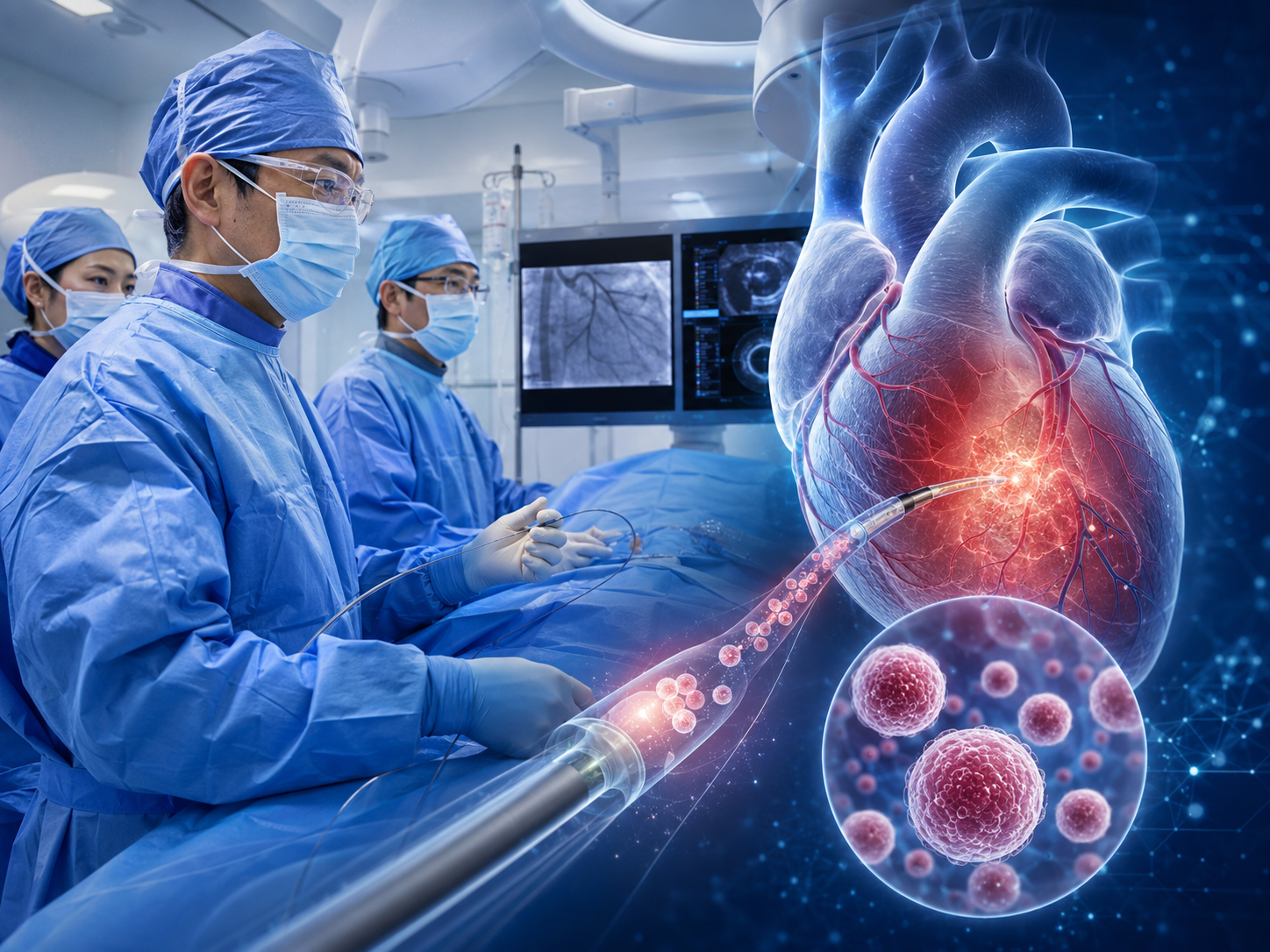
Japan’s regenerative-medicine story is beginning to change the geography of the operating room. Until recently, delivering iPS-derived heart cells to a damaged heart mostly meant opening the chest and attaching cell sheets to the surface, or injecting cell clusters from the outside. Heartseed’s HS-005 EMERALD study points in a different direction: a catheter advanced from inside the heart, delivering iPS-derived cardiomyocyte spheroids directly into the myocardium. The promise is not only cell therapy, but a less invasive route toward it.
On June 12, 2026, Heartseed announced that it had successfully dosed the first patient in what it describes as the world’s first clinical trial of catheter administration of iPS cell-derived cardiomyocyte spheroids. The patient, in his 70s, had severe heart failure caused by dilated cardiomyopathy. The procedure was performed at Shinshu University Hospital in late March 2026; the postoperative course was generally uneventful and the patient had been discharged. The EMERALD study plans to enroll 14 people — seven with ischemic heart disease and seven with dilated cardiomyopathy — to evaluate safety and effects on heart function.
How iPS cells reached the heart
Induced pluripotent stem cells were first reported in mice by Shinya Yamanaka’s group in 2006, and in human cells in 2007. The idea was astonishing: take a mature cell and reprogram it back into a state in which it can become many types of tissue. Japan then built an unusually complete ecosystem around the discovery — Kyoto University’s CiRA, iPS cell stock programs, academic clinical groups, startups, manufacturers and a distinctive regulatory framework.
The heart is one of the most obvious targets for the technology. Heart muscle does not regenerate like skin. After a major heart attack or in dilated cardiomyopathy, a weakened heart can be supported by drugs, devices, ventricular-assist systems or transplantation. But there are few options that replace the lost contracting muscle itself. iPS-derived cardiomyocytes are part of the effort to fill that gap.
From sheets to spheroids
Japan’s cardiac iPS work first moved forward through cardiomyocyte sheets. At Osaka University, Yoshiki Sawa and colleagues began work with iPS-derived cardiomyocytes after collaborating with Yamanaka’s group in 2008. By 2012, the team had tested the cells in pig models of ischemic cardiomyopathy; in 2020, a physician-led clinical trial began transplanting iPS cardiomyocyte sheets into human patients with severe cardiomyopathy.
In March 2026, Cuorips’ iPS-derived cardiomyocyte sheet therapy, RiHEART, received conditional and time-limited approval in Japan, marking a milestone for iPS-derived cardiomyocytes in heart failure. Sheet therapy attaches cells to the outside surface of the heart and aims to support repair through tissue support, secreted factors and the promotion of blood-vessel growth.
Heartseed’s route is different. Its HS-001 program uses cardiomyocyte spheroids delivered from the epicardial side, requiring surgery. HS-005 is the next-generation version: the same idea of purified iPS-derived heart-muscle microtissues, but delivered from inside the heart through a dedicated catheter system. That changes the medical question from “Can cells be placed on or into the heart?” to “Can regenerative cardiology become a catheter-based treatment?”
Why catheter delivery matters
Catheter medicine has already transformed cardiology. Stents can be placed through arteries. Arrhythmias can be treated from within the heart. Valves can be replaced through minimally invasive techniques. If iPS-derived cardiomyocyte spheroids can be safely injected through a catheter, regenerative medicine could move closer to the daily world of advanced cardiovascular centers, not only specialized surgical programs.
That is a large “if.” Cell therapy is more complex than routine catheter work. Researchers must test manufacturing quality, delivery accuracy, dose, cell survival, immune response, arrhythmia risk, tumor risk, engraftment and long-term function. Heartseed says HS-005 is designed for endocardial delivery and that spheroid formation may improve retention and viability compared with single-cell administration. The clinical question is whether those preclinical advantages translate into meaningful human benefit.


Could this become a Japanese medical industry?
Japan has a rare concentration of assets in iPS medicine: basic science, cell stocks, academic clinical groups, manufacturing systems, regulatory pathways and university startups. But turning cell therapy into industry is not simple. It requires quality control, cold-chain logistics, hospital training, patient selection, insurance coverage, pricing and long-term registries. A cell therapy is not just a drug; it is a system.
If HS-005 succeeds, Japan’s cardiac iPS work could move one step from highly specialized surgery toward catheter-based regenerative cardiology. That would not mean heart failure is “solved.” It would mean that the country that discovered iPS cells is learning how to deliver them through the tools cardiologists already use. The June 2026 news is therefore not a miracle announcement. It is a milestone in a long translation: from cell, to product, to procedure, to evidence, to a medicine that might one day fit inside the rhythm of ordinary hospitals.
Sources and references
This Japan.co.jp report is based on company releases, clinical-trial information, university background and public reporting.
- Heartseed: First patient dosed in catheter administration of iPSC-derived cardiomyocyte spheroids
- Nippon.com / Jiji: Japan startup tests catheter injection of iPS heart muscle cells
- WIRED: Japan approves iPS-derived regenerative medical products
- Osaka University: iPS cardiomyocyte sheets clinical trial background
- Cuorips: Conditional approval of iPS-derived cardiomyocyte sheet therapy
- ClinicalTrials.gov: HS-001 cardiomyocyte spheroids study